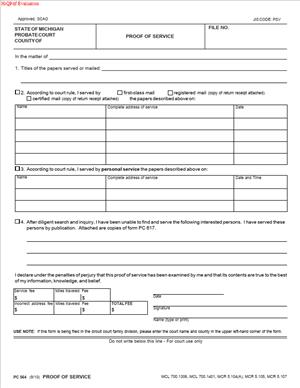
PC 564 – Proof of Service
Fill out nowJurisdiction: Country: United States | Province or State: Michigan
If you are involved in a court case in Michigan, you may be required to prove that you delivered certain papers to another person. PC 564 – Proof of Service is the form used to confirm that delivery. It tells the court who was served, how the documents were delivered, and when service took place.
This form does not start a case and it does not explain your legal arguments. Its purpose is narrower. It shows the court that the required documents were properly provided to the correct person.
You might encounter this form in probate or other court matters. Courts rely on proof of service to ensure fairness. Everyone involved must receive notice before the court can move forward.
If you are representing yourself, understanding this form is essential. Without proof of service, the court may delay your request or refuse to act on it. This document acts as the official record of the service that happened.
What is PC 564 – Proof of Service?
Clear definition
PC 564 – Proof of Service is a written statement filed with a Michigan court to confirm that specific documents were delivered to another party. It identifies the documents served, the person who received them, the method of delivery, and the date of service.
In simple terms, it is the court’s receipt showing that notice was given. It connects a specific set of documents to a specific act of delivery.
The form is usually completed by the person who actually delivered the documents. That person may be a process server, a sheriff’s deputy, or another adult who is not a party to the case, depending on the rules that apply to the situation.
Who typically uses this form?
This form is commonly used by individuals involved in probate proceedings. That can include personal representatives, petitioners, guardians, conservators, and other interested persons in a court matter.
It may also be used by attorneys, court officers, or professional process servers. Even if you are not a lawyer, you may encounter this form if you are responsible for making sure that required documents are delivered.
In many situations, the person who fills out the form is not the person who filed the original petition or motion. The server completes and signs the proof to confirm what they personally did.
Why might you need this form?
Courts require notice before they make decisions that affect someone’s rights. PC 564 – Proof of Service creates a formal record that notice was given.
If you file a petition asking the court for an order, other interested parties may need to receive copies. The court will often require proof that those copies were delivered in a legally recognized way.
Without this document, the court may not schedule a hearing or issue a ruling. Filing the main paperwork alone is usually not enough. The proof of service shows that due process was followed.
Typical real-life scenarios
- You file a petition to open a probate estate. The court requires that heirs and other interested persons receive a copy. After the documents are delivered, the person who served them completes the proof of service to confirm that each required person was notified.
- You request the appointment of a guardian for an adult. The law may require that the individual and certain family members receive notice. Once the notice is delivered, the server fills out the form to show the date, method, and recipients of service.
- You submit a motion asking the court to change an existing order. Before the court considers your request, you must send a copy to other parties. The proof of service documents that the motion was properly provided.
- You are responding to a petition filed by someone else. If court rules require you to serve your response on other interested persons, the proof of service confirms that you completed that step.
When would you use PC 564 – Proof of Service?
You use PC 564 – Proof of Service when a court rule or statute requires you to notify someone about a filing or hearing. The need for service often arises after you submit a petition, motion, objection, or other formal document.
In probate matters, notice requirements are common. Before the court appoints a personal representative or approves certain actions, interested persons typically must receive notice. The proof of service verifies that this step occurred.
You may also use the form after serving documents by mail. If court rules allow mailing as a valid method of service, the person who placed the documents in the mail can complete the form to confirm the mailing date and addresses used.
In some cases, personal delivery is required. If a process server or sheriff personally hands the documents to the recipient, that person completes the form to describe when and where service occurred.
Timing can be important. Many court procedures require that service happen a certain number of days before a hearing. The proof of service provides the dates the court uses to determine whether deadlines were met.
Legal characteristics of PC 564 – Proof of Service
PC 564 – Proof of Service functions as a sworn confirmation that service took place. It becomes part of the court record once filed. Judges rely on it when deciding whether proper notice was given.
For the form to be effective, it generally must be complete and accurate. It must clearly identify the documents served. It must list the full names and addresses of the people served. It must state the method of service and the date.
Common problems include incomplete addresses, missing dates, unsigned forms, or listing the wrong documents. If the information on the form does not match the case record, the court may question whether service was valid.
Another frequent issue is using an improper method of service. Some documents may require personal service, while others may allow mailing. If the method used does not meet the applicable rule, the proof of service alone will not fix that issue.
Requirements can vary depending on the type of case and the role of the person being served. For example, notice requirements in probate may differ from those in other civil matters. The form records what happened, but the underlying rules determine whether that service method was acceptable.
It is important to understand what this form does not do. It does not prove that the recipient actually read the documents. It does not confirm agreement with the contents. It only shows that the documents were delivered in a specific way on a specific date.
Is it legally binding?
PC 564 – Proof of Service is legally significant because it is a formal statement filed with the court. When signed, it typically certifies that the information provided is true to the best of the signer’s knowledge.
If the form is signed under oath or penalty of perjury, false statements can carry legal consequences. This gives the document weight in court proceedings.
However, the form itself does not create rights or obligations between parties. It does not resolve disputes or grant relief. Its binding effect relates to the truth of the statement about service, not to the substance of the underlying case.
If the information is accurate and the service complied with the relevant rules, the court may rely on the form to move the case forward. If the information is inaccurate or incomplete, the court may require additional proof or repeat service.
How to fill out PC 564 – Proof of Service
Step 1 – Identify the court and case information
At the top of the form, enter the name of the court, the county, and the case number exactly as they appear on your other filed documents. Include the full case title, listing the parties in the same order used in prior filings. This ensures the proof of service is placed in the correct court file.
Step 2 – List the documents that were served
Clearly describe each document that was delivered. Use the exact titles shown on the documents, such as petition, motion, notice of hearing, or order. If more than one document was served at the same time, list each one so the record reflects everything that was provided.
Step 3 – Identify each person served
Provide the full name of every person who received the documents. Include complete mailing or physical addresses, depending on the method of service. Make sure the names match the individuals identified as interested persons or parties in the case file.
Step 4 – State the method of service
Indicate how the documents were delivered. This may include personal delivery, first-class mail, or another method permitted in the case. The description should be specific enough that someone reading the form understands exactly how the service occurred.
Step 5 – Enter the date of service
Write the exact date on which the documents were delivered or mailed. If service occurred over multiple days for different recipients, the form should clearly reflect those dates. Accurate dating is important because courts often calculate deadlines from the date of service.
Step 6 – Provide details for personal service if applicable
If the documents were personally handed to someone, include information such as the location of service and any other details requested on the form. The person completing the form must have direct knowledge of the delivery.
Step 7 – Sign and date the form
The person who performed the service completes this section. They sign their name and date the form where indicated. By signing, they confirm that the information provided about the service is true.
Step 8 – File the completed form with the court
After the form is signed, it is submitted to the court clerk for inclusion in the case file. Filing may occur in person, by mail, or through an approved electronic system, depending on the court’s procedures. Once filed, it becomes the official record showing that service was completed.
Legal terms you might encounter in PC 564 – Proof of Service
- Affidavit: A written statement made under oath. When this document is signed before a notary, it becomes an affidavit. The person signing confirms that the details about how and when the service happened are true.
- Certificate of Service: A formal statement confirming that documents were delivered to the required parties. This document functions as a certificate that the service occurred. It becomes part of the official court record.
- Declarant: The person who completes and signs the proof. This is usually the individual who actually served the documents. The declarant is responsible for ensuring every detail is accurate.
- Personal Service: Delivery of court documents directly to the person named in the case. The form may require you to confirm that the documents were handed to the recipient. Details like the date and location matter.
- Service by Mail: Sending documents through postal delivery. The form may ask for the mailing date and address used. Accuracy here proves that proper notice was attempted or completed.
- Interested Party: Any person or entity who has a legal interest in the case. You may need to list each interested party served. Leaving someone out can delay the proceedings.
- Case Caption: The heading section that includes the court name, case number, and names of the parties. This must match the main court file exactly. Errors in the caption can cause filing issues.
- Sworn Statement: A statement confirmed as true under penalty of perjury. When you sign the form, you are making a sworn statement. False information can have serious consequences.
- Date of Service: The exact calendar date when the documents were delivered or mailed. This date affects deadlines and response periods. It must be accurate and clearly written.
- Method of Service: The way documents were delivered, such as personal delivery or mailing. You must indicate the correct method used. The court relies on this detail to determine whether service meets legal requirements.
FAQs
What information must match the main court case exactly?
The court name, case number, and party names must match the case caption already on file. Check spelling, middle initials, and formatting. If anything is different, the clerk may reject the filing or question whether the proof belongs to the correct case.
Who is allowed to sign this form?
The person who actually delivered or mailed the documents must sign it. If someone else completed service for you, that person signs as the declarant. Make sure the signature matches the printed name and that the signer confirms the statements are true.
Do I need to attach anything to this document?
You typically do not attach the served documents themselves unless instructed. However, you must clearly list every document that was delivered. Double-check that the titles match exactly what was filed or sent.
What date should I enter as the date of service?
Enter the exact day the documents were handed over or placed in the mail. Do not use the filing date unless it is the same. Deadlines for responses often begin on the service date, so accuracy is critical.
What if I made a small mistake on PC 564 – Proof of Service after signing it?
If the mistake affects key details like the date, method, or recipient, complete a new, corrected form. Do not cross out major information unless the court allows corrections. The court record should clearly show accurate service details.
Does this form become part of the public record?
Yes. Once filed, this document becomes part of the case file. Anyone reviewing the file can see who was served, how, and when.
How do I know if the court accepted my filing?
After submitting the form, confirm acceptance through the clerk’s office or your court’s filing system. Look for a file stamp or confirmation notice. If it was rejected, correct the issue quickly to avoid delays.
What happens if someone was not listed or served properly?
The court may delay hearings or refuse to move forward until proper service is completed. You may need to serve the missing person and file a new PC 564 – Proof of Service reflecting that updated service.
Checklist: Before, During, and After PC 564 – Proof of Service
Before
- Confirm you have the correct case number and court name.
- Make sure all documents to be served are finalized and complete.
- Verify the full legal names and addresses of each recipient.
- Decide on the correct method of service allowed in your situation.
- Confirm that the server is legally permitted to serve the documents.
- Review deadlines tied to the date of service.
- Prepare extra copies for your records.
- Check whether notarization will be required.
During
- Deliver or mail the exact documents listed.
- Record the precise date of delivery or mailing.
- Note the full address where the service occurred.
- Confirm the identity of the person receiving personal service.
- Complete every required field on the form clearly.
- Print names neatly and avoid abbreviations unless accurate.
- Review the form before signing.
- Sign only after verifying all information is correct.
After
- Make copies of the signed form.
- File the original with the court promptly.
- Obtain confirmation of filing or a file-stamped copy.
- Store your copy in a safe and organized place.
- Calendar any response deadlines triggered by the service.
- Follow up if the court does not confirm receipt.
- Monitor the case docket for updates.
- Be prepared to show proof of service at a hearing if asked.
Common mistakes to avoid with PC 564 – Proof of Service
- Mistake: Entering the wrong case number because you copied it from memory, which can lead to rejection by the clerk and delay your case; always verify directly from the official court document, and do not forget to match every digit.
- Mistake: Listing incomplete or incorrect party names due to rushing, which can create confusion about who was served and potentially invalidate service; carefully copy names exactly as they appear, and do not forget middle initials if listed.
- Mistake: Using the filing date instead of the actual service date because they happened close together, which can affect response deadlines and court scheduling; confirm the true delivery or mailing date, and do not forget that deadlines often start from service.
- Mistake: Forgetting to list all documents served because you assumed they were obvious, which may cause the court to question whether proper notice was given; write out each document title clearly, and do not forget attachments.
- Mistake: Having the wrong person sign the form because you prepared it yourself, which can invalidate the proof if that person did not perform the service; ensure the actual server signs, and do not forget that the signature confirms personal knowledge.
- Mistake: Leaving sections blank because they did not seem relevant, which can result in rejection or requests for correction; review each section carefully, and do not forget to mark or complete every required field.
What to do after filling out PC 564 – Proof of Service
Once you complete the form, pause and review it one more time. Small details matter. Check names, dates, and the method of service. Make sure everything is readable.
Next, organize your paperwork. Place the proof behind a copy of the documents that were served. This keeps your records consistent and easy to reference later.
- Step 1: Make at least two copies of the signed PC 564 – Proof of Service.
- Step 2: Keep one copy for your personal records in a dedicated case folder.
- Step 3: File the original with the court using the required filing method.
- Step 4: If filing in person, request a file-stamped copy before leaving.
- Step 5: If filing electronically, save the confirmation receipt or notice of acceptance.
- Step 6: Check the case docket within a few days to confirm it appears.
- Step 7: Update your calendar with any response deadlines triggered by the service.
- Step 8: Bring a copy of the filed proof to any scheduled hearing.
- Step 9: Monitor communication from the court in case corrections are required.
- Step 10: Keep all service-related notes, mailing receipts, or delivery confirmations with your copy.
Staying organized protects you. Courts rely on written proof. If someone claims they were not notified, your filed document becomes your evidence.
If the court rejects the filing, act quickly. Review the reason given. Correct the issue by preparing a revised form with accurate details. File the corrected version promptly and confirm acceptance.
Maintain a complete record until the case ends. Even after final orders are issued, keep your service documents stored safely. Questions can arise later, and having a clear record will save you time and stress.
Disclaimer: This guide is provided for informational purposes only and is not intended as legal advice. You should consult a legal professional.