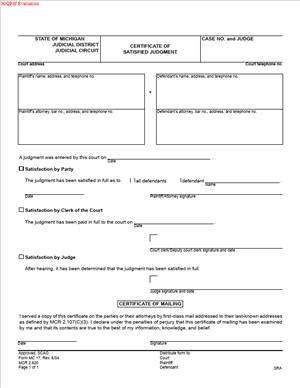
MC 17 – Certificate of Satisfied Judgment
Fill out nowJurisdiction: Country: United States | Province or State: Michigan
If you have paid off a court judgment in Michigan, the MC 17 – Certificate of Satisfied Judgment is the form that officially shows the debt has been paid. It updates the court record to reflect that the judgment is no longer owed.
This document matters because a judgment can affect your wages, bank accounts, property, and credit history. Even after payment, the judgment remains on record until it is formally marked as satisfied.
You may be the person who owed the money and has now paid it. Or you may be the creditor who received full payment and needs to confirm that fact with the court.
The MC 17 – Certificate of Satisfied Judgment is not about arguing the case again. It is about closing the loop. It tells the court, in writing, that the judgment has been fully satisfied.
Understanding how this form works helps you avoid delays, disputes, or continued collection activity after the debt is paid.
What is MC 17 – Certificate of Satisfied Judgment?
Clear definition
MC 17 – Certificate of Satisfied Judgment is a court form used in Michigan to confirm that a money judgment has been paid in full. It serves as written proof that the judgment creditor acknowledges complete payment.
When filed with the court, this document updates the case record. It shows that the amount awarded in the judgment has been satisfied. The court then reflects that status in its system.
This form does not change the original decision. It simply records that the financial obligation created by the judgment has been fulfilled.
Who typically uses this form?
The most common user is the judgment creditor. That is the person or business who won the case and was awarded money. After receiving full payment, the creditor completes and signs the form.
In some situations, the judgment debtor may prepare the form and ask the creditor to sign it. The debtor is the person who owes the money under the judgment.
Court clerks and judges do not usually fill out this document for you. It is typically completed by one of the parties to the case and then submitted to the court.
Why might you need this form?
You need this form when a judgment has been paid, and you want the court record to reflect that fact. Until the record is updated, the judgment may still appear as unpaid.
If you are the debtor, filing the certificate can help prevent further collection efforts. It also creates a clear paper trail showing that you met your obligation.
If you are the creditor, filing the certificate confirms that the matter is resolved. It documents that you received full payment and that no balance remains.
Without this filing, confusion can arise later about whether the debt was fully satisfied.
Typical real-life scenarios
- You lost a small claims case and were ordered to pay $2,000. After several months, you paid the full amount directly to the creditor. The creditor then completes the certificate to show the court that the judgment is satisfied.
- A creditor garnished wages over time and eventually collected the full balance. Once the total amount awarded in the judgment is received, the creditor uses this form to confirm full satisfaction.
- Two parties agreed on a lump-sum settlement after a judgment was entered. The debtor paid the agreed amount, and the creditor acknowledged that it satisfied the judgment by signing and filing the document.
- A debtor paid the judgment through installments. After the final payment clears, the creditor files the certificate so the case record reflects that nothing more is owed.
When would you use MC 17 – Certificate of Satisfied Judgment?
You use this form after a court has entered a money judgment and that judgment has been paid in full. It is not used before judgment and is not used for partial payments.
It typically comes into play at the end of the collection process. This may happen after voluntary payment, wage garnishment, bank levy, property lien resolution, or a negotiated settlement that fully satisfies the amount owed.
The creditor generally completes and signs the form once full payment is received. In some situations, a debtor may request that the creditor complete it promptly after payment.
If payment is made outside the court system, such as by personal check or direct transfer, the form becomes especially important. It ensures that the court file accurately reflects what has happened between the parties.
This document is not used to dispute the judgment. It is used only when there is agreement that the full amount has been paid.
Legal characteristics of MC 17 – Certificate of Satisfied Judgment
This form becomes effective when it is properly completed, signed by the appropriate party, and filed with the court that entered the judgment. Accuracy is critical. Case numbers, party names, and amounts must match the court’s records.
The certificate confirms full satisfaction of the judgment. It does not address unrelated claims, future disputes, or other legal matters between the parties.
Common problems include incorrect case numbers, missing signatures, or filing the form in the wrong court. Any of these issues can delay processing or prevent the record from being updated.
Another issue arises when the payment is only partial. This form is designed for full satisfaction. If the judgment has not been fully paid, using this form can create confusion or lead to rejection.
In Michigan, courts may have specific formatting and filing requirements. Some courts may require original signatures. Others may accept certain types of submissions. The key is that the completed document must meet the court’s general filing standards.
This form does not erase the fact that a judgment was entered. It records that the judgment has been satisfied. The original judgment remains part of the court’s history, but its status has changed to satisfied.
Is it legally binding?
Yes, once properly signed and filed, it has legal effect. It represents a formal acknowledgment that the judgment debt has been paid in full.
For the creditor, signing the certificate confirms that no balance remains under that judgment. For the debtor, it provides official confirmation that the obligation has been fulfilled.
Its binding effect depends on accurate information and proper filing. If it is signed by someone without authority or contains incorrect details, disputes may arise.
The document’s legal force comes from its role in the court record. When accepted by the court, it changes the official status of the judgment to satisfied.
How to fill out MC 17 – Certificate of Satisfied Judgment
Step 1 – Identify the court and case information
Start by entering the name of the court that entered the original judgment. Include the case number exactly as it appears on the judgment.
Write the full names of the parties as listed in the case. Use the same spelling and format shown in the court record. Consistency helps avoid processing delays.
Step 2 – Identify the judgment details
Locate the date the judgment was entered. Enter that date in the space provided on the form.
State the amount of the judgment as it was originally awarded. Make sure this matches the official court document, not just your personal records.
If the form asks for additional identifying details, such as the type of case, complete those sections clearly and legibly.
Step 3 – Confirm full satisfaction
In the section that addresses satisfaction, indicate that the judgment has been paid in full. This confirms that no balance remains due under the judgment.
Ensure that payment has fully cleared and that all amounts awarded, including any applicable costs or interest reflected in the judgment, have been resolved before completing this section.
This statement is central to the purpose of the document. It is the formal acknowledgment that the debt has been satisfied.
Step 4 – Provide creditor information and signature
The judgment creditor, or an authorized representative, typically signs the form. Enter the creditor’s name, address, and contact information as requested.
Sign the document in the designated area. Use the same name under which the judgment was entered, or clearly indicate your authority to sign on behalf of a business or organization.
If the form requires a date next to the signature, include the date the certificate is signed.
Step 5 – Review for accuracy
Before submission, review every section of the completed form. Confirm that the case number, party names, dates, and amounts match the court record.
Check that all required fields are filled in and that the signature is present. An incomplete form can be rejected or returned for correction.
Make sure the information is legible. Clear writing or properly formatted typed text helps the court process the filing without delay.
Step 6 – File the completed form with the court
Submit the completed MC 17 – Certificate of Satisfied Judgment to the same court that issued the original judgment. Filing updates the official case record.
Follow the court’s general filing process for civil documents. Once accepted, the court will record that the judgment has been satisfied.
After filing, the court file should reflect the updated status, showing that the financial obligation created by the judgment has been fulfilled.
Legal terms you might encounter in MC 17 – Certificate of Satisfied Judgment
- Judgment Creditor: This is the person or business that won the court case and is owed money. In this document, the creditor is usually the one confirming that the debt has been paid. You must ensure the creditor’s name matches the name shown in the original judgment.
- Judgment Debtor: This is the person or business that owes the money under the court’s judgment. The debtor’s name must appear exactly as it appears in the court record. Even small spelling differences can cause filing issues or confusion in public records.
- Full Satisfaction: This means the total amount owed under the judgment has been paid. It includes the principal, court costs, and any allowable interest. When you sign this form, you are confirming that nothing further is owed.
- Partial Satisfaction: In some situations, only part of the judgment has been paid. This document is generally used to confirm full payment, so if the judgment is only partially paid, you must make sure the form reflects that accurately, if applicable.
- Case Number: This is the unique number assigned to the court case. It connects this document to the correct court file. Enter it exactly as shown on the judgment to avoid delays or rejection.
- Court of Record: This refers to the specific court that issued the original judgment. The form must be filed in the same court. Filing it in the wrong court can prevent the judgment from being officially updated.
- Accrued Interest: This is the interest that builds up on the unpaid judgment amount over time. Before confirming satisfaction, you need to verify that any required interest has been paid, not just the original amount.
- Authorized Representative: If the judgment creditor is a company or organization, someone with proper authority must sign the form. This could be an officer, manager, or attorney. The signer’s authority should be clear and legitimate.
- Entry of Satisfaction: This is the court’s formal act of recording that the judgment has been paid. Once entered, the public record shows that the debt is no longer outstanding.
FAQs
What date should I use as the satisfaction date on this form?
Use the date when the full payment was actually received and cleared, not the date you agreed to accept payment. Check your payment records or bank confirmation to make sure the funds were fully processed. The date you enter becomes part of the official court record.
Who is allowed to sign the MC 17 – Certificate of Satisfied Judgment?
The judgment creditor must sign, or someone legally authorized to act for them. If the creditor is a business, the signer should have a clear role, such as an officer or authorized agent. Make sure the name and title of the signer are clearly printed so the court can confirm authority.
Do I need to attach proof of payment to this document?
In most cases, you do not attach proof of payment when filing this document. However, you should keep proof in your personal records in case the court or the other party questions the satisfaction later. If the court requests supporting documents, you must be ready to provide them.
What happens in the public record after this form is filed?
Once the court processes this document, the case docket will show that the judgment has been satisfied. This updates the official court record. It signals that the debt is no longer enforceable through that judgment.
What if the debtor’s name is slightly different from what appears on the original judgment?
You must use the exact name shown on the original court judgment. Do not correct or modernize the spelling on your own. If you believe there is an error in the court record, address that separately before filing this form.
Can this document be filed if only part of the judgment has been paid?
You must read the wording carefully. If it states full satisfaction, do not file it unless the entire amount, including interest and costs, has been paid. Filing it too early can prevent further collection of any remaining balance.
How do I confirm that the court accepted the MC 17 – Certificate of Satisfied Judgment?
After filing, check the court docket or request a stamped copy showing it was filed. The court’s record should clearly indicate satisfaction of judgment. Keep written confirmation in your records.
What should I double-check before signing this document?
Confirm the case number, names of the parties, total judgment amount, and payment date. Make sure all interest and costs have been included in the total paid. Once signed and filed, this document represents your formal acknowledgment that nothing further is owed.
Checklist: Before, During, and After MC 17 – Certificate of Satisfied Judgment
Before
- Confirm the full judgment amount, including costs and interest.
- Verify that all payments have cleared and are final.
- Locate the exact case number from the court record.
- Check the spelling of all party names on the original judgment.
- Confirm who has the authority to sign on behalf of the creditor.
- Review any prior payment agreements to ensure full compliance.
- Gather your payment records for your files.
- Make sure you have the correct version of the form.
During
- Enter the case number exactly as shown on the judgment.
- Write the full legal names of the creditor and the debtor without changes.
- State clearly that the judgment has been satisfied, if accurate.
- Insert the correct date of full payment.
- Print the signer’s name and title clearly.
- Sign the form using a consistent legal signature.
- Review every field for completeness before filing.
- Make a copy of the signed document for your records.
After
- File the completed form with the correct court.
- Obtain a stamped or confirmed copy showing it was filed.
- Check the court docket to confirm satisfaction is recorded.
- Provide a copy to the judgment debtor if appropriate.
- Store the filed copy with your financial records.
- Update your internal accounting to reflect payment completion.
- Keep proof of payment in case of future disputes.
- Monitor the record to ensure no enforcement actions continue.
Common mistakes to avoid with MC 17 – Certificate of Satisfied Judgment
- Mistake: Filing the form before full payment is received because you assume the final payment will clear, which can legally end your ability to collect the remaining balance; do not forget to confirm that all funds have cleared your account.
- Mistake: Using a nickname or corrected spelling for a party name because it looks cleaner, which can create inconsistencies in the court record; do not forget to copy names exactly as shown in the original judgment.
- Mistake: Leaving out accrued interest because you focus only on the original judgment amount, which can result in unpaid sums being permanently waived; do not forget to calculate and confirm all interest due.
- Mistake: Allowing someone without proper authority to sign, which can cause the court to reject the filing or question its validity; do not forget to confirm the signer’s legal authority and title.
- Mistake: Entering the wrong case number due to copying from memory, which can attach the satisfaction to the wrong file; do not forget to verify the number directly from the official judgment.
- Mistake: Failing to keep a filed copy because you assume the court will always have it available, which can create problems if records are lost or disputed; do not forget to secure and store a stamped copy.
What to do after filling out MC 17 – Certificate of Satisfied Judgment
Once you complete the form, your job is not finished. You must make sure the satisfaction is properly recorded and documented.
- Step 1: Make at least two copies of the signed document before filing.
- Step 2: File the original with the same court that issued the judgment.
- Step 3: Request confirmation that the filing has been accepted.
- Step 4: Obtain a stamped or officially marked copy for your records.
- Step 5: Check the court’s case record to verify that the judgment status now shows as satisfied.
- Step 6: Provide a copy to the judgment debtor so they have proof of satisfaction.
- Step 7: Update your internal financial records to show the account as paid.
- Step 8: Store all related documents together, including payment proof and the filed certificate.
- Step 9: Monitor for a short period to ensure no enforcement actions continue under the old judgment.
Keep your documents organized. Satisfaction of a judgment affects credit reporting, enforcement actions, and public records. Clear documentation protects you from future misunderstandings. Treat the filed and confirmed certificate as the final chapter of the case. Preserve it carefully in case questions arise years later.
Disclaimer: This guide is provided for informational purposes only and is not intended as legal advice. You should consult a legal professional.