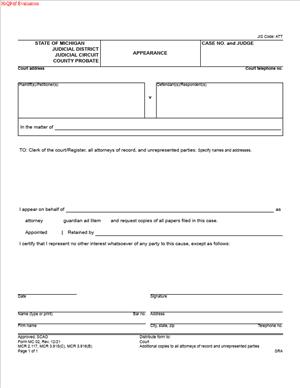
MC 02 – Appearance
Fill out nowJurisdiction: Country: United States | Province or State: Michigan
MC 02 – Appearance is a court form used in Michigan to formally notify the court and other parties that you are participating in a case. It tells the court who you are and how you should receive notices and documents. If you are representing yourself, this form is often one of the first filings you complete.
When you file MC 02 – Appearance, you are not arguing your side of the case. You are simply entering the case so you can receive updates and take part in hearings or other proceedings. It is a procedural step, not a statement of your claims or defenses.
This form matters because courts send important documents only to the parties who have officially appeared. If your appearance is not on record, you may miss hearing dates, motions, or rulings. That can affect your ability to respond on time.
If you are unsure what a court expects from you after being served with legal papers, understanding this form helps you take control of the process. It is a basic but important part of participating in a Michigan court case.
What is MC 02 – Appearance?
Clear definition
MC 02 – Appearance is a written notice filed with a Michigan court to inform the court that a specific person or attorney is appearing in a case. It identifies the party being represented and provides contact information for future communication.
The form becomes part of the official court record. Once filed and accepted, it signals that the person listed intends to participate in the case and receive court communications.
This document does not contain detailed facts or legal arguments. Its primary purpose is to establish formal participation and ensure proper service of future filings.
Who typically uses this form?
Self-represented individuals often use MC 02 – Appearance after being served with a summons and complaint. Filing it confirms that they are entering the case without hiring an attorney.
Attorneys also use this form when they begin representing a client in a matter already filed with the court. It lets the court know that the attorney, not the client, should receive future documents directly.
In some cases, a party may file the form after previously not responding. For example, if you decide to engage in the case after initial inaction, filing an appearance can help establish communication with the court.
Both plaintiffs and defendants may use this form, depending on the circumstances. The key factor is whether someone needs to formally place themselves or their attorney on record.
Why might you need this form?
You might need this form if you were served with court papers and want to ensure you receive all updates about the case. Filing an appearance helps make sure you are included in future notifications.
It can also be used when you change representation. If you hire a lawyer after starting the case on your own, the new attorney may file an appearance to take over communication with the court.
In some situations, courts require a formal appearance before allowing someone to file certain motions or requests. Filing this document can clarify that you are an active participant in the case.
The form also helps reduce confusion. When the court and the other party know who represents you, documents are sent to the correct address and person.
Typical real-life scenarios
- You are sued in a small claims or civil case and receive a summons in the mail. You plan to respond, but want to make sure the court sends you all future notices. Filing an appearance formally enters you into the case.
- You started a family court matter without an attorney. Later, you decide to hire one. Your attorney files an appearance, so the court directs all communication to their office instead of your home address.
- You are a defendant in a civil lawsuit and missed the initial deadline to respond. Before taking further action, you file an appearance to show that you intend to participate and to begin receiving official case updates.
- You represent a business in a civil matter and want to ensure that all documents are sent to a specific mailing address. Filing an appearance provides that contact information to the court.
- You are involved in a probate or post-judgment matter and need to establish that you are part of the proceeding. An appearance can help clarify your role in ongoing litigation.
When would you use MC 02 – Appearance?
You typically use MC 02 – Appearance at the beginning of your involvement in a case. This often happens soon after you are served with a summons and complaint. Filing it places your name and contact details into the court’s system.
You may also use it when your role in a case changes. For example, if you transition from self-represented to represented by counsel, a new appearance may be filed to reflect that change.
In ongoing litigation, the form may be filed when an attorney enters the case after it has already started. It ensures that the attorney receives all filings, notices of hearing, and court orders moving forward.
If a case has multiple parties, each person or attorney who wants to receive direct notice may file a separate appearance. This is common in civil matters with several defendants or in family cases involving multiple interested parties.
The form is used in a wide range of case types, including civil, family, and other court proceedings. Its purpose remains consistent: to formally record participation and establish how communication will occur.
Legal characteristics of MC 02 – Appearance
MC 02 – Appearance is procedural in nature. It does not resolve disputes or create rights by itself. Instead, it functions as an official notice within the court’s filing system.
For the form to be effective, it generally must be completed accurately and filed with the correct court. The case number, party names, and contact information must match the existing case record. Errors in these fields can delay processing or cause confusion.
Courts may reject or return the form if required sections are incomplete, signatures are missing, or the case information does not match the court’s file. Providing incorrect addresses can also lead to missed notices.
The form typically becomes effective when it is accepted and entered by the court clerk. Once recorded, it directs future service of documents to the person or attorney listed.
It is important to understand what the form does not do. It does not replace an answer to a complaint. It does not extend deadlines automatically. It does not present defenses or counterclaims. Those actions usually require separate filings.
Procedural details may vary slightly depending on the type of case or court division. However, the general function of entering a party or attorney into the case record remains consistent across Michigan courts.
Is it legally binding?
MC 02 – Appearance is legally significant because it creates a formal record that you or your attorney is participating in the case. Once filed, it affects how the court and other parties communicate with you.
It does not bind you to a settlement or admit any allegations. It does not waive your defenses by itself. Its binding effect relates to procedure, not to the substance of the dispute.
For example, once you have appeared, certain court actions may proceed with the understanding that you have notice of the case. This can affect scheduling and service requirements. The binding aspect lies in how the court treats your participation moving forward.
How to fill out MC 02 – Appearance
Step 1 – Enter the court information
At the top of the form, fill in the name of the court and its location exactly as shown on the original case documents. Include the case number as it appears on the summons or complaint. This ensures the filing is matched to the correct case.
Step 2 – Identify the parties
Enter the names of the parties exactly as they appear in the case caption. Do not change the order or spelling. Consistency with the existing record helps prevent administrative errors.
Step 3 – State who is appearing
Indicate whether the appearance is for yourself or for a specific party. If you are an attorney, include the name of the client you represent. This section clarifies whose participation is being formally entered.
Step 4 – Provide contact information
List the full mailing address where you want to receive court documents. Include a phone number and any other requested contact details. Make sure this information is accurate and up to date, as future notices will rely on it.
Step 5 – Sign and date the form
Sign your name in the designated signature area and include the date of signing. Your signature confirms that the information provided is accurate to the best of your knowledge. If you are an attorney, include any required identification details requested on the form.
Step 6 – File the form with the court
Submit the completed form to the same court where the case is pending. Follow the court’s standard filing process, whether in person, by mail, or through an approved electronic system if available. Ensure the filing is associated with the correct case number so your appearance is properly recorded.
Legal terms you might encounter in MC 02 – Appearance
- Appearance: An appearance is your formal notice to the court that you are participating in the case. By filing this document, you tell the court and the other party that you want to receive notices and take part in hearings. It does not explain your side of the story. It simply establishes your involvement.
- Party: A party is a person or entity directly involved in the case. This usually means the plaintiff, defendant, petitioner, or respondent. On this form, you must clearly identify which party you are appearing for.
- Attorney of Record: An attorney of record is a lawyer who has officially filed paperwork to represent a party. Once listed as attorney of record, that lawyer receives court notices and is responsible for filings. If you are not a lawyer, you are appearing on your own behalf.
- Pro Se: Pro se means you represent yourself without a lawyer. If you are completing this document for yourself, you are appearing pro se. The court will send notices directly to the contact information you provide.
- Case Caption: The case caption appears at the top of court documents. It includes the court name, case number, and names of the parties. You must copy this information exactly as it appears on other case documents.
- Case Number: The case number is the unique identifier assigned to your case. It ensures your filing is placed in the correct court file. Enter it carefully, because a wrong number can delay processing.
- Service: Service means formally delivering court documents to the other party. After you file your appearance, you may need to ensure the other side receives a copy. Courts often require proof that service was completed.
- Signature Block: The signature block is the section where you sign, print your name, and provide contact information. Your signature confirms the information is accurate. An incomplete signature block can result in rejection.
- Contact Information: This includes your mailing address, phone number, and sometimes email address. The court uses this information to send notices and hearing dates. If this information changes, you must update the court.
- Filing: Filing is the act of submitting your completed document to the court clerk. A document is not effective until it is filed and accepted. Keep proof that your filing was received.
FAQs
Does filing this form mean I am responding to the complaint?
No. This document only tells the court that you are participating in the case and where to send notices. It does not answer the claims made against you. If a response is required, you must file a separate document that addresses the allegations within the deadline provided.
When does my appearance become effective?
Your appearance becomes effective once the court clerk accepts and files the document. The effective date is usually the date stamped by the clerk. Check the filed copy to confirm the stamp or electronic filing confirmation so you know it has been officially recorded.
Do I need to attach anything to this document?
In most situations, you do not attach evidence or other materials. This form stands alone and simply records who is appearing. However, if you are an attorney entering the case, you may need to ensure your contact information is complete and matches court records so notices are routed correctly.
What happens if I enter the wrong case number?
If you list the wrong case number, the filing may be rejected or placed in the wrong file. That can cause missed notices or deadlines. Always compare the number you enter with a recent court document before submitting the MC 02 – Appearance to avoid processing delays.
Will the other party be notified after I file?
Yes. Once filed, your appearance becomes part of the court record, and future documents will reflect your participation. In many cases, you must also send a copy of this document to the other party and complete any required proof of service so the court knows they were informed.
Can more than one person file this document in the same case?
Yes. Each party, or each attorney representing a party, may file their own appearance. Every person who wants official notice from the court must submit their own document with their own contact details to ensure proper communication.
What if my address or phone number changes after I file?
You are responsible for keeping your contact information current. If it changes, you must file an updated notice with the court so you continue receiving hearing dates and court orders. Failing to update your details can result in missed deadlines or decisions made without your input.
Do I need to file MC 02 – Appearance if I already filed another document?
If you have already submitted a pleading or motion that clearly identifies you and includes your contact information, the court may already consider you as having appeared. However, if you want to be certain the record clearly reflects your participation, filing this form creates a direct and unmistakable entry of your involvement.
Checklist: Before, During, and After MC 02 – Appearance
Before
- Confirm the exact court name and location handling your case.
- Locate the correct case number from a recent court document.
- Verify the spelling of all party names in the case caption.
- Decide whether you are appearing for yourself or on behalf of someone else.
- Gather your current mailing address, phone number, and email if required.
- Check whether there is a filing deadline tied to your appearance.
- Review any prior filings to avoid duplicating information incorrectly.
During
- Write the court name exactly as shown on existing case documents.
- Enter the case number carefully and double-check each digit.
- Identify clearly which party you are appearing for.
- Print your full legal name consistently with other filings.
- Provide complete and accurate contact information.
- Sign and date the document in the correct signature block.
- Review the entire form for blank fields before submitting.
After
- Make at least one copy for your personal records.
- File the original with the court clerk or through the approved filing system.
- Obtain confirmation of filing, such as a date stamp or electronic receipt.
- Send a copy to the other party if required.
- Complete and file any proof of service if applicable.
- Store the filed copy in a safe and organized case file.
- Monitor your mail or email for court notices.
- Update your calendar with any hearing dates you receive.
Common mistakes to avoid with MC 02 – Appearance
- Mistake: Entering the wrong case number because you copied it from memory, which can cause the document to be misfiled or rejected; always verify the full number directly from an official court paper, and do not forget to check every digit.
- Mistake: Misspelling a party’s name because you rely on informal documents, which may create confusion in the court record; always copy names exactly as they appear in the case caption, and do not forget middle initials if listed.
- Mistake: Leaving contact information incomplete because you assume the court already has it, which can result in missed notices; always fill out every required contact field, and do not forget apartment numbers or ZIP codes.
- Mistake: Forgetting to sign the document because you focus only on the top portion, which can lead to rejection by the clerk; always review the signature block and do not forget to date your signature.
- Mistake: Failing to keep a copy because you assume you can access it later, which can create problems if there is a dispute about filing; always make and store a copy, and do not forget to keep proof of submission.
- Mistake: Not serving the other party when required because you think filing with the court is enough, which may delay proceedings; always confirm service rules, and do not forget to complete any proof of service form.
What to do after filling out MC 02 – Appearance
Once you complete the form, your next steps focus on proper filing and recordkeeping. Filing correctly ensures the court recognizes your participation. A good organization protects you if questions arise later.
Start by reviewing the document one more time. Look for small errors. Confirm names, numbers, and contact details match prior filings exactly. Even minor inconsistencies can create confusion in court records.
- Step 1: Make at least two copies of the completed form—one for your records and one for service on the other party if required.
- Step 2: Submit the original to the court using the accepted filing method, such as in person, by mail, or through an approved electronic system.
- Step 3: Obtain proof of filing, such as a stamped copy or electronic confirmation receipt.
- Step 4: Check that the filing date is clearly shown on your confirmation copy.
- Step 5: Serve a copy on the other party if the rules require it.
- Step 6: Complete and file any proof of service form if necessary.
- Step 7: Place your filed copy and proof of filing in a dedicated folder for this case.
- Step 8: Update your calendar to watch for court notices or deadlines.
- Step 9: Monitor your mail and email regularly for communications from the court.
- Step 10: Promptly notify the court in writing if your contact information changes.
Stay organized. Keep all case documents together in one place. Label each document with the date filed. If you speak with court staff, write down the date and what was discussed.
Finally, remain proactive. Filing an appearance is only one step in the case. Pay close attention to deadlines for responses, hearings, or additional filings. When you receive any new document from the court or the other party, read it carefully and note any action required. Consistent follow‑through helps you stay in control of your case.
Disclaimer: This guide is provided for informational purposes only and is not intended as legal advice. You should consult a legal professional.