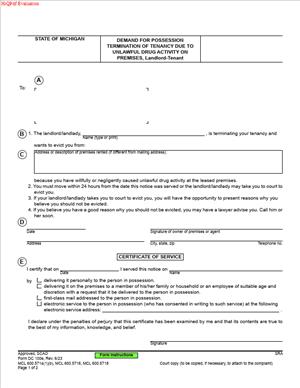
DC 100e – Demand for Possession Termination of Tenancy Due to Unlawful Drug Activity on Premises, Landlord-Tenant
Fill out nowJurisdiction: Country: United States | Province or State: Michigan
If you are dealing with serious lease violations involving drugs, the DC 100e – Demand for Possession Termination of Tenancy Due to Unlawful Drug Activity on Premises, Landlord-Tenant is a form you may encounter. It is a written notice used in Michigan rental situations. It tells a tenant that the landlord is ending the tenancy because of alleged unlawful drug activity on the property.
This document is not a court order by itself. It is a formal demand for possession of the rental unit. In simple terms, it tells the tenant to move out because of specific conduct.
You may be looking at this form because you are about to fill it out as a landlord. Or you may have received it as a tenant and want to understand what it means. Either way, it helps to know what the form does and what information it requires.
This form matters because it can be the first step toward an eviction case in court. If it is completed incorrectly, it may delay the process or cause problems later. Understanding each part before you write anything on it can save time and confusion.
What is DC 100e – Demand for Possession Termination of Tenancy Due to Unlawful Drug Activity on Premises, Landlord-Tenant?
Clear definition
DC 100e – Demand for Possession Termination of Tenancy Due to Unlawful Drug Activity on Premises, Landlord-Tenant is a written notice used by a landlord to terminate a rental agreement based on alleged unlawful drug activity at the rental property. It informs the tenant that the tenancy is ending and demands that the tenant give up possession of the premises.
The document usually identifies the rental property, the tenant, and the reason for termination. The reason stated is specifically tied to unlawful drug activity occurring on or near the premises.
This form is typically used before filing a formal eviction action in court. It serves as notice that the landlord claims the lease has been violated in a serious way.
Who typically uses this form?
Most often, a landlord or property manager completes this form. The landlord may be an individual owner or a business entity that owns rental property.
Property managers acting on behalf of the owner may also prepare and sign the form. In that case, they usually indicate their role or authority.
Tenants do not use this form to start a process. Instead, they receive it. However, tenants benefit from understanding what it says and what it may lead to.
Why might you need this form?
A landlord may need this form when they believe unlawful drug activity has taken place on the rental property. This could involve manufacturing, delivering, possessing with the intent to deliver, or other serious drug-related conduct.
The form is used to formally end the tenancy based on that conduct. It signals that the landlord considers the violation severe enough to justify termination rather than a warning.
Without this written notice, a landlord may not be able to move forward with an eviction case based on drug activity. The notice often serves as a required first step before filing in court.
Typical real-life scenarios
- A landlord may receive reports from neighbors about suspected drug sales happening inside a rental unit. After investigating and gathering information, the landlord decides to terminate the tenancy and prepares this form.
- In another situation, law enforcement may execute a search warrant at the rental property and make an arrest related to controlled substances. The landlord then uses this document to formally demand possession.
- Sometimes, illegal drug activity may involve not only the named tenant but also guests or other occupants. The landlord may still use this form if the conduct occurred on the premises and is tied to the tenancy.
- There are also cases where drug-related activity creates safety concerns for other tenants in a multi-unit building. The landlord may use this notice to address the situation quickly and begin the process of regaining control of the unit.
When would you use DC 100e – Demand for Possession Termination of Tenancy Due to Unlawful Drug Activity on Premises, Landlord-Tenant?
You would use DC 100e – Demand for Possession Termination of Tenancy Due to Unlawful Drug Activity on Premises, Landlord-Tenant when the reason for ending the tenancy is specifically related to unlawful drug activity. It is not used for unpaid rent, minor lease violations, or routine end-of-lease situations.
This form is typically used during an active tenancy. That means the lease or rental agreement is still in effect, but the landlord is choosing to end it early due to serious misconduct.
Landlords commonly use this form after they believe they have enough information to assert that drug-related conduct occurred. The notice communicates that the landlord considers the violation severe and is demanding possession of the property.
Tenants encounter this form when they are accused of drug-related activity connected to the rental unit. It may be handed to them in person, delivered in another authorized way, or posted and mailed, depending on how service is handled.
This form is not generally used to simply refuse renewal at the end of a lease term. It is tied to a specific allegation that unlawful drug activity occurred on the premises during the tenancy.
Legal characteristics of DC 100e – Demand for Possession Termination of Tenancy Due to Unlawful Drug Activity on Premises, Landlord-Tenant
This form has specific legal significance because it relates to the termination of tenancy based on alleged criminal conduct. For it to be effective, it usually must clearly identify the tenant, the address of the rental property, and the reason for termination.
Accuracy matters. Incorrect names, wrong addresses, or unclear statements about the basis for termination can create issues later. If the notice does not match the facts that are later presented in court, that inconsistency may cause delays.
The timing and method of delivery are also important. Many eviction-related notices require proper service before a case can be filed. If the notice is not delivered in a way recognized by law, the court process may be affected.
Different states handle drug-related lease terminations in slightly different ways. Some may allow shorter notice periods for certain serious conduct. Others may require specific language in the notice. In Michigan, this form is designed to address termination due to unlawful drug activity under state procedures.
It is also important to understand what this document does not do. It does not remove the tenant by itself. It does not authorize a lockout, property removal, or utility shutoff. It is a notice demanding possession and often serves as a step before a court filing.
Is it legally binding?
The form itself is a legally significant notice, but it is not a final judgment. It becomes effective as a formal demand when it is properly completed and delivered.
It is legally binding in the sense that it communicates the landlord’s decision to terminate the tenancy based on stated grounds. If the tenant does not leave, the landlord may use the notice as part of an eviction filing.
However, the actual removal of a tenant usually requires a court order. The notice does not, by itself, create an enforceable eviction. A judge must generally review the case and issue an order before a tenant can be legally removed.
If the form is incomplete, contains errors, or is not properly served, it may not support a later eviction action. That is why careful completion and accurate information are important.
How to fill out DC 100e – Demand for Possession Termination of Tenancy Due to Unlawful Drug Activity on Premises, Landlord-Tenant
Step 1 – Identify the court and case information section
At the top of the form, you will usually see space for court information. This may include the name of the district court and its address. Fill in the correct court that has jurisdiction over the location of the rental property. Make sure the information matches the property’s city or township.
If there is a case number field and you do not yet have one, leave it blank unless the form instructions state otherwise. A case number is typically assigned after a court filing.
Step 2 – Enter the names of the parties
Write the full legal name of the landlord or property owner. If the property is owned by a company, use the full registered business name.
Then enter the full legal name of each tenant listed on the lease. Include all adult occupants who signed the rental agreement, if the form provides space for multiple names. The names should match the lease as closely as possible.
Step 3 – Provide the rental property address
Fill in the complete address of the rental unit. Include the street number, street name, apartment or unit number if applicable, city, and ZIP code.
Double-check that the address is accurate. An incorrect address can create confusion and may affect later court proceedings.
Step 4 – State the reason for termination
In the section that explains why possession is being demanded, indicate that the termination is due to unlawful drug activity on the premises. Use clear, factual language if the form allows you to describe the conduct.
Focus on identifying the nature of the alleged activity and where it occurred. Avoid vague statements. The reason provided should be consistent with the purpose of the form.
Step 5 – Review the notice period language
Read the portion of the form that explains when the tenant must give up possession. The document may specify a time frame or immediate termination language, depending on how it is structured.
Ensure that the date or time period is completed correctly if the form requires you to fill in a specific deadline. The timeline should be written clearly and legibly.
Step 6 – Complete the signature section
Sign your name in the designated signature area. Print your name clearly below your signature if the form includes a separate line for that.
Add the date you are signing the form. This date is important because it may relate to the notice period and later court filings.
If you are signing as a property manager or agent, indicate your title or role if the form includes space for that information.
Step 7 – Fill out the certificate of service
Most versions of this form include a section that describes how the notice was delivered to the tenant. This is often called a certificate of service.
Indicate the method used to deliver the notice, such as personal delivery, mailing, or another permitted method. Enter the date of delivery and the address where it was served.
Sign the certificate of service. This section confirms that the tenant was given the notice in the manner described.
Step 8 – Make and keep copies
After completing the form, make a copy for your records. Keep the signed original in a safe place.
You may need this document if you later file an eviction case. Having a clear, legible copy can help you present accurate information about the notice and the date it was delivered.
Legal terms you might encounter in DC 100e – Demand for Possession Termination of Tenancy Due to Unlawful Drug Activity on Premises, Landlord-Tenant
- Demand for Possession: This is the formal written notice telling a tenant you want the rental unit back. In this document, it states that the tenancy is being terminated because of alleged unlawful drug activity. It is the first required step before starting a court eviction case based on this reason.
- Termination of Tenancy: This means the rental agreement is being ended before its natural expiration date. On this form, termination is tied specifically to alleged drug-related conduct. The document explains that the tenant’s right to remain in the property is ending due to that conduct.
- Unlawful Drug Activity: This refers to the illegal manufacture, delivery, possession with intent to deliver, or similar prohibited drug-related conduct. In the context of this form, the activity must be connected to the rental premises. The document usually requires you to state that such activity occurred on or near the property.
- Premises: The premises mean the rental property itself. This includes the specific unit and may include common areas or surrounding grounds, depending on how the lease defines it. You must correctly identify the premises by address in the form.
- Landlord: The landlord is the person or entity who owns the property or has the legal authority to manage it. The name you enter must match the legal owner or authorized agent. If you are acting on behalf of a company, your authority should be clear.
- Tenant: The tenant is the person who signed the lease or is legally responsible for paying rent and occupying the unit. All adult tenants listed on the lease should be named exactly as they appear in the rental agreement. If you miss someone, that person may not be properly notified.
- Possession: Possession means the legal right to control and occupy the property. When you demand possession, you are asserting your right to regain control of the premises. The form makes clear that the tenant must surrender possession by a specific date.
- Certificate of Service: This section confirms how and when the notice was delivered to the tenant. It records the method of delivery, such as personal delivery or another approved method. This part is critical because improper service can delay or undermine your case.
- Effective Date: The effective date is when the termination takes effect. This date is tied to the notice period required for this type of termination. You must calculate and clearly state this date so there is no confusion.
- Court Action: Court action refers to the eviction lawsuit that may follow if the tenant does not leave. This document is not the lawsuit itself. It is the required notice that must be given before filing a case in court.
FAQs
Do I need to file DC 100e – Demand for Possession Termination of Tenancy Due to Unlawful Drug Activity on Premises, Landlord-Tenant with the court right away?
No. This document is typically served on the tenant before any court case is started. It becomes part of your records and may later be attached to a complaint if you file for eviction. You do not usually file it with the court unless and until you begin a formal case.
What exact information must match the lease when I complete this form?
You should match the tenant’s full legal name, the rental property address, and your name as landlord exactly as they appear in the lease. Even small differences in spelling or missing middle initials can create confusion. Courts and clerks compare the notice to the lease and later filings, so consistency is important.
How do I determine the correct termination date to enter?
You need to count the required notice period based on the date you plan to serve the document. The termination date should reflect the full notice period, not the date you sign it. Double-check your calendar and count carefully to avoid setting a date that is too early.
Can I sign the notice if I am the property manager and not the owner?
Yes, if you are authorized to act for the owner. Your signature should clearly show your role, such as agent or property manager. Make sure your authority is documented internally in case the court later asks how you are connected to the property.
What should I write in the section describing unlawful drug activity?
Be specific but factual. State that unlawful drug activity occurred on the premises and reference the general nature of the conduct without adding unnecessary detail. Avoid emotional language and stick to clear statements that support the reason for termination.
Do I need to attach police reports or other evidence to DC 100e – Demand for Possession Termination of Tenancy Due to Unlawful Drug Activity on Premises, Landlord-Tenant?
You usually do not attach evidence to this document when serving it. However, you should keep any police reports, incident reports, or witness statements in your records. If you later file a court case, you may need that documentation to support your claims.
What happens if the tenant moves out before the termination date?
If the tenant leaves and returns the keys before the stated date, you should document the move-out condition and possession transfer. Keep written confirmation of the date you regained control of the property. This can affect rent calculations and any later court filings.
Does this notice become part of the public record?
The notice itself is not automatically public just because you serve it. It generally becomes part of the public record only if you file it with a court as part of an eviction case. Once filed, it may be accessible through court records.
Checklist: Before, During, and After DC 100e – Demand for Possession Termination of Tenancy Due to Unlawful Drug Activity on Premises, Landlord-Tenant
Before
- Review the lease agreement for all named tenants and property details.
- Confirm the full legal names of all adult occupants responsible under the lease.
- Verify the exact property address, including unit number.
- Gather documentation related to the alleged unlawful drug activity.
- Confirm your authority to sign as a landlord or authorized agent.
- Calculate the correct termination date based on the required notice period.
- Decide on the method of service you will use.
- Prepare a clean, legible copy of the form for each tenant.
During
- Fill in all required fields clearly and completely.
- Double-check spelling of names and the rental address.
- State the reason for termination in clear, factual language.
- Enter the correct termination date.
- Sign and date the document in the designated section.
- Complete the certificate of service immediately after serving the notice.
- Ensure the method of service matches what you actually did.
- Make copies of the fully completed and signed notice.
After
- Keep a signed copy in your property management records.
- Store proof of service with the notice copy.
- Calendar the termination date and any follow-up deadlines.
- Monitor whether the tenant vacates by the stated date.
- Document the condition of the property if the tenant leaves.
- Prepare any additional paperwork if you need to file a court case.
- Keep all related evidence organized in one file.
- Update your internal rent ledger and occupancy records.
Common mistakes to avoid with DC 100e – Demand for Possession Termination of Tenancy Due to Unlawful Drug Activity on Premises, Landlord-Tenant
- Mistake: Listing only one tenant when multiple adults signed the lease, which happens when you rely on memory instead of the lease; this can prevent proper notice to all parties, so do not forget to name every responsible tenant exactly as written in the agreement.
- Mistake: Using the wrong property address or leaving out the unit number because you assume it is obvious; this can create ambiguity about which premises are affected, so do not forget to verify the full legal address.
- Mistake: Setting the termination date too early due to miscounting days; this can invalidate the notice and delay court action, so do not forget to count the full notice period from the actual service date.
- Mistake: Failing to complete the certificate of service because you think delivery alone is enough; without written proof of how and when you served it, your case may be challenged, so do not forget to fill out and sign that section.
- Mistake: Adding emotional or accusatory language in the reason section because you are frustrated; this can weaken your credibility, so do not forget to keep the wording factual and professional.
- Mistake: Not keeping copies of the signed notice and proof of service because you assume you will remember the details; this can leave you without evidence later, so do not forget to store organized copies in your records.
- Mistake: Allowing someone without documented authority to sign the notice; this can raise questions about validity, so do not forget to ensure the signer has clear legal or contractual authority.
- Mistake: Delaying further action after the termination date passes, which often happens due to uncertainty about next steps; this can complicate rent accounting and possession claims, so do not forget to track deadlines and act promptly.
What to do after filling out DC 100e – Demand for Possession Termination of Tenancy Due to Unlawful Drug Activity on Premises, Landlord-Tenant
Once you complete the form, focus on proper delivery and documentation. The strength of your position often depends on clear records and consistent follow-through.
- Step 1: Make at least two copies of the signed notice, one for your records and one for each tenant named.
- Step 2: Serve the notice using your chosen method and ensure it complies with accepted delivery practices.
- Step 3: Immediately complete the certificate of service with the exact date and method used.
- Step 4: Place the original signed notice and proof of service in a secure file for that property.
- Step 5: Mark the termination date on your calendar and set a reminder a few days before it arrives.
- Step 6: Monitor the property to determine whether the tenant vacates by the stated date.
- Step 7: If the tenant leaves, document the move-out condition with photos and a written summary.
- Step 8: If the tenant does not leave, prepare the next required court forms using the same names and address exactly as listed on the notice.
- Step 9: Attach a copy of the completed notice and proof of service to your court filing, if required.
- Step 10: Update your internal rent ledger and tenant file to reflect the termination and any unpaid balances.
Stay organized. Keep all related documents together, including the lease, the completed notice, service proof, and any evidence of unlawful activity. Clear documentation makes the next steps more efficient and reduces the chance of avoidable delays.
Disclaimer: This guide is provided for informational purposes only and is not intended as legal advice. You should consult a legal professional.