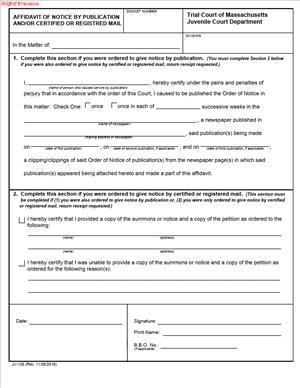
Affidavit of Notice by Publication and/or Certified or Registered Mail (JV-135)
Fill out nowJurisdiction: Country: The United States | Province/State: Massachusetts
What is a Affidavit of Notice by Publication and/or Certified or Registered Mail (JV-135)?
This affidavit is a sworn statement that proves you gave legal notice. It confirms that you sent notice by certified or registered mail and/or published notice in a newspaper. You file it with the court so the judge can verify that notice requirements were met.
In Massachusetts, courts require proof that every party was properly notified. That includes parents, guardians, and any other legally interested person in juvenile or family matters. It can also include agencies, caretakers, or alleged fathers. When personal service is not possible, the court often orders notice by certified mail or by publication. This affidavit documents that you completed those steps.
Think of the affidavit as your proof package. It identifies who you notified, how you notified them, when you did it, and what evidence supports that. You attach receipts, tracking numbers, return cards, copies of what you mailed, and copies of the published notice. The affidavit ties those pieces together and puts them under oath.
Who typically uses this form? Petitioners, respondents who must give notice to others, attorneys, law firm staff, child welfare workers, and approved process servers use it. In juvenile cases, a Department of Children and Families worker or agency counsel often completes it. In Probate and Family Court, a petitioner or their counsel usually completes it. Self-represented litigants can also use it.
You would need this form when the court has directed you to use mail or publication. You also use it when a rule requires certified or registered mail for a specific type of notice. If you cannot find a parent or party, the court may allow publication. If a party lives out of state or refuses personal service, you may need certified mail. If notice must be recorded in the file before a hearing, this affidavit provides that record.
Typical scenarios include a care and protection case with a missing parent. It also includes a guardianship where a parent’s address is unknown. You may need it in an adoption or termination case that requires strict proof of notice. You may also need it in a name change for a minor, when a noncustodial parent cannot be located. Civil matters in which a defendant evades service can also require these methods. The key question is whether the court needs proof that you completed mail or publication notice. When the answer is yes, you use this affidavit.
The affidavit matters because due process requires notice and a chance to be heard. If you cannot show proper notice, the court may delay your hearing. The judge may refuse to make final orders until notice is proven. Filing a complete, clean affidavit avoids repeat service and continuances. It builds a reliable record and moves your case forward.
When Would You Use a Affidavit of Notice of Publication and/or Certified or Registered Mail (JV-135)?
Use this affidavit after you complete the notice steps the court ordered. You would not file it first. You file it once you mail the notices, or once the newspaper publication runs. File it soon after you receive the proofs from the post office or publisher. Do not wait until the morning of the hearing if you can avoid it.
Here are practical situations. You represent the petitioner in a juvenile case. The court orders you to publish notice to a parent you cannot locate. You arrange publication in a newspaper that covers the last known area. The notice runs for the required duration. The publisher sends an affidavit and tear sheet. You complete this affidavit, attach the publisher’s documents, and file them.
You are a DCF worker. The court orders you to notify an out-of-state parent by certified mail. You mail the summons and petition by certified mail with return receipt requested. You track the item and receive the green card or electronic confirmation. You complete this affidavit listing the certified number and attach the receipts. You file it before the next hearing.
You are a self-represented petitioner seeking guardianship of a minor. A parent’s whereabouts are unknown. The court allows service by publication after diligent search. You publish as ordered and keep copies. You also mail to the last known address by certified mail. You receive the envelope back marked “Unclaimed.” You include that returned envelope and your postal receipt with this affidavit.
You are an attorney in a Probate and Family Court matter. The judge orders notice to an alleged father by registered mail. You send the packet by registered mail and get the registry receipt. You attach the proof and file this affidavit stating the date and method.
Typical users include petitioners, their attorneys, agency counsel, and paralegals handling service logistics. A process server might sign the affidavit if they completed the mailing. A law firm assistant often coordinates the exhibits. In some cases, the person with personal knowledge is best positioned to sign. That is often you if you arranged the mailings or publication.
Timing is important. Courts need time to review the affidavit before making orders. File as soon as you can. If publication must run multiple times, wait for the final run and the publisher’s affidavit. If a return receipt is pending, monitor tracking and check with the post office if needed. If the item is returned unclaimed, file the returned piece and your affidavit promptly.
Legal Characteristics of the Affidavit of Notice of Publication and/or Certified or Registered Mail (JV-135)
This document is legally binding because it is an affidavit. You sign it under oath before a notary. By signing, you swear the contents are true to the best of your knowledge. False statements can carry penalties. That creates accountability and reliability for the court.
The affidavit is evidence of notice. It is not a judgment by itself. It supports the court’s finding that proper notice occurred. The judge relies on your sworn statement and the attached exhibits. The court will examine dates, addresses, and compliance with its order. If the affidavit is complete and credible, it meets the notice proof requirement.
Enforceability comes from several elements. First, a clear court order or rule requires mail or publication. Second, you comply with that requirement. Third, you attach objective proof, such as USPS records and publisher affidavits. Fourth, you swear to the facts in a notarized statement. Those parts together make your proof reliable.
Courts often require strict compliance in juvenile and family cases. Small errors can cause delays. Examples include using the wrong newspaper, leaving out a tracking number, or misspelling a party’s name. The court may continue the case and direct you to correct the defect. Clear details and complete attachments avoid those issues.
Make sure the affiant has personal knowledge. If you did not mail the documents yourself, confirm who did. The signer must be able to testify about the steps taken. If an assistant mailed the items, that assistant can sign. If you coordinated the publication, you can sign based on your records and the publisher’s affidavit.
Notarization matters. An affidavit is not just a signature. It includes a notary’s jurat stating the affiant appeared, swore, and signed. The notary verifies your identity and the date. Some courts accept declarations under penalty of perjury. Many still require notarization for affidavits of service. Check your court’s preference and obtain a jurat to be safe.
Protect sensitive information. Juvenile records are confidential. Do not add extra personal details that the court did not request. Use the case caption exactly as it appears. Use initials or the child’s first name if that is how the case is captioned. Avoid including full Social Security numbers or unnecessary identifiers.
Finally, keep the original attachments. File copies, but store the originals in case the court asks to review them. If you file electronically, keep clean scans of each exhibit. Clear, legible exhibits improve credibility.
How to Fill Out a Affidavit of Notice of Publication and/or Certified or Registered Mail (JV-135)
Follow these steps to complete the affidavit correctly. Prepare your exhibits before you start. That includes postal receipts, tracking confirmations, return cards, returned envelopes, and publisher affidavits.
1) Set up the case caption.
- Enter the court name and division. Use the correct Massachusetts court department. That will be Juvenile Court or Probate and Family Court. Include the county division, such as Suffolk or Hampden.
- Enter the docket number exactly as it appears on your papers.
- Enter the case title exactly as it appears. For juvenile matters, it often reads “In the Matter of [Child’s Initials].” Use the same format the court uses in your case.
2) Identify yourself as the affiant.
- Print your full name, your role, and your relationship to the case. Examples: petitioner, attorney for petitioner, DCF worker, or process server.
- Provide your business or mailing address, phone number, and email. The court may contact you if it needs clarification.
3) State the purpose of the affidavit.
- Use a simple sentence. Example: “I make this affidavit to prove notice by publication and by certified or registered mail as ordered by the court.”
- Refer to the date of the court’s order if you have it. Example: “On [date], the court ordered notice by publication and certified mail.”
4) Describe what documents you mailed.
- Identify the documents you sent by mail. Examples include the summons, petition, notice of hearing, and any required informational notices.
- State that you used certified mail, registered mail, or both. Use the precise USPS service used.
5) List each person you mailed.
- For each person, list their name, role, and last known address. Example: “Jane Smith, mother, last known address: 123 Main Street, Springfield, MA 01103.”
- Include the date you mailed the packet. Include the certified or registered mail number for each item. Example: “Certified Mail No. 7017 1000 0000 0000 0001.”
- Attach the corresponding postal receipt as an exhibit. Label it clearly. Example: “Exhibit A.”
6) State the results of the mailing.
- If delivered, state the delivery date. Attach the signed return receipt or USPS confirmation. If you have an electronic confirmation, print and attach it.
- If returned, describe the return status. Examples include “Unclaimed,” “Moved, left no address,” or “Refused.” Attach the returned envelope with the postal notations visible.
- If still pending, state that tracking shows “In transit” and that you will supplement if needed. Many courts prefer completed results. File a supplement if the status changes.
7) Describe the publication steps.
- Identify the newspaper by its full name and coverage area. State why it was used. Example: “A newspaper of general circulation in [city or county].”
- State the dates the notice ran. If it ran multiple times, list each date. If the order required a specific number of weeks, state that you complied.
- Attach the publisher’s affidavit and tear sheets or proof pages. Label each as an exhibit. Example: “Exhibit D: Publisher’s Affidavit of Publication.”
8) Attach a copy of the published notice.
- Include a clean copy of the actual notice as it appeared. Confirm it matches the court-approved text.
- If the notice includes a hearing date and location, check for accuracy. If the notice had a typo, note the issue and whether a corrected notice ran.
9) Address diligent search, if relevant.
- If publication was allowed because you could not find a party, state that you conducted a diligent search. Keep it brief and factual.
- If you filed a separate affidavit of diligent search, reference it by date. You do not need to repeat every search step here. Keep the focus on notice completion.
10) Confirm compliance with the court’s order.
- Use a single sentence that connects the dots. Example: “These mailings and publications comply with the court’s order dated [date].”
- If the order specified timelines, state that you met them. Example: “Publication completed on or before the deadline.”
11) Organize and label exhibits.
- Use clear labels and a simple index. Example: “Exhibit A: Certified Mail Receipt to Jane Smith. Exhibit B: Return Receipt for Jane Smith. Exhibit C: Returned Envelope for John Doe. Exhibit D: Publisher’s Affidavit. Exhibit E: Tear Sheet dated [date].”
- Place exhibit labels on the bottom of each page. Make sure each label matches what you reference in the affidavit text.
12) Sign and notarize.
- Sign the affidavit in front of a notary public. Do not sign beforehand.
- Print your name under your signature. Include the date of signing.
- Ensure the notary completes the jurat. It must include the date, county, notary name, commission expiration, and seal.
13) Make copies and file.
- Make a full copy for your records, including exhibits.
- File the original with the court clerk. If e-filing is available, submit a clean scan with legible exhibits.
- Bring a courtesy copy to the hearing if the judge prefers paper.
14) Follow up, if needed.
- If a tracked item later shows delivery, file a short supplemental affidavit with the new proof.
- If a mailed item returns undelivered, consider asking the court for further directions. You may need additional publication or alternative service.
Common pitfalls and how to avoid them:
- Missing tracking numbers. Always include the complete certified or registered number.
- Wrong newspaper. Use a publication that meets the court’s order and coverage area.
- Inadequate dates. List the exact dates of mailing and publication.
- Missing attachments. Include receipts, return cards, returned envelopes, and publisher affidavits.
- No notarization. An unsigned or unnotarized affidavit is not valid.
- Inconsistent names or addresses. Use the exact names and addresses listed in the case and the court order.
- Late filing. File early enough for the judge to review before the hearing.
Practical tips:
- Prepare a simple timeline at the top of your draft. Note each mailing and publication date. Use it to check consistency.
- Print the USPS tracking page as of the day you finalize the affidavit. Attach it to show current status.
- If you manage multiple parties, use a mini-table in your notes to track each person, method, date, and exhibit. Keep the affidavit itself in paragraph form, but rely on your internal tracker to avoid errors.
- If your court requires a specific format for captions, follow it exactly. Copy the caption from a recent court notice to avoid mistakes.
- Keep the language factual and neutral. Do not argue the case in this affidavit. Stay focused on who, what, when, where, and how.
If you follow these steps, your affidavit will be clear and complete. The judge will see that you met the notice requirements. That allows the case to move forward on the merits.
Legal Terms You Might Encounter
Affidavit. An affidavit is a written statement you sign under oath. On this form, you swear you completed notice by publication and/or mailed notice by certified or registered mail.
Affiant. The affiant is the person who signs the affidavit. If you handled the mailing or publication, you are the affiant.
Notice by publication. Notice by publication means you ran a legal notice in a newspaper as ordered. You use this form to swear that publication occurred, and to state the publication dates.
Certified mail. Certified mail gives you a tracking number and, often, a signed receipt. On this form, you list the certified mail details you used to notify a person.
Registered mail. Registered mail is more secure than certified mail and includes tracking. If you used registered mail, you record its details on the form.
Return receipt. A return receipt is the postcard or electronic proof showing delivery or an attempted delivery. You attach it to the affidavit to prove notice by mail.
Proof of service. Proof of service shows that you gave formal notice in the correct way. This affidavit serves as proof of service by publication or by certified or registered mail.
Due diligence. Due diligence means you made reasonable efforts to find and notify the person. If you used publication, you confirm on this form that you tried to locate the person first.
Last known address. The last known address is the most recent address you can find for the person. You list that address in the mailing section and attach proof of your search.
Affidavit of publication. An affidavit of publication is a statement from the newspaper confirming the notice ran. You attach it to this form to complete the record.
Undeliverable mail. Undeliverable mail is mail returned by the post office. You attach the unopened envelope to show you attempted notice by mail.
FAQs
Do you need to use both publication and certified or registered mail?
Use the method the court ordered. If the order requires both, you must complete both. If you can mail to a last known address, do it, even if you also publish. This form lets you prove either or both methods.
Do you need a separate affidavit for each person notified?
Yes. Use one affidavit per person. Each person has unique addresses, dates, tracking numbers, and attachments. Keep each record distinct to avoid confusion.
Do you attach the newspaper proof or just list the dates?
Attach the newspaper’s affidavit of publication and a copy of the published notice if available. Also list the publication dates on this form. Your goal is to let the court verify the notice without guesswork.
Do you attach the certified/registered mail receipt and return receipt?
Yes. Attach the mailing receipt, tracking page or number, and the return receipt or delivery notice. If the mail was returned, attach the sealed returned envelope. The court needs to see the full chain of proof.
Do you need to notarize this affidavit?
Follow the form’s signature requirements. Many court affidavits are signed under penalty of perjury and do not require a notary. If the form or your court requires a notary, sign in front of a notary.
Do you file this before or after the hearing?
File as soon as you have complete proof. Courts often set a filing deadline before the hearing. Early filing avoids delays and gives the court time to review your notice.
Do you list every publication date if it ran more than once?
Yes. List each date the notice ran. The order often requires publication on multiple dates. Record every date and attach the newspaper’s confirming affidavit.
Do you need to amend the affidavit if you later find a better address?
Yes. File an amended affidavit and update the court on new notice steps. If time allows, mail notice to the new address and update the record with new proof.
Checklist: Before, During, and After the Affidavit of Notice of Publication and/or Certified or Registered Mail (JV-135)
Before signing: information and documents you need
- Court details: case number, department, next hearing date.
- Person being noticed: full legal name, relationship to the child.
- Child details: name, date of birth, case reference as required by the form.
- Court order for notice: which method is required, timelines, and any special instructions.
- Due diligence notes: search steps you took to find the person, with dates and sources.
- Publication details: newspaper name, city or county, publication dates, invoice or order number.
- Newspaper proofs: affidavit of publication and copy of the published notice.
- Mailing details: last known address, date mailed, carrier tracking number.
- Mailing proofs: certified or registered mail receipt, tracking page, return receipt.
- Returned mail: unopened envelope marked undeliverable, with postal notations visible.
- Translations (if required): translated notice and translator’s certification.
- Contact information: your name, role, phone, address, and email for court contact.
During signing: sections to verify
- Party names: confirm spelling of the person notified and the child.
- Case number and court: match the caption exactly to the case file.
- Notice method: check the right boxes for publication, certified mail, registered mail, or both.
- Dates: verify each publication date and each mailing date.
- Addresses: confirm the last known address and that it matches the envelope used.
- Tracking numbers: type them accurately; confirm against the receipt.
- Attachments: staple or label exhibits clearly (e.g., “Exhibit A: Affidavit of Publication”).
- Due diligence summary: include key steps you took to locate the person.
- Signature block: sign and date in the correct place; print your name and title.
- Notarization (if required): sign in the notary’s presence and ensure the seal is complete.
After signing: filing, notifying, storing
- File with the court: submit the original affidavit with all attachments.
- Meet deadlines: file before the hearing per the court’s timing rules.
- Serve copies: provide a copy to relevant parties as rules require.
- Keep a full copy: retain a complete set of the affidavit and every attachment.
- Track the docket: confirm the court accepted the filing and it appears on the record.
- Monitor delivery: if a return receipt is pending, calendar a follow-up to file it.
- Update the court: if new address info appears, file a supplemental or amended affidavit.
- Bring backups: take copies of all proofs to the hearing for reference.
- Secure storage: store originals and postal receipts in a safe, labeled file.
Common Mistakes to Avoid
Leaving out a publication date.
Don’t forget to list each date the notice ran. Missing dates can lead to a continuance or a denial of proper notice.
Using the wrong newspaper.
Don’t forget to use a paper that covers the required area. Using the wrong outlet can invalidate the notice and force re-publication.
Failing to attach proof.
Don’t forget the affidavit of publication, mailing receipts, and return receipts. Without them, the court may find service incomplete.
Combining multiple people on one affidavit.
Don’t include more than one person per affidavit. Mixing proofs can confuse the record and cause delays.
Mistyping tracking numbers or addresses.
Don’t transpose digits or miss apartment numbers. Errors can cause returned mail and require repeated notice efforts.
Signing late or after the hearing.
Don’t wait. Late filing can derail the hearing schedule and require a new date.
What to Do After Filling Out the Form
File the original with the court promptly.
Confirm you included all attachments: the newspaper’s affidavit of publication, the published notice, mailing receipts, return receipts, and any returned envelopes.
Provide copies to required parties.
Follow court rules for distributing filings to counsel, guardians, or agencies involved. Note how and when you sent the copies.
Check the court’s calendar entry.
Verify that your filing appears and is linked to the upcoming hearing. If the clerk flags a defect, correct it immediately.
Monitor pending proofs.
If you are waiting on a return receipt or the newspaper’s affidavit, calendar a deadline. File the missing proof as a supplemental affidavit when it arrives.
Prepare for the hearing.
Bring a copy set with labeled exhibits. Be ready to state the publication dates, the mail date, and the tracking outcome.
Amend if new information surfaces.
If you find a better address or learn the person received actual notice another way, file an amended affidavit. Mail new notice if time permits and update attachments.
Request time if proof is incomplete.
If a key document is still pending, ask the court for time to complete the record. Show the steps you already took and the expected delivery date.
Store records securely.
Keep all originals, receipts, and envelopes in one file. You may need them later if notice is challenged.
Close the loop after the hearing.
If the court orders more notice, do it quickly. Then file a new affidavit with fresh proofs. Update your checklist and calendar to confirm completion.
Disclaimer: This guide is provided for informational purposes only and is not intended as legal advice. You should consult a legal professional.