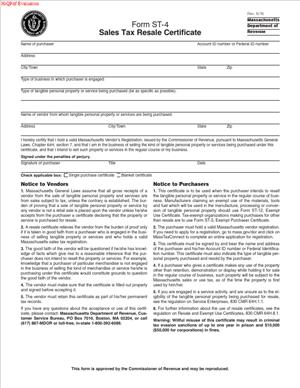
Form ST-4 – Sales Tax Resale Certificate
Fill out nowJurisdiction: Country: United States | Province or State: Massachusetts
The Form ST-4 – Sales Tax Resale Certificate is a document used in Massachusetts when you buy goods to resell them rather than to use them yourself. It allows you to purchase certain items without paying sales tax at the time of purchase. The idea is simple: sales tax is collected from the final consumer, not from a business that plans to resell the item.
If you are about to complete the Form ST-4 – Sales Tax Resale Certificate, you are likely operating a business that buys inventory for resale. This form is typically given to your supplier. It explains why you are not paying sales tax on that specific transaction.
This form matters because it shifts responsibility. Instead of the seller collecting tax from you, you certify that the item will be resold in the regular course of your business. If the information is incorrect or incomplete, both you and the seller may face problems later.
Before you sign, it helps to understand what the form does, what it does not do, and what information you are confirming. That way, your submission is accurate, and you avoid unexpected tax issues.
What is Form ST-4 – Sales Tax Resale Certificate?
Clear definition
Form ST-4 – Sales Tax Resale Certificate is a written statement provided by a buyer to a seller. In it, the buyer certifies that the items being purchased are for resale in the ordinary course of business. Because the goods are intended for resale, the seller does not charge sales tax at the point of sale.
This form is not a license, and it is not a permit. It is a certificate used to document a specific type of transaction. It serves as evidence that the seller accepted a valid resale claim instead of collecting tax.
The document typically includes your business name, address, tax registration number, and a description of the type of goods you sell. By signing it, you are confirming that the purchase qualifies for resale treatment.
Who typically uses this form?
Retailers commonly use this form when buying inventory from wholesalers or distributors. For example, a clothing store purchasing shirts for resale would provide this certificate to its supplier.
Online sellers who maintain inventory in Massachusetts may also use it when sourcing products. If you are buying items that you plan to list and sell to customers, this form often applies.
Contractors may use a resale certificate in limited situations, but this depends on how the materials will be used. In many cases, contractors are considered the end users of building materials, not resellers. The specific facts of the transaction matter.
Wholesalers may also provide this form when buying from manufacturers if they intend to resell the goods further down the supply chain.
Why might you need this form?
You may need this form to avoid paying sales tax on goods that you will later sell to your own customers. If you pay tax when purchasing inventory and then charge your customer tax again, the tax is effectively collected twice in the chain.
This form helps ensure that sales tax is only collected once, from the final consumer. It supports the tax system’s structure and keeps your cost of goods accurate.
Sellers often require a properly completed resale certificate before agreeing not to charge tax. Without it, they may collect tax by default to protect themselves from liability.
You may also need it to establish consistent purchasing practices. Suppliers often keep resale certificates on file and request updates periodically to confirm your business status.
Typical real-life scenarios
- You operate a small retail store in Massachusetts. You purchase home décor items from a regional wholesaler. Because you intend to place those items on your shelves for sale, you give the wholesaler a completed resale certificate instead of paying sales tax at checkout.
- You run an online business selling specialty food products. You order bulk inventory from a distributor. At the time of your first order, the distributor requests a resale certificate. You complete the form so your invoice does not include sales tax.
- You manage a chain of convenience stores. Your company regularly buys beverages and snacks from different suppliers. Each supplier asks for a resale certificate to keep on file. You provide the form once, and it generally applies to future qualifying purchases.
- You start a new boutique and begin sourcing clothing from various vendors. Some vendors will not process your wholesale account until you submit a resale certificate. You complete the form as part of your initial account setup.
When would you use Form ST-4 – Sales Tax Resale Certificate?
You use this form at the time you purchase tangible personal property that you intend to resell. It is typically provided to the seller before or at the time of sale. In many cases, the seller keeps the certificate on file and applies it to future transactions of the same type.
If you are opening a new business and setting up supplier relationships, you may use the form during onboarding. Suppliers often request it along with your tax registration information.
You might also use it when changing vendors. Each seller needs their own documentation. A resale certificate given to one supplier does not automatically apply to another.
In ongoing business relationships, you may be asked to update or renew your certificate. This can happen if your registration details change or if the seller’s records require confirmation.
This form is generally used by business owners, purchasing managers, or authorized representatives who handle procurement. Whoever signs it is confirming that the purchase qualifies as a resale transaction.
Legal characteristics of Form ST-4 – Sales Tax Resale Certificate
This document becomes effective when it is properly completed and provided to the seller in good faith. The seller relies on your certification to justify not collecting sales tax. Accuracy is essential because the seller’s protection often depends on the information you provide.
For the form to be valid, it typically must include your legal business name, address, signature, and tax registration number. Missing or incorrect information can create risk. If the certificate is incomplete, the seller may not be protected from tax liability.
A common issue arises when items purchased under a resale certificate are later used by the business instead of being resold. In that situation, tax may become due because the original basis for the exemption no longer applies.
Another problem occurs when the description of your business activities does not match the goods purchased. For example, if your certificate states that you sell office supplies but you purchase restaurant equipment tax-free, that inconsistency may raise questions.
Resale certificates are generally limited to tangible personal property intended for resale. They do not automatically apply to services or to items that are consumed in the course of providing services. The nature of the transaction matters.
Jurisdictional rules can differ in details, such as registration requirements or acceptable documentation. While the overall concept of resale treatment is common, specific procedures vary by state. In Massachusetts, the form is connected to your tax registration with the state’s revenue authority.
This form does not replace the obligation to collect and remit sales tax from your own customers. It also does not eliminate recordkeeping duties. You are still responsible for charging the correct tax when you make retail sales.
Is it legally binding?
Yes, this form is legally significant because it is a written certification made under penalties of law. When you sign it, you are affirming that the information is true and that the goods will be resold in the regular course of business.
The seller relies on your signed certificate to justify not charging tax. If the information is false or misleading, liability may shift. The consequences can include assessment of unpaid tax, interest, or penalties.
The form is binding in the sense that it documents your representation about how the goods will be used. It does not create a contract for the sale of goods, but it does affect the tax treatment of that sale.
Its legal effect depends on proper completion and good faith use. If you use the certificate for purchases that are not actually for resale, the protection it provides may not apply.
How to fill out Form ST-4 – Sales Tax Resale Certificate
Step 1 – Identify your business information
Enter your legal business name exactly as it appears on your tax registration. Include your business address and any required contact details. Make sure the information matches your official records to avoid inconsistencies.
Step 2 – Provide your tax registration number
Insert your Massachusetts sales tax registration number in the space provided. This number links your resale certificate to your tax account. Double-check the digits for accuracy before moving on.
Step 3 – Describe the nature of your business
State the type of business you operate. Be clear and specific. For example, indicate whether you are a clothing retailer, electronics reseller, or grocery store operator. The description should reflect what you actually sell.
Step 4 – Describe the type of property being purchased
Indicate the general category of goods you plan to purchase for resale. This may be broad, such as “retail merchandise,” or more specific, such as “home furnishings.” The description should align with your business activities.
Step 5 – Certify the intended use
Read the certification statement carefully. By signing, you confirm that the property is being purchased for resale in the regular course of business. Ensure that the purchase fits this description before you sign.
Step 6 – Sign and date the form
An authorized individual must sign the certificate. Print your name and title if required. Add the date of signing. The date helps establish when the certification became effective.
Step 7 – Provide the form to the seller
Give the completed form to the supplier at or before the time of purchase. The seller typically keeps it on file to support the tax-exempt treatment of your transactions. Ensure the seller confirms receipt before finalizing the sale.
Legal terms you might encounter in Form ST-4 – Sales Tax Resale Certificate
- Resale: Resale means you are buying tangible personal property with the intent to sell it again to your own customers. In this document, you certify that the items you purchase will not be used by your business but will be resold in the normal course of operations. If you later use the items instead of reselling them, you may owe use tax.
- Tangible Personal Property: This refers to physical goods you can see and touch, such as clothing, electronics, or tools. The form applies to purchases of tangible personal property for resale. It does not apply to services or to items that are not subject to sales tax.
- Sales Tax Registration Number: This is the identification number assigned to your business when you register to collect and remit sales tax. You enter this number on the certificate to show you are authorized to make tax-exempt purchases for resale. Sellers rely on this number to validate your status as a registered vendor.
- Vendor: A vendor is the seller from whom you are purchasing goods. You provide this certificate to the vendor so they can document why they did not collect sales tax from you. The vendor keeps the certificate in their records in case of an audit.
- Use Tax: Use tax applies when you purchase items without paying sales tax but later use them in your business instead of reselling them. By signing the form, you acknowledge that you may owe use tax if the goods are not actually resold. This prevents misuse of the resale exemption.
- Good Faith Acceptance: Good faith acceptance refers to the seller’s responsibility to reasonably believe that your purchase qualifies for resale. The seller must review the information you provide and ensure it makes sense for your type of business. Incomplete or inconsistent information can cause the seller to reject the certificate.
- Ordinary Course of Business: This means the regular and usual activities your business conducts. The items you purchase tax-free must fit within what you normally sell. If the items do not align with your business description, the exemption may be questioned.
- Certification: Certification is your signed statement that the information on the form is true and accurate. When you sign, you are making a legal declaration. False statements can result in penalties, tax assessments, or other enforcement actions.
- Audit: An audit is a review conducted by tax authorities to verify compliance. During an audit, the seller may be required to produce the certificate you provided. Accurate and complete information helps protect both you and the seller.
FAQs
What date should I enter on the certificate?
You should enter the date you sign the document, not the date of a specific purchase order unless the seller instructs otherwise. The signature date shows when your certification became effective. If you are giving the certificate to cover ongoing purchases, the signing date establishes the starting point for that coverage.
Who is allowed to sign this document?
The person signing must have authority to act on behalf of the business. This is usually the owner, an officer, a partner, or an authorized manager. Before signing, confirm that your title or role matches what you list on the form so the seller can rely on your certification.
Do I need to attach proof of my sales tax registration?
The form itself typically requires you to provide your sales tax registration number. Some sellers may ask for additional confirmation, such as a copy of your registration acknowledgment. Check with the seller in advance so you know whether any supporting documents are required.
What happens if my business name on this form does not exactly match my registration records?
The name you enter should match your official registration as closely as possible. If your business operates under a trade name, make sure both the legal name and the trade name are clear where appropriate. Inconsistencies can cause the seller to question the validity of the certificate and delay tax-exempt purchases.
Can I use one Form ST-4 – Sales Tax Resale Certificate for multiple purchases?
Yes, you can usually provide a blanket certificate to a seller to cover multiple future purchases. Confirm with the seller whether they will treat it as ongoing authorization. Make sure your business activities and the types of items purchased remain consistent with what you described.
What if my business changes after I submit this document?
If your business structure, name, address, or registration number changes, you should provide an updated certificate to your sellers. This document reflects your current legal and tax information. Outdated information can create problems during a review or audit.
Does this form get filed with the state?
You generally do not file this document directly with the state tax agency. Instead, you give it to the seller, and the seller keeps it in their records. The seller must be able to produce it if requested during an audit.
What if I accidentally use tax-free items instead of reselling them?
If you remove items from resale inventory and use them in your own business, you may owe use tax on those items. You are responsible for tracking this internally. Keep clear inventory records so you can report and pay any required tax accurately.
Checklist: Before, During, and After Form ST-4 – Sales Tax Resale Certificate
Before
- Confirm that your business is properly registered to collect sales tax.
- Locate your official sales tax registration number.
- Verify your legal business name and any trade names.
- Review the types of products you plan to purchase for resale.
- Make sure the purchases fit your ordinary course of business.
- Ask the seller if they require additional documentation.
- Confirm who in your organization has the authority to sign.
During
- Enter your full legal business name clearly and accurately.
- Provide your correct business address.
- Insert your valid sales tax registration number.
- Describe the nature of your business with enough detail to make sense.
- Specify the type of tangible personal property being purchased.
- Review all entries for spelling and number accuracy.
- Read the certification statement carefully before signing.
- Sign and date the form with your authorized title.
After
- Provide the completed certificate to the seller before or at the time of purchase.
- Confirm that the seller has accepted the certificate.
- Keep a copy of the signed document for your records.
- Store the copy with your tax and resale documentation.
- Track inventory purchased tax-free.
- Monitor any items removed from resale for business use.
- Update the certificate if your business information changes.
- Periodically review your resale practices for compliance.
Common mistakes to avoid with Form ST-4 – Sales Tax Resale Certificate
- Mistake: Providing an incorrect sales tax registration number because of a typo or outdated record, which happens when you rush the form, can lead the seller to reject the certificate or charge tax, so do not forget to verify the number against your official registration.
- Mistake: Describing your business too vaguely, which often occurs when you use generic terms, may cause the seller to question whether the purchases qualify for resale, so do not forget to clearly align the goods with your normal business activities.
- Mistake: Allowing an unauthorized employee to sign, which can happen in busy operations, may invalidate the certification and expose you to penalties, so do not forget to confirm signer authority before execution.
- Mistake: Using the certificate to buy items for business use instead of resale, often due to convenience, can result in unreported use tax and audit issues, so do not forget to separate resale inventory from business supplies.
- Mistake: Failing to update the certificate after a name or address change, which commonly occurs after reorganizations, can create discrepancies during audits, so do not forget to issue a new certificate when key information changes.
- Mistake: Not keeping a copy for your records, which happens when documents are sent quickly to vendors, can leave you without proof of what you certified, so do not forget to store a signed copy in your tax files.
- Mistake: Assuming the seller automatically accepts the form without review, which can delay transactions, may result in unexpected tax charges, so do not forget to confirm acceptance before finalizing large purchases.
- Mistake: Leaving sections incomplete because they seem optional, which may cause the seller to reject the document, can interrupt purchasing, so do not forget to fill out every applicable field clearly and completely.
What to do after filling out Form ST-4 – Sales Tax Resale Certificate
Once you complete the certificate, your next steps focus on documentation and compliance. The form is only effective if the seller receives and accepts it. You also need internal controls to support what you certified.
- Step 1: Make a clear copy of the signed certificate for your records before sending it to the seller.
- Step 2: Deliver the certificate to the seller using their preferred method, such as email, secure portal, or in person.
- Step 3: Ask the seller to confirm receipt and acceptance so you know your purchases will be processed without sales tax.
- Step 4: Verify that your invoices from the seller no longer include sales tax on qualifying resale items.
- Step 5: Store your copy of the certificate with your sales tax registration documents and prior resale certificates.
- Step 6: Set up or maintain an internal system to track inventory purchased tax-free.
- Step 7: Monitor withdrawals from resale inventory for business use and calculate any use tax due.
- Step 8: Review your vendor list periodically to ensure each seller that does not charge you sales tax has a current certificate on file.
- Step 9: Issue updated certificates promptly if your business name, address, structure, or registration number changes.
- Step 10: Prepare to provide copies of your certificates and related records if your business is ever reviewed or audited.
Taking these steps protects you and your vendors. It shows that you handle resale purchases responsibly and maintain accurate tax records. Clear documentation reduces the risk of disputes, unexpected tax bills, and penalties.
Disclaimer: This guide is provided for informational purposes only and is not intended as legal advice. You should consult a legal professional.