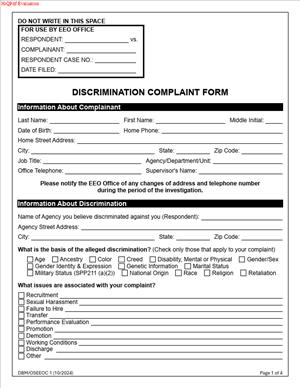
DBM/OSEEOC 1 – Discrimination Complaint Form
Fill out nowJurisdiction: Country: United States | Province or State: Maryland
What is a DBM/OSEEOC 1 – Discrimination Complaint Form?
The DBM/OSEEOC 1 – Discrimination Complaint Form is the official complaint form you use to start a civil rights discrimination case with the Commission on Civil Rights in Maryland. You complete this form to report discrimination, harassment, or retaliation that happened in Maryland or affects you in Maryland. When you submit a signed complaint, the Commission reviews it, decides if it has legal authority to act, and, if so, opens an investigation.
You use this form to report discrimination in three common areas: employment, housing, and public accommodations. Employment covers job applicants and workers. Housing covers renters, buyers, and people seeking housing-related services. Public accommodations cover access to businesses and services open to the public, like stores, restaurants, hotels, and places of entertainment.
You typically use this form if you believe you were treated worse because of a protected trait. Protected traits commonly include race, color, religion, sex, pregnancy, sexual orientation, gender identity, national origin, age, disability, marital status, genetic information, and retaliation for asserting your rights. The exact list depends on the law that applies to your situation, but these are the common categories the Commission reviews.
Who typically uses this form?
Employees and job applicants who faced discrimination at work. Tenants or home seekers who experienced unfair housing practices. Customers who were denied equal service in public spaces. Small business owners and landlords also use it to respond to allegations made against them, because the process includes notice and a chance to present information.
You would need this form if you want a neutral government investigation into a discrimination issue. For example, you reported workplace harassment, and nothing changed. You asked for a reasonable accommodation for a disability and were ignored or punished. You were refused an apartment after the landlord learned you use a housing voucher. You were denied service at a store because of your race. Filing this form puts your complaint in a formal process with clear steps, deadlines, and potential remedies.
Typical usage scenarios include a job applicant denied an interview after revealing pregnancy, a tenant whose landlord refuses to fix an accessibility feature, or a customer told to leave a business because of a protected trait. It also includes retaliation, such as being demoted after making a discrimination complaint or testifying for a coworker. If you are not sure whether your situation fits, you can still fill out the form with the facts you have. The Commission decides if the law covers your claim.
This form is not a private lawsuit. It is an administrative complaint that starts an agency process. The goal is to gather facts, assess whether the law was violated, and, when possible, resolve the matter through settlement or corrective action. If the investigation finds no violation, the Commission closes the case. If it finds evidence of discrimination, it may seek remedies, require changes, or move the case forward to a hearing.
When Would You Use a DBM/OSEEOC 1 – Discrimination Complaint Form?
You use this form when you believe discrimination, harassment, or retaliation occurred in Maryland and you want the Commission to act. You should act promptly because strict filing deadlines apply. If you wait too long, you may lose your right to file. The clock usually starts on the date of the last discriminatory act.
In employment, you would use it after events like a discriminatory firing, failure to hire, denial of promotion, unequal pay, or harassment based on a protected trait. You might also use it when your employer denies a reasonable accommodation for a disability, pregnancy, or religious practice. Job applicants can file if they were screened out for biased reasons. Current and former employees can file. State and local government employees can file. Independent contractors and interns may also be covered, depending on the facts.
In housing, you use it if you were denied a rental or sale because of a protected trait, steered to certain neighborhoods, charged higher fees, or faced discriminatory terms, conditions, or services. You also use it if a housing provider refuses a reasonable accommodation or modification for a disability, such as allowing a service animal or permitting a grab bar installation. Tenants use it for discriminatory evictions or harassment. Home seekers use it when agents discourage viewings or refuse offers for biased reasons.
In public accommodations, you use it if a business denies you entry, service, seating, or facilities because of a protected trait. You also use it for discriminatory policies, such as dress codes applied unevenly, or harassment by staff that the business refuses to address. Consumers, patrons, and visitors can file.
Business owners, landlords, and managers use this form’s process when they receive notice of a complaint. They respond with their side of the story, documents, and witness information. The process gives both sides a voice and encourages early resolution where possible.
If your situation involves a pattern of conduct, include all dates within the filing window. If the behavior is ongoing, the last incident date matters for timeliness. If you had an internal grievance or appeal, you can still file this form. Do not wait for an internal process to finish if that would push you past the filing deadline.
You might also use this form if you were retaliated against for asserting your rights. Retaliation can include being fired, demoted, denied services, evicted, harassed, or threatened after you reported discrimination, assisted in an investigation, or asked for an accommodation. Retaliation is unlawful even if the original issue is not proven, as long as you acted in good faith.
Legal Characteristics of the DBM/OSEEOC 1 – Discrimination Complaint Form
This form is a sworn complaint. When you sign it, you certify that the information is true to the best of your knowledge. That certification is what makes it legally significant. Your signature authorizes the Commission to open a file, notify the other party, and investigate. It also creates penalties for knowingly false statements.
The form becomes legally operative when it is properly completed, signed, and accepted for filing by the Commission. Acceptance does not mean your claims are proven. It means the complaint meets basic requirements, such as jurisdiction, timeliness, and a claim that, if true, would violate the law. Once accepted, the Commission serves the complaint on the respondent and starts the fact-finding process.
Enforceability comes from the Commission’s legal authority. The Commission can request information, interview witnesses, and review documents. It may convene fact-finding conferences. If it finds reasonable grounds to believe discrimination occurred, it can seek voluntary conciliation or move the matter toward a hearing. If the matter proceeds, potential outcomes can include policy changes, training, accommodation, reinstatement, or monetary relief, depending on the case type and facts.
The complaint also preserves your rights within the administrative system. Filing on time can protect your ability to pursue further remedies if the process later allows them. If you miss the filing window, your claim may be dismissed regardless of the facts. That is why dates, timelines, and prompt filing matter.
General legal considerations apply. You must allege facts that connect the adverse treatment to a protected trait or to protected activity. Disagreements, rude behavior, or unfair treatment not tied to a protected trait usually are not enough. The Commission needs details: who did what, when, where, how others were treated, and why you believe bias or retaliation motivated the conduct.
Confidentiality rules limit public disclosure of investigation materials. The Commission informs the respondent of the allegations and requests a response. You and the respondent can submit statements and evidence. Both sides have a duty to preserve relevant information. Destroying or altering evidence can harm a case.
If you have multiple issues, put them in one complaint when they involve the same parties and facts. If new issues arise later, you can ask to amend your complaint. The Commission may allow amendments within certain limits, especially to add new incidents that are related and timely.
How to Fill Out a DBM/OSEEOC 1 – Discrimination Complaint Form
Follow these steps to complete the form clearly and completely. Use plain facts. Keep your statements specific. Attach documents that support your claims. If a section does not apply, write “N/A.”
1) Identify yourself (Complainant information)
- Enter your full legal name.
- Provide your current mailing address, email, and phone number. Use an address where you can reliably receive mail for the next year. If you move, update your contact information immediately.
- If you need accommodations to participate in the process, state the accommodation you need. Examples include a sign language interpreter, large-print materials, or an accessible meeting space.
2) Identify the party you are complaining about (Respondent)
- List the full legal name of the employer, housing provider, business, agency, or individual you believe discriminated. Use the legal business name, not just a brand name.
- Provide the respondent’s street address, city, state, ZIP, and main phone number. For a company, include the department and the immediate supervisor or manager involved, if known.
- If there are multiple respondents, list each one with full details.
3) Select the area of discrimination
- Check the box or write the area: employment, housing, or public accommodations. If more than one area applies, explain how they are connected.
- For employment, include your job title, employment status (applicant, employee, former employee), hire and termination dates, and work location.
- For housing, include the property address, whether you were a tenant, applicant, buyer, or homeowner, and the type of property (apartment, single-family home, condo, etc.).
- For public accommodations, identify the business type and location where the incident occurred.
4) Identify the protected basis
- Check or list each protected trait you believe motivated the conduct. Common bases include race, color, religion, sex, pregnancy, sexual orientation, gender identity, national origin, age, disability, marital status, genetic information, and retaliation.
- If your claim involves failure to accommodate a disability, pregnancy, or religion, select both the underlying trait and “reasonable accommodation.”
5) Describe the discriminatory acts (Statement of facts)
- Provide a clear, chronological narrative. Use dates, names, job titles, and locations. Start with the earliest relevant event and move forward to the most recent.
- Explain what happened, who was involved, and how others were treated in similar situations. Comparators are powerful: “Three coworkers outside my protected group were allowed to telework. I was denied without explanation.”
- Avoid conclusions without facts. Instead of “they discriminated,” write “on June 5, my supervisor said ‘we don’t want someone your age in this customer-facing role’ and removed me from the schedule.”
- If you reported the issue internally, state when and to whom, and describe any response. Note if the conduct continued after your report.
- If retaliation occurred, identify the protected activity (for example, you complained about discrimination) and the adverse action that followed (such as a demotion) with dates.
6) List the timeline and deadlines
- Provide the date of the most recent incident. This date often controls timeliness.
- If the conduct was ongoing, explain the pattern and include the first and last dates you can identify.
- If a single decision had later effects (like lost pay), focus on the date of the decision itself.
7) Identify witnesses and contacts
- List witnesses’ names, job titles or roles, and contact information if known.
- Briefly state what each witness can confirm. For example, “saw the supervisor deny my accommodation,” or “received the same request and was approved.”
8) Attach supporting documents (Schedules/Exhibits)
- Include relevant documents, such as emails, text messages, letters, policies, performance reviews, applications, interview notes, lease documents, notices, photos, audio or video clips, schedules, and medical or religious documentation when relevant to an accommodation request.
- Label attachments clearly. Use “Schedule A – Emails May 1–15” or “Exhibit 1 – Lease and Addendum.” Reference these labels in your narrative: “See Schedule A.”
- Do not mark up originals. Provide copies. Keep the originals for yourself.
9) Explain the harm and impact
- Describe what the discrimination cost you. Include lost wages, lost housing opportunities, out-of-pocket costs, and other measurable losses.
- Note non-economic impacts such as stress or humiliation, but keep descriptions factual and concise.
- If you know amounts, include them. For example, “lost two weeks of pay totaling $1,200.”
10) State what you want to happen (Relief requested)
- Be specific. Examples include reinstatement, an approved accommodation, policy changes, training, a lease offer on equal terms, access to services, or compensation for losses.
- Asking for a remedy helps guide resolution, but does not limit what the Commission may consider.
11) Prior actions and other proceedings
- Indicate whether you used an internal complaint process, grievance, or appeal. Provide dates and outcomes.
- If you previously filed a complaint about the same matter, list the case number if you have it. This helps the Commission coordinate and avoid duplication.
12) Certification and signature
- Read the certification carefully. You are declaring that your statements are true to the best of your knowledge.
- Sign and date the form. If the form requires notarization or verification, follow the instructions exactly. Do not sign a notarized section until you are in front of the notary.
- If you are signing on behalf of someone else, state your relationship and authority, and attach any supporting documentation.
13) Submission
- Follow the submission options listed on the form. Common methods include mail, delivery in person, or electronic submission if provided.
- Keep a complete copy of everything you submit, including attachments and your signed complaint.
- If you use mail, consider a method that confirms delivery. Note the date you sent it.
14) After you file
- Watch for correspondence. The Commission may contact you for more details, request documents, or schedule an intake or fact-finding meeting.
- Respond promptly. Missed deadlines or unanswered requests can delay or close your case.
- Do not destroy or alter any documents related to your complaint. Preserve emails, messages, and files.
15) Professionalism and clarity
- Use clear, respectful language. Focus on facts and dates, not speculation.
- Avoid irrelevant details. Include only information that helps prove who did what, when, and why it connects to a protected trait or activity.
- If you discover new relevant facts or documents after filing, notify the Commission and provide the updates, labeled as additional schedules.
Practical examples help you see what a strong complaint looks like. In an employment case, you might write: “I worked as a server from March 2022 to August 2024. On May 1, 2024, I told my manager I was pregnant and asked not to lift more than 25 pounds. I provided a doctor’s note (Schedule B). From May 3 to June 10, I was assigned only heavy tasks and told ‘you should resign.’ On June 11, I was removed from the schedule. Two non-pregnant servers with less seniority kept their shifts. I complained to HR on June 15; no one responded. I was terminated on July 1. The last incident occurred on July 1, 2024.”
In a housing case, you might write: “On February 5, 2025, I applied to rent 123 Main Street, Unit 4. The property manager said ‘we don’t rent to families with children.’ I have a 3-year-old. My application met the income and credit criteria (Schedule C). On February 10, I received a denial citing ‘not a good fit.’ Two days later, a friend without children was offered a showing. The last incident occurred on February 10, 2025.”
In a public accommodations case, you might write: “On March 8, 2025, at 7:15 p.m., I attempted to enter the Westside Lounge with my service dog. The host said ‘no dogs allowed, policy is no exceptions.’ I showed my service animal card (Schedule A photo). I was refused entry while two patrons without animals were admitted. The last incident occurred on March 8, 2025.”
These examples include dates, comparators, and documents. They show a connection between the conduct and a protected trait, and they identify the last incident date for timeliness.
Common mistakes to avoid include leaving out the respondent’s full legal name and address, failing to include dates, making only broad statements without facts, missing the signature, or submitting unreadable attachments. Another mistake is waiting for internal processes to finish if a deadline is approaching. You can file while internal steps continue.
If English is not your first language, you can write in your strongest language and note that translation is needed. If you need disability-related assistance to communicate or participate, request it on the form.
Finally, remember that the process is collaborative and evidence-driven. Your complaint starts the case, but the investigation depends on documents, witness accounts, and clear timelines. Provide what you have, be responsive, and keep your information organized with labeled schedules. This gives the Commission what it needs to review your case and take appropriate action.
Legal Terms You Might Encounter
- Charging party means you—the person filing the complaint. On the DBM/OSEEOC 1 – Discrimination Complaint Form, you list your contact details and describe what happened to you. You sign to confirm the facts. The Commission uses the term to identify the complainant in the case.
- Respondent is the employer or organization you are filing against. On the form, you name the company, agency, or organization and, if needed, its local branch. You may also list individuals if the form requests it. Be precise so the Commission can contact the correct respondent.
- Protected class refers to the personal traits covered by anti-discrimination laws, such as race, color, religion, sex, national origin, age, disability, or other listed bases. On the form, you check the box or boxes that apply. You should connect your narrative to those protected traits. That link is key to a discrimination claim.
- Adverse action is the negative job action you experienced. Common examples include termination, demotion, denied promotion, reduced pay, suspension, or harsh schedule changes. On the form, you should name each adverse action and include dates. The Commission needs to see both what happened and when.
- Hostile work environment means severe or pervasive harassment that changes your working conditions. It can include repeated slurs, unwanted comments, or intimidation tied to your protected class. On the form, describe the conduct, frequency, and who did it. Note when it started and if it is ongoing.
- Retaliation occurs when an employer punishes you for reporting discrimination or participating in an investigation. Retaliation can be subtle, like exclusion, or obvious, like firing. On the form, clearly note if negative actions followed your complaint, witness role, or request for accommodation. Identify the timing to show the link.
- Reasonable accommodation is an adjustment for disability, religion, pregnancy, or another protected basis that helps you do your job without undue hardship to the employer. On the form, explain what accommodation you asked for and how the employer responded. Include dates and communications to show the full picture.
- Jurisdiction means the Commission’s authority to handle your claim. It depends on who the respondent is, where the events happened, and which laws apply. On the form, provide the employer’s location, size, and industry if asked. Accurate facts help confirm the Commission can accept your case.
- Filing deadline is the time limit to submit your complaint after the discrimination occurred. It can be short, so you should not delay. On the form, enter the earliest and latest dates of discrimination. That date range helps the Commission review timeliness.
- Mediation or conciliation is a voluntary process to resolve your complaint without a full investigation. Mediation happens earlier, often soon after filing. Conciliation usually occurs after the Commission finds cause. On the form, you may see questions about your willingness to mediate. Answer honestly so the process can move quickly.
- Verification is your signed statement confirming the complaint’s truthfulness. On the form, you sign and date under penalty of perjury. Your signature is required for the Commission to proceed. Do not submit an unsigned form.
- Continuing violation is a series of related discriminatory acts, not just a single event. For example, ongoing harassment for months. On the form, include the full date range and mark whether the conduct is ongoing. That helps the Commission consider the continuity of events.
- Prima facie case is a basic showing that connects your protected class to the adverse action. You do not need to prove your case on the form. But you should present enough facts to show plausibility. Clear, specific details in your narrative make this easier.
FAQs
Do you need a lawyer to file the DBM/OSEEOC 1 – Discrimination Complaint Form?
No. You can file on your own. The form is designed for you to complete without a lawyer. If you already have a lawyer, you can note their contact details. If you do not, you can still file and participate fully.
Do you have to submit evidence with the form?
You should include key documents if you have them, but you can still file without them. The Commission can request more information later. Attach only copies, not originals. Keep your own organized file in case you need to share more.
Do you need to notify your employer before filing?
No. You do not need to notify the employer before you file. The Commission will contact the respondent after intake and screening. Do not serve the respondent yourself unless the Commission instructs you to do so.
Can you remain anonymous?
No. The process requires your contact information and a signed verification. The respondent will receive notice of your complaint. If safety is a concern, tell the Commission. Ask about any available safety or contact measures.
What if the discrimination is ongoing?
File as soon as you can. On the form, list the earliest date and check that the conduct is ongoing if applicable. Continue to document new incidents. You can inform the Commission of new events after you file.
What if you missed a date or made a mistake on the form?
You can request to amend your complaint. Contact the Commission promptly with the correction. Provide the case number, the change you seek, and any supporting details. Do not wait, as timing can affect your case.
Do you have to name individual supervisors?
If the form asks for individuals involved, list them. Always identify the employer entity as the respondent. Naming individuals helps the Commission understand who did what. Stick to facts that link actions to your protected class.
Will filing protect you from retaliation?
The law prohibits retaliation for filing a discrimination complaint. Still, retaliation can happen. If it does, document it and tell the Commission right away. Save emails, texts, and calendar notes that show timing and impact.
How long will the process take?
Timelines vary. Some cases move quickly through mediation. Others require full investigations and can take longer. Respond to requests promptly. Keep your contact information current to avoid delays.
Can you withdraw your complaint?
Yes. You can request a withdrawal. Contact the Commission with your case number and reason. The Commission may ask to confirm in writing. If you withdraw, note any deadlines that might affect other options.
Checklist: Before, During, and After the DBM/OSEEOC 1 – Discrimination Complaint Form
Before signing: gather information and documents
- Your contact details: full name, mailing address, phone, and email.
- Respondent’s legal name, location, and main contact line, if known.
- Your job information: title, department, start date, and employment status.
- Timeline: earliest date of discrimination, most recent date, and key milestones.
- Description of adverse actions: termination, demotion, pay cut, denial of promotion, or harassment events.
- Protected basis: race, color, religion, sex, national origin, age, disability, or other listed categories.
- Names and roles of people involved: decision makers, witnesses, and HR contacts.
- Documents: offer letters, performance reviews, warnings, emails, texts, memos, schedules, or policies.
- Pay records: pay stubs, pay change notices, or bonus letters, if pay was affected.
- Accommodation records: request emails, doctor notes, schedules, and responses.
- Comparative information: who was treated differently and how, if known.
- Notes of incidents: date, time, location, who was present, what was said or done.
- Prior reports: complaints to HR or management and their responses.
- Prior related cases: if you filed elsewhere, note the agency and case number.
- Mediation preference: consider whether you want early mediation.
During signing: verify the form is clear, complete, and consistent
- Confirm your name, address, phone, and email are accurate and current.
- Check the respondent’s legal name and location; avoid nicknames or trade names.
- Verify you selected the correct protected basis boxes.
- Review your date range for accuracy and completeness.
- Make sure the facts tie your protected basis to the adverse action.
- Keep your narrative factual, specific, and chronological.
- Identify each adverse action with dates and who decided it.
- Confirm you listed witnesses or “unknown” if you lack names.
- Note whether the conduct is ongoing or has ended.
- Ensure attached documents are clearly labeled and readable.
- Cross-check that names, titles, and dates match your attachments.
- Read any mediation or consent sections and mark your choice.
- Complete any confidentiality or communication preference fields.
- Sign and date the verification under penalty of perjury.
- If the form requires an authorization or release, sign that too.
- Make a full copy of the signed form and attachments for your records.
After signing: file, communicate, and organize
- File using one of the submission options listed on the form.
- If mailing, use a trackable method and keep the receipt.
- If submitting electronically, save confirmation screens or emails.
- Record the date you filed and any reference or case number.
- Do not serve the respondent yourself unless directed.
- Monitor your email and mail for Commission correspondence.
- Respond promptly to requests for more information or documents.
- Update the Commission if your contact information changes.
- Continue documenting new incidents while the case is open.
- Keep your file organized by date: form, evidence, letters, and notes.
- Avoid deleting emails, texts, or files that may be evidence.
- If you get legal representation, inform the Commission in writing.
- Note mediation dates and deadlines on your calendar.
- Store your copy of the form and evidence in a secure location.
Common Mistakes to Avoid
Leaving out dates or using “unknown” for key timelines.
- Don’t forget to include the earliest and latest dates of discrimination. Missing dates can lead to questions about timeliness. It may delay intake or screening and can risk dismissal if deadlines are at issue.
Naming the wrong respondent or using only a brand or nickname.
- Don’t guess. Use the employer’s legal name and location. Incorrect respondent details can cause misdirected notices and slow the case. It may force you to amend later, losing time.
Submitting a narrative with conclusions but few facts.
- Avoid broad claims without detail. Include who acted, what happened, when, where, and how it ties to your protected basis. Thin facts can stall the investigation or lead to early closure.
Forgetting to sign and date the verification.
- Don’t omit the signature. An unsigned form is not valid. The Commission cannot proceed without your verified statement. This causes avoidable delays.
Bundling multiple employers or job sites without clarity.
- Don’t mix separate employers in one narrative without distinctions. If multiple entities are involved, explain each one’s role. Confusion about parties makes service and investigation harder.
Skipping the protected basis checkboxes.
- Don’t rely only on your narrative. Check the boxes that apply. If you skip them, your case may be coded incorrectly or delayed for clarification.
Using unreadable or unlabeled attachments.
- Don’t submit dark photos, sideways PDFs, or files with unclear names. Poor attachments waste time and may require resubmission.
What to Do After Filling Out the Form
- File the complaint using the submission method listed on the form. If you mail it, use a trackable service. If you deliver it in person or electronically, request a receipt or confirmation. Keep proof of filing in your records.
- Watch for a case number and intake follow-up. The Commission may contact you to confirm details or request more information. Respond promptly and keep your responses factual and concise. Delays at this stage can slow the entire process.
- Decide whether you want mediation. If the Commission offers mediation, you can accept, decline, or ask questions. If you accept, prepare a short settlement outline. Identify what you need to resolve the matter, such as reinstatement, pay, or policy changes.
- Continue to collect and preserve evidence. Save emails, texts, schedules, and notes. If new events happen, write them down with dates and names. Do not alter or destroy documents related to your case.
- Update your contact information. If you move, change jobs, or switch phone numbers, tell the Commission right away. Missed letters or emails can cause you to miss deadlines or meetings.
- Tell the Commission if retaliation occurs. If you face negative actions after filing, document them. Include dates, people involved, and the impact. Report the retaliation to the Commission as soon as possible.
- Ask about amendments if you need to correct or add facts. You can request to add new incidents, correct dates, or name additional parties. Provide your case number and a clear explanation of the change. Attach any new supporting documents.
- Prepare for interviews or requests for a position statement. The respondent may submit a written response. The Commission may ask you to reply or clarify points. Keep your responses focused on facts tied to your protected basis and adverse actions.
- Keep settlement options open. Mediation or conciliation can happen at different stages. Reassess your goals as the case develops. If a practical resolution is available, consider it carefully.
- Know how to close or withdraw if you choose. If you resolve the matter or wish to stop, contact the Commission with your case number. Ask for instructions to close or withdraw. Follow any steps required to finalize the record.
- Stay organized. Keep a central file with your complaint, evidence, communications, and notes. Update a running timeline as events unfold. A good organization helps you respond quickly and consistently.
- Be mindful of other related processes. If you have workplace policies, grievance procedures, or benefits claims in play, track them separately. Keep copies of everything, and do not assume one process replaces another.
- Finally, take care of yourself. Discrimination cases can be stressful. Keep notes factual and brief. Set calendar reminders for deadlines and meetings. Seek support when needed so you can stay focused and responsive.
Disclaimer: This guide is provided for informational purposes only and is not intended as legal advice. You should consult a legal professional.