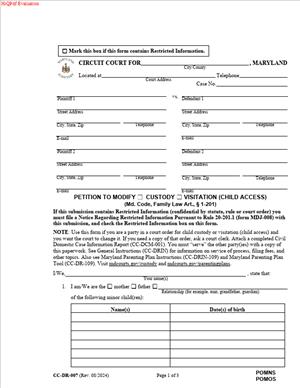
CC-DR-007 – Petition to Modify Custody or Visitation (Child Access)
Fill out nowJurisdiction: Country: United States | Province or State: Maryland
If you are asking a Maryland court to change an existing custody or visitation order, you may need to file CC-DR-007 – Petition to Modify Custody or Visitation (Child Access). This form starts the process of requesting a new court order that replaces part of your current arrangement.
This document is used after a custody or visitation order is already in place. It is not for first-time custody requests. Instead, it tells the court that circumstances have changed and that the current order no longer works as written.
When you file this form, you are formally asking the Circuit Court to review your case again. The judge will not automatically change the order. You must explain what has changed and what new arrangement you are requesting.
Understanding how this form works helps you avoid delays. Small errors can slow your case or require you to refile. Knowing what information the court expects makes the process more manageable.
This guide walks you through what the form does, when it is used, and how to complete it clearly and accurately.
What is CC-DR-007 – Petition to Modify Custody or Visitation (Child Access)?
Clear definition
CC-DR-007 – Petition to Modify Custody or Visitation (Child Access) is a written request filed in a Maryland Circuit Court asking a judge to change an existing custody or visitation order. It is a formal pleading. That means it becomes part of the official court record.
The form identifies the current case, the parties involved, and the children affected by the order. It also explains what parts of the existing order you want changed and why. You must describe the change in circumstances that you believe justifies modifying the order.
This document does not change custody or visitation by itself. It begins a legal process. The court will review the petition, notify the other parent or party, and schedule further proceedings if required.
Who typically uses this form?
Parents most often use this form. A mother or father who shares legal or physical custody may file it. A parent who currently has visitation rights may also file if the schedule no longer works.
In some cases, another legal guardian or person with court-ordered access to the child may use the form. The key requirement is that there is already a court order in place regarding custody or visitation.
People who represent themselves in court frequently use this form. It is designed to be completed without an attorney, though it must still meet court standards.
The person who files the form becomes the “petitioner.” The other party is typically referred to as the “respondent.” These labels are used throughout the case.
Why might you need this form?
You may need this form if your current custody or visitation order no longer fits your child’s needs or your family’s situation. Courts recognize that circumstances can change over time.
Common reasons include a parent relocating, a change in work schedule, concerns about the child’s safety, or significant changes in the child’s educational or medical needs. The court generally looks for a material change in circumstances since the last order.
You might also need this form if the existing schedule has become unworkable. For example, if exchanges consistently fail or the child’s age and activities make the schedule outdated, a modification request may be appropriate.
The form gives you a structured way to explain what has changed and what specific new arrangement you are asking the court to approve.
Typical real-life scenarios
- One common scenario involves relocation. A parent may move to a different city or county within Maryland. That move can make the original visitation schedule unrealistic. Longer travel times may require fewer exchanges or longer but less frequent visits.
- Another scenario involves changes in employment. If a parent shifts from a daytime schedule to overnight work, the current custody arrangement may no longer match their availability. A new schedule may better support the child’s stability.
- A third situation arises when a child’s needs evolve. As children grow older, their school schedules, extracurricular activities, and social lives expand. An arrangement that worked for a toddler may not work for a teenager.
- There are also cases involving safety concerns. If there are allegations of substance abuse, neglect, or unsafe living conditions, a parent may request that the court adjust custody or visitation to protect the child’s best interests.
- Finally, parents sometimes informally change their schedule over time. If the informal arrangement works, one parent may file to make that arrangement official so it can be enforced by the court.
When would you use CC-DR-007 – Petition to Modify Custody or Visitation (Child Access)?
You use this form after a final custody or visitation order has already been issued by a Maryland Circuit Court. It is not used during an initial divorce or custody case before a final order is entered.
You might file it months or years after the original order. There is no automatic review period. A case is reopened only when one party files a petition asking for a change.
This form is typically used by a parent who believes the current arrangement is no longer in the child’s best interests. It may also be used when one parent believes the other is not complying with the order and that a structural change is needed.
Sometimes, both parents agree that the order needs updating. Even in that situation, a formal filing is often required so the court can enter a new order reflecting the agreement.
The form is filed in the same Circuit Court that issued the original custody or visitation order, unless the case has been properly transferred. The existing case number is used so the court can connect your request to the prior proceedings.
Legal characteristics of CC-DR-007 – Petition to Modify Custody or Visitation (Child Access)
This form is a procedural tool. It does not grant rights by itself. It triggers a legal process in which a judge reviews the requested changes under Maryland family law standards.
For a modification to be considered, courts generally require a material change in circumstances. That means the situation must be meaningfully different from when the last order was entered. Minor disagreements or temporary issues are often not enough.
The petition must clearly state what part of the current order you want changed. Vague requests can cause delays. If you do not specify the exact modification you are seeking, the court may not know what relief to consider.
Common problems that lead to rejection or delay include missing case numbers, incorrect party names, incomplete service information, or failure to sign the form properly. Inaccurate or inconsistent details can also slow the process.
The court will require that the other party be formally notified of the filing. Proper service is a key part of making the petition effective. Without proof that the other party received notice, the court may not move forward.
This document does not automatically suspend or replace your current order. Until the court signs a new order, the existing custody or visitation terms typically remain in effect.
Maryland courts focus heavily on the best interests of the child. Even if both parents want a change, the judge reviews whether the proposed modification serves that standard.
Is it legally binding?
The form itself is not legally binding in the way a court order is. Filing the petition creates a pending request. It does not change anyone’s rights or obligations on its own.
Once the court reviews the petition and, if appropriate, holds a hearing, a judge may issue a new order. That signed court order is legally binding. It replaces or modifies the prior custody or visitation terms.
If both parties reach an agreement after the petition is filed, the court may incorporate that agreement into a new order. Once signed by the judge, that order carries legal force.
Until a new order is entered, the original custody or visitation order remains enforceable. Parties are generally expected to follow it unless the court directs otherwise.
How to fill out CC-DR-007 – Petition to Modify Custody or Visitation (Child Access)
Step 1 – Identify the court and case information
At the top of the form, enter the name of the Circuit Court that issued your original custody or visitation order. Include the county where the court is located. Fill in the existing case number exactly as it appears on prior court documents. List the names of the parties in the same order used in the original case.
Step 2 – Identify yourself and the other party
State your name and address as the petitioner. Provide the name and last known address of the other party, who will be the respondent. Accurate contact information is important because the court needs to ensure proper notice of the filing.
Step 3 – Identify the children involved
List the full names and dates of birth of each child covered by the current order. Make sure this information matches prior court records. If the existing order applies to more than one child, include each child clearly.
Step 4 – Describe the existing order
Provide the date of the current custody or visitation order you want to modify. Briefly describe what the order provides, such as who has legal custody, who has physical custody, and the visitation schedule. This gives the court context for your requested changes.
Step 5 – Explain the material change in circumstances
In the space provided, describe what has changed since the last order was entered. Be specific about events, dates, and facts. Focus on changes that affect the child’s well-being, stability, or daily life. Keep your explanation factual and organized.
Step 6 – State the modification you are requesting
Clearly explain what new custody or visitation arrangement you want the court to order. If you are asking for a revised schedule, describe it in practical terms, including days, times, and holiday arrangements. If you are requesting a change in legal custody, state that directly.
Step 7 – Address any related requests
If the form includes space for additional relief, such as adjustments to exchanges or communication terms, explain those requests clearly. Make sure each request relates to custody or visitation and is connected to the change in circumstances you described.
Step 8 – Review and sign the form
Read through the entire document before signing. Confirm that names, dates, and case numbers are correct. Sign and date the petition where indicated. Your signature confirms that the information provided is true to the best of your knowledge.
Step 9 – Prepare for filing and service
Make copies of the completed form for your records and for service on the other party. File the original with the appropriate Circuit Court clerk’s office. After filing, follow the required process to ensure the other party receives formal notice of your petition so the court can proceed with the case.
Legal terms you might encounter in CC-DR-007 – Petition to Modify Custody or Visitation (Child Access)
- Material Change in Circumstances: This is a key concept in any request to modify custody or visitation. It means something significant has changed since the last court order. On this form, you must explain what changed and why that change affects the child’s best interests. The court will not modify an order just because one parent is unhappy with it.
- Best Interests of the Child: This standard guides the court’s decision. When you complete the form, your explanation should focus on how your requested change benefits the child, not you. Judges consider factors like stability, safety, health, school performance, and each parent’s ability to meet the child’s needs.
- Legal Custody: Legal custody refers to the right to make major decisions for the child. This includes education, medical care, and religious upbringing. If you are asking to change legal custody, you must clearly state that in your petition and explain why the change is necessary.
- Physical Custody: Physical custody addresses where the child lives and who provides day-to-day care. The form may ask you to describe the current physical custody arrangement and the one you want the court to order. Be precise about schedules and overnights.
- Visitation (Child Access): Visitation, also called child access, refers to the time a non-custodial parent spends with the child. If you are seeking to modify visitation, you must describe the existing schedule and the specific changes you want. Vague statements like “more time” are not enough.
- Petitioner: The petitioner is the person filing the form. If you are completing this document, you are the petitioner. Your name must appear exactly as it does in the existing case, and you must provide current contact information unless it is protected by court order.
- Respondent: The respondent is the other party in the case. You must correctly identify the respondent as listed in the original custody order. The court relies on this information to ensure proper notice and service.
- Existing Order: This refers to the current court order governing custody or visitation. On the form, you must identify the date of that order and summarize its terms. The court cannot evaluate your request without knowing what is already in place.
- Service of Process: Service of process means formally delivering court documents to the other party. After you file your petition, you must ensure the respondent receives a copy in a legally recognized way. Without proper service, the court cannot move forward.
- Relief Requested: This section of the form asks what you want the court to do. You must clearly state the specific changes you are requesting. The judge can only grant the relief that you actually ask for in your petition.
FAQs
Do I need to attach a copy of the current custody or visitation order?
You should review the instructions that accompany this document to see whether a copy of the existing order must be attached. Even if it is not required, you will need the exact date and terms of the current order to complete the sections describing what is in place now. If you attach a copy, make sure it is complete and legible.
What counts as a “material change in circumstances” on this form?
You must describe a significant change that happened after the last order was entered. Examples include a parent relocating, changes in the child’s school or health needs, safety concerns, or a major shift in work schedules. Be specific about dates and facts. The court uses this explanation to decide whether to even consider modifying the order.
How specific do I need to be when describing the new schedule I want?
You should write out the exact schedule you are requesting. Include days of the week, pick-up and drop-off times, holiday arrangements, school breaks, and summer schedules if relevant. When completing CC-DR-007 – Petition to Modify Custody or Visitation (Child Access), avoid broad phrases like “reasonable visitation.” The judge needs clear terms that can be enforced.
What if the other parent agrees with the changes?
Even if you both agree, you still need to file this document so the court can review and approve the modification. The court order does not change until a judge signs a new order. Make sure any agreement is consistent with what you write in the petition.
Can I ask for changes to both custody and visitation at the same time?
Yes, this form allows you to request modifications to legal custody, physical custody, visitation, or any combination of these. Be clear about each type of change you are requesting. If you leave a section blank, the court may assume you are not asking to modify that part of the existing order.
What happens after I file CC-DR-007 – Petition to Modify Custody or Visitation (Child Access)?
After filing, the court will issue a summons or notice, and the other party must be formally served. The respondent has a limited time to file an answer. The court may schedule a hearing, mediation, or other proceeding before making a decision.
Do I need to update my contact information on this document?
Yes. You must provide your current mailing address and other required contact details unless the court has ordered that your information remain confidential. The court uses this information to send notices about hearings and rulings.
Will filing this form automatically change the existing custody order?
No. Filing this document only starts the process. The existing order remains in effect until a judge signs a new order modifying it. You must continue following the current terms unless and until the court changes them.
Checklist: Before, During, and After CC-DR-007 – Petition to Modify Custody or Visitation (Child Access)
Before
- Review your existing custody or visitation order and note its exact date.
- Identify the specific changes in circumstances that occurred after that order.
- Gather supporting documents, such as school records, work schedules, or medical information.
- Write out the exact schedule or decision-making arrangement you want.
- Confirm the full legal names of all parties as they appear in the original case.
- Check whether you need additional forms, such as a financial statement or information sheet.
- Verify the correct case number from your prior order.
- Prepare a clear summary of why your request serves the child’s best interests.
During
- Fill in the court name and case number exactly as shown on your existing documents.
- Print or type legibly so the court can read every entry.
- Complete every required section; write “N/A” where a section does not apply.
- Describe the material change in circumstances with dates and specific facts.
- Clearly state the precise modification you are requesting.
- Review your petition for consistency between what changed and what you are asking for.
- Sign and date the form where required.
- Make the required number of copies before filing.
After
- File the original document with the appropriate court clerk.
- Pay any required filing fee or submit a fee waiver request if eligible.
- Arrange for proper service of process on the respondent.
- Keep proof of service for your records.
- Calendar any deadlines for the respondent’s answer.
- Prepare for mediation or a court hearing if scheduled.
- Continue following the existing order until a new one is issued.
- Keep a complete file with stamped copies of everything you submit.
Common mistakes to avoid with CC-DR-007 – Petition to Modify Custody or Visitation (Child Access)
- Mistake: Failing to describe a true material change in circumstances, which happens when you focus on minor disagreements; this can lead to dismissal, so do not forget to explain what changed and when it happened.
- Mistake: Requesting vague modifications like “more time” without a detailed schedule, which occurs when you assume the court will fill in the gaps; this can result in denial, so do not forget to specify exact days and times.
- Mistake: Using different names or spellings than those in the original case, which often happens after remarriage or informal name changes; this can delay processing, so do not forget to match the prior order exactly.
- Mistake: Leaving sections blank instead of marking them not applicable, which happens when you are unsure how to answer; this can cause confusion or rejection, so do not forget to complete every field.
- Mistake: Not arranging proper service on the respondent, which occurs when you assume mailing a copy is enough; this can stall your case, so do not forget to follow formal service requirements.
- Mistake: Ignoring the existing order after filing, which happens when you believe the request changes things immediately; this can put you in violation, so do not forget to follow the current order until the court signs a new one.
- Mistake: Submitting handwritten forms that are hard to read, which happens when you rush; this can create misunderstandings, so do not forget to write clearly or type the form.
- Mistake: Failing to bring supporting documents to the hearing, which happens when you rely only on your written petition; this can weaken your case, so do not forget to organize and present evidence of the changes you described.
What to do after filling out CC-DR-007 – Petition to Modify Custody or Visitation (Child Access)
Once you finish the form, slow down and review it line by line. Make sure the case number matches your existing order. Confirm that the names of the parties are spelled exactly the same. Check that you clearly described both the current arrangement and the changes you want.
- Step 1: Make at least two copies of the completed form, one for your records and one to serve on the other party.
- Step 2: Gather any required companion forms that must be filed at the same time.
- Step 3: File the original petition with the clerk of the circuit court where your case is pending.
- Step 4: Pay the filing fee or submit an application to waive the fee if you qualify.
- Step 5: Obtain a stamped copy showing the filing date for your records.
- Step 6: Arrange for proper service of the petition and any summons on the respondent using an approved method.
- Step 7: File proof of service with the court once the respondent has been served.
- Step 8: Track the deadline for the respondent to file an answer and watch for any court notices.
- Step 9: Prepare for mediation or a hearing by organizing documents, outlining your main points, and focusing on the child’s best interests.
- Step 10: Continue complying with the existing custody or visitation order until the judge signs a new order.
After filing, stay organized. Create a folder for all documents related to your modification request. Keep copies of everything you submit and everything you receive from the court or the other party. Bring this folder with you to any court appearance.
If the court schedules mediation, approach it prepared and focused on practical solutions. If a hearing is set, be ready to explain clearly what changed, when it changed, and why your requested modification benefits the child. Speak directly to the judge and answer questions honestly and concisely.
When the court issues a new order, read it carefully. Make sure you understand every term. Update your personal calendar with the new schedule. If the order changes decision-making authority, inform schools, healthcare providers, or other relevant institutions as appropriate. Keep a certified copy of the new order in a safe place in case you need to provide proof of the updated arrangement.
Disclaimer: This guide is provided for informational purposes only and is not intended as legal advice. You should consult a legal professional.