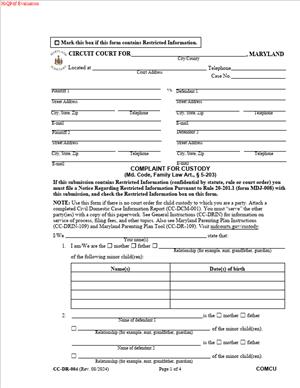
CC-DR-004 – Complaint for Custody
Fill out nowJurisdiction: Country: United States | Province or State: Maryland
If you are asking a Maryland court to decide custody of a child, the CC-DR-004 – Complaint for Custody is the document that starts your case. It is the formal written request you file with the Circuit Court.
This form tells the court who you are, who the other parent is, and what custody arrangement you are asking for. It also provides basic information about the child and the current living situation.
You use this document when there is no existing custody order, or when custody has not yet been legally established by a court. Filing it opens a new case and places the issue before a judge.
The details you include matter. The court relies on what you write to determine next steps, including service of process and scheduling. Clear, complete answers reduce delays and confusion.
Understanding how the CC-DR-004 – Complaint for Custody works helps you prepare accurate information and avoid common filing problems.
What is CC-DR-004 – Complaint for Custody?
Clear definition
The CC-DR-004 – Complaint for Custody is a formal court filing used in the Maryland Circuit Court to request a custody order for a minor child. A “complaint” is the document that begins a civil case. In this context, it asks the court to decide legal custody, physical custody, or both.
Legal custody generally refers to decision-making authority about major issues, such as education and medical care. Physical custody relates to where the child lives and the day-to-day schedule. This form allows you to state what arrangement you are asking the court to establish.
The document becomes part of the official court record. Once filed, it triggers the legal process that requires the other parent or party to respond.
Who typically uses this form?
This form is commonly used by a parent who wants a formal custody order but does not have one. It may also be used by a parent who was never married to the other parent and needs the court to define custody rights.
In some situations, a non-parent, such as a grandparent or other third party, may file a custody complaint. The form allows space to explain your relationship to the child.
Self-represented individuals often use this form. It is designed to collect the core information the court needs to open a custody case.
Why might you need this form?
You may need this form if you and the other parent cannot agree on custody arrangements. Without a court order, there may be no clear legal structure governing decision-making or parenting time.
You may also need it if one parent is limiting contact with the child and there is no existing order to enforce. A court order can create defined rights and responsibilities.
Another reason is to create stability. Schools, medical providers, and other institutions sometimes require proof of legal custody before sharing information or making certain decisions.
Filing this complaint allows a judge to review the situation and, if appropriate, issue an enforceable custody order.
Typical real-life scenarios
- You and the other parent separated, but you never went to court. The child lives primarily with you, and you want a formal order confirming that arrangement. Filing this form begins that process.
- You were never married to the child’s other parent. There is disagreement about where the child should live. You need the court to determine custody and possibly address related issues.
- The child has been living with a grandparent for an extended period. The grandparent seeks legal authority to make decisions and provide stability. A custody complaint may be used to ask the court for that authority.
- One parent has moved out and is not following an informal schedule. There is confusion about exchanges and decision-making. A court order can define expectations and reduce conflict.
When would you use CC-DR-004 – Complaint for Custody?
You use CC-DR-004 – Complaint for Custody when you are starting a new custody case in the Maryland Circuit Court. It is appropriate when there is no prior custody order covering the child in question.
If there is already a custody order and you want to change it, a different type of filing is often used to request a modification. This complaint is generally for initiating a case, not for altering an existing final order.
You might file it as a mother, father, or third party who believes the court needs to establish custody. The form allows you to describe the current situation and the arrangement you are requesting.
Timing can matter. Some people file shortly after separation. Others file when informal arrangements break down. The form itself does not require a specific event to occur, but it does require you to explain why the court’s involvement is necessary.
If the child has lived in Maryland for a significant period, Maryland courts often have the authority to decide custody. If the child recently moved or has connections to another state, jurisdiction questions may arise. The form asks for information about where the child has lived to help the court assess its authority.
Legal characteristics of CC-DR-004 – Complaint for Custody
This document is a pleading. That means it formally presents your claims and requests to the court. It must be completed accurately and filed with the appropriate Circuit Court to begin the case.
For the filing to be effective, it typically needs to include complete information about the parties, the child, and the requested relief. Omitting required details, such as addresses or prior court cases involving the child, can lead to delays or requests for additional information.
After filing, the complaint must usually be properly served on the other party. Service is the process of officially delivering the documents so the other person has notice and an opportunity to respond. Improper service can delay the case or prevent it from moving forward.
The form also interacts with other required documents. In many custody cases, you may need to file additional paperwork, such as a financial statement or case information sheet. The complaint itself does not replace those requirements.
Jurisdiction is a central legal feature. Courts can only decide custody if they have authority over the case. The information you provide about the child’s residence history helps the court determine whether Maryland is the proper state to hear the case.
The complaint does not automatically create custody rights. Filing it starts a case, but the court must still review evidence and issue an order. Until a judge signs an order, there is no new enforceable custody arrangement based solely on the complaint.
Common problems that lead to rejection or delay include incomplete addresses, missing signatures, failure to pay required filing fees, or leaving sections blank. Writing unclear or contradictory information can also create confusion that slows the process.
Is it legally binding?
The CC-DR-004 – Complaint for Custody itself is not a binding custody order. It is a request for the court to issue an order.
Once filed, it becomes part of the official court record. You are responsible for the truthfulness of the statements you include. Providing false information can have serious consequences.
A custody arrangement becomes legally binding only after a judge signs a court order. That order, not the complaint, defines enforceable rights and responsibilities.
However, the complaint plays a crucial role. It frames the issues the court will consider and sets the scope of what you are asking the judge to decide.
How to fill out CC-DR-004 – Complaint for Custody
Step 1 – Caption and court information
At the top of the form, enter the name of the Circuit Court where you are filing. This includes the county. Fill in your full legal name as the plaintiff and the other party’s full legal name as the defendant. Leave the case number blank if you are filing a new case; the court typically assigns it.
Step 2 – Information about the parties
Provide your current address and contact information as requested. Enter the other party’s last known address. Accurate addresses are important because they are used for service of process and court notices.
Step 3 – Information about the child or children
List each child involved in the case. Include full legal names, dates of birth, and current addresses. If the child lives with someone other than you, clearly state with whom and where.
Step 4 – Jurisdiction and residence history
Complete the section asking about where the child has lived during the past several years. Include addresses and the names of the people the child lived with. This information helps the court determine whether it has authority to decide custody.
Step 5 – Other custody cases
Indicate whether there have been any previous or ongoing court cases involving the child. This may include divorce, protective orders, or prior custody matters. Provide details such as case numbers and court locations if known.
Step 6 – Requested custody arrangement
State clearly what type of custody you are asking for. Specify whether you seek legal custody, physical custody, or both. If you are requesting a particular schedule, describe it in practical terms so the court understands what you are proposing.
Step 7 – Reasons for your request
Explain why you believe the requested custody arrangement is appropriate. Focus on the child’s living situation, routines, and needs. Keep your statements factual and specific rather than emotional or argumentative.
Step 8 – Relief requested
Review the section where you ask the court for specific orders. This may include custody determinations and any related relief allowed by the form. Make sure your requests are consistent with what you described earlier.
Step 9 – Signature and verification
Sign and date the form where indicated. Your signature confirms that the information is true to the best of your knowledge. Ensure all required signature lines are completed before submitting the document to the court.
Legal terms you might encounter in CC-DR-004 – Complaint for Custody
- Plaintiff: This is the person who starts the custody case by filing the complaint. On this form, you are the plaintiff if you are asking the court to issue a custody order. Your name will appear first in the case caption.
- Defendant: The defendant is the other parent or person you are asking the court to grant or change custody against. This person must be formally notified about the case. Their contact information is listed in the form so the court can ensure proper service.
- Minor Child: A minor child is any child under 18 years old. The form requires you to list each minor child involved in the custody dispute. You must provide accurate identifying information for each child.
- Legal Custody: Legal custody refers to the authority to make major decisions about a child’s life, such as education, medical care, and religion. On this form, you may request sole legal custody or joint legal custody. The court will review your request and decide what is in the child’s best interest.
- Physical Custody: Physical custody relates to where the child lives and who provides daily care. You may ask for sole physical custody or propose a shared arrangement. The form asks you to clearly state what schedule you want the court to order.
- Joint Custody: Joint custody can refer to joint legal custody, joint physical custody, or both. It means both parents share certain responsibilities. You must specify which type of joint custody you are requesting so the court understands your proposal.
- Best Interest of the Child: This is the legal standard the court uses to decide custody cases. When you explain your request, you should focus on facts that show why your proposed arrangement supports the child’s safety, stability, and well-being. The judge will evaluate everything through this lens.
- Service of Process: Service of process is the formal delivery of court papers to the defendant. Filing the complaint alone is not enough. The defendant must receive official notice before the court can move forward.
- Relief Requested: Relief refers to what you are asking the court to order. In this form, you state the type of custody you want and any related requests. This section tells the judge exactly what outcome you are seeking.
- Verification: Verification is your sworn statement that the information in the complaint is true to the best of your knowledge. You sign the form under penalty of perjury. This gives the document legal weight and makes accuracy essential.
FAQs
Do I have to list every child on the CC-DR-004 – Complaint for Custody?
Yes. You must list every minor child who is part of the custody dispute. The court uses this information to determine its authority and to ensure any order covers the correct children. Do not leave out a child because you think the issue is minor or already agreed upon.
What address should I use for myself and the other parent?
Use your current, complete mailing address where you can reliably receive court notices. For the other parent, provide their most recent known address so they can be properly served. If you do not know their exact address, you must still provide as much detail as possible to help with service.
How do I decide whether to request sole or joint custody?
Look at the section where you choose the type of legal and physical custody you want. Think about decision-making authority and the child’s living schedule. This document records your request, so be clear and specific about what arrangement you believe works best.
What if there is already another custody case involving the same child?
You must disclose any other custody cases involving the same child. The form includes a section asking about related cases. The court needs this information to avoid conflicting orders and to confirm it has the authority to proceed.
When does the custody arrangement I request become effective?
The arrangement you request in this form does not take effect just because you file it. It becomes legally binding only after a judge signs a custody order. Until then, there is no new enforceable custody order unless one already exists.
Do I need to attach any documents to this complaint?
You may need to attach additional forms required by the court, such as financial or informational disclosures. Check that all required attachments are complete before filing. Missing documents can delay acceptance of your filing.
What happens after I file CC-DR-004 – Complaint for Custody with the court?
After filing, the court will assign a case number if one has not already been issued. You must then arrange for proper service on the defendant. The case will move forward only after proof of service is filed and the other party has an opportunity to respond.
Can I change information on this form after I file it?
If you realize there is an error, you may need to file an amended complaint or notify the court according to its procedures. Do not simply edit your copy and assume it updates the record. The court file must reflect any corrections through proper filing.
Checklist: Before, During, and After CC-DR-004 – Complaint for Custody
Before
- Confirm that the child meets the residency requirements for the court’s authority.
- Gather full legal names, birth dates, and current addresses for all children involved.
- Collect accurate contact information for the other parent or defendant.
- Review any existing custody or court orders related to the child.
- Decide clearly whether you are requesting sole or joint legal custody.
- Outline the physical custody schedule you want the court to consider.
- Prepare a clear summary of facts that support your request.
- Check whether additional required court forms must be filed with the complaint.
During
- Write your full legal name exactly as it appears on official identification.
- Enter the defendant’s name exactly as it appears on legal documents, if possible.
- List every minor child accurately and completely.
- Provide a complete residence history where required.
- Answer all questions about other custody cases truthfully and fully.
- Clearly state the type of custody you are requesting.
- Review every page for blank fields and fill in “N/A” where appropriate.
- Sign and date the verification section.
After
- Make several copies of the completed and signed form.
- File the original with the appropriate court clerk.
- Pay the required filing fee or submit a request for a fee waiver if eligible.
- Arrange for proper service of process on the defendant.
- Obtain and file proof of service with the court.
- Calendar any deadlines for responses or hearings.
- Keep a complete copy of everything you filed for your records.
- Update your personal records with the assigned case number.
Common mistakes to avoid with CC-DR-004 – Complaint for Custody
- Mistake: Leaving out a child because you assume custody is not disputed for them; this happens when parents focus only on the main conflict, but it can lead to incomplete court orders and delays, so do not forget to list every minor child involved.
- Mistake: Providing an outdated or incorrect address for the defendant; this often happens after a recent move, and it can result in failed service and postponed hearings, so do not forget to verify the most current address possible.
- Mistake: Checking the wrong custody box without understanding the difference between legal and physical custody; this occurs due to confusion about terminology, and it can cause the court to consider an arrangement you did not intend, so do not forget to read each option carefully.
- Mistake: Skipping questions about other court cases; people sometimes think prior cases are irrelevant, but failing to disclose them can damage credibility and delay the case, so do not forget to disclose all related proceedings.
- Mistake: Forgetting to sign the verification section; this often happens when rushing, and the clerk may reject the filing, so do not forget to sign and date the document.
- Mistake: Not arranging proper service after filing; many assume filing alone starts the case, but without service, the court cannot move forward, so do not forget to complete and document service of process.
- Mistake: Writing vague reasons for your request; this happens when emotions run high, and unclear explanations may weaken your position, so do not forget to include specific, fact-based statements.
What to do after filling out CC-DR-004 – Complaint for Custody
Once you complete the form, slow down and review it carefully. Read every answer out loud. Make sure names are spelled correctly and dates are accurate. Small errors can cause delays.
- Step 1: Make at least two copies of the signed complaint, one for your records and one for service on the defendant.
- Step 2: Organize any additional required forms and place them behind the complaint in the correct order.
- Step 3: File the original documents with the circuit court clerk in the appropriate county.
- Step 4: Pay the filing fee or submit a fee waiver request if you qualify.
- Step 5: Obtain a stamped copy showing the filing date and case number.
- Step 6: Arrange for service of process on the defendant using an approved method.
- Step 7: Ensure proof of service is filed with the court.
- Step 8: Mark your calendar with any deadlines, including the time for the defendant to respond.
- Step 9: Prepare for the next stage, such as a scheduling conference, mediation, or hearing.
- Step 10: Keep all court papers in a dedicated folder and update your records with the case number and hearing dates.
Stay organized. Courts rely on written records. Keep copies of everything you send or receive. If your address changes, notify the court promptly in writing so you do not miss important notices.
You should also begin gathering documents that support your custody request, such as school records, medical information, or communication logs. While the complaint starts the case, preparation for future hearings strengthens your position.
Finally, monitor all mail and electronic notifications from the court. Respond on time to any orders or requests. Taking consistent, organized steps after filing helps your case move forward without unnecessary delays.
Disclaimer: This guide is provided for informational purposes only and is not intended as legal advice. You should consult a legal professional.