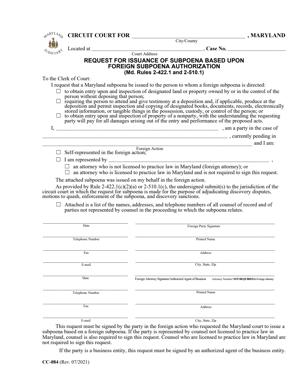
CC-084 – Request for Issuance of Subpoena Based Upon Foreign Subpoena Authorization
Fill out nowJurisdiction: Country: United States | Province or State: Maryland
CC-084 – Request for Issuance of Subpoena Based Upon Foreign Subpoena Authorization is a Maryland court form used when a case is pending in another state, but evidence or testimony is needed from someone located in Maryland. It allows a Maryland court to issue a local subpoena based on a subpoena that was already authorized in a different state.
If you are representing yourself, this form can feel confusing at first. You are not starting a new lawsuit in Maryland. Instead, you are asking a Maryland Circuit Court to recognize a subpoena from another state and issue a corresponding Maryland subpoena.
This form is part of a process that helps courts cooperate across state lines. It is commonly used in civil cases, such as contract disputes, personal injury claims, family law matters, and business litigation.
Understanding what this filing does, and what it does not do, will help you complete it correctly and avoid delays. The court’s role here is limited, but accuracy still matters.
What is CC-084 – Request for Issuance of Subpoena Based Upon Foreign Subpoena Authorization?
Clear definition
CC-084 – Request for Issuance of Subpoena Based Upon Foreign Subpoena Authorization is a formal request filed with a Maryland Circuit Court. It asks the court clerk to issue a Maryland subpoena based on a subpoena that was issued in another state.
A “foreign subpoena” in this context does not mean international. It refers to a subpoena from another U.S. state. The form connects the out-of-state court proceeding with Maryland’s court system so that evidence can legally be obtained within Maryland.
When accepted, the Maryland court issues its own subpoena. That Maryland subpoena can then be served on a person or business located in Maryland.
Who typically uses this form?
This form is often used by parties in civil lawsuits pending outside Maryland. That includes plaintiffs, defendants, or their attorneys. Self-represented individuals may also use it when they need records or testimony from someone in Maryland.
Common users include individuals involved in contract disputes, business owners in commercial litigation, parents in custody cases, or parties in personal injury claims. The key factor is that the main case is in another state, but the witness or records are in Maryland.
Sometimes the person filing this request is not a party to the case but represents a party. In self-represented situations, you would file it directly if you are handling your own case.
Why might you need this form?
You might need this form if important evidence is located in Maryland. For example, a company headquartered in Maryland may have documents relevant to your case. Or a witness who saw a key event may now live in Maryland.
An out-of-state subpoena alone usually cannot be enforced in Maryland. Courts generally require a Maryland-issued subpoena for service and enforcement within the state. This form bridges that gap.
Without this filing, you may not be able to compel a Maryland resident or business to produce documents or appear for testimony. That can affect your ability to prove your claims or defend yourself in the original case.
Typical real-life scenarios
- You are involved in a contract dispute in Virginia. The opposing party claims certain payments were never made. The bank that holds the account records is located in Maryland. You need those records for the trial. You use this form to ask a Maryland court to issue a subpoena to the bank.
- You are part of a custody case in Pennsylvania. A therapist who treated the child now practices in Maryland. The court in Pennsylvania authorizes a subpoena for testimony or records. You file this request in Maryland so the therapist can be subpoenaed locally.
- You are defending a personal injury lawsuit in Delaware. A manufacturer located in Maryland produced a component related to the incident. You need design documents from that company. This form allows you to request a Maryland subpoena directed at that business.
- You are pursuing a business fraud claim in the District of Columbia. A former employee with relevant knowledge moved to Maryland. To take that person’s deposition, you request that a Maryland Circuit Court issue a subpoena based on the subpoena authorized in your main case.
- In each of these situations, the central lawsuit remains in another state. Maryland’s role is limited to helping obtain evidence located within its borders.
When would you use CC-084 – Request for Issuance of Subpoena Based Upon Foreign Subpoena Authorization?
You would use this form after a subpoena has been issued or authorized in the state where your case is pending. It is not the first step in the discovery process. It comes after the out-of-state court has approved or recognized the need for a subpoena.
Timing matters. This filing is typically made when you are actively gathering evidence, often during the discovery phase of a civil case. That can include requesting documents, scheduling depositions, or requiring a witness to appear at a hearing.
If you learn that a key witness or document custodian is located in Maryland, and your main case is elsewhere, this is when the form becomes relevant. It allows the Maryland court to mirror the foreign subpoena in a form enforceable under Maryland law.
You would not use this form for criminal cases handled by prosecutors across state lines. The process described here generally applies to civil matters. It also does not apply to international subpoenas or requests from outside the United States.
If you are unsure whether the out-of-state subpoena meets the necessary standards, reviewing it carefully before filing in Maryland can prevent delays. The Maryland court will look at whether the foreign subpoena appears valid and properly issued.
Legal characteristics of CC-084 – Request for Issuance of Subpoena Based Upon Foreign Subpoena Authorization
This filing is procedural in nature. It does not argue the merits of your case. It does not ask the Maryland court to decide who is right or wrong. It simply requests the issuance of a Maryland subpoena based on an existing authorization from another state.
For the request to be effective, the foreign subpoena generally must already be properly issued by a court in the other state. The details in your Maryland request must match the foreign subpoena. Inconsistencies in names, dates, or document descriptions can lead to rejection or delay.
The form must be filed in the correct Maryland Circuit Court, usually in the county where the person or business to be served is located. Filing in the wrong location may cause administrative rejection or require refiling.
Clerical errors are a common source of problems. Misspelled names, incorrect addresses, or incomplete case information can make service difficult or invalidate the subpoena. Clear, complete information reduces the risk of enforcement issues later.
It is also important to understand what this document does not do. It does not transfer your entire case to Maryland. It does not open a full lawsuit in Maryland about the underlying dispute. It does not guarantee that the person served will comply without objection. A recipient may still challenge the subpoena in a Maryland court.
Different states follow similar interstate discovery principles, but procedural details can vary. While many states recognize out-of-state subpoenas through streamlined processes, local court rules and filing practices may differ slightly. Paying attention to Maryland-specific formatting and filing requirements helps avoid unnecessary delay.
Is it legally binding?
The form itself is a request. It becomes legally significant once the Maryland court issues a Maryland subpoena based on that request. The binding effect attaches to the subpoena issued by the Maryland court, not to the request form alone.
Once issued and properly served, a Maryland subpoena can require a person or business in Maryland to produce documents, appear for deposition, or testify, depending on its terms. Failure to comply may have legal consequences under Maryland law.
However, the subpoena is subject to challenge. A person served may file a motion to quash or modify it. If that happens, a Maryland court may review whether the subpoena is overly broad, burdensome, or otherwise improper. The underlying case still remains in the other state.
How to fill out CC-084 – Request for Issuance of Subpoena Based Upon Foreign Subpoena Authorization
Step 1 – Identify the Maryland Circuit Court
At the top of the form, enter the name of the appropriate Maryland Circuit Court. This is usually the county where the person or business to be served is located. Make sure the court name is written exactly and completely.
Step 2 – Provide the Caption from the Original Case
Enter the case caption as it appears in the out-of-state proceeding. This includes the names of the parties and the case number from the original court. Copy this information carefully to avoid discrepancies.
Step 3 – Identify the Foreign Court
List the name of the court where the original case is pending. Include the state and any identifying information shown on the foreign subpoena. This connects your request to the existing proceeding.
Step 4 – Attach the Foreign Subpoena
Indicate that you are attaching a copy of the subpoena issued by the out-of-state court. The attached document should be complete and legible. The Maryland court relies on this attachment to issue a corresponding subpoena.
Step 5 – Confirm the Type of Subpoena Requested
Specify whether the subpoena seeks documents, testimony at a deposition, testimony at a hearing, or a combination. The Maryland subpoena generally mirrors the type and scope of the foreign subpoena.
Step 6 – Provide Information About the Person or Entity to Be Served
Enter the full legal name and address of the individual or business located in Maryland. Accuracy here is critical. The information you provide will appear on the Maryland-issued subpoena and will be used for service.
Step 7 – Include Your Contact Information
Provide your name, address, and contact details as the requesting party. If you are self-represented, you list yourself. This allows the court and the recipient to know who initiated the request.
Step 8 – Review for Consistency and Completeness
Before filing, compare the information in your request with the foreign subpoena. Check names, dates, document descriptions, and case numbers. Make sure nothing is missing and all fields are filled in clearly.
Step 9 – Sign and Date the Form
Sign the form where indicated and enter the date of signing. Your signature confirms that the information you provided is accurate to the best of your knowledge and that you are requesting issuance based on a valid foreign subpoena.
Step 10 – File with the Clerk of the Circuit Court
Submit the completed form, along with the attached foreign subpoena, to the clerk of the appropriate Maryland Circuit Court. After review, the clerk may issue a Maryland subpoena that reflects the terms of the foreign subpoena.
Legal terms you might encounter in CC-084 – Request for Issuance of Subpoena Based Upon Foreign Subpoena Authorization
- Foreign Subpoena: A subpoena issued by a court outside Maryland. This is the document you attach to your request. The Maryland court relies on this existing subpoena to issue a local version for service within the state.
- Issuance: The formal act of a clerk signing, sealing, and releasing a subpoena so it becomes enforceable. On this form, you are asking the clerk to issue a Maryland subpoena based on the foreign one. Nothing is enforceable in Maryland until issuance occurs.
- Clerk of the Circuit Court: The court official who processes filings and issues subpoenas. You submit this document to the clerk’s office. The clerk checks for required attachments and corrects case information before issuing the Maryland subpoena.
- Caption: The heading of a court case that lists the court name, parties, and case number. You must copy the caption exactly as it appears in the original out-of-state case. Any mismatch can delay processing.
- Discovery: The pretrial process in which parties exchange information and evidence. A subpoena is one discovery tool. This form is used when discovery needs to reach a person or business located in Maryland for a case pending elsewhere.
- Service of Process: The formal delivery of legal documents to a person or entity. After the Maryland subpoena is issued, it must be properly served. Service rules matter because improper service can make the subpoena unenforceable.
- Subpoena Duces Tecum: A subpoena that requires the production of documents, records, or tangible items. If the foreign subpoena requests documents, the Maryland subpoena will reflect that request. Be clear about what must be produced and by when.
- Subpoena for Testimony: A subpoena requiring a person to appear for a deposition or hearing. If the foreign subpoena seeks testimony in Maryland, the local subpoena will state the time and place. Accuracy in scheduling details is critical.
- Proof of Service: Written confirmation that the subpoena was delivered correctly. This is usually completed by the person who served the documents. You may need to file or keep proof of service to show compliance with procedural requirements.
- Uniform Interstate Depositions and Discovery Act (UIDDA): A law adopted by many states to streamline interstate discovery. This process allows a foreign subpoena to be presented to a local court for issuance without opening a full new case. This form fits within that streamlined framework.
FAQs
Do I need to open a new Maryland case to use this form?
In most situations, you do not open a full new lawsuit. This document is used to ask the clerk to issue a Maryland subpoena based on an existing out-of-state case. The caption and case number remain tied to the original case, so you must copy them exactly as they appear on the foreign subpoena.
What exactly must I attach to this document?
You must attach a complete copy of the foreign subpoena. It should include the full caption, case number, court name, and the specific commands for testimony or document production. If pages are missing or illegible, the clerk may reject your submission.
Does the Maryland clerk review the substance of the foreign subpoena?
The clerk’s role is generally administrative. The clerk checks that you provided a valid foreign subpoena and completed the required information on this form. The clerk does not usually decide whether the requests are appropriate; that issue is handled if someone objects later.
What information must match between the foreign subpoena and this form?
The party names, case number, and issuing court must match exactly. The type of subpoena requested in Maryland should reflect what the foreign subpoena commands. Even small differences in spelling or numbering can cause delays, so verify every detail before filing.
Who signs the CC-084 – Request for Issuance of Subpoena Based Upon Foreign Subpoena Authorization?
The person requesting issuance signs it. That may be an attorney of record in the out-of-state case or a self-represented party, depending on the circumstances. Use your full legal name and provide current contact information so the clerk can reach you if something is missing.
When does the Maryland subpoena become enforceable?
It becomes enforceable after the clerk issues it. Completing this form alone does not require anyone to act. Wait for the issued Maryland subpoena, then arrange proper service before expecting compliance.
What happens if the person in Maryland objects to the subpoena?
The person served may file a motion in the appropriate court to quash or modify the subpoena. Objections are handled under Maryland procedure, even though the underlying case is elsewhere. Keep copies of everything so you can respond if needed.
Will filing CC-084 – Request for Issuance of Subpoena Based Upon Foreign Subpoena Authorization change the public record of the original case?
It does not change the out-of-state case record. It creates a limited Maryland court record related to issuing and serving the local subpoena. The underlying claims and rulings remain with the original court.
Checklist: Before, During, and After CC-084 – Request for Issuance of Subpoena Based Upon Foreign Subpoena Authorization
Before
- Confirm there is an active out-of-state case with a valid subpoena.
- Obtain a complete and legible copy of the foreign subpoena.
- Verify the full and correct caption, including the case number.
- Identify the correct Maryland Circuit Court based on where service will occur.
- Confirm the full legal name and address of the person or entity to be served.
- Decide whether the subpoena seeks testimony, documents, or both.
- Review deadlines in the foreign subpoena to ensure realistic timing.
- Prepare your contact information for the form.
During
- Accurately copy the caption from the foreign subpoena.
- Enter the name of the foreign court exactly as written.
- Attach the complete foreign subpoena without altering it.
- Specify the type of subpoena requested in Maryland.
- Provide the correct service address for the recipient.
- Double-check spelling of names and case numbers.
- Sign and date the form clearly.
- Make copies before submitting to the clerk.
After
- Confirm the clerk has issued the Maryland subpoena.
- Obtain certified copies if required for service.
- Arrange proper service according to Maryland rules.
- Calendar the compliance date for testimony or document production.
- Retain proof of service once completed.
- Monitor for objections or motions filed in response.
- Send produced documents to the appropriate party in the original case.
- Keep all paperwork organized in your case file.
Common mistakes to avoid with CC-084 – Request for Issuance of Subpoena Based Upon Foreign Subpoena Authorization
- Mistake: Copying the caption incorrectly because you retype it from memory, which happens when you rush, leading to clerk rejection or delay, so do not forget to copy it exactly as shown on the foreign subpoena.
- Mistake: Failing to attach the full foreign subpoena because you assume the clerk only needs the first page, which can result in refusal to issue, so do not forget to include every page and attachment.
- Mistake: Listing the wrong Maryland court because you are unsure about the proper county, which may require refilling and extra fees, so do not forget to confirm the correct Circuit Court location before submitting.
- Mistake: Requesting the wrong type of subpoena due to a misunderstanding of whether testimony or documents are required, which can create confusion at service, so do not forget to match the Maryland request to the foreign subpoena’s commands.
- Mistake: Forgetting to sign and date the form because you focus on attachments, which can cause administrative rejection, so do not forget to review the signature line before filing.
- Mistake: Serving the foreign subpoena instead of the issued Maryland subpoena because they look similar, which can invalidate service, so do not forget to wait for and use the issued local version.
- Mistake: Providing an incomplete address for the recipient due to outdated information, which can delay or invalidate service, so do not forget to verify the current service address.
- Mistake: Ignoring deadlines in the original subpoena because you assume new dates will apply, which can disrupt discovery, so do not forget to align timing and act promptly after issuance.
What to do after filling out CC-084 – Request for Issuance of Subpoena Based Upon Foreign Subpoena Authorization
Once you complete the form, pause and review it carefully. Small clerical errors can slow down the process. Compare every entry against the foreign subpoena. Confirm spelling, numbers, and dates.
Make at least two copies of everything. Keep one full set for your records. Use the other set for filing and service preparation.
- Step 1: Assemble the completed form and the full copy of the foreign subpoena.
- Step 2: Confirm you selected the correct Maryland Circuit Court for filing.
- Step 3: Submit the paperwork to the clerk’s office by the accepted filing method.
- Step 4: Pay any required filing fee and obtain a receipt.
- Step 5: Wait for confirmation that the Maryland subpoena has been issued.
- Step 6: Obtain file-stamped or certified copies of the issued subpoena if needed.
- Step 7: Arrange proper service on the person or entity named in the subpoena.
- Step 8: Calendar the response or appearance deadline stated in the subpoena.
- Step 9: Secure written proof of service from the person who completed service.
- Step 10: Store all documents, receipts, and proof of service in an organized case file.
After service, monitor your mail and court communications. If the recipient files an objection or motion, respond within the required time frame. Keep communication professional and documented.
If documents are produced, review them promptly and send them to the appropriate party in the original case as required. If testimony is scheduled, confirm logistics such as date, time, and location.
Maintain a clear record of every step. This helps you demonstrate compliance and respond quickly if questions arise. Organized documentation reduces stress and strengthens your position in the underlying case.
Disclaimer: This guide is provided for informational purposes only and is not intended as legal advice. You should consult a legal professional.