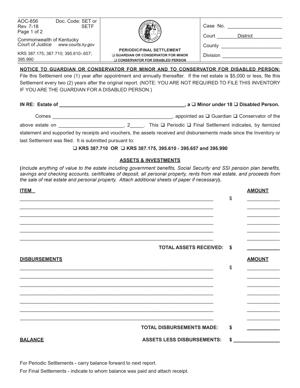
AOC- 856 – Periodic or Final Settlement
Fill out nowJurisdiction: Country: United States | Province or State: Kentucky
The AOC- 856 – Periodic or Final Settlement is a court form used in Kentucky probate cases. It reports how an estate’s money and property have been managed. If you are handling an estate, this document helps you show the court what has happened since your appointment.
You may be serving as an executor, administrator, or another court‑appointed fiduciary. In that role, you are responsible for collecting assets, paying debts, and distributing property. The court expects clear records of every transaction.
This form matters because it creates an official record. It shows what came into the estate, what went out, and what remains. It also helps protect you by documenting your actions.
If you are about to complete this filing, you need to understand what information it requires and how the court reviews it. Accuracy and organization are key. The court relies on this document to decide whether your handling of the estate meets legal standards.
What is AOC- 856 – Periodic or Final Settlement?
Clear definition
The AOC- 856 – Periodic or Final Settlement is a financial report filed in a Kentucky probate case. It details the receipts, disbursements, and remaining assets of an estate over a specific period of time.
A “periodic” settlement covers a set timeframe, such as one year. A “final” settlement covers the entire administration and is filed when the estate is ready to close. Both versions use the same basic format.
The form summarizes the estate’s financial activity in a structured way. It often includes beginning balances, income received, expenses paid, distributions made, and the balance left on hand.
Who typically uses this form?
This form is typically used by a personal representative. In Kentucky, that may be an executor named in a will or an administrator appointed by the court when there is no will.
It may also be used by other fiduciaries handling estate funds, depending on the court’s instructions. The person filing the document is responsible for keeping accurate records and reporting them honestly.
You are the one who signs the settlement. By signing, you confirm that the information is complete and accurate to the best of your knowledge.
Why might you need this form?
You may need this form because the court requires regular reporting. Many estates must file a settlement annually until the estate is closed.
You also need it when you are ready to wrap up the estate. A final settlement shows that all debts, taxes, and expenses have been handled and that remaining assets have been distributed properly.
In some cases, beneficiaries or interested parties may request a review of the estate’s finances. This filing provides a clear accounting for them and for the court.
Typical real-life scenarios
- You were appointed executor of your parents’ estate. Over the past year, you collected funds from bank accounts, sold a vehicle, and paid funeral expenses and credit card bills. The court now requires a yearly report. You use this form to list each receipt and payment.
- You are closing a small estate. All assets have been gathered, and all debts have been paid. Before the court releases you from your duties, it requires a final settlement. You prepare this document to show a zero balance or the final distributions to heirs.
- You are handling an estate that includes rental property. Each month, rent comes in, and expenses go out. At the end of the reporting period, you summarize this activity in the settlement form.
- You inherited property along with your siblings. One sibling is serving as administrator. They filed this document to show how estate funds were handled and how distributions were calculated.
When would you use AOC- 856 – Periodic or Final Settlement?
You use this form when the court overseeing the probate case requires an accounting. That often happens on a set schedule, such as once every 12 months after your appointment.
You also use it when the estate administration is ending. A final settlement is part of the closing process. It gives the court a complete financial picture from start to finish.
If there has been significant financial activity, the court may expect detailed reporting. This can include sales of property, investment income, payment of taxes, or partial distributions to beneficiaries.
The form may also be used when there is a change in fiduciary. For example, if one personal representative steps down or is replaced, a settlement may be filed to show the financial status at that point in time.
In larger or more complex estates, periodic settlements provide ongoing transparency. In smaller estates, there may be fewer reporting periods, but a final accounting is still common before discharge.
Legal characteristics of AOC- 856 – Periodic or Final Settlement
This document is a formal court filing. It becomes part of the probate record. Once submitted, it can be reviewed by the judge, court staff, and interested parties.
For the settlement to be effective, it must be complete and accurate. That typically means listing all estate income and expenses for the reporting period. It also means providing clear totals and balances.
Common problems include math errors, missing documentation, or unexplained transactions. Inconsistent dates or amounts can lead to questions from the court. If figures do not match earlier filings, the court may request clarification.
The form does not replace the need to maintain detailed records. It is a summary of your bookkeeping, not a substitute for it. You may need to attach supporting documents or be prepared to provide them if requested.
While probate procedures vary by state, the basic purpose of an estate settlement is similar. It reports financial management to the court. However, timing requirements and review processes can differ across jurisdictions.
This document does not transfer property by itself. It reports transactions that have already occurred. It also does not resolve disputes automatically. If a beneficiary challenges your accounting, the matter may require further court review.
Is it legally binding?
The AOC- 856 – Periodic or Final Settlement is legally significant because it is filed under oath or affirmation. When you sign it, you are attesting to the accuracy of the information provided.
Once the court reviews and approves a settlement, that approval can carry legal weight. It may confirm that your accounting for the covered period is accepted. In many cases, approval of a final settlement is part of releasing you from further responsibility.
However, the binding effect depends on proper filing and court approval. If the document contains errors, omissions, or misstatements, it can be challenged. The court may require corrections or additional information before accepting it.
The form itself does not create new rights. Instead, it documents how you have carried out your existing duties as a fiduciary. Its legal effect comes from the court’s acceptance and the accuracy of your reporting.
How to fill out AOC- 856 – Periodic or Final Settlement
Step 1 – Identify the estate and case information
Begin by entering the basic case details at the top of the form. This usually includes the name of the deceased person, the case number, and the court where the probate is pending. Copy this information exactly as it appears on prior court documents to avoid inconsistencies.
Step 2 – Indicate whether the settlement is periodic or final
The form will ask you to specify whether you are filing a periodic settlement or a final settlement. Select the appropriate option based on the reporting period and the status of the estate. A periodic filing covers a defined timeframe. A final filing covers the entire administration and signals that you are ready to close the estate.
Step 3 – State the reporting period
Enter the beginning and ending dates for the period covered by this settlement. For a periodic report, this is often one year from your last settlement. For a final report, it may begin on the date of your appointment and end on the date of final distribution. Make sure the dates match your financial records.
Step 4 – List the beginning balance
Record the total value of estate assets at the start of the reporting period. If this is your first settlement, the beginning balance may match the inventory value previously filed with the court. If it is a later filing, use the ending balance from your prior settlement as the new starting point.
Step 5 – Itemize all receipts
List all money and property received during the reporting period. This can include bank interest, sale proceeds, rental income, refunds, or other funds collected on behalf of the estate. Provide enough detail to show the source of each receipt and the date received. Add the amounts carefully to calculate the total receipts.
Step 6 – Itemize all disbursements
Next, list every payment made from estate funds during the same period. Common examples include funeral costs, creditor payments, court costs, taxes, insurance, maintenance expenses, and distributions to beneficiaries. Include the payee, purpose, date, and amount. Double-check your totals for accuracy.
Step 7 – Calculate the ending balance
Add the beginning balance and total receipts. Then subtract the total disbursements. The result is the balance remaining in the estate at the end of the reporting period. Confirm that this figure matches the actual balance in the estate account and any remaining property values.
Step 8 – Reflect distributions in a final settlement
If you are filing a final settlement, show how the remaining balance was distributed. Identify each beneficiary and the amount or property received. After all distributions are listed, the remaining balance is often zero. Ensure that the math clearly supports this outcome.
Step 9 – Review for accuracy and completeness
Before signing, read through the entire document. Check names, dates, and amounts. Verify that totals are correct and consistent. Make sure all required sections are filled in and that attachments, if any, are included.
Step 10 – Sign and prepare for submission
Sign the form where indicated. Your signature confirms that the information is accurate to the best of your knowledge. After signing, prepare the document for filing with the appropriate Kentucky probate court handling the estate case.
Legal terms you might encounter in AOC- 856 – Periodic or Final Settlement
- Fiduciary: The person responsible for managing the estate’s assets. This may be called an executor, administrator, or guardian, depending on the case. On this form, the fiduciary is the one who prepares the accounting and signs to confirm it is accurate.
- Estate: The total property, money, and rights owned by the deceased person or protected individual. The estate includes bank accounts, real estate, personal property, and any income earned during administration. Every number you enter on this document relates to estate property, not your personal funds.
- Periodic Settlement: An interim accounting that covers a specific time frame during the administration. You use this when the estate is still open and not ready to close. It shows the court how assets have been managed so far.
- Final Settlement: The last accounting filed before the estate is closed. It reflects all financial activity from the last report through the end of administration. It also shows how remaining assets are distributed to beneficiaries or heirs.
- Receipts: All money or property received by the estate during the reporting period. This may include proceeds from sales, refunds, rental income, or interest earned. You must list each source and the exact amount.
- Disbursements: All payments made from estate funds. This includes court costs, debts, taxes, professional fees, and distributions. Each disbursement should match your supporting records.
- Beginning Balance: The total amount of estate funds on hand at the start of the reporting period. For a periodic settlement, this usually matches the ending balance from your last report. Accuracy here prevents calculation errors later in the form.
- Ending Balance: The amount remaining after you subtract disbursements from the beginning balance plus receipts. In a final settlement, this number should be zero or match the amount being distributed at closing.
- Distribution: The transfer of estate assets to heirs or beneficiaries. In a final settlement, you must clearly show who received what and in what amount. This confirms the estate has been properly handled.
- Voucher: A receipt, invoice, canceled check, or other document that proves a payment was made. Courts often require vouchers to support the disbursements listed in your accounting. Keep these organized in case they are requested.
FAQs
What is the difference between a periodic and a final settlement?
A periodic settlement reports financial activity for a set period while the estate remains open. A final settlement reports all remaining activity and shows how the estate is fully distributed. In this document, you must clearly indicate which type you are filing so the court knows whether the estate should stay open or be closed.
What reporting period should I enter?
Use the exact start and end dates that match your accounting records. The start date should follow the last approved settlement or the date you were appointed if this is your first report. The end date should be the last day covered by your bank statements and records. Make sure the dates align with the transactions you list.
Do I need to attach bank statements and receipts?
You may need to attach documentation that supports the amounts listed, especially for disbursements. This includes invoices, canceled checks, or detailed bank statements. Check what the court expects so your filing is not delayed for missing proof.
What if my beginning balance does not match my prior ending balance?
You should stop and reconcile your records before filing. Compare your prior approved settlement, bank statements, and transaction history. If you find an error, correct it and clearly explain any adjustment so the court can follow the change.
Who must sign the AOC- 856 – Periodic or Final Settlement?
The fiduciary must sign this document. Your signature confirms that the information is complete and accurate to the best of your knowledge. If more than one fiduciary was appointed, each may need to sign, depending on how authority was granted.
What happens after I file this form?
The court reviews the information and may set a hearing or allow time for objections. Interested parties may examine the accounting. If everything is correct and no objections are raised, the court may approve the settlement.
Can I amend the form after filing it?
If you discover an error, you can usually file an amended settlement. Clearly mark it as amended and explain the correction. Provide updated totals and any additional supporting documents so the record is accurate.
Will the information in this document become part of the public record?
Most estate filings become part of the court record. That means financial details listed may be accessible according to court rules. Review entries carefully and ensure all figures are correct before submitting.
Checklist: Before, During, and After AOC- 856 – Periodic or Final Settlement
Before
- Gather all bank statements covering the full reporting period
- Collect receipts, invoices, and proof of every payment made
- Confirm the prior ending balance from the last approved settlement
- Review your appointment papers to confirm your authority
- Verify the names of beneficiaries or heirs as they appear in court records
- Reconcile the estate bank account to ensure totals are correct
- Separate estate funds from personal funds if not already done
During
- Enter the correct case number and estate name exactly as filed
- Check the box for periodic or final settlement clearly
- Write the reporting period dates accurately
- List each receipt with a clear description and amount
- List each disbursement separately with matching totals
- Double-check math when calculating totals and balances
- Ensure distributions match the will or court order
- Review every page before signing
After
- Make copies of the completed form for your records
- Attach required supporting documents
- File the form with the appropriate court clerk
- Note the date of filing for your records
- Monitor for court notices or hearing dates
- Respond promptly to any court requests for clarification
- Keep all original financial documents in a secure file
- Update your estate accounting ledger to reflect the filing
Common mistakes to avoid with AOC- 856 – Periodic or Final Settlement
- Mistake: Listing rounded or estimated numbers because exact figures seem unnecessary, which happens when records are incomplete, can lead to court rejection or objections, so do not forget to reconcile accounts and use precise amounts from statements.
- Mistake: Combining multiple disbursements into one line for convenience, which happens when trying to save space, may create confusion or requests for clarification, so do not forget to itemize payments clearly.
- Mistake: Forgetting to carry forward the correct beginning balance from the prior report, which often occurs when preparing reports months apart, can cause math discrepancies, so do not forget to verify the prior approved ending balance.
- Mistake: Filing a final settlement without reflecting all distributions, which happens when distributions were made informally, may delay estate closure, so do not forget to document each payment to beneficiaries.
- Mistake: Signing before reviewing attachments, which happens when rushing to meet a deadline, can result in incomplete filings, so do not forget to confirm all required documents are included.
- Mistake: Using personal funds to pay estate expenses and failing to document reimbursement properly, which happens during urgent payments, can create accounting confusion, so do not forget to record reimbursements as receipts and disbursements accurately.
What to do after filling out AOC- 856 – Periodic or Final Settlement
Once you complete the accounting, slow down and review everything line by line. Accuracy matters more than speed. Even small math errors can delay approval.
- Step 1: Review all totals and confirm the ending balance is correct.
- Step 2: Confirm that the reporting period dates match your bank statements.
- Step 3: Verify that all receipts and disbursements are supported by documents.
- Step 4: Make at least one complete copy of the signed form for your records.
- Step 5: Assemble required attachments in a clear, organized order.
- Step 6: File the original with the court clerk handling the estate case.
- Step 7: Obtain confirmation of filing, such as a stamped copy.
- Step 8: Calendar any deadlines for objections or hearings.
- Step 9: Continue maintaining the estate account until the court approves the settlement.
- Step 10: If this is a final settlement, wait for the court’s order closing the estate before considering your duties complete.
Keep your records organized even after filing. Store bank statements, receipts, court approvals, and copies of distributions together. If questions arise later, you will be able to respond quickly.
If the court approves a periodic settlement, continue tracking all new financial activity for the next reporting period. If the court approves a final settlement, update your internal records to show that the estate has been closed and your fiduciary role has ended.
Stay attentive to any notices from the court. Prompt responses help prevent delays. Careful recordkeeping now protects you later.
Disclaimer: This guide is provided for informational purposes only and is not intended as legal advice. You should consult a legal professional.