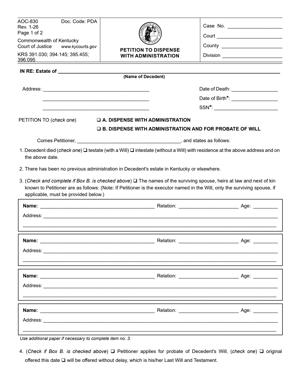
AOC-830 – Petition to Dispense with Administration
Fill out nowJurisdiction: Country: United States | Province or State: Kentucky
The AOC-830 – Petition to Dispense with Administration is a court form used in Kentucky probate matters. You use it to ask the court to settle a person’s estate without opening a full probate administration. This can simplify the process when certain conditions are met.
When someone dies, their property usually goes through probate. Probate is the legal process for collecting assets, paying debts, and distributing what remains to heirs. In some situations, a full probate case is not necessary. That is where this form comes in.
If you are a spouse, child, or other interested person handling a small or straightforward estate, you may encounter this document. It allows you to request that the court transfer property without appointing a personal representative. This can save time and reduce paperwork.
Understanding how this form works helps you avoid delays. If the court rejects your filing, you may need to start over or open a full administration. Knowing what information the court expects makes the process smoother.
What is AOC-830 – Petition to Dispense with Administration?
Clear definition
AOC-830 – Petition to Dispense with Administration is a formal request filed in the Kentucky District Court. It asks the court to distribute a deceased person’s assets without appointing an executor or administrator.
In a typical probate case, the court appoints someone to manage the estate. That person gathers assets, pays valid debts, and distributes the remainder. This form is used when the estate may qualify for a simpler approach.
The document includes information about the deceased person, their date of death, heirs, and property. It also identifies whether the estate’s value and circumstances meet the legal requirements for dispensing with administration.
Who typically uses this form?
This form is often used by a surviving spouse. Kentucky law commonly allows a surviving spouse to receive certain property without full administration if the estate is small enough.
Adult children of the deceased may also use this form. Other heirs, such as parents or siblings, might file it if they are entitled to inherit and no full probate is needed.
In some cases, a creditor or other interested party may file. However, it is most often a family member seeking a straightforward transfer of property.
You are usually someone with a direct interest in the estate. That means you expect to receive property or have a legal claim connected to the estate.
Why might you need this form?
You may need this form if the estate has limited assets. Kentucky law provides a process for handling smaller estates without full probate administration.
You might also need it if the deceased did not leave a will and the estate qualifies for simplified handling. Even if there is a will, the estate may still qualify under certain conditions.
Another reason is efficiency. A full administration requires formal appointment, a bond in some cases, notices, and reports. Dispensing with administration can reduce those steps if the legal requirements are met.
Using this document may also reduce court costs and filing complexity. It allows the court to issue an order transferring assets directly to those entitled to them.
Typical real-life scenarios
- A surviving spouse’s husband dies owning a vehicle and a small bank account in his name alone. The total value falls within the limit allowed by law. The spouse files the petition to have those assets transferred without opening full probate.
- An unmarried parent dies with modest personal property and no real estate. The adult children agree on how to divide the property. One child files the petition to allow distribution without formal administration.
- A person dies owning only household goods and a small amount of cash. There are no significant debts. A family member files the form so the court can authorize the transfer of the property quickly.
- A widow dies and leaves a will naming her daughter as executor. The estate’s value is low and qualifies for simplified handling. Instead of going through full probate, the daughter files this petition to complete the matter more efficiently.
When would you use AOC-830 – Petition to Dispense with Administration?
You would use this form after someone has died and before a personal representative is appointed. It is typically filed in the district court of the county where the deceased person lived.
Timing matters. The court must determine whether the estate meets statutory requirements. Often, the filing occurs soon after death, once the petitioner gathers basic information about assets and heirs.
You might use this form when there is no dispute among heirs. If family members disagree about who inherits, a simplified process may not be appropriate. Contested issues often require formal administration.
This document is commonly used when there is no need for ongoing estate management. For example, if there are no complex debts, lawsuits, or business interests, the court may find that administration can be dispensed with.
If real estate is involved, additional considerations may apply. Some estates with real property still qualify, while others require more formal proceedings. The specific facts of the estate affect whether this filing is suitable.
Legal characteristics of AOC-830 – Petition to Dispense with Administration
This form is a court petition. That means it is a formal written request asking a judge to issue an order. It does not transfer property by itself. The court must review and approve it.
For the petition to be effective, it must contain accurate and complete information. This includes the decedent’s name, date of death, residence, heirs, and a description of assets. Omissions or errors can delay the process.
The estate must meet Kentucky’s legal criteria for dispensing with administration. If the value exceeds statutory limits or if required information is missing, the court may deny the petition.
Proper signatures are also important. The petitioner must sign the document. In many cases, the signature is made under oath, meaning you affirm that the information is true to the best of your knowledge.
Common reasons for rejection include incomplete heir listings, unclear asset descriptions, and failure to show that the estate qualifies under the law. Clerical mistakes, such as incorrect case captions or missing attachments, can also cause delays.
High-level differences may exist depending on the county’s local procedures. Some courts may require additional documentation, such as a certified death certificate. Filing practices and review times can vary.
This form does not resolve disputes between heirs. It does not eliminate valid debts. It also does not provide legal advice or confirm tax obligations. It is limited to asking the court to allow distribution without formal administration.
Is it legally binding?
The petition itself is not binding until the court signs an order granting it. Once the judge issues an order dispensing with administration, that order has legal effect.
The court’s order authorizes the transfer of identified assets to the entitled person or persons. Financial institutions and other asset holders often rely on the certified court order as proof of authority.
The legal effect depends on truthful and accurate information. If the petition contains material misstatements, the order may be challenged. Accuracy supports the enforceability of the court’s decision.
Once granted, the order generally closes the need for further estate administration regarding the listed property. However, if additional assets are later discovered, further court action may be required.
How to fill out AOC-830 – Petition to Dispense with Administration
Step 1 – Identify the court and case caption
At the top of the form, enter the name of the appropriate Kentucky District Court and the county where the deceased person resided. Fill in the case caption exactly as required, including the name of the deceased. If a case number has been assigned, include it in the designated space.
Step 2 – Provide information about the deceased
Enter the full legal name of the deceased person. Include the date of death and the county and state of residence at the time of death. Accuracy here is critical because the court uses this information to confirm jurisdiction.
Step 3 – State your relationship and interest
Identify yourself as the petitioner. Provide your name, address, and relationship to the deceased, such as surviving spouse or child. This shows the court why you have standing to file the petition.
Step 4 – List heirs and beneficiaries
Provide the names and addresses of all known heirs or beneficiaries. Even if one person expects to receive all property, the court needs a complete list of those legally entitled to inherit. This allows the judge to confirm proper distribution.
Step 5 – Describe the estate assets
List the assets that belong to the estate. Include clear descriptions, such as bank account balances, vehicle details, or personal property. If values are required, state them carefully and as accurately as possible.
Step 6 – Address debts and obligations
Indicate whether the estate has outstanding debts. If the form requests information about funeral expenses or other obligations, provide it clearly. The court considers whether dispensing with administration is appropriate in light of these obligations.
Step 7 – State the legal basis for dispensing with administration
Complete the section that explains why the estate qualifies under Kentucky law. This typically involves confirming that the estate meets value limits or other statutory conditions. Ensure that the information matches the asset details you listed earlier.
Step 8 – Review for completeness and accuracy
Before signing, read the entire form carefully. Confirm that names are spelled correctly, numbers are accurate, and all required sections are filled in. Check that attachments, if any, are included.
Step 9 – Sign and date the petition
Sign the form in the designated area. If the form requires notarization or an oath, follow the instructions provided on the document. Enter the date of signing clearly.
Step 10 – Prepare for filing with the court
Make copies of the completed petition for your records and for any required service. Ensure that the original document is ready for submission to the appropriate district court clerk, along with any required supporting documents.
Legal terms you might encounter in AOC-830 – Petition to Dispense with Administration
- Petitioner: The petitioner is the person asking the court for relief. On this form, that is you or the person filing on behalf of the estate. Your name, address, and relationship to the deceased must be clearly stated so the court can confirm you have standing to make the request.
- Decedent: The decedent is the person who has died. The form requires the decedent’s full legal name, date of death, and residence information. This ensures the court identifies the correct estate and avoids confusion with similar names.
- Intestate: Intestate means the person died without a valid will. If the decedent did not leave a will, the estate passes according to state law. The form may require you to indicate whether a will exists or not.
- Testate: Testate means the person died with a valid will. If a will exists, you may need to attach a copy. The court will review it to confirm that dispensing with administration is still appropriate.
- Heirs at Law: Heirs at law are the people entitled to inherit under state law when there is no will. You must list all heirs, even if they agree with your request. The court relies on this list to ensure no one’s rights are overlooked.
- Beneficiaries: Beneficiaries are individuals named in a will to receive property. If a will exists, you must identify these people. The court needs to confirm that all beneficiaries are accounted for and properly notified if required.
- Estate Assets: Estate assets include all property owned by the decedent at death. This can include bank accounts, vehicles, personal property, or real estate. The form typically asks you to describe these assets and estimate their value.
- Debts and Liabilities: These are obligations the decedent owed at the time of death. You may need to confirm whether debts exist and whether they have been paid or will be paid. The court uses this information to decide whether formal administration is necessary.
- Administration: Administration refers to the formal probate process where a personal representative is appointed to manage the estate. This includes collecting assets, paying debts, and distributing property. Dispensing with administration means asking the court to skip that full process.
- Personal Representative: A personal representative is the person officially appointed by the court to manage the estate. By filing this petition, you are asking the court not to appoint one. The court must be satisfied that no formal representative is required.
FAQs
Do I have to file AOC-830 – Petition to Dispense with Administration if there is very little property?
You use this document when you want the court to allow transfer or distribution of property without appointing a personal representative. If there are assets that require a court order to move or retitle, filing this form may be necessary even if the estate is small. Check whether any bank, agency, or title office requires a court order before deciding.
What information must exactly match the death certificate?
The decedent’s full legal name, date of death, and sometimes the county of residence must match the death certificate. If you shorten a name or leave out a middle initial that appears on the certificate, the clerk may question it. Use the exact spelling and format shown on the official record.
Do all heirs have to agree before I file this document?
You must list all heirs or beneficiaries, even if they do not sign the form. Some courts require written consent or proof that interested parties were notified. Before filing, confirm whether you need signatures or separate consent forms to avoid delays.
What if I discover an asset after I submit the AOC-830 – Petition to Dispense with Administration?
If a new property is found, the court’s original order may not cover it. You may need to notify the court or file additional paperwork. Keep detailed records of what was included so you can show whether the newly discovered asset changes the situation.
Do I need to attach supporting documents to this form?
You may need to attach a certified copy of the death certificate and, if applicable, a copy of the will. Some situations also require documentation showing asset values or proof that debts have been paid. Review the instructions carefully and prepare copies before you file.
When does this document become effective?
It becomes effective when the judge signs the order granting the petition. Filing alone does not give you authority. Wait for a signed court order before attempting to transfer or distribute assets.
What happens to the public record after the court approves it?
Once approved, the case and the order become part of the court’s probate record. This creates a documented legal basis for transferring property. Financial institutions and other third parties may rely on the court’s order as proof of authority.
Can I correct a mistake after filing this form?
Yes, but you must act quickly. Minor clerical errors can sometimes be corrected by filing an amended petition or a written correction. If the mistake affects heirs, asset values, or debt information, the court may require a revised filing and possibly additional notice.
Checklist: Before, During, and After AOC-830 – Petition to Dispense with Administration
Before
- Obtain a certified copy of the death certificate.
- Confirm whether a valid will exists and locate the original if possible.
- Gather a complete list of heirs and beneficiaries with contact details.
- Identify all estate assets and estimate their fair market value.
- Determine whether any debts remain unpaid.
- Check whether any asset holder requires a court order for transfer.
- Verify the correct court and county for filing.
- Prepare copies of any supporting documents you may need to attach.
During
- Enter the decedent’s full legal name exactly as shown on official records.
- Provide your full legal name and current contact information.
- Clearly state your relationship to the decedent.
- List every heir or beneficiary, even if they are not receiving property.
- Describe assets accurately and avoid vague language.
- Disclose known debts and explain their status.
- Review each section for completeness before signing.
- Sign and date the petition where required.
After
- Make several copies of everything you filed.
- File the petition with the appropriate court clerk.
- Pay any required filing fee or request a fee waiver if eligible.
- Monitor the case for a hearing date if one is scheduled.
- Obtain a certified copy of the signed court order once approved.
- Provide copies of the order to banks or other institutions as needed.
- Keep all documents together in a secure file.
- Update your records to reflect transferred or distributed property.
Common mistakes to avoid with AOC-830 – Petition to Dispense with Administration
- Mistake: Leaving out an heir because you believe they are not entitled to property, which happens when families assume informal agreements control; this can delay approval or invalidate the order, so do not forget to list every legally recognized heir.
- Mistake: Using nicknames or incomplete legal names for the decedent, often due to habit; this can cause rejection by the clerk or confusion in records, so do not forget to match the death certificate exactly.
- Mistake: Underestimating asset values to qualify more easily, which happens when you guess instead of verifying; inaccurate values can create legal exposure, so do not forget to use reasonable and supportable estimates.
- Mistake: Failing to disclose debts because you think they are minor, often due to uncertainty about balances; this can result in creditor disputes later, so do not forget to investigate and report known obligations.
- Mistake: Signing the petition without reviewing all sections, which happens when you rush to file; missing information can require amendments, so do not forget to double-check every blank.
- Mistake: Attempting to transfer property before the judge signs the order, usually due to urgency; institutions may refuse the transaction, so do not forget to wait for the officially signed order.
- Mistake: Not keeping copies of filed documents, often because you assume the court will provide them later; this can complicate follow-up actions, so do not forget to retain complete copies for your records.
- Mistake: Ignoring notice requirements to interested parties, which happens when you assume consent is implied; lack of proper notice can void the process, so do not forget to confirm and complete any required notifications.
What to do after filling out AOC-830 – Petition to Dispense with Administration
Once you complete the form, slow down and review it one more time. Make sure names are spelled correctly. Confirm dates match official records. Check that every required attachment is included.
- Step 1: Make at least two complete copies of the signed petition and all attachments.
- Step 2: Organize your originals and copies in the same order.
- Step 3: Prepare payment for the filing fee, if required.
- File the petition with the appropriate court clerk. Submit the original set and keep stamped copies for your records. If you file in person, ask the clerk to confirm that the packet is complete. If you file by mail, consider using a method that provides delivery confirmation.
- Step 4: Obtain a file-stamped copy showing the case number.
- Step 5: Calendar any deadlines or hearing dates the clerk provides.
- Step 6: Monitor mail and voicemail for court notices.
- If the court schedules a hearing, prepare to explain why formal administration is unnecessary. Bring copies of supporting documents. Be ready to confirm asset values and the status of debts.
- Step 7: Attend the hearing if one is required.
- Step 8: Request a certified copy of the signed order once the judge approves the petition.
- After approval, use the certified order to complete asset transfers. Banks, vehicle title offices, and other institutions may require a certified copy rather than a regular photocopy.
- Step 9: Provide certified copies to institutions holding estate property.
- Step 10: Update your personal records to reflect completed transfers.
Keep all paperwork in a safe place. You may need it later to answer questions from heirs, financial institutions, or tax authorities. Organized records protect you and make future issues easier to resolve.
Disclaimer: This guide is provided for informational purposes only and is not intended as legal advice. You should consult a legal professional.