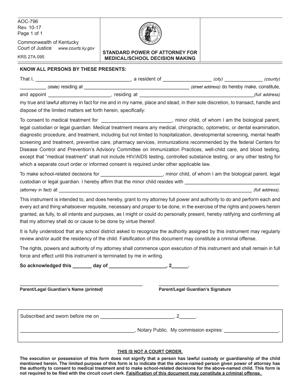
AOC-796 – Standard Power of Attorney for Medical or School Decision Making
Fill out nowJurisdiction: Country: United States | Province or State: Kentucky
The AOC-796 – Standard Power of Attorney for Medical or School Decision Making is a court-approved form used in Kentucky to give another adult authority to make certain decisions for a child. You use it when you need someone else to act in your place for medical care, school matters, or both.
This form is often used by parents or legal guardians who cannot be present for a period of time. It allows a trusted adult to step in and handle day-to-day decisions without going to court for guardianship.
If you are about to fill it out, you likely want clear answers. You want to know what powers you are giving, how long they last, and what makes the document valid.
This guide explains what the form does, when people use it, and how to complete it in a practical way. The focus is on helping you understand the document before you sign it.
What is AOC-796 – Standard Power of Attorney for Medical or School Decision Making?
Clear definition
AOC-796 – Standard Power of Attorney for Medical or School Decision Making is a written document that lets a parent or legal guardian authorize another adult to make medical or school-related decisions for a minor child.
It is a type of limited power of attorney. That means the authority is restricted to specific areas listed in the form. It does not transfer full parental rights.
The person giving authority is often called the principal. The person receiving authority is commonly called the attorney-in-fact or agent. In this context, the agent acts only within the boundaries described in the form.
This document is part of the Kentucky Court of Justice forms. It is designed to be straightforward so families can use it without starting a formal court case.
Who typically uses this form?
Parents who travel for work often use this form. If you will be out of town for weeks or months, you may want another adult to handle school forms or medical appointments.
Military families sometimes rely on this type of power of attorney during deployment. It allows a caregiver to enroll a child in school or consent to treatment if needed.
Parents who face medical treatment themselves may also use it. If you are recovering from surgery or managing a serious condition, you may want someone else to step in temporarily.
Legal guardians can also use the form when a child is living with a relative or close family friend for a period of time. It gives the adult clear authority to act.
Why might you need this form?
Schools and medical providers usually require written proof before they accept instructions from someone who is not the parent or guardian. Verbal permission is often not enough.
Without this document, a caregiver may be unable to consent to routine medical care. This can delay treatment or create stress in an emergency.
Schools may refuse to discuss grades, discipline, or special services with someone who lacks written authorization. This can limit a caregiver’s ability to support the child.
The form helps avoid confusion. It clearly states who can make decisions and what those decisions include.
Typical real-life scenarios
- You plan to work in another state for six months. Your child will live with a grandparent in Kentucky. The grandparent needs authority to take your child to the doctor and speak with school staff. This form allows that.
- Your child stays with an aunt during the school year to attend a different district. The aunt needs to enroll the child, sign permission slips, and attend school meetings. A power of attorney for school decisions makes that possible.
- You are undergoing medical treatment that limits your ability to attend appointments. A close family friend agrees to help. The document allows that friend to consent to medical care on your behalf for your child.
- Your family faces a temporary housing change. Your child lives with a trusted neighbor for a short time. The neighbor needs legal authority to respond if the child gets sick or injured at school.
- In each example, the parent keeps parental rights. The authority given is specific and temporary. The form creates a clear record that institutions can rely on.
When would you use AOC-796 – Standard Power of Attorney for Medical or School Decision Making?
You would use this form when you expect to be unavailable to make decisions in person. That might be due to travel, work obligations, illness, or another temporary situation.
It is commonly used when a child lives with someone who is not the parent. That adult may need authority to handle school registration, attend parent-teacher conferences, or approve extracurricular activities.
The form can also be used when a child is staying with a relative during a family emergency. Instead of seeking court-ordered guardianship, families often choose this simpler option for short-term needs.
Some parents use it to cover a specific time period, such as a summer program or an extended visit with relatives. The document can reflect a clear start and end date.
It is important to understand that this is not an adoption and not a permanent custody change. It is a delegation of limited authority. The parent or guardian generally remains responsible for the child.
Legal characteristics of AOC-796 – Standard Power of Attorney for Medical or School Decision Making
This form is effective when it is properly completed and signed according to Kentucky requirements. That usually means including all required information, signatures, and any necessary notarization.
The authority granted is limited to what the document describes. If the form lists medical and school decisions, the agent cannot go beyond those areas.
The document typically includes the names and identifying details of the parent or guardian, the child, and the agent. Accuracy matters. Mistakes in names or dates can cause delays or rejection by institutions.
Common problems arise when the form is incomplete. Missing signatures, blank sections, or unclear dates may cause a school or hospital to question its validity.
Another issue is conflicting documents. If there is an existing court order about custody or decision-making, that order may control. A power of attorney cannot override a court’s custody decision.
Laws can differ by state. While this form is specific to Kentucky, other states may have different rules about duration, notarization, or parental authority. If the child will be outside Kentucky, institutions there may review the document under their own policies.
This form does not terminate parental rights. It does not create permanent guardianship. It does not give the agent authority over financial matters unless those are clearly included, which this standard form does not typically cover.
Is it legally binding?
In general, a properly completed and signed AOC-796 – Standard Power of Attorney for Medical or School Decision Making is legally binding in Kentucky. Schools and healthcare providers can rely on it as written authority.
For it to be binding, the person signing must have the legal right to grant the authority. That usually means the parent or legal guardian has valid custody rights at the time of signing.
The document must also meet formal requirements. If notarization is required and not completed, the form may not be accepted.
A power of attorney can usually be revoked by the parent or guardian. Once revoked, the agent no longer has authority. Revocation is often done in writing and communicated to relevant institutions.
As long as it is valid, within its time limits, and not revoked, the document serves as a clear delegation of decision-making power.
How to fill out AOC-796 – Standard Power of Attorney for Medical or School Decision Making
Step 1 – Review the entire form before writing
Start by reading the full document from beginning to end. This helps you understand the scope of authority you are granting. Pay attention to sections about duration, revocation, and required signatures.
Make sure this is the correct form for your situation. Confirm that you are delegating only medical or school decision-making authority, not broader custody rights.
Step 2 – Enter the parent or guardian information
Fill in your full legal name as it appears on official records. Provide any requested contact details, such as your address and phone number.
If more than one parent or guardian has legal custody, the form may require both to sign. Check whether space is provided for multiple signatures.
Accuracy is important. Use complete names rather than nicknames.
Step 3 – Identify the minor child or children
List each child covered by the document. Include full legal names and any other identifying information requested, such as date of birth.
If you are granting authority for more than one child, ensure each child is clearly listed. If the form does not allow enough space, confirm whether an attachment is permitted.
Clear identification helps schools and healthcare providers match the document to the correct child.
Step 4 – Name the person receiving authority
Enter the full legal name of the adult who will act as agent. Include their address and contact information if the form requests it.
Choose someone who is willing and able to take on this responsibility. The person should understand the limits of the authority granted.
Make sure the name is spelled correctly. Institutions will compare this name to the person’s identification.
Step 5 – Specify the powers granted
Read the section that describes the medical and school decision-making authority. Some forms allow you to check boxes or initial next to certain powers.
Indicate clearly which powers you are granting. If the form includes optional sections, complete only those that apply to your situation.
Do not leave required sections blank. If a section does not apply, follow any instructions provided, such as writing “not applicable.”
Step 6 – Set the effective date and duration
Locate the section that states when the power of attorney begins. Enter the start date if the form requires one.
If the form asks for an end date, fill it in carefully. Some powers of attorney are limited to a specific period, while others last until revoked or until a stated event occurs.
Make sure the time frame matches your actual needs. Schools and medical providers will rely on these dates.
Step 7 – Read the statements about revocation and parental rights
Before signing, review any language explaining that you retain parental rights and may revoke the document.
Understand how revocation works. The form may explain whether a written notice is required.
This section confirms that the document does not permanently transfer custody.
Step 8 – Sign the form in the required manner
Sign your name exactly as listed earlier in the form. Follow any instructions about signing in front of a notary or witnesses.
If notarization is required, wait to sign until you are in front of the notary. Bring identification if needed.
If more than one parent or guardian must sign, ensure each signature is completed according to the form’s instructions.
Step 9 – Provide copies to the appropriate people
After signing and notarization, make copies of the completed document. Keep the original in a safe place.
Give copies to the agent and to any school or healthcare provider that may rely on it. This ensures they have written proof of the authority granted.
Clear communication at this stage helps avoid confusion when decisions need to be made.
Legal terms you might encounter in AOC-796 – Standard Power of Attorney for Medical or School Decision Making
- Principal: The principal is the person who gives the authority. In this form, that is usually the parent or legal guardian of the child. You must clearly print your full legal name as it appears on official identification, so there is no confusion about who is granting the powers.
- Attorney-in-Fact: This is the person you choose to act on your behalf. It does not mean the person is a lawyer. On this form, the attorney-in-fact is the adult who will make medical or school decisions for your child within the limits you set.
- Minor Child: The minor child is the person under 18 for whom the authority is granted. You must list each child’s full legal name and date of birth exactly as shown on official records. Any mismatch can delay acceptance by schools or medical providers.
- Delegated Authority: Delegated authority refers to the specific powers you are giving to the attorney-in-fact. This may include consenting to medical treatment, enrolling the child in school, or accessing educational records. The form outlines what can be delegated and may allow you to limit certain powers.
- Effective Date: The effective date is when the authority begins. You may choose for it to start immediately upon signing or on a specific future date. The date you enter controls when the attorney-in-fact can begin acting.
- Duration: Duration means how long the power of attorney lasts. The form may provide a default end date or allow you to choose one. If you do not clearly state the duration, institutions may question whether the authority is still valid.
- Revocation: Revocation is the act of canceling the power of attorney. As the parent or guardian, you generally keep the right to revoke it at any time. The form often explains that revocation should be in writing to avoid confusion.
- Notarization: Notarization means signing the document in front of a notary public who verifies your identity. Many schools and medical providers require notarization before accepting the form. If notarization is required and missing, the document may be rejected.
- Custodial Rights: Custodial rights refer to your legal rights as a parent or guardian to make decisions about your child. This form does not permanently transfer custody. It temporarily shares specific decision-making powers.
- Acknowledgment: An acknowledgment is a formal declaration that you signed the document voluntarily. This usually happens before a notary. It helps prove the form was properly executed if anyone later questions it.
FAQs
Does this form give up my parental rights?
No. This document allows you to share certain decision-making powers, but you remain the child’s parent or legal guardian. You still keep your custodial rights unless a court orders otherwise. This form records a temporary delegation, not a permanent transfer of rights.
When does the authority actually begin?
Look at the section where you choose the effective date. If you select “upon signing,” the authority starts as soon as you sign and complete any required notarization. If you write in a future date, the attorney-in-fact must wait until that date before acting.
Do I need to file AOC-796 – Standard Power of Attorney for Medical or School Decision Making with the court?
In most cases, you do not file this form with a court clerk. Instead, you give copies directly to schools, doctors, or other institutions that need proof of authority. Always confirm whether the receiving organization requires an original or a certified copy.
What information must match exactly on the form?
Names and dates of birth should match the child’s school and medical records. Your name should match your government-issued identification. If the attorney-in-fact’s name is spelled differently than on their ID, a school or hospital may refuse to rely on the document.
Can I limit what the other adult is allowed to decide?
Yes. Review the section that describes the powers granted. If the form allows you to exclude certain powers, clearly mark or write those limits. If you leave that section blank, the attorney-in-fact may have all the powers listed.
What happens if I want to cancel this document early?
You must complete a written revocation. After signing it, provide copies to the attorney-in-fact and to any school or healthcare provider that received the original document. If institutions are not told about the cancellation, they may continue to rely on the earlier authority.
Will a school automatically accept this document?
Schools usually review it before accepting it. They will check signatures, dates, and notarization if required. If anything is incomplete, they may ask you to correct it before honoring the authority.
What if the child has two parents with decision-making rights?
If both parents have legal authority, both may need to sign this document. Review the signature section carefully to see how many signatures are required. If only one parent signs when both are required, the form may not be accepted.
Checklist: Before, During, and After AOC-796 – Standard Power of Attorney for Medical or School Decision Making
Before
- Confirm you are the child’s parent or legal guardian with authority to delegate decisions.
- Review any custody orders to ensure you are allowed to grant this power.
- Gather full legal names and dates of birth for each child.
- Obtain the full legal name and contact details of the attorney-in-fact.
- Decide when the authority should start and end.
- Check whether notarization will be required.
- Ask the school or medical provider if they have additional requirements.
During
- Print clearly in black or blue ink if completing by hand.
- Enter your name exactly as shown on your identification.
- List each child separately if the form requires it.
- Carefully read the section describing the powers being granted.
- Mark or write any limitations on the authority.
- Fill in the effective date and duration fields.
- Do not sign until you are in front of a notary if notarization is required.
- Double-check all dates for accuracy and consistency.
After
- Make several copies of the signed document.
- Provide a copy to the attorney-in-fact.
- Deliver copies to the child’s school and healthcare providers.
- Keep the original in a safe but accessible place.
- Note the expiration date on your calendar.
- Prepare a written revocation if your plans change.
- Retrieve and destroy outdated copies once the form expires or is revoked.
Common mistakes to avoid with AOC-796 – Standard Power of Attorney for Medical or School Decision Making
- Mistake: Leaving the effective date blank because you assume it starts automatically, which happens when you overlook the date section; this can cause schools or doctors to reject it, so do not forget to clearly state when the authority begins.
- Mistake: Misspelling names or using nicknames, which happens when you fill it out quickly; this can lead to refusal by institutions, so do not forget to match all names to official records.
- Mistake: Failing to check custody arrangements first, which happens when parents assume they have sole authority; this can invalidate the document, so do not forget to review any court orders.
- Mistake: Not limiting powers when you intend to, which happens when you skip reading the delegation section; this may give broader authority than you wanted, so do not forget to clearly state any restrictions.
- Mistake: Signing without notarization when notarization is expected, which happens when you overlook the acknowledgment section; this can result in rejection, so do not forget to confirm and complete notarization if required.
- Mistake: Forgetting to distribute copies, which happens after you finish signing; this prevents the attorney-in-fact from proving authority, so do not forget to provide copies to all relevant institutions.
- Mistake: Ignoring the expiration date, which happens when you file the document away and forget it; this can leave your child without authorized decision-making support, so do not forget to track and renew it if needed.
- Mistake: Failing to revoke outdated forms in writing, which happens when circumstances change; this can cause conflicting authority, so do not forget to formally cancel prior versions and notify all parties.
What to do after filling out AOC-796 – Standard Power of Attorney for Medical or School Decision Making
Once you complete and sign the form, your next steps are practical and important. The document only works if the right people receive it and understand it.
- Step 1: Review the signed form for completeness. Check signatures, dates, and notarization. Make sure nothing is left blank.
- Step 2: Make multiple clear copies. Keep the original in a safe place where you can access it quickly if needed.
- Step 3: Give a copy to the attorney-in-fact. Go over the powers you granted so the person understands the limits.
- Step 4: Provide copies to your child’s school. Ask the front office who should keep it on file and whether they need additional internal forms.
- Step 5: Provide copies to healthcare providers. This may include your child’s primary doctor, dentist, and any specialists.
- Step 6: Confirm acceptance. Ask each institution to confirm that the document is sufficient and properly recorded in their system.
- Step 7: Record the effective date and expiration date in your calendar. Set a reminder several weeks before it expires so you can renew it if needed.
- Step 8: Communicate with the other parent, if applicable. Make sure everyone with decision-making rights understands that this authority is in place.
- Step 9: Update related records. If emergency contact forms or school enrollment documents list decision-makers, ensure they match the authority you granted.
- Step 10: Revoke in writing if circumstances change. Provide the written revocation to the attorney-in-fact and all institutions that received the original.
Taking these steps helps prevent confusion at critical moments. Clear communication and proper recordkeeping ensure that the person you choose can act quickly and confidently for your child.
Disclaimer: This guide is provided for informational purposes only and is not intended as legal advice. You should consult a legal professional.