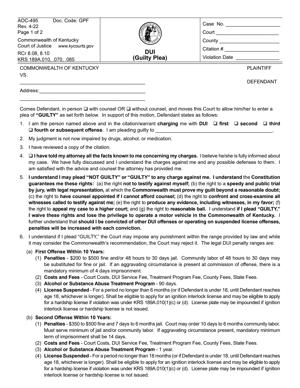
AOC-495 – DUI (Guilty Plea)
Fill out nowJurisdiction: Country: United States | Province or State: Kentucky
If you are facing a DUI charge in Kentucky and have decided to plead guilty, you may be asked to complete or review AOC-495 – DUI (Guilty Plea). This document is part of the official court process in the Commonwealth of Kentucky.
AOC-495 – DUI (Guilty Plea) is more than a simple form. It records your decision to admit guilt and confirms that you understand the rights you are giving up. Courts use it to make sure your plea is voluntary and informed.
If you are representing yourself, this document can feel overwhelming. It contains legal language and references to constitutional rights. Understanding what it says before you sign it is critical.
This guide walks you through what the form is, when it is used, and how it generally works. It also explains how to complete it step by step so you know what each section is asking.
What is AOC-495 – DUI (Guilty Plea)?
Clear definition
AOC-495 – DUI (Guilty Plea) is a Kentucky court document used when a defendant chooses to plead guilty to a charge of driving under the influence. It formalizes your decision and creates a written record of your plea.
The form typically confirms that you understand the charge against you, the possible penalties, and the rights you are giving up by pleading guilty. It may also outline agreed terms such as fines, license suspension, treatment programs, or jail time.
In short, it is a written acknowledgment that you are admitting guilt and accepting the legal consequences that follow.
Who typically uses this form?
This form is used by defendants charged with DUI in the Kentucky district court. Most DUI cases are handled at the district court level, especially for first or second offenses.
Judges review the completed form before accepting a guilty plea. Prosecutors may reference it when placing the plea agreement on the record. Court clerks process it as part of the case file.
Some defendants complete the document with the help of an attorney. Others may review and sign it on their own in open court.
Why might you need this form?
You may need AOC-495 – DUI (Guilty Plea) if you have reached a plea agreement with the prosecution. The court generally requires written confirmation that you understand and accept the agreement.
You might also use it if you decide to plead guilty without a negotiated agreement. In that case, the form documents that your decision is voluntary.
The form protects the court as well as you. It shows that you were informed of your rights and that you knowingly chose to waive them.
Typical real-life scenarios
- You are charged with a first-time DUI. After reviewing the evidence, you decide not to contest the charge. In court, the judge asks you to complete and sign the guilty plea form before sentencing.
- You negotiate with the prosecutor for a reduced sentence in exchange for a guilty plea. The agreed terms are written into the court record, and the form confirms that you accept them.
- You initially plead not guilty but later change your mind. Before the court accepts your new plea, you must complete the form to show you understand the consequences of changing your plea.
- You are representing yourself and want to resolve the case quickly. The court provides the form during your court date and reviews it with you before entering judgment.
When would you use AOC-495 – DUI (Guilty Plea)?
You use this document at the point in your case when you are ready to enter a guilty plea. It is not filed at the time of arrest. It comes later, after charges have been formally filed and you have appeared in court.
The form is typically used during a scheduled court hearing. This may be an arraignment, a pretrial conference, or another hearing where plea discussions take place.
If a plea agreement has been reached, the form often reflects the terms discussed between you and the prosecutor. In many cases, the judge will ask questions in open court and refer to the completed form while doing so.
If there is no agreement and you are pleading “open” to the court, the form still serves the same purpose. It confirms that you understand the potential penalties and are choosing to admit guilt.
Timing matters. The form is used before sentencing is finalized. Once the judge accepts your plea, the case moves to judgment and sentencing based on that plea.
Legal characteristics of AOC-495 – DUI (Guilty Plea)
A guilty plea form becomes effective when it is signed by you and accepted by the judge. Your signature alone does not finalize the case. The court must review and approve the plea.
For a plea to be valid, it must be knowing, voluntary, and intelligent. This means you understand the charge, the consequences, and the rights you are giving up. The form is designed to document those elements clearly.
Common problems arise when information is incomplete or unclear. Missing signatures, incorrect case numbers, or unanswered questions can delay acceptance. If the judge believes you do not fully understand the consequences, the court may refuse to accept the plea.
In Kentucky, DUI penalties can vary depending on prior offenses, blood alcohol content, and other factors. The form generally reflects statutory ranges of penalties. While the structure of DUI plea forms is similar across many states, specific penalty ranges and license consequences differ by jurisdiction.
This document does not erase the charge from your record. It does not seal or expunge the case. It does not negotiate terms by itself. It simply records your plea and understanding.
The form also does not replace the judge’s role. Even if you and the prosecutor agree on a sentence, the judge typically has the authority to accept or reject the agreement within legal limits.
Is it legally binding?
Yes, once accepted by the court, a guilty plea recorded on this form is legally binding. It results in a conviction for DUI.
The binding effect comes from the court’s acceptance of your plea, not just your signature. After acceptance, the judge enters a judgment of conviction based on your admission of guilt.
Because it is binding, withdrawing a guilty plea later can be difficult. Courts generally require a valid reason, such as evidence that the plea was not voluntary or informed. The written form plays a key role in determining whether you understood what you were doing at the time.
The form supports the finality of the case. It shows that you acknowledged your rights and chose to waive them. That written record is important if questions arise later about the validity of the plea.
How to fill out AOC-495 – DUI (Guilty Plea)
Step 1 – Review the case information at the top of the form
Start by checking the case caption. This section usually includes the court name, county, case number, and the names of the parties. Confirm that your name is spelled correctly and that the case number matches your court paperwork.
If any of this information is wrong, bring it to the court’s attention before signing. Accurate case details ensure the plea is recorded in the correct file.
Step 2 – Read the charge description carefully
Locate the section that identifies the DUI charge. It may include the statute number and a short description of the offense.
Make sure the charge listed matches what you were told in court. If there are multiple counts, verify that the form clearly states which count you are pleading guilty to.
Understanding the exact charge matters because penalties can differ depending on the specific allegation.
Step 3 – Review the possible penalties
The form often lists the range of penalties for DUI in Kentucky. This can include fines, jail time, license suspension, alcohol education or treatment programs, and other conditions.
Read this section slowly. It explains the maximum and sometimes minimum consequences allowed by law. Even if you have a plea agreement, the form usually outlines the full legal range.
This helps confirm that you understand what could happen as a result of your plea.
Step 4 – Confirm your constitutional rights
One section typically explains the rights you give up by pleading guilty. These often include the right to a trial, the right to confront witnesses, and the right to remain silent.
By signing, you acknowledge that you understand you are waiving these rights. Take time to read each right individually.
If anything is unclear, ask for clarification before signing. The court’s acceptance of your plea depends on your understanding of these rights.
Step 5 – Review any plea agreement terms
If you have reached an agreement with the prosecutor, the terms may be written directly on the form or attached to it. This can include agreed fines, recommended jail time, probation conditions, or program requirements.
Check that the terms match what was discussed in court. Pay attention to details such as payment deadlines or reporting requirements.
The written terms create a record of what was agreed upon at the time of the plea.
Step 6 – Answer required declarations
The form may ask you to confirm statements such as whether you are under the influence of drugs or alcohol at the time of signing, or whether anyone has forced or threatened you.
Answer these statements truthfully. They are included to ensure that your plea is voluntary and clear-minded.
Your answers become part of the official court record.
Step 7 – Sign and date the form
Once you have reviewed all sections, you will sign and date the document. Your signature confirms that you have read the form and understand its contents.
In many cases, you will sign in open court. The judge may ask you questions before or after you sign.
Do not sign until you have finished reviewing every section.
Step 8 – Court review and acceptance
After you sign, the judge will review the form. The court may ask you questions to confirm your understanding.
If the judge is satisfied that your plea is knowing and voluntary, the court will accept it and enter a judgment. The signed form becomes part of your permanent court record.
Once accepted, the case moves forward to sentencing based on the terms stated or authorized by law.
Legal terms you might encounter in AOC-495 – DUI (Guilty Plea)
- Guilty Plea: A formal statement that you admit the DUI charge as described in the charging document. On this form, you confirm that you are pleading guilty voluntarily and understand the consequences. Once accepted by the judge, this plea replaces a trial and leads directly to sentencing.
- Waiver of Rights: A written acknowledgment that you are giving up specific constitutional rights. In this document, you confirm that you understand you have the right to a trial, to remain silent, and to confront witnesses. By signing, you state that you choose not to exercise those rights.
- Arraignment: A court hearing where you are formally told the charges and asked to enter a plea. If you complete this form, you may be resolving your case at or after the arraignment. The form reflects your decision not to proceed to trial.
- Plea Agreement: An arrangement between you and the prosecutor about recommended penalties. The agreement may address jail time, fines, probation, or other conditions. The judge reviews the agreement, but is not always required to follow it.
- Sentencing: The stage where the court imposes penalties after accepting your guilty plea. The form confirms that you understand the possible sentencing range. Sentencing may happen immediately or at a later hearing.
- Minimum and Maximum Penalties: The lowest and highest punishments allowed by law for the charge. The document usually lists these ranges so you know the full exposure before you plead. This can include jail time, fines, license suspension, and mandatory programs.
- Voluntary and Knowing Plea: A legal standard that requires your plea to be made freely and with full understanding. The form includes statements confirming that no one forced or improperly pressured you. You also confirm that you understand what you are admitting.
- Prior Offense: A previous DUI conviction that may increase penalties. If applicable, the form may reference whether this charge is a first or subsequent offense. Prior offenses directly affect sentencing ranges.
- Probation: A period of supervision instead of, or following, jail time. The document may reference probation as part of the agreed or possible sentence. You must follow specific conditions during this period.
- Court Costs and Fees: Financial obligations imposed in addition to fines. The form may state that you understand you are responsible for these amounts. These costs become part of the final judgment entered against you.
FAQs
Do I have to complete every blank on this form?
Yes. Every section that applies to you must be completed before the judge can consider accepting your plea. If a section does not apply, it is usually marked accordingly by the court. Leaving blanks can delay acceptance because the court must confirm that your plea is complete and informed.
What if I do not understand one of the rights listed?
Do not sign until you understand each right. This document confirms that you knowingly give up those rights. Ask the judge or court staff to clarify what each paragraph means so the record reflects that your decision is informed.
Can I change my mind after signing AOC-495 – DUI (Guilty Plea)?
Once the judge accepts your plea, it becomes part of the official court record. Changing it later is difficult and typically requires a formal request to the court. That request must explain why the plea was not voluntary or informed, so review everything carefully before signing.
What happens if the judge does not accept the plea agreement?
The judge may reject a recommended sentence if it does not meet legal requirements. If that happens, you may be allowed to withdraw your plea. Pay attention during the hearing so you understand whether the court is accepting both your plea and the proposed sentence.
Does this document affect my driving record?
Yes. A guilty plea to a DUI charge is reported and can affect your driving privileges. The conviction becomes part of your criminal and driving history. The exact impact depends on the offense level and any prior record.
What date should I use when signing?
Use the actual date you sign the document in court. The date confirms when you made the plea knowingly and voluntarily. Make sure the date matches the court proceeding so there is no confusion in the record.
Do I need to attach anything to this form?
In most cases, attachments are handled by the court or prosecutor, such as the citation or plea agreement summary. If the agreement includes specific written terms, confirm that they are properly referenced in this document. Do not assume outside paperwork is automatically included in the court file.
What does my signature legally confirm?
Your signature confirms that you understand the charge, the penalties, and the rights you are giving up. It also confirms that no one forced you to plead guilty. Once the court accepts it, this document supports the final judgment entered against you.
Checklist: Before, During, and After AOC-495 – DUI (Guilty Plea)
Before
- Read the full charge description carefully.
- Review the listed minimum and maximum penalties.
- Confirm whether the charge reflects a prior offense, if applicable.
- Go over any written plea agreement terms.
- Make sure your name and case number match your court paperwork.
- Prepare questions about any right or consequence you do not understand.
- Bring identification to court if required.
- Verify the scheduled court date and time.
During
- Listen carefully as the judge reviews your rights.
- Confirm on the record that you understand each right.
- State clearly that your plea is voluntary.
- Ensure the plea agreement terms are accurately described in court.
- Check that the sentencing range discussed matches the form.
- Review the document one final time before signing.
- Sign and date the form in the appropriate place.
- Wait for the judge to formally accept the plea.
After
- Obtain a copy of the signed document for your records.
- Review the written judgment when it is entered.
- Calendar all deadlines for fines, classes, or probation reporting.
- Follow instructions regarding license suspension or reinstatement.
- Keep proof of completed programs or payments.
- Update personal records with sentencing details.
- Monitor compliance with probation terms.
- Retain all paperwork in a secure file.
Common mistakes to avoid with AOC-495 – DUI (Guilty Plea)
- Mistake: Signing without reading each rights waiver, often because you feel rushed, which can lead to claiming later that you did not understand the consequences; do not forget to pause and ask questions before you sign.
- Mistake: Assuming the judge must follow the plea agreement, which happens when people treat the prosecutor’s recommendation as guaranteed, leading to surprise at sentencing; do not forget that the court has final authority.
- Mistake: Overlooking prior offense information, usually because you think older cases do not count, which can result in unexpected enhanced penalties; do not forget to confirm how your record is classified.
- Mistake: Leaving sections incomplete, often due to confusion about legal wording, which can delay court acceptance; do not forget to review every blank line before submission.
- Mistake: Using the wrong signing date, typically by pre-signing before the hearing, which can create record inconsistencies; do not forget to date the form on the actual day you enter the plea.
- Mistake: Failing to keep a copy, because you assume the court will always provide access later, which makes it harder to verify conditions; do not forget to request and store a stamped copy.
- Mistake: Ignoring financial obligations listed in the judgment, often due to focusing only on jail time, which can lead to collection actions or additional penalties; do not forget to track fines and court costs.
- Mistake: Not understanding probation terms, because they are discussed quickly in court, which can result in violations; do not forget to write down each requirement before leaving.
What to do after filling out AOC-495 – DUI (Guilty Plea)
After you complete and sign the form, your focus shifts to follow-through. A guilty plea is not just paperwork. It triggers real obligations that begin right away.
First, confirm that the judge has formally accepted your plea in open court. Acceptance makes it effective. Until the court accepts it, the case is not fully resolved.
- Step 1: Make sure the signed document is filed with the clerk immediately after the hearing.
- Step 2: Request a stamped or certified copy for your personal records.
- Step 3: Review the written judgment when it becomes available and compare it to what was stated in court.
- Step 4: Calendar all payment deadlines for fines, fees, and court costs.
- Step 5: Note any jail reporting date or probation start date.
- Step 6: Record deadlines for required classes, treatment, or evaluations.
- Step 7: Confirm any instructions related to your driver’s license status.
- Step 8: Keep receipts and proof of every completed requirement.
- Step 9: Maintain a dedicated folder with the plea form, judgment, and compliance documents.
- Step 10: Monitor your compliance status until every condition is satisfied.
Stay organized. Courts expect you to follow the exact terms imposed. Missing a deadline can lead to additional hearings or penalties.
If probation is ordered, clarify who your supervising officer is and how to report. Keep contact information accessible. Document each interaction and submission.
If financial obligations are part of the sentence, create a payment plan that meets the court’s schedule. Pay early when possible. Late payments can trigger enforcement actions.
Finally, check your records after completing all requirements. Confirm that the court shows your sentence as satisfied. Keeping proof protects you if questions arise later about compliance.
Disclaimer: This guide is provided for informational purposes only and is not intended as legal advice. You should consult a legal professional.