AOC-492.A – Affidavit For Hardship License
Fill out nowJurisdiction: Country: United States | Province or State: Kentucky
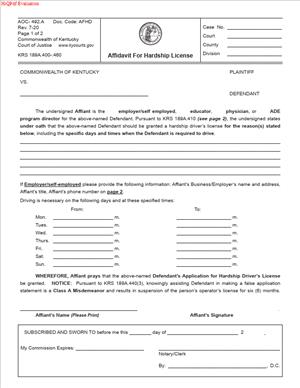
The AOC-492.A – Affidavit For Hardship License is a court form used in Kentucky when you are asking for limited driving privileges after your driver’s license has been suspended. It is a sworn written statement. You sign it under oath.
If you are about to fill out this form, you are likely trying to keep driving for essential reasons. That often includes work, school, medical appointments, or court-ordered programs. This document helps the court understand why you need a hardship license.
This form is filed with the Kentucky Court of Justice. It becomes part of your case record. The judge reviews it when deciding whether to grant limited driving privileges.
The information you provide must be accurate and complete. Because it is an affidavit, you are swearing that everything written in it is true to the best of your knowledge.
Understanding what this document does and what it does not do will help you fill it out with confidence.
What is AOC-492.A – Affidavit For Hardship License?
Clear definition
The AOC-492.A – Affidavit For Hardship License is a sworn statement submitted to a Kentucky court by a person whose driving privileges have been suspended. In it, you explain the hardship you would face without limited driving privileges.
An affidavit is a written statement made under oath. By signing this form, you confirm that the information is true. False statements can lead to penalties.
This document supports your request for a hardship license. It does not automatically grant one. The court reviews your affidavit along with the rest of your case before making a decision.
Who typically uses this form?
You typically use this form if your driver’s license has been suspended and you are seeking limited driving privileges. That often includes individuals suspended due to DUI-related offenses, unpaid fines, or other traffic violations.
People who rely on driving for employment often complete this form. For example, if your job requires you to travel between work sites or commute long distances, you may need to show that not driving would create serious financial strain.
Students may also use this form if they need to drive to attend classes or training programs. In some cases, parents or caregivers use it to explain the need to transport dependents.
Anyone asking the court for a hardship license during a suspension period may be required to submit this affidavit as part of the filing process.
Why might you need this form?
You may need this form because losing full driving privileges can affect your ability to earn income. If you cannot get to work, you may risk losing your job. The court considers this when evaluating hardship.
You may also need it if you are enrolled in court-ordered treatment or educational programs. If driving is necessary to attend those programs, your affidavit helps explain that connection.
Medical needs are another common reason. If you must attend regular medical appointments and have limited transportation options, the form allows you to describe that hardship.
In some situations, public transportation may not be available or practical in your area. The affidavit gives you space to explain why other transportation options are not realistic.
Typical real-life scenarios
- You work in construction and travel to different job sites each week. Your license is suspended. Without limited driving privileges, you cannot reach those job sites. In your affidavit, you describe your work schedule and why reliable transportation is essential.
- You are a single parent with primary custody of your children. You need to drive them to school and medical appointments. Public transportation is limited where you live. Your affidavit outlines these daily responsibilities.
- You are enrolled in a substance abuse treatment program required by the court. Attendance is mandatory. The treatment center is several miles away, and you must drive to attend sessions consistently.
- You are a college student attending classes across town. Missing classes could delay your graduation. You use the affidavit to explain your academic schedule and transportation challenges.
- In each of these situations, the form helps the judge understand the real impact of a license suspension on your daily life.
When would you use AOC-492.A – Affidavit For Hardship License?
You would use AOC-492.A – Affidavit For Hardship License when your driver’s license has been suspended, and you are eligible to request limited driving privileges under Kentucky law. This usually happens after a court proceeding or administrative action related to traffic or alcohol-related offenses.
The form is typically used after a suspension has already been imposed. It is part of the process of asking the court to allow restricted driving during that suspension period.
You may also use this form when the court schedules a hearing on your request for a hardship license. In many cases, the affidavit is filed before the hearing so the judge can review your statement in advance.
The document can be relevant if you are employed, enrolled in school, participating in a treatment program, or responsible for the care of others. It allows you to present your circumstances in writing, rather than relying only on spoken testimony.
In some situations, attorneys prepare and file this form on behalf of clients. In other cases, self-represented individuals complete and submit it themselves. If you are representing yourself, understanding each section becomes even more important because the affidavit speaks directly to the court on your behalf.
You generally use this form when you need to show specific, limited purposes for driving. A hardship license often restricts where and when you may drive. The affidavit supports those specific requests by explaining why they are necessary.
Legal characteristics of AOC-492.A – Affidavit For Hardship License
This form is a sworn affidavit. That means it carries legal weight because you sign it under oath. Courts treat sworn statements seriously.
For the affidavit to be effective, it must be complete and truthful. Missing information, unclear explanations, or inconsistent details can weaken your request. If the form requires notarization or a sworn signature before a court official, that step must be properly completed for the document to be valid.
Clarity matters. Courts often review many filings in a single day. If your explanation is vague, it may be harder for the judge to understand your hardship. Specific details about work hours, locations, and responsibilities are typically more helpful than general statements.
Common issues that can cause problems include leaving sections blank, providing incorrect dates, or failing to describe the exact hardship. Another frequent issue is requesting unrestricted driving without explaining why limited driving would not be enough. Courts often focus on narrow, necessary uses of a vehicle.
There can be differences in how hardship licenses are handled depending on the reason for suspension. Some suspensions may have mandatory waiting periods or eligibility requirements before limited privileges can be considered. The affidavit itself does not override those rules. It is only one part of the overall process.
This document does not reinstate your full driving privileges. It does not cancel your suspension. It simply supports your request for limited driving rights under specific conditions set by the court.
Is it legally binding?
Yes, the affidavit is legally binding in the sense that you are swearing that its contents are true. When you sign it, you are making a formal statement under oath.
If the information is false, there may be legal consequences. Courts rely on affidavits when making decisions. That is why accuracy is essential.
However, the form itself does not create a contract between you and the court. It does not guarantee approval of a hardship license. The judge reviews your sworn statement along with any other evidence or testimony before making a ruling.
Once a hardship license is granted, you are generally bound by the restrictions in the court’s order. Violating those restrictions can lead to additional penalties. The affidavit supports that order, but the court’s final decision is what controls your driving privileges.
How to fill out AOC-492.A – Affidavit For Hardship License
Step 1 – Review the entire form before writing
Start by reading the full AOC-492.A – Affidavit For Hardship License from top to bottom. This helps you understand what information is required. Pay attention to sections asking for personal details, case numbers, and specific hardship explanations.
Make sure you have your court case information available. This often includes your case number, the court location, and the date of your suspension. Having these details ready will make the completion process smoother.
Step 2 – Enter your identifying information
Fill in your full legal name exactly as it appears in court records. Include your current address and contact information if the form requests it.
Provide your date of birth and driver’s license number, if required. Accuracy here is important because the court uses this information to match the affidavit to your case file.
If there is a section for the county or court division, write the correct court where your case is pending. This ensures the document is filed in the proper location.
Step 3 – Include your case details
Locate the section asking for your case number. Enter it carefully and double-check for errors. Even a small mistake can delay processing.
You may also need to state the reason for your license suspension. Provide a clear description, such as the type of offense or administrative action involved. Keep this factual and concise.
If the form asks for the date of suspension or the length of the suspension period, use the exact dates from your court or administrative paperwork.
Step 4 – Describe your employment situation
If you are requesting a hardship license for work, explain your job clearly. State your employer’s name, your job title, and your typical work hours.
Describe where you work and how far it is from your home. If your job requires travel between locations, explain that in detail. The court needs to understand why driving is necessary for your employment.
Include information about your work schedule. If you work early mornings, late nights, or irregular shifts, mention this. It helps explain why alternative transportation may not be realistic.
Step 5 – Explain other qualifying hardships
If you need to drive for school, medical care, or treatment programs, provide specific details. Name the school, medical provider, or program, and describe how often you must attend.
State the location and typical appointment times. Explain why missing these appointments would cause serious difficulty.
If you are responsible for transporting dependents, describe your role and their needs. Include details such as school schedules or recurring medical visits.
Focus on facts. Avoid emotional language. Clear, specific explanations are more effective than broad statements.
Step 6 – Address alternative transportation options
Many hardship license requests consider whether other transportation is available. If the form includes a section about this, explain your situation honestly.
Describe whether public transportation exists in your area. If it does, explain why it may not meet your needs, such as limited routes or schedules that conflict with work hours.
If you have explored rides from family or coworkers, mention any limits to those arrangements. The court often looks at whether driving is truly necessary.
Keep your explanation straightforward. The goal is to show practical barriers, not to criticize available services.
Step 7 – Specify the limited driving you are requesting
Some versions of the form ask you to outline the specific times and purposes for which you need driving privileges. Be precise.
State the days of the week and time ranges you need to drive. Tie those times directly to work, school, or other essential activities.
Avoid asking for unrestricted driving unless the form clearly allows it. Courts commonly grant limited privileges tied to defined purposes.
Clarity in this section helps the judge craft an order with clear boundaries.
Step 8 – Review your statements carefully
Before signing, read every section again. Check for spelling errors, incorrect dates, or missing information.
Make sure your statements are consistent. For example, your listed work hours should match the driving times you are requesting.
Confirm that all required fields are completed. Blank sections can raise questions or delay the review process.
Step 9 – Sign the affidavit under oath
The AOC-492.A – Affidavit For Hardship License requires your signature under oath. Follow the instructions on the form regarding where and how to sign.
If notarization or signing in front of a court official is required, complete that step properly. Do not sign the affidavit in advance if it must be witnessed.
By signing, you are affirming that the information provided is true. Take a moment to ensure you are comfortable with every statement before you finalize the document.
Once signed, the form is ready for submission to the appropriate court as part of your hardship license request.
Legal terms you might encounter in AOC-492.A – Affidavit For Hardship License
- Affidavit: An affidavit is a written statement you swear or affirm is true. On this form, you are declaring under oath that the facts about your hardship are accurate. Because it is sworn, false statements can lead to penalties.
- Hardship License: A hardship license is a limited driving privilege granted after your regular driving privilege has been suspended or revoked. It does not restore full driving rights. Instead, it allows you to drive only for specific, court-approved purposes.
- Suspension: A suspension is a temporary loss of your driving privilege. The form usually requires you to identify the reason for the suspension and the dates involved. The court reviews this information before deciding whether limited driving should be allowed.
- Revocation: A revocation is a more serious termination of your driving privilege. Unlike a suspension, revocation often requires you to reapply for driving privileges after a set period. If your license is revoked, the court will closely examine whether you qualify for limited driving.
- Restricted Privilege: This refers to the narrow permission you are asking the court to grant. The form typically asks you to describe when, where, and why you need to drive. The restriction details may later appear in a court order.
- Essential Need: An essential need is a legally recognized reason for driving despite a suspension. Common examples include employment, school, medical care, or court-ordered programs. You must clearly explain how your situation fits into one of these categories.
- Verification: Verification means supporting your statements with proof. The court may expect documents such as a work schedule, employer letter, school enrollment record, or medical appointment notice. Without verification, your affidavit may not carry enough weight.
- Notary Public: A notary public is an authorized official who witnesses your signature and confirms your identity. Because this is an affidavit, you usually must sign it in front of a notary or court clerk. Signing before notarization can invalidate the document.
- Perjury: Perjury is knowingly making a false statement under oath. When you sign this affidavit, you are swearing the information is true. False information can lead to criminal charges and the denial of your request.
- Court Order: A court order is the judge’s written decision granting or denying your request. If the hardship license is approved, the order will outline the specific driving limits. You must follow that order exactly.
FAQs
Do I need to file AOC-492.A – Affidavit For Hardship License in the same court that handled my suspension?
In most situations, you file this document in the court connected to your suspension or underlying case. Check your suspension paperwork for the case number and court name. Make sure the caption on this form matches that court exactly, including county and case number, so the clerk can place it in the correct file.
What information must match my driving record exactly?
Your full legal name, date of birth, driver’s license number, and current address should match what appears on your license and court records. Even small differences, like a missing middle name or outdated address, can delay processing. Review your suspension notice and copy the details carefully.
Do I have to attach proof of my job or school schedule?
Yes, you should attach documents that support every reason you list. If you say you need to drive to work, include a letter from your employer showing your work hours and location. If you need to attend school or treatment, attach enrollment records or appointment confirmations that show dates, times, and addresses.
When does the hardship license become effective if the judge approves it?
It becomes effective only after the judge signs a written order and any required steps are completed. That may include paying fees or meeting other conditions. Do not start driving until you have confirmation that the order has been entered and any required documentation has been processed.
Do I need to sign this form in front of someone?
Yes. Because it is an affidavit, you must sign in front of a notary public or authorized court official. Bring a valid photo ID. Do not sign it ahead of time, since the notary must witness your signature to complete the notarization section.
What happens if my work schedule changes after I file this document?
If your approved driving times no longer match your actual schedule, you may need to request an update from the court. Driving outside the approved times can violate the court order. Keep copies of your current schedule and be prepared to file additional paperwork if needed.
Will this form automatically change my public driving record?
No. This document is only your sworn request. Your driving record changes only if the court enters an order granting limited driving privileges, and that order is processed. Until then, your suspension or revocation remains in effect.
Can I submit additional documents after filing the AOC-492.A – Affidavit For Hardship License?
Yes, you can usually submit supplemental documents before your hearing or as directed by the clerk. Label them clearly with your case number. Make sure any additional proof directly supports what you stated in this form so the judge can easily connect the documents to your request.
Checklist: Before, During, and After AOC-492.A – Affidavit For Hardship License
Before
- Review your suspension or revocation notice carefully.
- Confirm the correct court name and case number.
- Gather proof of employment, school, medical needs, or treatment.
- Verify your full legal name and driver’s license number.
- Check whether you need to schedule a hearing.
- Make sure you have valid photo identification.
- Locate a notary public or a confirming clerk for notarization.
During
- Read each question slowly and answer completely.
- Use clear, specific dates and times for requested driving.
- Attach copies, not originals, of supporting documents.
- Double-check that all attachments are labeled with your case number.
- Ensure your contact information is current and legible.
- Do not leave required sections blank.
- Sign only in front of the notary or authorized official.
After
- Make at least two copies of everything you filed.
- Confirm with the clerk that your filing was accepted.
- Calendar your hearing date, if one is set.
- Bring copies of all documents to court.
- Wait for a signed court order before driving.
- Review the order carefully for specific restrictions.
- Keep the order in your vehicle when driving under the hardship license.
Common mistakes to avoid with AOC-492.A – Affidavit For Hardship License
- Mistake: Giving vague reasons like “I need to drive for work,” which happens when you rush through the explanation, leading the judge to question the necessity; do not forget to include exact work hours, location, and why no alternative exists.
- Mistake: Failing to attach proof of employment or appointments because you assume your word is enough, which can result in denial; do not forget to include written verification for every hardship you claim.
- Mistake: Signing the affidavit before meeting with a notary, which often happens out of convenience and can invalidate the document; do not forget to wait and sign only in front of the authorized official.
- Mistake: Listing broader driving times than necessary in hopes of flexibility, which may make your request appear excessive; do not forget to tailor the requested hours strictly to essential activities.
- Mistake: Using outdated or inconsistent personal information due to copying from old records, which can delay filing; do not forget to match your current license and court documents exactly.
- Mistake: Driving before receiving a signed court order because you assume approval is automatic, which can lead to further penalties; do not forget that permission begins only after official approval.
- Mistake: Ignoring mail or court notices after filing, often because you think your part is done, which can cause you to miss a hearing; do not forget to monitor your mail and voicemail for updates.
What to do after filling out AOC-492.A – Affidavit For Hardship License
Once you complete the affidavit, slow down and review everything one more time. Accuracy matters. Small errors can delay your request or create confusion in court.
- Step 1: Make a clean copy of the completed form for your records before signing it.
- Step 2: Sign the affidavit in front of a notary public or authorized court official with proper identification.
- Step 3: Assemble your supporting documents in a logical order, placing the most important proof first.
- Step 4: File the original notarized form and attachments with the appropriate court clerk.
- Step 5: Ask the clerk to stamp your copy as “filed” so you have proof of submission.
- Step 6: Confirm whether a hearing is required and, if so, note the date, time, and courtroom.
- Step 7: Prepare a short, clear explanation of your hardship to present to the judge if a hearing is scheduled.
- Step 8: Check your mail and contact information regularly for court updates or orders.
- Step 9: Once you receive a signed court order, read every restriction carefully, including days, times, routes, and purposes.
- Step 10: Keep a copy of the court order in your vehicle whenever you are driving under the hardship privilege.
- Step 11: Follow all conditions strictly, including any treatment, payment, or reporting requirements tied to the order.
- Step 12: If your circumstances change, act quickly to request clarification or modification rather than assuming informal flexibility.
Staying organized protects you. Keep a dedicated folder with your affidavit, attachments, proof of filing, and court order. If questions arise later, you will have everything you need in one place.
Disclaimer: This guide is provided for informational purposes only and is not intended as legal advice. You should consult a legal professional.