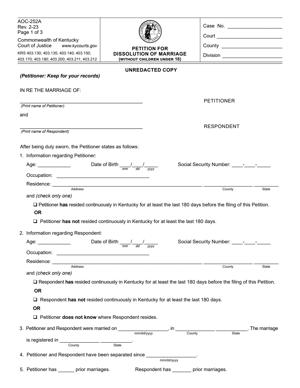
AOC-252A – Petition for Dissolution of Marriage (Without Children Under 18)
Fill out nowJurisdiction: Country: United States | Province or State: Kentucky
If you are preparing to end your marriage and you do not have minor children, the AOC-252A – Petition for Dissolution of Marriage (Without Children Under 18) is the document that starts the court process in Kentucky. This form is your formal request asking the court to dissolve your marriage.
You file this document with the circuit court. It tells the court basic information about you, your spouse, and your marriage. It also confirms that certain legal requirements are met before the court can act.
This form is designed for couples who do not have children under 18 together. That changes what issues the court must address. Child custody, parenting time, and child support are not part of this specific document.
Understanding what this form does can help you avoid delays. Small errors in names, dates, or residency information can slow your case. When you know what the court is looking for, you can complete the filing more confidently.
The AOC-252A – Petition for Dissolution of Marriage (Without Children Under 18) is not the entire divorce process. It is the starting point. What you include here shapes everything that follows.
What is AOC-252A – Petition for Dissolution of Marriage (Without Children Under 18)?
Clear definition
AOC-252A – Petition for Dissolution of Marriage (Without Children Under 18) is a court form used in Kentucky to begin a divorce case when the spouses do not share minor children. It is filed by one spouse, called the petitioner.
The document provides the court with essential facts. These include the date and place of the marriage, current addresses, and whether the marriage is considered irretrievably broken. It also states whether there are issues related to property, debts, or maintenance.
This form officially opens a case in the circuit court. Once filed, the court assigns a case number, and the legal process moves forward.
Who typically uses this form?
You use this form if you are legally married and want a divorce, and there are no children under 18 born of the marriage. This includes situations where the couple never had children, or all children are now adults.
Either spouse may file as the petitioner. The other spouse becomes the respondent. Only one of you completes and signs the petition.
This form is often used by individuals handling their own divorce paperwork. It may also be prepared by an attorney on behalf of a client. In both situations, the information required is the same.
Why might you need this form?
You need this form when you want the court to legally end your marriage. Without filing a petition, the court cannot grant a divorce.
The petition tells the court that at least one spouse meets Kentucky’s residency requirements. It also confirms that the marriage cannot be saved.
You may also use this form to set the stage for dividing property and debts. While the petition does not list every detail of an agreement, it signals whether there are unresolved issues.
If you and your spouse have already agreed on all terms, this petition still begins the formal process. The court must enter a decree before the marriage is legally dissolved.
Typical real-life scenarios
- You and your spouse have lived apart for several months and agree that the marriage is over. There are no minor children, and you want a straightforward process to end the marriage legally. Filing this petition is the first step.
- You recently separated and have not yet reached an agreement about property. You still need to open a court case to move forward. This form starts that case, even if other issues will be decided later.
- You were married briefly and have a few shared assets. You want to formally close this chapter so you can move on with your life. The petition creates the legal record of your request.
- Your children are all over 18 and financially independent. Even though you are still their parent, the court does not need to address custody or support. This form is used because there are no minor children involved.
- You may also file this petition after living separately but remaining legally married for years. The form does not require that you have been separated for a specific period, but it does require that the marriage is irretrievably broken.
When would you use AOC-252A – Petition for Dissolution of Marriage (Without Children Under 18)?
You use AOC-252A – Petition for Dissolution of Marriage (Without Children Under 18) when you are ready to formally request a divorce through the Kentucky court system, and there are no children under 18 from the marriage.
This form is appropriate whether the divorce is contested or uncontested. In an uncontested case, both spouses agree on all major issues. In a contested case, one or more issues remain unresolved. The same petition begins both types of cases.
You would not use this version of the form if you and your spouse have minor children together. A different petition includes sections about custody, visitation, and child support.
Timing also matters. At least one spouse must meet the state’s residency requirement before filing. The form includes statements confirming residency. The court reviews this information before moving the case forward.
If you are the spouse taking the first step, you file as the petitioner. After filing, the other spouse must receive formal notice of the case. The petition triggers that notification process.
Legal characteristics of AOC-252A – Petition for Dissolution of Marriage (Without Children Under 18)
This form is a pleading filed with a Kentucky circuit court. It becomes part of the official court record. Accuracy is important because the court relies on the information provided.
For the petition to be accepted, it must generally include complete names, correct addresses, and details about the marriage. Missing signatures or incomplete sections can result in rejection by the clerk or delays in processing.
The form must be filed in the proper county. Filing in the wrong location can create procedural issues. Courts typically require that at least one spouse reside in Kentucky for a required period before filing.
The petition itself does not divide property or assign debts. It asks the court to dissolve the marriage and indicates whether there are issues to resolve. Additional documents may be needed to finalize the case.
Kentucky follows a no-fault divorce approach. The petition states that the marriage is irretrievably broken. You do not need to list specific wrongdoing. In general, the court does not require proof of fault to grant the divorce.
Problems often arise from inconsistent information. For example, listing different separation dates in different documents can raise questions. Using full legal names and consistent dates helps avoid confusion.
Is it legally binding?
The petition is legally significant once filed because it opens a court case. However, it does not by itself end your marriage. The marriage ends only when the court signs a decree of dissolution.
Statements made in the petition are made to the court. Providing false information can have legal consequences. Courts expect truthful and accurate disclosures.
The petition becomes binding in the sense that it defines what you are asking the court to do. If you request specific relief, that frames the issues for the case. Later agreements or orders may expand on those requests.
Once the court issues a final decree, that decree is legally binding. The petition is the foundation that leads to that final order.
How to fill out AOC-252A – Petition for Dissolution of Marriage (Without Children Under 18)
Step 1 – Caption and court information
At the top of the form, enter the name of the circuit court and the county where you are filing. Leave the case number blank if it has not yet been assigned. List your full legal name as the petitioner and your spouse’s full legal name as the respondent.
Step 2 – Residency statements
Complete the section confirming residency. Provide information showing that at least one of you meets Kentucky’s residency requirement. Use accurate dates and current addresses, since the court relies on this to confirm jurisdiction.
Step 3 – Marriage details
Enter the date and place of your marriage. Include the city and state where the marriage occurred. If you and your spouse have separated, provide the date of separation if the form requests it.
Step 4 – Statement about children
Confirm that there are no children under 18 born of the marriage. Read this section carefully before signing. This form is only appropriate if there are truly no minor children from the marriage.
Step 5 – Grounds for dissolution
Indicate that the marriage is irretrievably broken. This is the legal basis for a no-fault divorce in Kentucky. You are stating that there is no reasonable prospect of reconciliation.
Step 6 – Property and debt issues
Review the section addressing marital property and debts. Indicate whether there are property rights or financial matters to be resolved. The petition may reference that these issues will be addressed by agreement or a later court order.
Step 7 – Request for relief
In the section asking what you want the court to do, state that you are requesting a dissolution of marriage. If the form allows space for additional requests, ensure they match your situation and are clearly written.
Step 8 – Signature and verification
Sign and date the petition where indicated. Some versions of the form require your signature to be notarized or verified. Follow the instructions on the form carefully, and ensure all required signature lines are completed before filing.
Legal terms you might encounter in AOC-252A – Petition for Dissolution of Marriage (Without Children Under 18)
- Petitioner: This is you, the person filing the request to end the marriage. Your name appears first in the caption and throughout the document. You are asking the court for specific relief, such as ending the marriage and dividing property.
- Respondent: This is your spouse. The respondent must be formally notified that you filed this document. The court cannot move forward until proper service is completed or waived.
- Dissolution of Marriage: This is the legal term for divorce used in the document. It means the court is being asked to legally end your marriage contract. When granted, both parties return to their single status.
- Residency Requirement: This refers to how long you or your spouse must have lived in the state before filing. The form requires you to confirm this under oath. If the residency requirement is not met, the court may reject or dismiss the case.
- Separation Date: This is the date you and your spouse began living apart with the intent to end the marriage. The court may use this date when considering property and debt issues. You should provide an accurate and consistent date.
- Irretrievable Breakdown: This is the ground for divorce stated in the document. It means the marriage cannot be saved, and there is no reasonable chance of reconciliation. You are confirming this statement when you sign the petition.
- Marital Property: This includes assets acquired during the marriage, regardless of whose name is on them. The form may require you to state whether the property needs to be divided. Be prepared to list or address major assets and debts.
- Non-Marital Property: This refers to assets owned before the marriage or received individually as a gift or inheritance. You may need to clarify whether certain property should be excluded from division. Accurate classification helps prevent disputes later.
- Verification: This is the sworn statement at the end of the document. By signing it, you confirm the information is true to the best of your knowledge. False statements can have serious legal consequences.
- Relief Requested: This section tells the court exactly what you want. It may include dissolving the marriage, restoring a former name, and dividing property and debts. The judge generally cannot grant relief you did not ask for.
FAQs
Do both spouses have to sign AOC-252A – Petition for Dissolution of Marriage (Without Children Under 18)?
No. Only the petitioner signs this document. Your spouse does not sign the petition itself, but they must be formally served with it unless they sign a separate waiver of service. Check that your signature appears in the verification section and that it is dated. An unsigned petition may be rejected for filing.
What date should I use as the separation date?
Use the date when one of you decided the marriage was over and you began living separately with that intent. If you lived in the same home but considered yourselves separated, be consistent with how you describe that situation in this document and any related filings. Do not guess. Pick the most accurate date you can support if asked later.
What happens after I file this form with the clerk?
After filing, the clerk assigns a case number if one has not already been issued and officially opens your case. You must then complete service on your spouse unless service is waived. The case cannot move forward until the court has proof that the respondent received notice. Keep the file-stamped copy for your records.
Can I ask to go back to my former name in this document?
Yes, if there is a section allowing you to request restoration of a former name, you must clearly write the full name you want restored. Make sure the spelling is exact. The court order will reflect what you enter here, and that order becomes the basis for updating identification and records.
What if we already agreed on how to divide property and debts?
You still need to indicate in this form that property and debt issues exist and whether you have reached an agreement. A written settlement agreement is usually filed separately. Confirm that the terms in your agreement match what you request in this document so the final order is consistent.
Can I change information after submitting AOC-252A – Petition for Dissolution of Marriage (Without Children Under 18)?
You generally cannot just edit the original once it is filed. If something important is wrong, you may need to file an amended petition. That means preparing a corrected version and following the same filing and service steps again. Small clerical errors might be handled differently, but do not assume they will be ignored.
Is this document public record?
In most cases, divorce filings become part of the public court record. That means the names of the parties and the fact that a dissolution was filed are generally accessible. Be accurate and professional in what you write. Do not include unnecessary personal details beyond what the form asks.
What if my spouse does not respond after being served?
If your spouse fails to respond within the allowed time, you may request that the court proceed without their participation. This is often called a default process. You must show proof of proper service before the court will consider moving forward without a response.
Checklist: Before, During, and After AOC-252A – Petition for Dissolution of Marriage (Without Children Under 18)
Before
- Confirm that there are no minor children under 18 born to or adopted during the marriage.
- Verify that you or your spouse meets the residency requirement.
- Gather basic information: full legal names, addresses, date of marriage, and separation date.
- Identify major marital assets and debts.
- Decide whether you are requesting restoration of a former name.
- Review any existing written property settlement agreement for consistency.
- Check that you have valid photo identification for filing if required.
- Prepare payment for filing fees or a request to proceed without prepaying fees if applicable.
During
- Write full legal names exactly as they appear on official records.
- Complete every required field; do not leave blanks unless instructed.
- Use consistent dates for marriage and separation throughout.
- Clearly state that the marriage is irretrievably broken.
- Indicate whether property and debts need to be divided.
- Review the relief requested section carefully before signing.
- Sign and date the verification in the correct place.
- Make at least two copies of the completed document before filing.
After
- File the original with the clerk and obtain a file-stamped copy.
- Arrange for proper service on your spouse unless service is waived.
- Keep proof of service in your records.
- Calendar any response deadlines.
- Prepare any additional required documents, such as settlement agreements.
- Attend any scheduled hearings or case management dates.
- Review the final decree carefully once issued.
- Update your records if your name is restored.
Common mistakes to avoid with AOC-252A – Petition for Dissolution of Marriage (Without Children Under 18)
- Mistake: Listing children under 18 on this form because you overlooked the title, which happens when people use the wrong version, leading to rejection or delay; do not forget to confirm eligibility before filing.
- Mistake: Using nicknames or shortened names, which happens out of habit, causing mismatches with official records; do not forget to use full legal names exactly as they appear on identification.
- Mistake: Entering an inconsistent separation date, which happens when you guess or round dates, creating credibility issues later; do not forget to choose one accurate date and use it consistently.
- Mistake: Leaving the relief requested section incomplete, which happens when you assume the court will “fill in the blanks,” resulting in an order that omits something important; do not forget to clearly state everything you want granted.
- Mistake: Forgetting to sign the verification, which happens when you focus only on the content, leading to filing rejection; do not forget that an unsigned petition is usually not accepted.
- Mistake: Failing to complete proper service, which happens when you assume filing is enough, causing the case to stall; do not forget that the court needs proof your spouse was notified.
- Mistake: Ignoring filing fee requirements, which happens when you arrive unprepared, delaying case opening; do not forget to confirm the correct fee or approved fee request paperwork.
- Mistake: Attaching unrelated or excessive documents, which happens when you try to “explain everything,” cluttering the record; do not forget to include only what the instructions require.
What to do after filling out AOC-252A – Petition for Dissolution of Marriage (Without Children Under 18)
Once you complete the form, pause and review it line by line. Make sure names are spelled correctly, dates are accurate, and your requests are clear. Small errors can slow your case.
- Step 1: Make at least two copies of the signed petition—one for you and one for service on your spouse.
- Step 2: File the original with the appropriate court clerk. Pay the filing fee or submit approved paperwork requesting a fee waiver if needed.
- Step 3: Obtain a file-stamped copy showing the date and case number. Keep this in a safe place.
- Step 4: Arrange for proper service on your spouse unless they are signing a valid waiver of service. Follow the approved method so you can later show proof.
- Step 5: File proof of service with the clerk once service is completed. Without this, the court cannot move your case forward.
- Step 6: Mark your calendar with any deadlines for your spouse to respond. Track these dates carefully.
- Step 7: If you and your spouse have a settlement agreement, finalize it in writing and file it according to court procedure so the judge can review it.
- Step 8: Prepare for the next stage, which may include submitting additional documents or attending a brief hearing. Bring copies of all filed paperwork.
- Step 9: Review the final decree carefully when the court issues it. Confirm that it reflects your requests regarding dissolution, property division, debts, and any name restoration.
- Step 10: After the decree is entered, update your personal records as needed. This may include identification, financial accounts, insurance policies, and beneficiary designations.
Keep a complete copy of everything you file and receive. Organized records make it easier to respond to questions and protect your interests later.
Disclaimer: This guide is provided for informational purposes only and is not intended as legal advice. You should consult a legal professional.