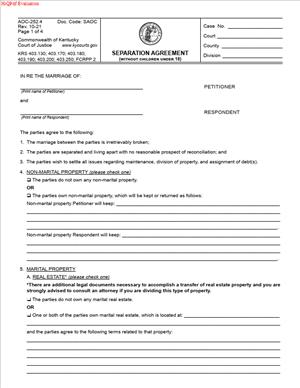
AOC-252.4 – Separation Agreement (Without Children Under 18)
Fill out nowJurisdiction: Country: United States | Province or State: Kentucky
AOC-252.4 – Separation Agreement (Without Children Under 18) is a court form used in Kentucky when married spouses decide to separate and settle their financial and property issues without minor children involved. It allows you to put your agreement in writing in a format recognized by the court.
If you are preparing for a divorce and you and your spouse agree on how to divide property and handle debts, this document helps formalize that understanding. It becomes part of the court record if submitted with your divorce paperwork.
This form matters because it outlines who gets what and who is responsible for which obligations. Clearly written terms reduce misunderstandings later.
If you are representing yourself, you may be looking at this form and wondering what details the court expects. Understanding its structure makes completion more manageable and helps you avoid delays.
What is AOC-252.4 – Separation Agreement (Without Children Under 18)?
Clear definition
AOC-252.4 – Separation Agreement (Without Children Under 18) is a standardized Kentucky court document that records an agreement between spouses who are separating and do not have children under 18. It addresses property division, debts, and related financial matters.
It is not a petition to start a divorce. Instead, it is a written contract between spouses that can be submitted to the court as part of a divorce case. Once accepted by the court, it may be incorporated into the final divorce decree.
The form provides structured sections so both spouses can clearly state their decisions. This format helps the court review the agreement efficiently.
Who typically uses this form?
Married couples in Kentucky who have already reached an agreement about their property and debts often use this form. It is commonly used in uncontested divorce cases.
Spouses who have no children under 18 use this specific version. If minor children are involved, a different form is generally required because child custody and support must be addressed separately.
Self-represented individuals frequently rely on this document when they want to avoid extended disputes and keep the process straightforward.
Why might you need this form?
You may need this form if you and your spouse agree on how to divide marital property and responsibility for debts. The court typically requires a clear written agreement before finalizing a divorce.
Without a written agreement, the court may need to decide these issues for you. That can involve additional hearings and time.
A properly completed agreement can clarify who keeps certain assets, such as a house or vehicle. It can also specify who will pay credit card balances or loans.
This form provides a structured way to confirm that both parties understand and accept the terms.
Typical real-life scenarios
- You and your spouse decide to divorce after several years of marriage. You have a house, two vehicles, and joint credit card debt. After discussing it, you agree that one spouse will keep the house and refinance it, while the other keeps a vehicle and certain savings. This agreement is written into the form.
- You may be renting and have limited shared assets. You agree to divide furniture and close joint accounts. Even in simpler cases, putting the terms in writing avoids confusion about who takes which items.
- In some situations, one spouse agrees to pay a specific debt in exchange for receiving a larger share of another asset. The form allows you to clearly spell out those trade-offs.
- You might also use this form when you have been separated for some time and have already informally divided your property. The document formalizes what has already happened so the court can include it in the divorce decree.
When would you use AOC-252.4 – Separation Agreement (Without Children Under 18)?
You use AOC-252.4 – Separation Agreement (Without Children Under 18) when you are legally married in Kentucky, are seeking a divorce, and have no children under 18 from the marriage. It is most commonly used after both spouses have agreed on financial terms.
This form is typically prepared during the divorce process, not before filing. It is often submitted along with other required divorce documents or before the final hearing.
If both spouses want the court to adopt their agreement instead of having the judge divide property, this document becomes important. It shows the court that the issues have been resolved by mutual consent.
In uncontested cases, one spouse may draft the agreement and share it with the other for review. Both spouses then sign it before it is filed with the court.
The form may also be used when one spouse is the petitioner and the other is the respondent, but both agree on all financial terms. It reflects cooperation, even if only one person formally initiated the case.
Legal characteristics of AOC-252.4 – Separation Agreement (Without Children Under 18)
This document is generally treated as a contract between spouses. For it to be effective, both parties must voluntarily agree to the terms. Each spouse signs to confirm understanding and acceptance.
Clarity is critical. Vague descriptions of property or debts can cause problems. For example, saying “we will divide our debts fairly” does not explain who pays what. Courts usually look for specific details, such as account names, approximate balances, or clear descriptions of property.
Both spouses typically need to sign the agreement in the manner required by the form. If signatures are missing or incomplete, the court may reject it or request corrections.
The agreement must address all relevant property and debt issues. Leaving out significant assets or obligations can create disputes later. Full disclosure between spouses is commonly expected in separation agreements.
High-level requirements can vary by state, but in Kentucky, courts generally review agreements to ensure they are not unconscionable. This means the terms cannot be extremely one-sided or fundamentally unfair under the circumstances.
It is important to understand what this form does not do. It does not by itself grant a divorce. The court must issue a divorce decree. It also does not address child custody or child support, since it is specifically for couples without children under 18.
Is it legally binding?
A separation agreement like AOC-252.4 – Separation Agreement (Without Children Under 18) can become legally binding once both spouses sign it and the court incorporates it into the final divorce decree.
Before court approval, it is generally considered a contract between the spouses. After incorporation into the decree, its terms may be enforceable as part of a court order.
If one spouse later fails to follow the terms, the other may be able to seek enforcement through the court. However, enforceability often depends on whether the agreement was properly completed, signed, and accepted by the court.
Courts may decline to enforce an agreement if there is evidence of fraud, coercion, or significant nondisclosure of assets. Voluntary and informed consent is central to its validity.
How to fill out AOC-252.4 – Separation Agreement (Without Children Under 18)
Step 1 – Identify the court and case information
At the top of the form, enter the name of the appropriate Kentucky court and the county where the divorce case is filed. Fill in the case number if one has already been assigned. List the full legal names of both spouses exactly as they appear in the divorce case.
Step 2 – Confirm marital information
Provide basic details about the marriage, such as the date of marriage and current separation status if requested. Ensure the information matches what appears in your divorce petition or response. Consistency across documents helps avoid delays.
Step 3 – State that there are no children under 18
The form is specifically for couples without children under 18. Complete the section confirming that no minor children were born of the marriage or adopted during the marriage. Read this section carefully before signing to ensure it accurately reflects your situation.
Step 4 – Describe the division of real property
If you own real estate, such as a house or land, describe how it will be handled. Include the property address and clearly state which spouse will receive it or whether it will be sold. If one spouse will refinance or assume a mortgage, reflect that understanding in the space provided.
Step 5 – Divide personal property
List major items of personal property and indicate who will keep them. This can include vehicles, bank accounts, retirement accounts, furniture, or other significant assets. Use clear descriptions so there is no confusion about which items are covered.
Step 6 – Allocate debts and liabilities
Identify joint and individual debts and state who will be responsible for each. Include enough detail to distinguish between accounts, such as the type of debt and the creditor. Clear allocation reduces the risk of later disputes about payment responsibility.
Step 7 – Address maintenance if applicable
If the form includes a section about spousal maintenance, indicate whether either spouse will pay support and, if so, the agreed terms. If neither spouse will receive maintenance, reflect that agreement clearly in the designated area.
Step 8 – Review for completeness and accuracy
Before signing, read the entire document from start to finish. Check that all sections are filled in and that there are no blank spaces where information is required. Confirm that the terms match what both spouses discussed and agreed upon.
Step 9 – Sign and date the agreement
Both spouses sign and date the form in the spaces provided. Signatures confirm that each person understands and voluntarily agrees to the terms. Follow any instructions on the form regarding notarization or witnessing if required.
Step 10 – File with the court
After signing, submit the completed agreement to the court as part of your divorce case. Keep a copy for your records. Once the court reviews and incorporates the agreement into the divorce decree, it becomes part of the official order resolving your financial matters.
Legal terms you might encounter in AOC-252.4 – Separation Agreement (Without Children Under 18)
- Petitioner: The spouse who filed the court case. This title appears in the case caption at the top of the document. Make sure the name listed as Petitioner matches the name used in the court file.
- Respondent: The other spouse in the case. This person did not start the case but is a party to it. The Respondent’s name must be written exactly as it appears in the court record.
- Marital Property: Property acquired during the marriage. This can include a home, vehicles, bank accounts, retirement funds, and household items. In this document, you identify and divide marital property between you.
- Non-Marital Property: Property owned by one spouse before the marriage or received individually as a gift or inheritance. This document may state that certain property remains with the original owner and is not divided.
- Real Property: Land and anything attached to it, such as a house. If you own real estate together, the agreement must clearly state who keeps it or whether it will be sold.
- Personal Property: Movable items such as furniture, vehicles, electronics, jewelry, and bank funds. The form allows you to list how these items will be divided.
- Marital Debt: Debts incurred during the marriage. This can include mortgages, credit cards, personal loans, and tax obligations. The agreement specifies who is responsible for each debt.
- Maintenance: Also called spousal support. This is money one spouse may pay to the other after separation. The form allows you to state whether maintenance will be paid or waived.
- Incorporation: When the court includes your agreement in the final divorce decree. If incorporated, the terms become enforceable as part of the court’s order.
- Notarization: The process of signing the agreement in front of a notary public. The notary verifies your identity and confirms that you signed voluntarily.
FAQs
Do both of us have to sign this document?
Yes. This document reflects a mutual agreement, so both spouses must sign it. Signatures usually need to be notarized, which means you both sign in front of a notary who verifies your identity. If one person does not sign, the court will not treat it as a complete agreement.
When does the agreement become effective?
The agreement is typically effective once both parties sign it, unless you state a different effective date in the document. However, if it is filed with the court and incorporated into a divorce decree, it becomes enforceable as part of that court order. Check the section where you confirm the terms are voluntary and final.
What if we forget to list a bank account or debt?
If something is not listed, it may not be clearly assigned to either person. That can lead to disputes later. Before signing, review every account, loan, and asset to confirm it appears in the document and is clearly awarded or assigned.
Can we change the terms after we sign?
You can only change the terms if both spouses agree to modify the agreement. Any change should be put in writing and signed again. If the agreement has already been incorporated into a court order, you may need court approval to modify certain terms.
Do we need to attach additional pages?
Yes, if there is not enough space to fully describe the property or debts. If you attach extra pages, label them clearly and reference them in the main body of the form. Make sure both of you sign or initial any attachments if required.
Is AOC-252.4 – Separation Agreement (Without Children Under 18) the same as a divorce decree?
No. This form is your written agreement about how to divide property and debts, and whether maintenance will be paid. A divorce decree is the judge’s final order that legally ends the marriage. The court may incorporate this document into that decree.
What names should we use in the caption?
Use the exact legal names as they appear in the court case. The case number and party designations must match the court record. Do not use nicknames or informal versions of your names.
Will this document change what is listed in public records?
This document itself does not automatically change property titles or loan accounts. If real estate or vehicles are transferred, you may need to complete separate transfer documents. Filing AOC-252.4 – Separation Agreement (Without Children Under 18) with the court places it in the case record.
Checklist: Before, During, and After AOC-252.4 – Separation Agreement (Without Children Under 18)
Before
- Gather recent statements for all bank, retirement, and investment accounts.
- Locate deeds, vehicle titles, and loan documents.
- Make a complete list of household items of significant value.
- Write down all credit cards, loans, and tax debts.
- Confirm the correct court case number and party names.
- Decide whether maintenance will be requested or waived.
- Review any prior temporary court orders.
During
- Fill in the case caption exactly as shown in the court file.
- Clearly describe each piece of real estate, including the full address.
- Assign each bank account and retirement account to one spouse.
- State who will pay each listed debt.
- Indicate whether maintenance will be paid and the amount, if any.
- Add attachments if you need more space for detailed lists.
- Review every page together before signing.
- Sign in front of a notary if required.
After
- Make copies of the signed and notarized agreement.
- File the original with the court clerk if required in your case.
- Confirm the document was accepted and added to the court file.
- Keep a copy in a safe and accessible place.
- Begin transferring property as outlined in the agreement.
- Update account ownership and beneficiary designations where needed.
- Monitor debt payments to ensure they follow the agreement.
Common mistakes to avoid with AOC-252.4 – Separation Agreement (Without Children Under 18)
- Mistake: Leaving out small bank accounts or old debts because they seem minor, which happens when you rely on memory instead of statements, leading to future disputes over responsibility, so do not forget to review full financial records before signing.
- Mistake: Using vague language like “we will split everything evenly,” which happens when couples want simple wording, causing confusion about specific items later, so do not forget to clearly assign each asset and debt.
- Mistake: Forgetting to address retirement accounts, which often happens because they are not immediately visible like checking accounts, resulting in incomplete division of property. Do not forget to list each retirement plan by name.
- Mistake: Not updating the case caption correctly, which happens when copying from another document, leading to filing delays, so do not forget to match names and case numbers exactly.
- Mistake: Signing without notarization when required, which happens due to a misunderstanding of signature rules, causing rejection by the clerk, so do not forget to verify whether notarization is needed.
- Mistake: Assuming the agreement alone transfers property titles, which happens because the document feels final, leaving property legally unchanged, so do not forget to complete separate transfer paperwork if necessary.
- Mistake: Failing to keep a copy of the signed agreement, which happens in the rush to file, creating problems if questions arise later, so do not forget to store copies safely.
- Mistake: Agreeing to terms without reading every page carefully, which happens when trust replaces review, leading to unintended obligations, so do not forget to review each paragraph before signing.
What to do after filling out AOC-252.4 – Separation Agreement (Without Children Under 18)
Once you complete and sign the agreement, your work is not finished. You need to make sure the document is properly handled, filed if required, and carried out in real life.
Start by organizing the final version. Confirm that every page is included and that any attachments are clearly labeled. Check that both signatures appear where required and that notarization is complete if applicable.
- Step 1: Make at least two copies of the fully signed agreement, one for you and one for your spouse.
- Step 2: Review your court instructions to confirm whether you must file the agreement with the clerk.
- Step 3: Submit the original signed document to the clerk if filing is required in your case.
- Step 4: Ask the clerk to stamp your copy as filed, or request confirmation that it has been entered into the record.
- Step 5: Store your copy in a secure place along with other important legal documents.
- Step 6: Begin transferring property as outlined, such as signing vehicle titles or preparing deeds if real estate is involved.
- Step 7: Contact financial institutions to update account ownership if accounts are being closed or transferred.
- Step 8: Refinance or close joint debts if the agreement assigns responsibility to only one spouse.
- Step 9: Update automatic payments to reflect who is responsible for each debt.
- Step 10: Review your beneficiary designations on retirement accounts and insurance policies to ensure they reflect your current wishes.
Take action promptly. Delays in transferring property or updating accounts can create confusion and financial risk. If the agreement is incorporated into a divorce decree, monitor the case until the final order is entered. Once the decree is issued, confirm that it reflects the terms you agreed to.
Keep communication clear and professional during this stage. Even if the agreement is signed, cooperation may still be necessary to complete transfers or close accounts. Staying organized now helps prevent problems later.
Disclaimer: This guide is provided for informational purposes only and is not intended as legal advice. You should consult a legal professional.