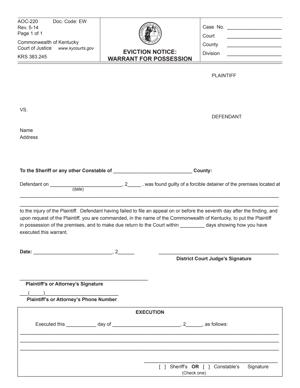
AOC-220 – Eviction Notice – Warrant for Possession
Fill out nowJurisdiction: Country: United States | Province or State: Kentucky
The AOC-220 -Eviction Notice – Warrant for Possession is a court-issued document used in Kentucky eviction cases. It is not the first notice in the process. It comes after a judge has entered a judgment for possession in favor of a landlord.
If you are filling out or reviewing this form, you are likely involved in a court-ordered eviction. This document gives legal authority for law enforcement to restore possession of rental property to the landlord.
For tenants, it signals that the case has moved past the hearing stage. For landlords, it is the step that allows enforcement of a court’s decision. It is part of the official record in the Commonwealth of Kentucky, Court of Justice.
Understanding how this form works helps you avoid confusion at a critical stage. It affects timelines, property access, and next steps for both parties.
What is AOC-220 -Eviction Notice – Warrant for Possession?
Clear definition
AOC-220 -Eviction Notice – Warrant for Possession is a court form used in Kentucky to authorize the removal of a tenant from rental property after a judgment for possession has been entered. It is sometimes referred to simply as a “warrant for possession.”
This document directs the appropriate law enforcement officer, often a sheriff or constable, to restore possession of the premises to the landlord. It is issued by the court, not by the landlord.
The form includes case information, the names of the parties, the property address, and the date of the underlying judgment. It confirms that the court has already ruled and that the time for voluntary compliance has passed or is about to pass.
Who typically uses this form?
The form is typically used by landlords or property owners who have won an eviction case in district court. After the court enters a judgment for possession, the landlord may request issuance of this warrant.
Court clerks process the document as part of the case file. A judge’s prior order or judgment is required before the warrant can be issued.
Law enforcement officers rely on this form to carry out the physical eviction. Tenants may receive or be served with notice related to the warrant as part of the enforcement process.
Why might you need this form?
You might need this form if you are a landlord and the tenant has not vacated the property after the court awarded you possession. The judgment alone does not remove the tenant. Enforcement requires a warrant.
You may also encounter this form if you are a tenant who lost an eviction case. It means the court has authorized removal from the property.
The form provides legal authority for law enforcement to act. Without it, a landlord cannot lawfully carry out a forced removal.
Typical real-life scenarios
- A landlord files an eviction for nonpayment of rent. The court holds a hearing and enters judgment for possession in favor of the landlord. The tenant does not move out within the allowed time. The landlord requests issuance of the warrant for possession.
- A lease ends, and the tenant remains in the unit without renewing. The landlord obtains a court order for possession. The tenant stays beyond the deadline. The warrant is issued so law enforcement can restore possession.
- A tenant violates a lease term, such as keeping an unauthorized occupant. The landlord files an eviction action and wins in court. The tenant disputes the outcome but does not vacate. The warrant is used to enforce the judgment.
- A property changes ownership after foreclosure. The new owner seeks possession through court proceedings. After judgment, the warrant authorizes the removal of occupants who remain in the property.
When would you use AOC-220 -Eviction Notice – Warrant for Possession?
You would use this form only after a court has entered a judgment for possession. It is not part of the initial eviction filing. It comes later in the process.
In Kentucky eviction cases, there is typically a sequence. First, the landlord files a complaint. A hearing is scheduled. The court decides whether the landlord is entitled to possession. If the court rules in the landlord’s favor, it enters a judgment.
If the tenant does not vacate within the time allowed by the court or by statute, the landlord may request issuance of the warrant. At that point, the AOC-220 -Eviction Notice – Warrant for Possession becomes relevant.
Tenants may encounter this document after the judgment stage. It signals that enforcement is moving forward. It is not a negotiation notice or a warning letter. It is a court enforcement tool.
Property managers, attorneys, and individual landlords may be involved in preparing or requesting this document. Court staff review and issue it according to the court’s procedures.
Legal characteristics of AOC-220 -Eviction Notice – Warrant for Possession
This form is effective only if there is an underlying judgment for possession. The warrant relies on that judgment. If the judgment is missing, incorrect, or stayed, the warrant may not be enforceable.
For the document to be valid, it generally must contain accurate case information. This includes the correct case number, names of the parties, and property address. Errors in these details can cause delays or rejection by the clerk.
The warrant must be issued by the court. A landlord cannot create a substitute document and expect law enforcement to act on it. The authority comes from the court’s official issuance.
Timelines matter. In many eviction cases, there is a short period between the judgment and the issuance of the warrant. If an appeal or motion affects the judgment, that may impact when or whether the warrant can be executed.
This form does not determine whether the eviction was justified. That decision was made at the hearing. The warrant does not award money damages, unless tied to a separate judgment. It focuses on possession of the property.
High-level procedures can vary between jurisdictions in how warrants are scheduled or executed. However, in Kentucky, the authority flows from the district court’s judgment and the formal issuance of the warrant.
Is it legally binding?
Yes, once properly issued by the court, the warrant for possession is legally binding. It carries the authority of the court’s prior judgment.
It is binding on the parties named in the case. It directs law enforcement to act according to its terms. It is not a private agreement between landlord and tenant.
The binding effect depends on proper issuance and service procedures. If the underlying judgment is valid and no legal barrier prevents enforcement, the warrant authorizes removal of occupants from the premises.
If the judgment is later altered, appealed, or stayed, that can affect the enforceability of the warrant. The warrant does not stand alone. Its authority depends on the status of the case.
How to fill out AOC-220 -Eviction Notice – Warrant for Possession
Step 1 – Confirm the Judgment for Possession
Before completing the form, review the court record. Make sure a judgment for possession has been entered in your favor. Check the case number, the date of judgment, and the exact names of the parties. The information on the warrant must match the court’s record exactly.
Step 2 – Enter the Case Caption Information
At the top of the form, fill in the court name and county as shown in the case file. Enter the case number exactly as assigned. List the plaintiff and defendant names as they appear in the original complaint and judgment. Avoid abbreviations that do not match the official record.
Step 3 – Identify the Property
Provide the full address of the rental property. Include unit numbers, apartment numbers, or lot numbers if applicable. The address must clearly identify the premises covered by the judgment. Inaccurate property details can delay enforcement.
Step 4 – Reference the Date of Judgment
Insert the date on which the court entered the judgment for possession. This connects the warrant to the specific court order. Ensure the date matches the signed judgment in the file.
Step 5 – Review the Command to Law Enforcement
Read the section directing the sheriff or other authorized officer to restore possession to the plaintiff. Confirm that the language reflects the court’s order. Do not alter standard language unless directed by court personnel.
Step 6 – Complete Any Required Request Section
If the form includes a request portion for issuance, fill in your name and contact information as the requesting party or representative. Provide accurate contact details so the court or law enforcement can reach you if needed.
Step 7 – Leave Signature Lines for Court Officials
Do not sign in areas reserved for the judge or clerk. Those sections are completed by court officials when the warrant is issued. Signing in the wrong place can invalidate the submission.
Step 8 – File the Form with the Court Clerk
Submit the completed form to the clerk of the district court where the case was heard. The clerk reviews the information for accuracy and completeness. Once approved and issued, the warrant becomes part of the official court record and may be forwarded for service and execution.
Legal terms you might encounter in AOC-220 -Eviction Notice – Warrant for Possession
- Warrant for Possession: This is the court’s written command directing law enforcement to return possession of the property to the landlord. This document, it reflects that a judge has already granted a judgment for possession. It authorizes the physical enforcement of that judgment.
- Judgment for Possession: This is the court’s decision that the landlord is entitled to take back the rental property. The warrant is based on this judgment. You will see the judgment date referenced because enforcement depends on it.
- Case Caption: The caption appears at the top of the form and lists the court name, county, case number, and the names of the parties. It must match the original eviction case exactly. Any mismatch can delay enforcement.
- Plaintiff: The plaintiff is the party who filed the eviction case, usually the landlord or property owner. The plaintiff’s name must appear exactly as it does in the court record. Even small spelling differences can create confusion.
- Defendant: The defendant is the tenant or occupant named in the eviction action. The warrant applies to this person and anyone occupying under them. The name must match the judgment for possession.
- Court Clerk: The clerk processes filings and issues official court documents. In this process, the clerk typically prepares or certifies the warrant after the judge authorizes it. You should not sign in place of the clerk.
- Sheriff or Law Enforcement Officer: This is the official responsible for serving and executing the warrant. The document commands this officer to remove occupants if they do not leave voluntarily. The officer carries out the physical enforcement.
- Service: Service refers to delivering the warrant to the tenant. Proper service is required before law enforcement can carry out the eviction. The method and timing of service are recorded in the court process.
- Execution Date: This is the date law enforcement carries out the eviction under the warrant. It may not be the same as the date the warrant is issued. You should confirm how the execution date will be scheduled.
- Restoration of Possession: This phrase describes the landlord being placed back in control of the property. It is the end result of enforcing the warrant. The document exists to make this restoration lawful and official.
FAQs
When does this document become effective?
This document becomes effective after a judge has entered a judgment for possession and the clerk issues the warrant. The effective date is tied to the court’s authorization, not the day you request it. Check the judgment date and confirm that any required waiting period has passed before asking the clerk to issue it.
Do I need to fill out the entire AOC-220 -Eviction Notice – Warrant for Possession myself?
In many cases, the clerk prepares or completes most of the form once the judgment is entered. You may need to verify names, the property address, and the case number. Do not sign or complete sections reserved for the judge, clerk, or law enforcement.
What if the tenant’s name is spelled differently on the judgment and on this document?
The names should match the court’s official record exactly. If you notice a difference, ask the clerk how to correct it before the warrant is issued. Mismatched names can delay enforcement or create disputes about who is authorized to be removed.
Can the tenant stop the eviction after this document is issued?
A tenant may file motions or appeals that affect enforcement. If something is filed, it may pause or delay execution. Before scheduling enforcement, confirm with the clerk whether any new court orders affect the status of this document.
How do I know if law enforcement has received the warrant?
After issuance, the clerk typically forwards the warrant to the appropriate law enforcement office. You can contact the clerk to confirm it was transmitted. You may also check with the sheriff’s office to confirm receipt and ask about scheduling procedures.
What property address should appear on this document?
The address must match the rental unit listed in the original eviction complaint and judgment. Include unit numbers or specific identifiers if they were part of the case. An incomplete or incorrect address can prevent proper enforcement.
Is there a deadline to act once the warrant is issued?
There is usually a limited period during which the warrant can be executed. If too much time passes, you may need further court action. Ask the clerk how long this document remains valid and monitor the timeline closely.
Will this document become part of the public court record?
Yes, once issued and filed, it becomes part of the case file. That means the issuance and execution may appear in the court record. If you review the docket, you should see entries reflecting the warrant and any return of service.
Checklist: Before, During, and After AOC-220 -Eviction Notice – Warrant for Possession
Before
- Confirm that a judgment for possession has been entered in your favor.
- Verify the full and correct case number from the court record.
- Check that the plaintiff and defendant names match the judgment exactly.
- Confirm the complete property address, including the unit number if applicable.
- Make sure any required waiting period after judgment has passed.
- Review the court docket for any motions, appeals, or stays.
- Gather a copy of the signed judgment for your records.
- Contact the clerk to ask about the process for issuing the warrant.
During
- Provide the clerk with accurate case details when requesting issuance.
- Review the form carefully before it is finalized.
- Confirm that the judgment date is correctly listed.
- Ensure you do not sign in sections reserved for court officials.
- Ask how and when the warrant will be sent to law enforcement.
- Clarify any service requirements or scheduling procedures.
- Request copies of the issued warrant for your records.
- Note any fees associated with issuance or enforcement.
After
- Confirm that law enforcement has received the warrant.
- Ask about the expected timeline for service and execution.
- Keep copies of the issued warrant and related receipts.
- Prepare to secure the property after enforcement.
- Bring identification and proof of ownership or authority on the execution date if required.
- Document the condition of the property once possession is restored.
- Update your internal records to reflect the change in possession.
- Monitor the court docket for a return of service or execution entry.
Common mistakes to avoid with AOC-220 -Eviction Notice – Warrant for Possession
- Mistake: Requesting the warrant before a judgment for possession is officially entered, which happens when you assume the hearing outcome is enough; this can lead to rejection by the clerk and wasted time, so do not forget to verify the signed judgment date in the court record.
- Mistake: Listing an incomplete or incorrect property address because you rely on memory; this can delay or prevent enforcement, so do not forget to copy the exact address from the complaint and judgment.
- Mistake: Misspelling a party’s name due to minor differences in prior documents; this may create identification issues during enforcement, so do not forget to match the spelling exactly as shown in the case caption.
- Mistake: Signing or altering sections reserved for the judge or clerk because you want to speed up the process; this can invalidate the document, so do not forget to leave official signature lines blank.
- Mistake: Ignoring possible appeals or motions filed after judgment because you assume the case is over; this can result in a paused eviction, so do not forget to review the docket before scheduling enforcement.
- Mistake: Failing to follow up with law enforcement after issuance because you expect automatic scheduling; this may cause delays, so do not forget to confirm receipt and ask about next steps.
- Mistake: Waiting too long to act on an issued warrant due to uncertainty about timelines; this can require additional court action, so do not forget to ask how long the warrant remains valid.
What to do after filling out AOC-220 -Eviction Notice – Warrant for Possession
Once the form is properly completed and issued, your focus shifts to coordination and documentation. The goal is to make sure enforcement happens smoothly and that you are prepared to take possession lawfully and safely.
Start by organizing your paperwork. Keep the judgment for possession, a copy of the issued warrant, and any payment receipts together in one file. You may need to show these documents to court staff or law enforcement.
- Step 1: Confirm with the clerk that the warrant has been officially issued and entered into the case record.
- Step 2: Verify that the warrant has been transmitted to the appropriate law enforcement office.
- Step 3: Contact the sheriff or designated office to ask about scheduling and procedures.
- Step 4: Ask what you are expected to bring on the day of execution, such as identification or proof of authority.
- Step 5: Arrange for a locksmith if you anticipate needing to change locks after possession is restored.
- Step 6: Plan how you will handle any personal property left behind, consistent with court orders or local procedures.
- Step 7: Be present at the scheduled time if required, but allow law enforcement to lead the process.
- Step 8: After possession is restored, secure the property immediately.
- Step 9: Take clear photos or videos of the property’s condition.
- Step 10: Update your rental records to show the date possession was returned.
- Step 11: Review the court docket to confirm that a return of service or execution has been recorded.
- Step 12: Store all documents related to the eviction in a secure place for future reference.
After enforcement, act promptly but calmly. Change locks if necessary. Inspect the unit. Document any damage. Update your accounting records to reflect the end of the tenancy.
Keep your communication professional. If former tenants contact you about retrieving belongings, handle those communications in a documented and consistent way. Maintain written records of any arrangements.
Finally, close the loop on your court file. Make sure the execution is reflected in the docket. Keep copies of everything. Accurate records protect you if questions come up later about how possession was restored.
Disclaimer: This guide is provided for informational purposes only and is not intended as legal advice. You should consult a legal professional.