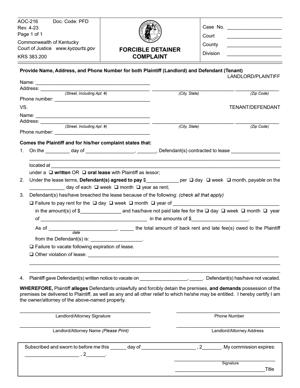
AOC-216 – Forcible Detainer Complaint
Fill out nowJurisdiction: Country: United States | Province or State: Kentucky
The AOC-216 – Forcible Detainer Complaint is a court form used in Kentucky when a property owner or landlord is asking the court to remove someone from a rental property. It starts a legal eviction case in the district court.
If you are about to fill it out, you are likely dealing with a tenant who has not moved out after notice was given. This form is the first formal step in asking a judge to order possession of the property returned to you.
The document is short, but it carries serious consequences. Once filed, it leads to a court hearing. The tenant will have an opportunity to respond, and a judge will decide whether the eviction can move forward.
Understanding what this form does—and what it does not do—helps you complete it accurately. Small errors can delay your case or require you to refile.
This guide explains what the AOC-216 – Forcible Detainer Complaint is, when it is used, and how to fill it out clearly and correctly.
What is AOC-216 – Forcible Detainer Complaint?
Clear definition
The AOC-216 – Forcible Detainer Complaint is a formal written request to a Kentucky district court asking for possession of real property. In plain terms, it tells the court that someone is occupying your property and you want the court to order them to leave.
“Forcible detainer” is the legal term used in Kentucky for this type of eviction action. The form begins a court case. It does not, by itself, remove a tenant. It triggers the legal process that can lead to a court order.
The form identifies the parties, the property address, and the reason the person is being asked to leave. It also states that proper notice was given, if required.
Who typically uses this form?
This form is usually completed by a landlord or property owner. It may also be used by a property manager acting on behalf of the owner.
In some situations, a purchaser of property at a foreclosure sale may use it if the prior occupant refuses to leave. An estate representative may also use it if a former tenant remains in possession without legal right.
Most people who fill out this form are not lawyers. It is commonly used by self-represented landlords in the district court.
Why might you need this form?
You may need this form if a tenant has not paid rent and has not moved out after notice. Nonpayment is one of the most common reasons for filing.
You may also need it if the lease has ended and the tenant stays without signing a new agreement. When a tenancy expires, and the occupant refuses to vacate, this form starts the court process.
Another reason may involve a violation of the lease, such as unauthorized occupants or other breaches. If the issue is not resolved after proper notice, the landlord may turn to the court.
In each situation, the form is used to ask the court for possession of the property, not to collect rent alone.
Typical real-life scenarios
- A tenant stops paying rent for two months. You give written notice as required under the lease. The tenant remains in the unit and does not pay. You use this form to begin the eviction case.
- A one-year lease ends. The tenant does not move out and does not sign a renewal. You want the property back to rent to someone else. The form allows you to ask the court for possession.
- You sell a property with a tenant in place, but the tenancy has already expired. The occupant refuses to leave after notice. The new owner may file this complaint to regain possession.
- A tenant violates a material term of the lease, such as keeping a prohibited pet or allowing unauthorized residents. After notice and no correction, the landlord may file the complaint to seek removal.
- In each example, the key issue is possession. The person in the property remains without legal right, and the property owner is asking the court to intervene.
When would you use AOC-216 – Forcible Detainer Complaint?
You use this form when informal efforts to resolve the occupancy issue have failed. It is generally the next step after the required notice has been given and the occupant has not complied.
The timing depends on the reason for eviction. In many cases, notice must be provided before filing. The form itself includes space to indicate that notice was given and when.
Landlords most often use it after nonpayment of rent. It is also used after lease termination for other reasons. The key condition is that the occupant remains in possession of the property.
Property owners use it when they want a court hearing. Filing the complaint schedules a date for both sides to appear before a judge.
You would not use this form simply to demand late rent while allowing the tenant to stay. Its purpose is to regain possession, even though unpaid rent may be mentioned in the case.
If the occupant has already moved out voluntarily and returned the keys, this form is typically not needed. It addresses ongoing possession disputes.
Legal characteristics of AOC-216 – Forcible Detainer Complaint
This document is a court pleading. That means it formally presents your claim to a judge. Once filed with the district court clerk, it becomes part of an official court case.
For the complaint to be effective, it must clearly identify the correct parties and the correct property address. Errors in names or addresses can create confusion or delay service.
The form must be signed by the person filing it. The court also requires payment of a filing fee at submission. Without filing and acceptance by the clerk, the case does not move forward.
Service of the complaint is an important step. The defendant must receive notice of the court date. If the service is not completed properly, the hearing may be postponed.
Common problems include listing the wrong tenant, failing to include all adult occupants, or stating incorrect dates. Inconsistent information between the lease, notice, and complaint can raise questions at the hearing.
Different counties may have slightly different administrative procedures, such as scheduling methods or local filing practices. However, the core purpose of the form remains the same across Kentucky.
It is important to understand what the complaint does not do. It does not physically remove a tenant. It does not automatically grant you possession. Only a court order after a hearing can authorize further enforcement steps.
The form also does not resolve disputes about property damage or large monetary claims beyond possession. Those issues may require separate filings, depending on the circumstances.
Is it legally binding?
The AOC-216 – Forcible Detainer Complaint itself is not a final order. It becomes legally significant once it is filed with the court and served on the defendant.
When properly filed, it creates a pending legal case. Both parties are then required to appear in court on the scheduled date or risk a default decision.
The document is legally effective as a pleading because it invokes the authority of the district court. By signing it, you are formally stating that the facts in the complaint are true to the best of your knowledge.
If the judge grants possession after the hearing, that court order is legally binding. The complaint is the step that leads to that order, but it is not the order itself.
How to fill out AOC-216 – Forcible Detainer Complaint
Step 1 – Enter the Court Information
At the top of the form, fill in the name of the county where the property is located. This identifies the correct district court. Eviction cases are generally filed in the county where the real property sits, not where you live.
Write the full county name clearly. The clerk will use this information to assign a case number after filing.
Step 2 – Identify the Plaintiff
In the section labeled for the plaintiff, enter your full legal name. If you own the property jointly, include all owners as listed on the deed or lease.
If a company owns the property, use the full legal business name. Be consistent with how the name appears on the lease agreement.
Provide your address and contact information as requested on the form. This allows the court to send notices and copies of filings.
Step 3 – Identify the Defendant
In the defendant section, list the full legal name of each adult occupant you are seeking to remove. Use the names exactly as they appear on the lease, if possible.
If more than one tenant signed the lease, include each of them. If you know the names of additional adult occupants, list them as well.
Accurate names are important for proper service. Incorrect or incomplete names may delay the case.
Step 4 – Provide the Property Address
Enter the complete street address of the rental property. Include unit or apartment numbers if applicable.
Be precise. The court order, if granted, will refer to this address. Any error can create confusion about which property is involved.
This address must match the property described in your lease and any prior written notice.
Step 5 – State the Grounds for Forcible Detainer
In the section describing why the defendant is unlawfully detaining the property, briefly state the reason. Common reasons include nonpayment of rent or termination of the lease.
Include relevant dates, such as when rent became overdue or when the lease ended. Keep the statement factual and clear.
If notice was required, indicate that notice was given and the date it was delivered. The form may provide a specific space to include this information.
Step 6 – State the Relief Requested
The complaint asks what you are requesting from the court. Typically, this includes possession of the property.
If the form allows space for rent owed or costs, enter the amounts carefully. Use accurate figures based on your records.
Review this section to ensure it reflects what you are asking the judge to award at the hearing.
Step 7 – Review for Accuracy
Before signing, read through the entire document. Check spelling of names, dates, and the property address.
Confirm that the information matches your lease and any written notices. Consistency strengthens clarity at the hearing.
Make sure no required field is left blank. Incomplete forms may be rejected by the clerk.
Step 8 – Sign and Date the Form
Sign your name where indicated. Print your name below your signature if the form requests it.
Add the date of signing. Your signature confirms that the information provided is true to the best of your knowledge.
If you are signing on behalf of a business entity, indicate your title or role if space is provided.
Step 9 – File the Complaint with the Court Clerk
Take the completed form to the district court clerk in the county where the property is located. Submit the document and pay the required filing fee.
The clerk will assign a case number and schedule a court date. The complaint will then be processed for service on the defendant.
Keep a copy of the filed document and any receipt for your records. These documents will be important at the hearing.
Legal terms you might encounter in AOC-216 – Forcible Detainer Complaint
- Forcible Detainer: This is the legal claim you are making. It means the person in possession of the property is unlawfully holding it after their right to stay has ended. On this form, you are asking the court to recognize that the occupant no longer has a legal right to remain.
- Plaintiff: The plaintiff is the person or entity filing the complaint. If you are the landlord or property owner seeking possession, you are the plaintiff. Your full legal name must appear exactly as it should be listed in court records.
- Defendant: The defendant is the person you claim is unlawfully occupying the property. You must list every adult occupant you want removed. The court can only issue orders against the individuals named in this document.
- Premises: This refers to the rental property at issue. The form requires a complete address, including the unit number if applicable. Accuracy matters because the court order will apply only to the premises identified.
- Notice to Vacate: This is the written notice you gave the occupant before filing the complaint. It informs them that their right to remain has ended and gives them a deadline to leave. The date and method of delivery may be relevant to the court’s review.
- Possession: Possession means the legal right to control and occupy the property. Through this complaint, you are asking the court to restore possession to you. The court focuses on possession, not broader contract disputes.
- Summons: After you file, the court typically issues a summons. This is the official notice telling the defendant when and where to appear. Without proper service of the summons, the case cannot move forward.
- Judgment for Possession: This is the court’s formal decision that you are entitled to the property. If granted, it allows you to request enforcement through the appropriate court process. The judgment is based on the information and testimony presented.
- Warrant for Possession: If the defendant does not leave after judgment, the court may issue this document. It authorizes law enforcement to remove the occupant. You must follow the court’s procedures to request it.
- Service of Process: This is the formal delivery of court papers to the defendant. The court requires proof that the defendant was properly notified. Incorrect service can delay or dismiss your case.
FAQs
What information do I need before I start filling out this form?
You need the full legal names of all tenants or occupants you want removed, the complete property address, and details about the lease or rental agreement. You should also have the date the tenancy ended and the date you gave any required notice. The court will rely on what you enter, so confirm spelling, dates, and numbers before you write them on the document.
Do I need to attach a copy of the lease or notice to vacate?
You may be required to bring supporting documents to the hearing, even if they are not physically attached when you file. It helps to have a copy of the lease, written notices, and proof of delivery. The judge may ask you to confirm the date the notice was given and what it said.
What if I do not know the full name of one of the occupants?
You should make a reasonable effort to identify every adult occupant. If you leave someone out, the court’s order may not apply to that person. That can delay your ability to recover full possession of the property.
How do I know if the court accepted my AOC-216 – Forcible Detainer Complaint?
When you file, the clerk will review the document for completeness and collect the filing fee. If accepted, the clerk will assign a case number and schedule a hearing date. Keep the stamped copy because it confirms the case is officially opened.
What date should I list as the reason for the filing?
You should list the specific date the tenant’s right to remain ended. That might be the date rent was due and not paid, or the date given in your notice to vacate. Make sure the date you enter matches your written records and any notice you provided.
Can I include unpaid rent on this document?
This document primarily focuses on possession of the property. If you are seeking unpaid rent, there may be a section where you can state the amount owed, or you may need a separate claim. Review the form carefully so the amount you list is accurate and supported by your records.
What happens if the defendant moves out after I file?
If the occupant leaves before the hearing, you should still appear in court unless you are told otherwise. The court may need to formally close the case or address any remaining claims. Bring confirmation that the property has been returned to you.
Will this filing become part of the public record?
Yes. Once filed, the information in this document becomes part of the court record. That includes the names of the parties, the property address, and the claim for possession. Make sure all information is accurate because it may appear in background checks or court searches.
Checklist: Before, During, and After AOC-216 – Forcible Detainer Complaint
Before
- Confirm the legal names of all tenants and adult occupants.
- Review the lease or rental agreement for key dates and terms.
- Prepare a copy of the notice to vacate and proof of delivery.
- Verify the full and correct property address, including unit number.
- Calculate any unpaid rent or damages you plan to claim.
- Check that the notice period has expired before filing.
- Gather identification and any documents you may need at filing.
During
- Print clearly or type all information to avoid misreading.
- Enter the court name and county correctly.
- List yourself exactly as you want to appear in court records.
- Double-check the spelling of each defendant’s name.
- State the grounds for forcible detainer clearly and briefly.
- Review all dates for consistency with your documents.
- Sign and date the complaint where required.
- Make copies before submitting the original.
After
- Obtain a stamped copy with the case number from the clerk.
- Note the hearing date, time, and courtroom.
- Confirm how the service of process will be completed.
- Organize your evidence for the hearing.
- Mark deadlines related to requesting a warrant if needed.
- Keep all court documents in one secure file.
- Update your rental records to reflect the pending case.
- Attend the hearing on time and prepared.
Common mistakes to avoid with AOC-216 – Forcible Detainer Complaint
- Mistake: Listing only one tenant when multiple adults live in the unit, which happens when you rely on memory instead of the lease, leading to incomplete enforcement of a court order; do not forget to name every adult occupant you want removed.
- Mistake: Entering the wrong property address because of copying errors, which can cause confusion or dismissal; do not forget to include the full address and unit number exactly as shown on the lease.
- Mistake: Filing before the notice period expires, often due to a misunderstanding of deadlines, which may result in the case being dismissed; do not forget to count the days carefully from the date notice was delivered.
- Mistake: Stating an incorrect amount of unpaid rent due to poor recordkeeping, which can weaken your credibility in court; do not forget to verify your payment ledger before writing any figures.
- Mistake: Forgetting to sign and date the complaint, which happens when rushing at the clerk’s office, causing filing delays; do not forget to review the signature section before submission.
- Mistake: Failing to appear at the hearing because you assume filing is enough, which can result in dismissal of your case; do not forget to calendar the hearing date immediately after filing.
- Mistake: Bringing no supporting documents to court, often because you believe the form alone is sufficient, which limits your ability to answer the judge’s questions; do not forget to organize and carry copies of the lease and notices.
- Mistake: Ignoring service requirements, assuming the court will handle everything automatically, which can delay the case if service is not completed properly; do not forget to confirm how and when the defendant is served.
What to do after filling out AOC-216 – Forcible Detainer Complaint
Once you complete the form, slow down and review it line by line. Make sure every name is spelled correctly, and every date matches your records. Small errors can create delays.
- Step 1: Make at least two copies of the completed complaint before filing.
- Step 2: File the original with the appropriate court clerk and pay the required filing fee.
- Step 3: Obtain a stamped copy showing the case number and hearing date.
- Step 4: Confirm how service of process will be completed and note any tracking information.
- Step 5: Create a hearing folder with the lease, notices, payment history, and communication records.
- Step 6: Mark the hearing date on your calendar and set reminders a few days before.
- Step 7: Check the court docket, if available, to confirm service has been completed.
- Step 8: Attend the hearing on time, dressed appropriately, and ready to present clear facts.
- Step 9: If you receive a judgment for possession, ask the clerk about the next procedural step if the occupant does not leave.
- Step 10: Update your internal property records to reflect the court’s decision and store all documents securely.
Stay organized throughout the process. Keep every document related to the tenancy and the court case together. Accurate records help you respond confidently to questions and protect your position if issues arise later.
Disclaimer: This guide is provided for informational purposes only and is not intended as legal advice. You should consult a legal professional.