AOC-215 – Eviction Notice – Notice of Eviction Hearing Trial by the Court
Fill out nowJurisdiction: Country: United States | Province or State: Kentucky
If you have received or are expecting AOC-215 – Eviction Notice – Notice of Eviction Hearing Trial by the Court, you are dealing with a court-scheduled eviction hearing in Kentucky. This document is not just a warning. It is a formal notice from the court.
AOC-215 – Eviction Notice – Notice of Eviction Hearing Trial by the Court tells you when and where your eviction case will be heard. It connects the landlord’s eviction filing to an actual court date. It also alerts you that a judge will decide the case if it goes forward.
You may receive this form as a tenant being sued for eviction. You may also encounter it as a landlord who has started the eviction process and is waiting for a hearing. Either way, this document signals that the matter is now before the court.
Understanding what this form means helps you prepare. It explains the timeline, the hearing setting, and the next procedural step. Missing or misunderstanding it can lead to serious consequences in your housing situation.
This guide explains what the form is, when it is used, what makes it valid, and how it is typically completed.
What is AOC-215 – Eviction Notice – Notice of Eviction Hearing Trial by the Court?
Clear definition
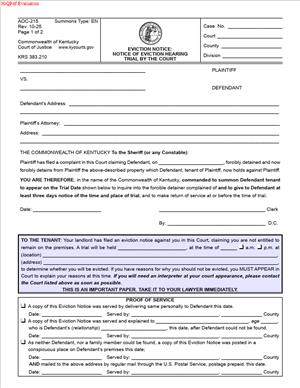
AOC-215 – Eviction Notice – Notice of Eviction Hearing Trial by the Court is a court-issued document used in Kentucky eviction cases. It provides official notice that a hearing or trial has been scheduled before a judge.
The form includes key details such as the names of the parties, the case number, the court location, and the date and time of the hearing. It serves as confirmation that the eviction complaint has moved forward in the court system.
This document is part of the formal eviction process. It is not the initial lease violation notice from a landlord. Instead, it comes after a case has been filed with the court.
Who typically uses this form?
This form is typically issued by the Kentucky Court of Justice after a landlord files an eviction complaint. Court staff prepare or process it as part of the case scheduling.
Landlords use the form to confirm the hearing date and ensure the tenant is notified. Tenants receive it to understand when they must appear in court.
Attorneys may handle the filing and service of the document for either party. Self-represented individuals often rely directly on the information in this notice to track their case.
Why might you need this form?
You need this form if you are involved in an eviction case that has been formally filed in court. It provides the specific hearing information required to participate in the process.
For tenants, it tells you when you must appear to respond to the eviction claim. If you do not appear, the court may proceed without you.
For landlords, it confirms the date you must attend to present your claim for possession of the property. Without attending the hearing, your case may be delayed or dismissed.
The form also creates a record that notice of the hearing was generated. Proper notice is a core part of due process in eviction proceedings.
Typical real-life scenarios
- A landlord claims that a tenant has not paid rent and files an eviction complaint in district court. After the filing, the court issues a hearing date. AOC-215 – Eviction Notice – Notice of Eviction Hearing Trial by the Court is generated to inform both parties of that date.
- A tenant receives a copy of this document by service and learns that a hearing is set within a short time frame. The tenant reviews the form to confirm the courtroom and time, then prepares to attend.
- A property owner files for eviction based on a lease violation unrelated to rent, such as unauthorized occupants. The court schedules the case quickly. The form provides the official details for the upcoming trial before the judge.
- In some cases, the landlord and tenant are discussing a settlement. Even while those talks continue, the hearing date remains in place. The notice ensures that both sides are aware that the court expects attendance unless the case is resolved or withdrawn.
When would you use AOC-215 – Eviction Notice – Notice of Eviction Hearing Trial by the Court?
You would encounter this form after an eviction case has already been filed in a Kentucky district court. It is not used at the very start of a dispute. It follows the filing of a legal complaint seeking possession of property.
If you are a landlord, you may use this form to verify that your case has been scheduled. It provides the official court setting and allows you to plan your appearance.
If you are a tenant, you use the document to understand your court date and location. It signals that the dispute has moved beyond private communication and into a formal legal proceeding.
Court clerks and court personnel use the form as part of the administrative process. It ensures that cases are assigned dates and that both parties are notified in writing.
The form may also be referenced if there is confusion about scheduling. For example, if either party is unsure about the hearing time, the information on this document serves as the controlling notice.
Legal characteristics of AOC-215 – Eviction Notice – Notice of Eviction Hearing Trial by the Court
This form is effective because it is issued within the court system and tied to a specific case number. It contains identifying details that link it to an official eviction filing.
For the notice to function properly, it must accurately list the names of the parties, the property address, and the scheduled hearing information. Errors in these details can cause confusion or delay.
Service of the notice is also important. In eviction cases, proper delivery to the tenant is typically required so the tenant has an opportunity to appear. Problems often arise when a party claims they did not receive notice.
The form itself does not decide the case. It does not grant possession to the landlord or remove the tenant. It simply schedules the matter for a judge’s review.
Requirements and timelines can vary depending on local court practices within Kentucky. Some courts may schedule hearings quickly. Others may have slight variations in formatting or procedure. However, the core function of the document remains the same: it gives official notice of the hearing.
Common issues that lead to complications include incorrect addresses, wrong hearing dates, or mismatched case numbers. These errors can result in rescheduling or procedural disputes.
Is it legally binding?
The form is legally significant because it is part of an official court proceeding. It represents the court’s order setting a hearing date.
However, it does not, by itself, create a binding eviction judgment. It does not automatically require a tenant to move out. A separate court ruling is required for that outcome.
Its binding effect relates to the obligation to appear in court. Once properly issued and served, it establishes that a hearing has been scheduled. Failing to attend may allow the court to proceed in a party’s absence.
In that sense, the document carries procedural weight. It advances the case toward a judicial decision, but it does not resolve the dispute on its own.
How to fill out AOC-215 – Eviction Notice – Notice of Eviction Hearing Trial by the Court
Step 1 – Identify the court and case information
At the top of the form, enter the name of the correct district court and county. Include the assigned case number exactly as it appears in court records. This links the notice to the proper eviction filing.
Step 2 – List the parties accurately
Write the full legal name of the landlord or property owner as the plaintiff. Then list the full legal name of the tenant or occupants as the defendant. Ensure the spelling matches the original complaint.
Step 3 – Provide the property address
Enter the complete rental property address involved in the eviction. Include street number, street name, apartment or unit number if applicable, city, and ZIP code. This clarifies which premises are at issue.
Step 4 – Insert the hearing date and time
Fill in the exact date and time scheduled by the court. Use the format required on the form. Double-check for accuracy, since an incorrect date can cause confusion or delay.
Step 5 – Specify the courtroom or location
Include the courtroom number or specific location within the courthouse where the hearing will take place. If the court provides remote appearance instructions, note the designated method as reflected in the scheduling order.
Step 6 – Review service or notice details
Complete any section that confirms how the notice will be delivered to the tenant. This may involve identifying the method of service or acknowledging that the clerk will handle service according to court procedures.
Step 7 – Clerk or authorized signature
Ensure the appropriate court official signs or authorizes the document as required. A valid signature or court seal indicates that the notice is officially issued.
Step 8 – Verify completeness before submission or distribution
Review the entire form for missing information, spelling errors, or incorrect numbers. Confirm that all required fields are filled in and that the details match the court record before the notice is finalized and provided to the parties.
Legal terms you might encounter in AOC-215 – Eviction Notice – Notice of Eviction Hearing Trial by the Court
- Eviction Hearing: This is the scheduled court date when a judge listens to both sides in a landlord-tenant dispute. On this form, the hearing date and time are clearly listed so you know when to appear. If you miss it, the court may decide the case without you.
- Trial by the Court: This means a judge, not a jury, will decide the case. The document states that the eviction matter will be heard and decided by the judge at the scheduled hearing.
- Plaintiff: The person or entity who started the eviction case. In most situations, this is the landlord. The plaintiff’s name appears exactly as it was filed in the original complaint.
- Defendant: The person against whom the eviction was filed. This is usually you, the tenant. Your name must match the name on the lease and the court case to avoid confusion.
- Case Number: This is the unique number assigned by the court to the eviction case. It appears at the top of the form and identifies your specific file in the court system.
- Premises: This refers to the rental property involved in the eviction. The form lists the full address of the property, so there is no doubt about which unit or building is at issue.
- Service of Process: This is the official delivery of court documents to a party. The notice confirms that you have been formally notified of the hearing date and location.
- Default Judgment: This is a decision the court can enter if one party does not show up. If you fail to attend the hearing listed on this document, the judge may rule in favor of the other side automatically.
- Courtroom: This is the physical or virtual location where the hearing will take place. The form specifies the courtroom number or building, so you know exactly where to go.
- Clerk of Court: The court official who processes and issues documents. The clerk’s office handles scheduling and ensures that this notice is properly entered into the court record.
FAQs
What should I do as soon as I receive AOC-215 – Eviction Notice – Notice of Eviction Hearing Trial by the Court?
First, read the entire document carefully. Confirm the hearing date, time, and courtroom location. Then check that your name and the property address are correct. Mark the hearing date on your calendar and start gathering any documents you plan to bring, such as your lease, payment receipts, or written communication with the landlord.
What if my name is misspelled or incorrect on this form?
Compare the spelling of your name with your lease and any court paperwork you previously received. If there is a minor typo, the case may still proceed, but you should raise the issue at the hearing so the record can be corrected. If the wrong person is listed entirely, bring identification and any documents showing you are not the named defendant.
Can the hearing date be changed if I cannot attend?
The hearing date listed on this document is set by the court. If you have a serious conflict, you may need to request a continuance. That usually requires contacting the clerk’s office promptly and, in some cases, filing a written request. Do not assume the date will change unless you receive confirmation from the court.
What happens if I do not go to the hearing?
If you do not appear at the time listed, the judge may enter a default judgment against you. That means the other party could win automatically. The court record would reflect that you failed to appear, which can affect what happens next in the eviction process.
Do I need to file anything in response to this document?
In many eviction cases, no written answer is required before the hearing. However, you should review any prior documents you received to confirm whether a response was expected. Bring all supporting papers with you to court, even if you did not file them in advance.
What documents should I bring to the hearing?
Bring a copy of your lease, proof of rent payments, repair requests, notices you received, photos if relevant, and any written agreements. Organize them by date. The judge will focus on facts supported by documents, so clear records can make a difference.
Does this notice mean I have already lost the case?
No. This document schedules the hearing; it does not decide the outcome. The judge will listen to both sides before making a ruling. The information on this form simply tells you when and where your case will be heard.
Will this hearing become part of the public record?
Yes, court hearings are generally recorded in the public court file. The case number, names of the parties, and the outcome become part of the court’s records. What the judge decides at the hearing will be entered into that official file.
Checklist: Before, During, and After AOC-215 – Eviction Notice – Notice of Eviction Hearing Trial by the Court
Before
- Read the entire notice and confirm the hearing date and time.
- Verify that your name and the property address are correct.
- Write down the case number for reference.
- Gather your lease agreement and any written amendments.
- Collect proof of rent payments or payment attempts.
- Organize repair requests, emails, texts, or letters.
- Arrange transportation and plan to arrive early.
- Prepare a short outline of what you want to tell the judge.
During
- Arrive at the courthouse at least 15–30 minutes early.
- Check in with court staff if required.
- Sit quietly and wait for your case to be called.
- Speak clearly and respectfully when addressing the judge.
- Present your documents when asked.
- Do not interrupt the other party while they speak.
- Take notes on what the judge says.
- Ask polite questions if you do not understand the ruling.
After
- Write down the judge’s decision and any deadlines given.
- Request a copy of the written order if available.
- Comply with any payment or move-out timelines stated.
- Keep all court documents in a safe place.
- Update your personal records with the outcome.
- Monitor the case docket if you are unsure about next steps.
- Seek clarification from the clerk’s office about procedural questions.
Common mistakes to avoid with AOC-215 – Eviction Notice – Notice of Eviction Hearing Trial by the Court
- Mistake: Ignoring the notice because you think it is only informational, which happens when tenants assume nothing happens until later; this can lead to a default judgment, so do not forget that the hearing date is mandatory.
- Mistake: Failing to check the accuracy of your name and address, often due to rushing through the document; errors can complicate the record, so do not forget to compare it with your lease and ID.
- Mistake: Arriving late to court because you underestimated security lines or parking issues; lateness can result in your case being called without you, so do not forget to plan extra travel time.
- Mistake: Bringing no documentation because you believe verbal explanations are enough; without proof, the judge may favor the documented side, so do not forget to organize and carry copies of key papers.
- Mistake: Speaking out of turn or interrupting, which often happens under stress; this can harm your credibility, so do not forget to wait until the judge invites you to speak.
- Mistake: Leaving the courtroom without understanding the ruling, often because the language was formal or fast; confusion can cause missed deadlines, so do not forget to write down instructions and ask for clarification.
- Mistake: Throwing away the notice after the hearing, assuming it is no longer needed; you may need it for reference or records, so do not forget to keep all court paperwork together.
- Mistake: Assuming the case disappears if you move out before the hearing, which can still result in a court judgment; do not forget that the scheduled hearing may proceed unless formally resolved.
What to do after filling out AOC-215 – Eviction Notice – Notice of Eviction Hearing Trial by the Court
Once this notice has been issued and you have reviewed it, focus on preparation and follow-through. This document sets the timeline. Your next steps determine how well you present your side.
- Step 1: Make at least two copies of the notice—one for your records and one to bring to court.
- Step 2: Confirm the courthouse address and courtroom number listed on the document.
- Step 3: Create a folder with your lease, payment history, and communication records.
- Step 4: Arrange your documents in date order so you can quickly reference them.
- Step 5: Mark all related deadlines on your calendar, including the hearing date and any move-out date mentioned in earlier papers.
- Step 6: If you need time off work, request it as soon as possible and keep proof of your request.
- Step 7: Prepare a short, clear summary of your position. Focus on facts, dates, and documents.
- Step 8: Attend the hearing and listen carefully to the judge’s instructions.
- Step 9: After the hearing, obtain or review the written order entered into the court record.
- Step 10: Follow the court’s decision exactly as stated, including any payment or possession deadlines.
- Step 11: Store the final order and all related papers together for future reference.
- Step 12: Update any personal files related to your tenancy, including notes about the outcome and next required actions.
Staying organized and proactive reduces stress and helps you respond effectively. The notice is not the end of the process. It is the moment to prepare carefully and act with clarity.
Disclaimer: This guide is provided for informational purposes only and is not intended as legal advice. You should consult a legal professional.