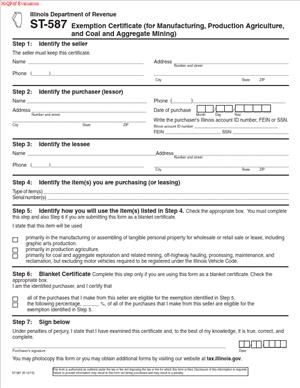
ST-587 Exemption Certificate (for Manufacturing, Production Agriculture, and Coal and Aggregate Mining)
Fill out nowJurisdiction: Country: United States | Province or State: Illinois
The ST-587 Exemption Certificate (for Manufacturing, Production Agriculture, and Coal and Aggregate Mining) is a tax document used in Illinois to claim a sales tax exemption on certain purchases. If you are buying equipment, machinery, or specific supplies for qualifying activities, this form allows you to document why sales tax does not apply to your transaction.
You complete this form and give it to the seller at the time of purchase. It tells the seller that the item you are buying qualifies for a specific exemption under Illinois sales tax rules. The seller then keeps the certificate in their records to support not charging you tax.
This form is mainly used by businesses involved in manufacturing, farming, coal mining, and aggregate mining. If you operate in one of these industries, you may use it regularly when purchasing qualifying items.
Understanding how this document works matters because sales tax errors can be costly. If the certificate is filled out incorrectly or used for items that do not qualify, you may face tax assessments later. Knowing what the form does—and does not do—helps you avoid common problems.
What is ST-587 Exemption Certificate (for Manufacturing, Production Agriculture, and Coal and Aggregate Mining)?
Clear definition
The ST-587 Exemption Certificate (for Manufacturing, Production Agriculture, and Coal and Aggregate Mining) is a written statement that a purchaser provides to a seller to claim a specific Illinois sales tax exemption. It certifies that the property being purchased will be used in a qualifying manufacturing, production agriculture, coal mining, or aggregate mining activity.
In simple terms, it is proof that your purchase meets the conditions for a tax exemption. Instead of paying sales tax at the time of sale, you provide this completed certificate to support the tax-free transaction.
The form does not automatically make a purchase exempt. The exemption depends on how the item will be used. The certificate documents your claim about that use.
Who typically uses this form?
This form is typically used by business owners, farm operators, production managers, purchasing agents, and accounting staff working in qualifying industries. If you are responsible for buying equipment or supplies for a manufacturing plant or farm, you may be the person who completes and signs it.
Corporations, limited liability companies, partnerships, and sole proprietors can all use this form if they engage in qualifying activities. The key factor is the nature of the business activity, not the business structure.
Sellers also rely on this document. Retailers, equipment dealers, and suppliers keep the completed certificate on file to show why they did not collect sales tax on a sale.
Why might you need this form?
You may need this form when buying machinery or equipment that directly participates in the manufacturing or production process. In many cases, Illinois provides exemptions for items that are essential to producing tangible personal property for sale.
Farm operators use it when purchasing qualifying farm machinery or equipment used in production agriculture. Mining companies may use it for equipment involved in coal or aggregate extraction and processing.
Without this certificate, a seller will generally charge sales tax. If you later believe the purchase qualified for exemption, resolving the issue may require additional paperwork and time. Using the form at the time of purchase helps prevent that situation.
Typical real-life scenarios
- You operate a manufacturing company that produces metal parts. You purchase a new piece of machinery that directly shapes raw materials into finished components. At the time of purchase, you provide this certificate to document that the machinery qualifies for exemption.
- You run a grain farm and buy a new combine used to harvest crops. Because the equipment is used in production agriculture, you complete the form and give it to the dealer to avoid paying sales tax on the qualifying purchase.
- You manage a coal mining operation and acquire replacement equipment used in the extraction process. You provide the certificate to the supplier to confirm that the equipment is used in qualifying mining activities.
- You own an aggregate business and purchase machinery that crushes and processes stone for sale. Since the equipment is directly involved in production, you use the certificate to claim the exemption at the time of sale.
When would you use the ST-587 Exemption Certificate (for Manufacturing, Production Agriculture, and Coal and Aggregate Mining)?
You use this form at the time of purchase, or before the seller finalizes the transaction. It is most commonly used when buying high-value equipment, but it can also apply to certain parts and replacements if they meet the exemption criteria.
Manufacturers often use it when acquiring new production machinery, upgrading existing systems, or replacing worn components that are integral to the production line. The key issue is whether the item is directly used in the manufacturing process.
Farmers and agricultural producers use it when purchasing equipment that plays an active role in planting, cultivating, or harvesting crops, or in raising livestock for market. The timing typically aligns with seasonal equipment purchases or operational upgrades.
Mining operators use the form when purchasing machinery and equipment directly involved in extraction or processing activities. Office supplies, administrative equipment, and general maintenance tools usually fall outside the scope of this exemption.
Purchasing managers may keep blank copies available for routine transactions with regular suppliers. In some businesses, accounting departments review purchases to determine whether the exemption applies before issuing the certificate.
Legal characteristics of ST-587 Exemption Certificate (for Manufacturing, Production Agriculture, and Coal and Aggregate Mining)
This form serves as a formal certification from the purchaser to the seller. It states that the property being purchased qualifies for a specific exemption under Illinois sales tax law. The seller relies on this certification when deciding not to collect tax.
For the certificate to be effective, it must be completed accurately and signed by an authorized person. The information provided must match the nature of the purchaser’s business and the intended use of the item.
Common problems include incomplete fields, incorrect identification numbers, vague descriptions of use, or claiming the exemption for items that do not directly qualify. If the information is unclear, a seller may refuse to accept the certificate.
Another frequent issue is misuse. The exemption generally applies to items directly used in qualifying production activities. Items used for administration, storage after production, or general building maintenance often do not qualify. Misclassifying these items can lead to tax assessments later.
This form does not register your business, create a license, or replace other tax filings. It only applies to the specific transaction or class of transactions described in the certificate. It also does not exempt you from other taxes that may apply.
Although this form is specific to Illinois, other states may have similar exemption certificates with different rules and definitions. The scope of what qualifies can vary, even for similar industries.
Is it legally binding?
Yes, this certificate is generally considered a legally binding statement by the purchaser. When you sign it, you are certifying that the information is accurate and that the property qualifies for exemption based on its intended use.
The seller relies on your certification. If the exemption is later disallowed because the item did not qualify or the information was incorrect, the purchaser may be responsible for the unpaid tax.
The binding nature of the form comes from the written declaration and signature. By signing, you affirm that the purchase meets the conditions set out for the exemption. This makes accuracy and clarity important when completing the document.
How to fill out ST-587 Exemption Certificate (for Manufacturing, Production Agriculture, and Coal and Aggregate Mining)
Step 1 – Identify the purchaser
Enter the full legal name of your business or farm as it appears in official records. Include your business address and any required identification numbers. Make sure the information matches your registration details to avoid confusion or rejection.
Step 2 – Provide the seller’s information
Fill in the name and address of the seller from whom you are purchasing the item. This connects the certificate to a specific vendor and helps document the transaction in both parties’ records.
Step 3 – Describe the property being purchased
Clearly describe the machinery, equipment, or items you are buying. Use specific terms rather than general labels. The description should make it clear how the property relates to manufacturing, agriculture, or mining activities.
Step 4 – State the qualifying use
Indicate the type of activity that supports the exemption, such as manufacturing, production agriculture, coal mining, or aggregate mining. Briefly describe how the item will be used in that activity. Focus on its direct role in production or extraction.
Step 5 – Select the applicable exemption category
Choose the category on the form that matches your situation. The form may list different types of qualifying uses. Review the options carefully and select the one that accurately reflects your business activity.
Step 6 – Sign and date the certificate
An authorized owner, officer, or representative must sign the form. Enter the date of signing and print the signer’s name and title if required. The signature confirms that the information provided is true and complete at the time of submission.
Step 7 – Deliver the certificate to the seller
Provide the completed certificate to the seller before or at the time of purchase. Keep a copy for your records. This ensures both parties have documentation supporting the tax treatment of the transaction.
Legal terms you might encounter in ST-587 Exemption Certificate (for Manufacturing, Production Agriculture, and Coal and Aggregate Mining)
- Exemption Certificate: A written statement you give to a seller claiming that a specific purchase is not subject to sales tax. On this document, you certify that the items qualify under a manufacturing, agriculture, coal, or aggregate mining exemption. The seller relies on your certification to not charge tax.
- Retailer: The business selling you the equipment, machinery, or other tangible personal property. The retailer keeps this document in its records to show why sales tax was not collected. You must provide accurate seller information so the certificate is tied to the correct transaction.
- Purchaser: You or your business entity claiming the exemption. The form asks for your legal business name and address. The name should match your tax registration and other official records.
- Tangible Personal Property: Physical items you can see and touch, such as machinery, replacement parts, tools, or equipment. The form applies to specific types of tangible property used in qualifying activities. It does not apply to services unless they are part of a taxable sale of property.
- Primary Use: The main purpose for which the property will be used. Many exemptions require that the item be used primarily, often more than 50 percent of the time, in a qualifying activity. You are certifying that the primary use meets the exemption requirements.
- Manufacturing Process: The series of steps that transform raw materials into a new product with a different name, character, or use. The exemption typically covers equipment used directly in this process. The form asks you to confirm that your purchase relates to this type of activity.
- Production Agriculture: Activities involved in producing crops, livestock, or other agricultural products for sale. The exemption may apply to machinery and equipment used directly in these operations. You must indicate that your business activities fall within this category if you are claiming it.
- Coal and Aggregate Mining: The extraction and processing of coal, stone, sand, gravel, or similar materials. Certain machinery and equipment used directly in mining operations may qualify. You certify that the purchased items are used in these mining activities.
- Good Faith Acceptance: A concept that protects the seller when it accepts a properly completed certificate without knowing it is false. If you complete the form inaccurately, the liability can shift back to you. That is why accuracy and honesty matter.
- Liability: Your legal responsibility if the exemption is later denied. If the purchase does not qualify, you may owe the unpaid tax, plus interest and possible penalties. By signing, you accept that responsibility.
FAQs
Do I need to submit the ST-587 Exemption Certificate (for Manufacturing, Production Agriculture, and Coal and Aggregate Mining) to the state?
No. You give this document directly to the seller at the time of purchase or shortly after. The seller keeps it in their records to support not charging you sales tax. You should keep a copy in your own files in case the transaction is reviewed later.
What date should I enter on the form?
Enter the date you complete and sign the document. This is usually the same date you provide it to the seller. Make sure the date aligns with the purchase or invoice date so there is no confusion about when the exemption was claimed.
What if I am buying multiple items over time from the same seller?
You may be able to use a single certificate to cover ongoing purchases, depending on how the seller structures its records. Confirm with the seller whether the document will apply to a single invoice or to all qualifying purchases until revoked. Make sure your description of the property and qualifying use clearly matches what you plan to buy.
Does the name on this form have to match my tax registration exactly?
Yes. The legal name and address you enter should match your business registration and tax records. If you operate under a trade name, confirm whether the seller needs both the legal name and the doing-business-as name. Mismatched names can cause the seller to reject the certificate.
Who is allowed to sign this document?
An owner, corporate officer, partner, or other authorized representative of the business should sign. The signer must have the authority to bind the business to the statements made. By signing, you are certifying that the information is true and that the purchases qualify.
Do I need to attach supporting documents?
Typically, you do not attach extra documents when giving this form to the seller. However, you should keep internal records that support your claim, such as equipment descriptions, usage logs, or production details. If the exemption is ever questioned, you will need those records to show that the use qualifies.
What happens if I later use the item for a non-qualifying purpose?
If the primary use changes and the item no longer qualifies, you may become responsible for paying use tax on that item. Review your records and consult your internal accounting procedures to determine whether tax needs to be reported. Do not ignore a change in use.
How do I know if the seller accepted the certificate?
Ask the seller to confirm that the document is complete and acceptable before finalizing the transaction. Check your invoice to ensure sales tax was not charged. If tax appears on the invoice despite providing this form, address it immediately with the seller’s billing department.
Checklist: Before, During, and After ST-587 Exemption Certificate (for Manufacturing, Production Agriculture, and Coal and Aggregate Mining)
Before
- Confirm that your business activity qualifies as manufacturing, production agriculture, or coal and aggregate mining.
- Review how the item will be used and confirm that its primary use is in a qualifying activity.
- Gather your legal business name, address, and tax registration details.
- Verify the seller’s correct legal name and business address.
- Review the invoice or quote to identify the exact items being purchased.
- Check internal policies to confirm who has authority to sign tax documents.
- Make sure your records can support the claimed exempt use if questioned later.
During
- Enter your full legal business name exactly as registered.
- Provide complete and accurate seller information.
- Clearly describe the property being purchased.
- Select the correct exemption category that matches your business activity.
- State the qualifying use in specific terms, not general language.
- Review the entire form for blank fields before signing.
- Sign and date the document using an authorized signature.
- Provide the completed certificate to the seller promptly.
After
- Confirm that the seller did not charge sales tax on the invoice.
- Keep a signed copy of the certificate in your tax records.
- Store related invoices and purchase orders with the certificate.
- Track how the equipment or property is actually used in your operations.
- Review purchases periodically to ensure continued qualifying use.
- Update the seller if your business structure or name changes.
- Be prepared to provide documentation if the exemption is reviewed.
Common mistakes to avoid with ST-587 Exemption Certificate (for Manufacturing, Production Agriculture, and Coal and Aggregate Mining)
- Mistake: Claiming the exemption for items that are not used primarily in qualifying activities, often because the business assumes all equipment is exempt; this can lead to tax assessments and penalties, so do not forget to analyze the actual primary use before signing.
- Mistake: Using a trade name instead of the full legal business name, which happens when invoices display only the trade name; this can cause rejection by the seller or issues in an audit, so do not forget to match your registered name exactly.
- Mistake: Leaving sections blank or providing vague descriptions like “equipment,” which often occurs when rushing through paperwork; incomplete forms may not be accepted in good faith, so do not forget to describe the items clearly.
- Mistake: Having an unauthorized employee sign the form, which happens when signature authority is unclear; this can invalidate the certificate, so do not forget to confirm the signer’s authority.
- Mistake: Failing to keep a copy of the signed certificate, often because the focus is on completing the purchase; this leaves you without proof of what was certified, so do not forget to retain a copy in your records.
- Mistake: Continuing to claim exemption after the use of the equipment changes, which can occur as operations evolve; this creates unexpected tax liability, so do not forget to review and update your tax treatment if usage shifts.
What to do after filling out ST-587 Exemption Certificate (for Manufacturing, Production Agriculture, and Coal and Aggregate Mining)
Once you complete the form, treat it as part of your permanent tax file. It supports why you did not pay sales tax on specific purchases. Good recordkeeping now can prevent problems later.
Start by confirming that the seller has received and accepted the certificate. Do not assume acceptance. Look at the final invoice to verify that sales tax was not charged. If a tax appears, contact the seller quickly and clarify whether the form was processed.
- Step 1: Provide the signed certificate to the seller before or at the time of purchase, whenever possible.
- Step 2: Request written or email confirmation that the seller has accepted it for their records.
- Step 3: Review your invoice to confirm that no sales tax was applied.
- Step 4: Save a digital and paper copy of the signed certificate in your tax files.
- Step 5: Attach or link the certificate to the related invoices and purchase orders in your accounting system.
- Step 6: Monitor how the purchased property is actually used in your operations.
- Step 7: Document any change in use that could affect the exemption status.
- Step 8: Report and remit any use tax if the property no longer qualifies based on its primary use.
- Step 9: Update certificates on file if your business name, address, or structure changes.
- Step 10: Periodically review all active exemption certificates with your accounting team to ensure they still reflect your operations accurately.
You should also build this form into your internal purchasing process. Train staff who order equipment to check whether a certificate is already on file with a vendor. This reduces duplicate paperwork and lowers the risk of inconsistent claims.
Keep records organized by vendor and year. If your transactions are ever reviewed, you will need to show both the completed certificate and proof that the items were used in qualifying activities. Clear documentation makes that process much smoother.
Finally, revisit your exemption claims at least once a year. Businesses evolve. Equipment gets repurposed. By reviewing your records regularly, you protect your business from unexpected tax exposure and maintain compliance with Illinois Department of Revenue requirements.
Disclaimer: This guide is provided for informational purposes only and is not intended as legal advice. You should consult a legal professional.