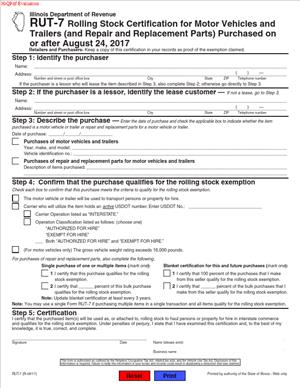
RUT 7 Rolling Stock Certification for Motor Vehicles and Trailers (and Repair and Replacement Parts) Purchased on or after August 24, 2017
Fill out nowJurisdiction: Country: United States | Province or State: Illinois
If you are about to complete the RUT 7 Rolling Stock Certification for Motor Vehicles and Trailers (and Repair and Replacement Parts) Purchased on or after August 24, 2017, you are likely dealing with a tax issue tied to a vehicle or trailer purchase. This document relates to how Illinois sales and use tax applies to certain vehicles and parts used in interstate commerce.
This form is not for everyday passenger vehicles. It focuses on “rolling stock,” which generally means trucks, tractors, trailers, and related equipment used by qualifying transportation companies. The purpose is to certify that a purchase meets specific requirements for tax treatment.
You fill it out to support a claim that the purchase qualifies for a rolling stock exemption or special tax treatment. The certification provides written confirmation from the purchaser that the vehicle or parts meet the legal standards set by Illinois.
The details matter. An incomplete or inaccurate submission can delay processing or lead to tax being assessed differently than expected. Understanding what the form does before you begin helps you avoid errors and confusion.
What is RUT 7 Rolling Stock Certification for Motor Vehicles and Trailers (and Repair and Replacement Parts) Purchased on or after August 24, 2017?
Clear definition
The RUT 7 Rolling Stock Certification for Motor Vehicles and Trailers (and Repair and Replacement Parts) Purchased on or after August 24, 2017, is a tax certification document used in Illinois. It allows a purchaser to certify that a motor vehicle, trailer, or qualifying repair or replacement part is considered “rolling stock” used in interstate commerce.
In simple terms, the form tells the state that the equipment you purchased is used by a qualifying transportation company in a way that may qualify for a sales or use tax exemption. It is a written statement made under penalties of perjury.
The certification connects the purchase to specific tax rules. Without it, the transaction may be treated as a standard taxable vehicle purchase.
Who typically uses this form?
This form is commonly used by trucking companies and other motor carriers. It applies to businesses that transport property or passengers for hire across state lines.
It may also be used by private carriers that move their own goods in interstate commerce, if they meet certain activity thresholds. Fleet managers, company owners, accountants, and tax staff often handle the completion and submission.
Dealers may request this form at the time of sale. In some cases, the purchaser completes it and provides it to the seller as proof of exemption. In other cases, it may be filed with the appropriate state office as part of the tax process.
Why might you need this form?
You may need this form to claim that a vehicle or trailer qualifies as exempt rolling stock. Without the certification, the seller may be required to collect tax on the sale.
You might also use it when purchasing repair and replacement parts for qualifying rolling stock. The form supports the claim that these parts are tied to eligible vehicles used in interstate commerce.
The document can also be required when registering or titling certain vehicles in Illinois. It serves as part of the tax documentation for the transaction.
Typical real-life scenarios
- A trucking company purchases a new semi‑tractor that will be used to haul freight between Illinois and neighboring states. At the time of purchase, the company completes the certification to show the vehicle qualifies as rolling stock used in interstate commerce.
- A carrier replaces the engine in a trailer that is regularly used for out‑of‑state deliveries. The company provides the form to document that the repair part qualifies for the same tax treatment as the original rolling stock.
- A logistics business expands its fleet and buys several new trailers. The accounting department prepares the certification for each unit to ensure the transactions are handled consistently for tax purposes.
- A manufacturer that ships its own goods across state lines buys a truck to transport products to customers in other states. The company evaluates whether it meets the activity requirements and, if so, completes the form to support its tax position.
When would you use RUT 7 Rolling Stock Certification for Motor Vehicles and Trailers (and Repair and Replacement Parts) Purchased on or after August 24, 2017?
You would use this form at the time of purchasing qualifying rolling stock or related parts. It is typically completed during or shortly after the sales transaction.
It is often used when the purchaser wants to claim that the vehicle or parts are exempt from Illinois sales or use tax because they are used in interstate commerce. The timing matters because sellers rely on the certification to determine whether to collect tax.
The form may also be used when registering a vehicle in Illinois if the tax treatment depends on rolling stock status. In that context, the certification helps document how the vehicle will be used.
Businesses that operate fleets frequently use the form as part of their standard purchasing process. Tax professionals within a company may review usage records, mileage logs, or revenue sources before completing the certification.
If a company’s operations change, such as shifting from mostly in‑state to mostly interstate activity, the form may come into play for future purchases. It reflects the expected and actual use of the equipment in interstate commerce.
Legal characteristics of RUT 7 Rolling Stock Certification for Motor Vehicles and Trailers (and Repair and Replacement Parts) Purchased on or after August 24, 2017
This certification is a formal tax document. It includes statements that the purchaser affirms are true. The person signing it declares that the vehicle or parts meet the legal definition of rolling stock used in interstate commerce.
For the document to be effective, it must be complete and accurate. Required fields typically include identifying information about the purchaser, the vehicle or parts, and the nature of the business operations. Missing or inconsistent information can cause delays or rejection.
The form usually requires a signature from an authorized individual. That person must have the authority to bind the business and attest to the facts stated. Signing without proper authority can create internal and legal complications.
Common problems include misunderstanding what qualifies as interstate commerce, miscalculating activity thresholds, or using the form for vehicles that do not meet the statutory definition of rolling stock. Errors in vehicle identification numbers or purchase details can also create issues.
Tax rules can vary by state. While many states recognize some form of rolling stock exemption, the definitions and thresholds are not identical. The certification discussed here applies specifically to Illinois and reflects Illinois tax law.
The document does not transfer title. It does not replace registration paperwork. It does not act as a contract between buyer and seller. Its purpose is limited to certifying tax status for qualifying rolling stock and related parts.
Is it legally binding?
Yes, the certification is legally binding in the sense that it is a signed statement made under penalties of perjury. By signing, you affirm that the information is true and correct to the best of your knowledge.
If the statements are inaccurate, the state may reassess the tax. There may also be financial consequences, such as interest or penalties. The legal effect comes from the sworn nature of the declaration and the tax laws that rely on it.
The form’s binding nature depends on proper completion. An unsigned or incomplete document may not be accepted. A properly signed and completed certification, however, serves as formal evidence of the purchaser’s claim regarding rolling stock status.
How to fill out RUT 7 Rolling Stock Certification for Motor Vehicles and Trailers (and Repair and Replacement Parts) Purchased on or after August 24, 2017
Step 1 – Review eligibility before entering information
Before writing anything, confirm that the vehicle, trailer, or parts meet the general definition of rolling stock used in interstate commerce. Review how your business operates, including whether it transports property or passengers across state lines and whether it meets any required activity thresholds. Gather records that support your understanding of how the equipment will be used.
Step 2 – Enter purchaser identification details
Provide the legal name of the business or individual purchasing the rolling stock. Use the name exactly as it appears on official registration documents. Enter the business address and any required identification numbers carefully, since errors here can affect processing.
Step 3 – Describe the business activity
Complete the section that asks about the nature of your transportation business. Indicate whether you are a carrier for hire or transporting your own goods. Provide the requested details about interstate operations, using accurate and current information.
Step 4 – Provide vehicle or trailer information
Enter the specific details for each motor vehicle or trailer covered by the certification. This typically includes the vehicle identification number, year, make, and model. Double‑check these entries against the title or manufacturer documents to avoid mistakes.
Step 5 – Identify repair or replacement parts if applicable
If the certification covers repair or replacement parts, describe the parts clearly. Connect them to qualifying rolling stock by referencing the related vehicle information. Ensure the parts are actually used on equipment that meets the rolling stock definition.
Step 6 – Review the certification statement carefully
Read the declaration section in full before signing. Make sure you understand the statements you are affirming about interstate use and qualification. Confirm that all prior sections are complete and consistent with your records.
Step 7 – Sign and date the form
An authorized owner, officer, or representative signs the document. Print the name and title if required. Date the form on the day it is signed, ensuring the date aligns with the purchase timeframe.
Step 8 – Provide the form to the appropriate party
Submit the completed certification as required for the transaction. This may involve giving it to the seller at the time of purchase or including it with other tax or registration paperwork. Keep a copy with your business records for future reference.
Legal terms you might encounter in RUT 7 Rolling Stock Certification for Motor Vehicles and Trailers (and Repair and Replacement Parts) Purchased on or after August 24, 2017
- Rolling Stock: This refers to certain motor vehicles and trailers used in interstate commerce to transport persons or property. On this form, you certify that the vehicle or trailer you purchased qualifies as rolling stock under Illinois tax law. The definition matters because only qualifying rolling stock may be eligible for specific tax treatment.
- Interstate Commerce: This means transporting goods or passengers across state lines. In this document, you confirm that the vehicle or trailer is used in activities that involve more than one state. The use in interstate commerce is a key factor in determining eligibility.
- Certification Statement: This is the section where you formally declare that the information you provided is true and accurate. By signing it, you affirm that the vehicle, trailer, or parts meet the legal requirements described in the form. False certification can lead to penalties.
- Purchaser: The person or business entity that bought the vehicle, trailer, or parts. The form requires the purchaser’s legal name and identifying information. This must match purchase documents and registration records.
- Seller: The dealer or business that sold you the vehicle, trailer, or parts. The seller may rely on this certification to document why certain taxes were not collected. Accurate seller information helps support the transaction record.
- Repair and Replacement Parts: These are components purchased to fix or maintain qualifying rolling stock. The form may apply not only to complete vehicles or trailers but also to parts used for repair or replacement. The parts must be used on qualifying rolling stock to fall under the same certification.
- Effective Date: The form applies to qualifying purchases made on or after August 24, 2017. You must confirm that your purchase date falls within this timeframe. The purchase date typically appears on your bill of sale or invoice.
- Identification Number: This usually refers to the Vehicle Identification Number (VIN) for a motor vehicle or trailer. You must enter it exactly as shown on the title or manufacturer’s plate. Errors in this number can delay processing or create inconsistencies in records.
- Authorized Signer: The person who has legal authority to sign on behalf of the purchaser. For a business, this may be an owner, officer, or other authorized representative. The signer confirms that they have the authority to make the certification.
- Tax Liability: This refers to your responsibility to pay applicable state taxes if the vehicle, trailer, or parts do not qualify as certified. By completing the form, you are addressing whether a specific tax applies. Incorrect certification can result in future assessments of tax, interest, and penalties.
FAQs
Does this form need to be submitted with my vehicle title application?
In many cases, this document is provided to the seller at the time of purchase rather than filed directly with your title paperwork. However, the seller may keep it as support for not collecting certain taxes. You should confirm whether a copy must accompany any state filing related to your purchase.
What purchase date should I enter if I signed the contract one day and took delivery later?
Use the actual date of purchase as shown on your sales contract or invoice. That date controls whether the transaction falls on or after August 24, 2017. Make sure the date you enter matches the official document used for title and registration purposes.
Who is allowed to sign the RUT 7 Rolling Stock Certification for Motor Vehicles and Trailers (and Repair and Replacement Parts) Purchased on or after August 24, 2017?
An individual buyer may sign for themselves. If a business purchased the vehicle or parts, someone with authority to bind the business must sign. That person should use their legal title or position when signing to show they are authorized.
What happens if I later stop using the vehicle in interstate commerce?
If your use changes, the original certification may no longer reflect how the vehicle is actually used. This can affect your tax responsibility. You should review your records and determine whether additional tax may become due based on the new use.
Do I need to list every repair part separately?
You should follow the form’s instructions carefully. If the document asks for a description or invoice reference, include enough detail to clearly connect the parts to qualifying rolling stock. Keep copies of invoices that show the parts were purchased for the certified vehicle or trailer.
What if the name on the invoice is slightly different from the name on this form?
The name on this form should match the legal name of the purchaser as shown on official documents. Minor variations can create confusion in records. If there is a difference, correct it before signing so that the certification aligns with the purchase and title documents.
Will I receive confirmation that this document was accepted?
If you give this form to the seller, the seller typically keeps it in their records and does not issue a formal acceptance notice. You can request a copy stamped or signed as received. If the form is submitted with other filings, check whether you receive a receipt or acknowledgment.
What changes in the public record after I complete this form?
This document itself does not usually create a separate public record. It supports how the transaction is treated for tax purposes. The main public record changes would relate to vehicle title and registration, not the certification document itself.
Checklist: Before, During, and After RUT 7 Rolling Stock Certification for Motor Vehicles and Trailers (and Repair and Replacement Parts) Purchased on or after August 24, 2017
Before
- Confirm that your purchase date is on or after August 24, 2017.
- Verify that the vehicle or trailer is used in interstate commerce.
- Gather your bill of sale, invoice, and title documents.
- Locate the correct VIN or trailer identification number.
- Confirm the exact legal name of the purchaser.
- Determine who has the authority to sign if a business is involved.
- Review whether the purchase includes repair or replacement parts.
- Read the entire form once before filling anything out.
During
- Enter the purchaser’s legal name exactly as shown on official records.
- Carefully input the VIN or identification number without errors.
- Describe the vehicle, trailer, or parts clearly and accurately.
- Double-check dates to ensure consistency with invoices.
- Review the certification statement word for word.
- Print clearly if completing by hand.
- Ensure the authorized signer includes their title or position.
- Check that all required fields are completed before signing.
After
- Make a complete copy of the signed form for your records.
- Provide the original to the seller or the appropriate party.
- Store supporting invoices with your copy of the certification.
- Confirm whether the seller needs any additional documentation.
- Monitor your tax records for consistency with this certification.
- Update internal accounting records to reflect the certified purchase.
- Keep the document accessible in case of an audit or inquiry.
- Review vehicle usage periodically to ensure it still qualifies.
Common mistakes to avoid with RUT 7 Rolling Stock Certification for Motor Vehicles and Trailers (and Repair and Replacement Parts) Purchased on or after August 24, 2017
- Mistake: Entering an incorrect VIN because of a typo or reading error, which happens when copying by hand, can create mismatched records and delays; do not forget to verify the number directly from the vehicle or title before signing.
- Mistake: Using a trade name instead of the full legal business name, which often occurs in daily operations, may cause inconsistencies in tax and title records; do not forget to match the exact legal name shown on official filings.
- Mistake: Having someone sign without proper authority, often due to convenience, can invalidate the certification; do not forget to confirm the signer’s role and authority within the business.
- Mistake: Failing to keep supporting invoices for repair or replacement parts, which happens when paperwork is separated, may leave you without proof of qualification; do not forget to store all related purchase documents together.
- Mistake: Certifying interstate commerce use without confirming actual operations, often based on assumptions, can lead to tax assessments later; do not forget to review how the vehicle is truly used.
- Mistake: Leaving blank fields because they seem unimportant, which can occur when rushing, may result in rejection or follow-up requests; do not forget to review the entire form for completeness before submission.
- Mistake: Ignoring the effective date requirement, which happens when using outdated information, can make the certification invalid; do not forget to confirm that the purchase date qualifies.
- Mistake: Not keeping a copy of the signed form, often due to oversight at closing, can create problems during audits; do not forget to make and store a complete copy immediately after signing.
What to do after filling out RUT 7 Rolling Stock Certification for Motor Vehicles and Trailers (and Repair and Replacement Parts) Purchased on or after August 24, 2017
Once you complete and sign the form, your job is not quite finished. You need to handle it properly so your records stay consistent and protected.
Start by reviewing the signed document one more time. Make sure every page is complete and legible. Confirm that the signature and date are present and that the VIN and purchaser name match your other paperwork.
- Step 1: Make at least one clear copy of the fully signed form.
- Step 2: Attach copies of related invoices or bills of sale to your file copy.
- Step 3: Deliver the original signed form to the seller or other required party as instructed.
- Step 4: Request written confirmation of receipt if possible, such as a stamped copy.
- Step 5: File your copy in the same folder as your vehicle title and tax documents.
- Step 6: Update your accounting records to reflect how the purchase was treated for tax purposes.
- Step 7: Inform your internal compliance or bookkeeping staff, if applicable, that the certification was completed.
- Step 8: Monitor how the vehicle or trailer is used to ensure it continues to meet the certification criteria.
- Step 9: Keep the form and supporting documents for the duration of your standard record retention period.
- Step 10: If your business structure or ownership changes, review whether your records should be updated to reflect the correct purchaser information.
Treat this form as part of your long-term tax documentation. It may not be filed publicly, but it supports how the transaction was handled. Keeping it organized and consistent with your other records will help you respond quickly if questions arise later.
Disclaimer: This guide is provided for informational purposes only and is not intended as legal advice. You should consult a legal professional.