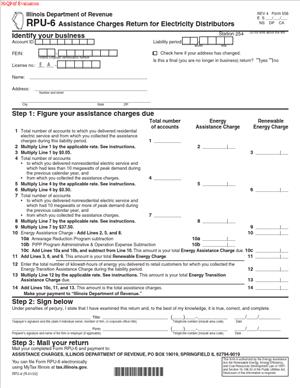
RPU-6 Assistance Charges Return for Electricity Distributors
Fill out nowJurisdiction: Country: United States | Province or State: Illinois
The RPU-6 Assistance Charges Return for Electricity Distributors is a tax reporting form used in Illinois by certain electricity distributors. It relates to the collection and remittance of specific assistance charges applied to electric service. If you are preparing this filing, you are likely responsible for reporting amounts collected from customers and sending those amounts to the state.
This form is not a general business tax return. It focuses on a specific type of charge tied to electricity distribution. The information you report directly affects how assistance-related funds are tracked and reconciled.
If you are about to complete the RPU-6 Assistance Charges Return for Electricity Distributors, you need to understand what the charge is, who must file, and how the numbers are calculated. Accuracy matters because the amounts reported reflect funds collected from customers.
This guide walks you through what the form is, when it is used, and how to complete it step by step. The goal is to help you understand what you are entering and why each section matters.
What is RPU-6 Assistance Charges Return for Electricity Distributors?
Clear definition
The RPU-6 Assistance Charges Return for Electricity Distributors is a state tax return used to report assistance charges collected by electricity distributors in Illinois. These charges are typically added to customer bills under state-authorized programs.
The form functions as a periodic reporting document. It shows the total amount of assistance charges billed, collected, and owed for a specific reporting period. It also accounts for adjustments, such as credits or prior balances.
This return allows the state to confirm that the correct amount of assistance charges has been transmitted. It connects billing activity at the utility level to the state’s revenue tracking system.
Who typically uses this form?
This form is generally used by electricity distributors operating in Illinois. That may include investor-owned utilities, municipal systems, electric cooperatives, or alternative retail electric suppliers, depending on how the assistance charge is structured.
The person completing the form is often a tax manager, accounting staff member, regulatory compliance officer, or finance department employee. In smaller organizations, an owner or general manager may handle the filing.
Third-party accountants or tax preparers may also prepare the document on behalf of a distributor. Even in that case, the distributor remains responsible for the accuracy of the information reported.
Why might you need this form?
You need this form if your organization collects assistance charges from customers as part of electric service billing. The state requires periodic reporting of those amounts.
The filing ensures that the assistance funds collected from ratepayers are properly accounted for and remitted. It creates a formal record of what was billed, what was collected, and what is due.
Without submitting this return, there would be no structured way to reconcile the assistance charges collected with the amounts transmitted to the state. The form serves as that reconciliation tool.
Typical real-life scenarios
- An electric utility bills residential customers each month and includes a small assistance charge on every statement. At the end of the reporting period, the utility totals those charges and completes the return to report the full amount collected.
- A cooperative experiences customer account write-offs due to nonpayment. When completing the return, the accounting team must reflect the difference between billed charges and actually collected amounts. The form captures those distinctions.
- An electricity distributor identifies a billing system error that caused overcollection of assistance charges in a prior month. The correction appears as an adjustment on the next return to ensure the state receives accurate totals.
- A newly registered electricity supplier begins operating in Illinois and starts collecting the assistance charge from customers. The company uses this form to report its first period of collections and establish a reporting pattern with the state.
When would you use RPU-6 Assistance Charges Return for Electricity Distributors?
You use this form at the end of each required reporting period. The filing frequency may be monthly, quarterly, or another interval, depending on how the distributor is registered and the volume of charges collected.
The return is used after assistance charges have been billed to customers. It is not completed at the time of billing. Instead, it summarizes activity that has already occurred during the reporting window.
You would also use this form when adjustments are necessary. If you discover errors in a previous filing, the current return may include corrections or reconciliations, depending on how the reporting system is structured.
If your organization stops operating or ceases collecting assistance charges, you may use the form to file a final return covering the last reporting period. This closes out the account associated with the charge.
Organizations that recently began operating in Illinois use the form once they start collecting the applicable assistance charge. The first return often establishes the reporting baseline for future filings.
Legal Characteristics of RPU-6 Assistance Charges Return for Electricity Distributors
This form is a state tax return. Its validity depends on complete and accurate information, proper identification of the distributor, and timely submission.
For the return to be effective, it must include correct registration details, reporting period dates, and financial totals. Mathematical errors, missing fields, or inconsistent figures may delay processing or trigger follow-up questions.
The form reflects statutory obligations tied to assistance charges. These charges are generally authorized by state law and collected under regulatory frameworks governing electricity distribution. The return acts as a compliance document within that framework.
Common problems include reporting gross billed amounts instead of collected amounts when the form requires collections, failing to account for prior credits, or entering the wrong reporting period. Small errors in totals can create discrepancies that require reconciliation later.
While the structure of the form is specific to Illinois, similar assistance charge reporting exists in other jurisdictions. However, filing schedules, calculation methods, and terminology often differ. Using an out-of-state process as a model can lead to mistakes.
This return does not replace other tax filings. It does not report income tax, sales tax, or general utility tax obligations unless specifically tied to the assistance charge. It also does not change the distributor’s licensing or regulatory status.
Is it legally binding?
Yes, the RPU-6 Assistance Charges Return for Electricity Distributors is legally binding once submitted. By signing and filing it, the distributor affirms that the information provided is accurate to the best of its knowledge.
The signature section typically includes a declaration statement. This confirms that the person signing has authority to act on behalf of the distributor and that the figures reported are true and complete.
Because the return reports funds collected from customers under state authority, inaccurate reporting can lead to assessments, interest, or penalties. The binding nature of the form comes from its role as an official tax document.
However, the form itself does not create the obligation to collect the charge. That obligation arises from underlying statutes and regulations. The return simply reports compliance with those existing requirements.
How to fill out RPU-6 Assistance Charges Return for Electricity Distributors
Step 1 – Identify the distributor
Start by entering the full legal name of the electricity distributor. Use the exact name associated with your state registration. Include any required identification numbers, such as your state tax account number or federal employer identification number, if requested.
Check that the business address matches the address on file. If the form allows for an updated address, complete that section carefully to ensure future correspondence reaches the correct location.
Step 2 – Select the reporting period
Enter the beginning and ending dates for the reporting period covered by this return. Make sure these dates align with your assigned filing frequency.
Confirm that the period does not overlap with a prior return. Each filing should cover a distinct block of time with no gaps and no duplication.
Step 3 – Report total assistance charges billed
Locate the line that requests the total assistance charges billed during the reporting period. Use your billing system records to determine the aggregate amount charged to customers before adjustments.
Ensure that this figure reflects only the assistance charge component. Do not combine it with delivery charges, supply charges, taxes, or unrelated fees.
Step 4 – Report total assistance charges collected
Enter the total amount actually collected from customers during the reporting period for the assistance charge. This may differ from the billed amount due to late payments, partial payments, or uncollectible accounts.
Use your accounts receivable and cash receipt records to verify the figure. The collected amount should reflect real payments received, not projected or accrued amounts.
Step 5 – Account for adjustments and credits
If the form includes lines for adjustments, report any corrections related to prior periods. This can include overcollections, undercollections, billing errors, or approved credits.
Document the basis for each adjustment in your internal records. The form may not require a detailed explanation, but you should be able to support the numbers if reviewed.
Step 6 – Calculate the net amount due
Follow the form’s instructions to calculate the net assistance charge owed for the period. This usually involves subtracting allowable deductions or prior credits from the total collected amount.
Double-check all calculations. Even small arithmetic errors can cause discrepancies between your return and your payment.
Step 7 – Report prior balance and payments
If the form asks for prior balances, enter any unpaid amounts from earlier periods. Also include payments already made that apply to the current reporting period, if applicable.
This section ensures that your total amount due reflects both current activity and any outstanding obligations.
Step 8 – Determine total payment enclosed or transmitted
Calculate the final amount you are remitting with the return. This should match the net amount due after considering prior balances and adjustments.
If you are filing electronically, confirm that the payment amount entered in the payment system matches the amount shown on the form.
Step 9 – Review all figures for consistency
Before signing, review every numeric entry. Confirm that totals add correctly and that billed, collected, and adjusted amounts follow a logical pattern.
Compare the return against your internal reports for the same period. Look for unexplained differences between billing records and reported totals.
Step 10 – Sign and date the return
An authorized individual must sign the return. This is often an officer, manager, or other person with authority over financial reporting.
Enter the signer’s title and the date of signing. Make sure the declaration statement is complete before submission. Once signed and submitted, the return becomes part of the official record for that reporting period.
Legal terms you might encounter in RPU-6 Assistance Charges Return for Electricity Distributors
- Assistance Charge: This is the specific surcharge collected from customers to fund state-authorized assistance programs. In this document, you report the total amount billed and the amount actually collected during the reporting period. The difference between billed and collected amounts can affect the balance you owe or carry forward.
- Electricity Distributor: This refers to the entity responsible for delivering electricity to end users and collecting applicable charges. On this form, you must clearly identify the legal name of the distributor as registered with the Illinois Department of Revenue. The name must match the department’s records to avoid processing delays.
- Reporting Period: This is the specific month or quarter covered by the return. You must enter the exact start and end dates or designated filing period as required. Errors in the reporting period can result in misapplied payments or duplicate filings.
- Gross Amount Billed: This is the total assistance charge amount invoiced to customers during the reporting period, before adjustments. You report this figure even if not all amounts were collected. It forms the starting point for calculating what you owe.
- Net Amount Due: This is the final amount you are required to remit after accounting for collections, adjustments, credits, and prior balances. You calculate this figure on the form using the lines provided. If this amount is incorrect, your payment will not match your reported liability.
- Adjustments: These are increases or decreases to previously reported assistance charges. Adjustments can result from billing errors, customer refunds, or corrected account classifications. You must document them accurately to ensure your totals are correct.
- Credits: Credits reduce the amount you owe. They may arise from overpayments in prior periods or authorized offsets. If you claim a credit, you should ensure your internal records clearly support the amount listed.
- Remittance: This is the payment you send along with the return. The remittance must match the total amount due as calculated on the form. If the payment does not align with the reported liability, the department may issue a notice.
- Authorized Signer: This is the individual who signs the return on behalf of the electricity distributor. The signer must have authority to certify the information as true and correct. Listing an unauthorized person can invalidate the submission.
- Account Number: This is the identification number assigned by the Illinois Department of Revenue to your business for tax reporting purposes. You must enter it exactly as issued. An incorrect account number can cause the return to be applied to the wrong account.
FAQs
What information do I need in front of me before completing the RPU-6 Assistance Charges Return for Electricity Distributors?
You need your distributor’s legal business name, account number issued by the Illinois Department of Revenue, and the correct reporting period. You also need internal billing reports showing total assistance charges billed, total collected, and any adjustments or credits for that period. Have your prior return and proof of last payment available so you can confirm any carryover balance.
How do I confirm I am using the correct reporting period on this form?
Check the filing schedule assigned to your account. Look at your previous return to confirm whether you file monthly or quarterly. Make sure the dates you enter match the exact billing cycle you are reporting and that you are not overlapping with a prior period.
Who is allowed to sign this document?
The signer must be an authorized individual within your organization, such as an officer, manager, or other designated representative with authority over financial reporting. Before signing, confirm that the name and title entered match company records. The signature certifies that the numbers reported are accurate to the best of your knowledge.
What happens if the amount I collected is less than the amount I billed?
You still report the full amount billed during the period. Then you report the amount actually collected. The difference may affect the calculation of the net amount due. Make sure your internal receivables report supports the figures you enter so you can explain any discrepancy if asked.
Can I correct an error after submitting this form?
Yes, but you need to act promptly. Review the filed copy to identify the exact line where the mistake occurred. Then follow the department’s procedure for amending or correcting a previously filed return. Keep written documentation showing how you recalculated the corrected amount.
Do I need to attach supporting documents to this document?
Most of the time, you do not attach detailed billing reports unless specifically instructed. However, you should keep all supporting schedules in your records. If you are reporting significant adjustments or claiming credits, ensure your documentation clearly explains the reason and calculation.
How do I know if my submission was accepted?
After filing and remitting payment, monitor your account records for confirmation or acknowledgment. Check that your payment clears and that your account balance reflects the reported amount. If you receive a notice or discrepancy letter, review it immediately and compare it to your filed copy.
What records should I keep after filing the RPU-6 Assistance Charges Return for Electricity Distributors?
Keep a complete copy of the signed return, proof of payment, internal billing summaries, adjustment calculations, and any correspondence related to the filing. Store these records in a way that allows you to retrieve them by reporting period. This helps you respond quickly to questions or audits.
Checklist: Before, During, and After RPU-6 Assistance Charges Return for Electricity Distributors
Before
- Confirm your assigned reporting frequency and due date.
- Gather billing reports showing assistance charges billed during the period.
- Gather collection reports showing assistance charges actually received.
- Review prior period returns for any carryover balance or credit.
- Verify your account number and legal business name match state records.
- Identify any adjustments or corrections that apply to this period.
- Confirm who will serve as the authorized signer.
During
- Enter the reporting period exactly as assigned.
- Double-check the legal name and account number before proceeding.
- Report total assistance charges billed without netting collections.
- Enter total collected amounts based on finalized accounting data.
- Clearly record any adjustments and ensure they are supported.
- Calculate the net amount due using the form’s line instructions.
- Compare the calculated total with your internal ledger.
- Review every figure for transposed numbers or decimal errors.
- Ensure the authorized signer signs and dates the form.
After
- Make a complete copy of the signed return for your records.
- Submit the return using the approved filing method.
- Transmit payment in the correct amount shown as due.
- Save confirmation of filing or proof of mailing.
- Verify that the payment has cleared your bank account.
- Check your account statement for proper credit of the payment.
- File supporting documents by reporting period.
- Calendar the next reporting deadline.
Common mistakes to avoid with RPU-6 Assistance Charges Return for Electricity Distributors
- Mistake: Reporting only collected amounts instead of total billed amounts because internal reports focus on cash receipts, which leads to underreporting and possible notices, so do not forget to separate billed and collected figures.
- Mistake: Using the wrong reporting period due to overlapping billing cycles, which causes duplicate or missing filings and account discrepancies, so do not forget to confirm the exact start and end dates.
- Mistake: Entering an incorrect account number because of copying from outdated records, which can misapply your payment to another account, so do not forget to verify the number against current registration documents.
- Mistake: Forgetting to include prior balances or credits because they were tracked separately in accounting records, which results in incorrect net payment, so do not forget to reconcile prior period amounts before finalizing.
- Mistake: Allowing an unauthorized employee to sign the return due to convenience, which may delay processing or invalidate the certification, so do not forget to confirm signer authority.
- Mistake: Mathematical errors caused by manual calculations or spreadsheet mistakes, which can trigger billing notices and extra administrative work, so do not forget to recheck every calculation line by line.
- Mistake: Claiming adjustments without documentation because the correction seems minor, which can lead to audit questions or reversal of credits, so do not forget to maintain written support.
- Mistake: Submitting payment that does not match the reported net amount due due to rounding or timing differences, which creates an artificial balance on your account, so do not forget to match the exact figure shown on the return.
What to do after filling out the RPU-6 Assistance Charges Return for Electricity Distributors
Once you complete the form, pause before sending it. Review every line against your internal accounting reports. Small entry errors can create bigger issues later.
- Step 1: Make a full copy of the signed return, including all pages and schedules.
- Step 2: Prepare your payment in the exact net amount due shown on the form.
- Step 3: Confirm the filing method required for your account and submit accordingly.
- Step 4: Save proof of submission, such as confirmation numbers or mailing receipts.
- Step 5: Record the payment in your internal accounting system under the correct reporting period.
- Step 6: Monitor your bank account to confirm the payment clears.
- Step 7: Check your account statement to ensure the department applied the payment correctly.
- Step 8: File all supporting documentation together with the return copy.
- Step 9: Note any unusual adjustments so you remember the reason during the next reporting cycle.
- Step 10: Set a reminder for the next filing deadline to maintain consistent compliance.
Staying organized after filing is just as important as completing the form accurately. Keep your records structured by reporting period. This makes future filings faster and reduces stress if questions arise. Consistent review and documentation protect your organization and keep your reporting accurate.
Disclaimer: This guide is provided for informational purposes only and is not intended as legal advice. You should consult a legal professional.