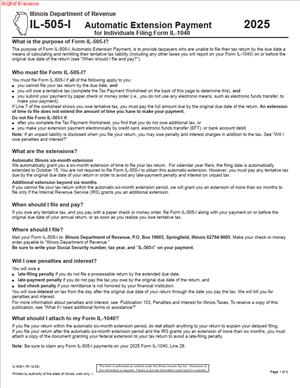
IL-505-I Automatic Extension Payment for Individuals Filing Form IL-1040
Fill out nowJurisdiction: Country: United States | Province or State: Illinois
If you are filing an Illinois individual income tax return and need more time, the IL-505-I Automatic Extension Payment for Individuals Filing Form IL-1040 is the document that helps you send a payment with your extension. It connects your extension period with any tax you expect to owe.
This form is used when you cannot file your Illinois income tax return by the original deadline but still need to pay what you owe. An extension gives you more time to file paperwork. It does not automatically give you more time to pay.
The IL-505-I Automatic Extension Payment for Individuals Filing Form IL-1040 allows you to submit a payment to the Illinois Department of Revenue during the extension period. This reduces or avoids penalties and interest that can apply to unpaid balances.
If you are about to fill this out, you likely want clear answers. You want to know what information is required, how it connects to your tax return, and what happens after you send it. This guide walks through those details in plain language.
This form belongs to the Illinois Department of Revenue and is part of the state’s individual income tax process.
What is IL-505-I Automatic Extension Payment for Individuals Filing Form IL-1040?
Clear definition
The IL-505-I Automatic Extension Payment for Individuals Filing Form IL-1040 is a state tax payment voucher. It is used by individuals who are filing the Illinois Form IL-1040 and need more time to submit the completed return.
An “automatic extension” generally means you do not need to file a separate request to receive more time to file your return. However, if you expect to owe Illinois income tax, you must pay that estimated amount by the original due date. This form is the method used to send that payment when filing by mail.
The document links your payment to your Social Security number and tax year. It ensures the state credits your account properly while you prepare your full return.
Who typically uses this form?
Individual taxpayers use this form. This includes employees, self-employed individuals, retirees, and anyone else required to file the Illinois Form IL-1040.
People who expect to receive a refund usually do not need this form. The form is typically used by taxpayers who expect to owe money.
Taxpayers who file jointly may also use this form. In that case, identifying information for both spouses is included so the payment is credited correctly.
Tax professionals may prepare this form on behalf of clients. Even then, the responsibility for accurate information remains with the taxpayer.
Why might you need this form?
You might need this form if you cannot complete your Illinois income tax return by the filing deadline. Common reasons include missing tax documents, complex income sources, or waiting for corrected forms.
You may also need it if your federal return is not yet finalized. Because state returns often rely on federal figures, a delay at the federal level can affect your Illinois filing.
Another reason is a change in financial circumstances late in the year. For example, selling property or receiving unexpected income can require additional calculations.
If you expect to owe Illinois income tax, you may want to make a timely payment to limit interest and penalties. This form provides a structured way to do that by mail.
Typical real-life scenarios
- You work for multiple employers and are still waiting for one corrected wage statement. You know you will owe state tax, but you cannot complete your return accurately yet. You calculate an estimated balance and use this form to submit payment before the deadline.
- You are self-employed and had a strong fourth quarter. Your estimated payments were lower than your final liability. You need more time to reconcile your records. You send an extension payment using this form to cover the difference.
- You moved in or out of Illinois during the year and must determine your residency status. The calculation is not simple, and you want time to review it carefully. You estimate what you owe and send payment with this form.
- You experienced a major life event, such as marriage, divorce, or the death of a spouse. Your filing status changed, and you need extra time to gather documents. If you anticipate a balance due, you use this form to submit payment by the original deadline.
When would you use the IL-505-I Automatic Extension Payment for Individuals Filing Form IL-1040?
You use this form when the filing deadline for Illinois Form IL-1040 is approaching, and you are not ready to submit your completed return, but you expect to owe tax.
It is commonly used in the weeks leading up to the annual tax deadline. At that point, you may have a reasonable estimate of your income and tax liability, but not a finalized return.
If you have already obtained a federal extension, Illinois often recognizes that extension for filing purposes. However, the obligation to pay any expected Illinois tax by the original deadline generally remains. In that situation, this form allows you to send payment to the state.
Taxpayers with business income, rental property, investments, or other complex financial situations often use this form. These types of income can require additional documentation and review.
You would not typically use this form if you have already filed your Illinois return. It is intended for the extension period before filing, not for paying balances shown on a completed and submitted return.
You also would not use it if you expect a full refund and have no balance due. In that case, filing later within the allowed extension period may not require a payment voucher.
Legal characteristics of IL-505-I Automatic Extension Payment for Individuals Filing Form IL-1040
This form functions as a payment document within Illinois’ tax system. Its effectiveness depends on accurately identifying information and timely submission.
For the payment to be properly credited, your name, Social Security number, and tax year must match the information on your eventual Illinois Form IL-1040. Even small errors in identification can delay processing.
The form must be submitted by the original due date of the return to serve its purpose in limiting penalties and interest. If it is sent late, interest may still apply to any unpaid tax.
A common issue arises when taxpayers underestimate the amount owed. An extension of time to file is not an extension of time to pay. If the payment submitted with this form is significantly lower than the final tax due, penalties and interest may apply to the difference.
Another common problem is sending a payment without clearly marking the correct tax year. This can cause the payment to be applied to the wrong period.
The form does not replace your Illinois income tax return. You must still file Form IL-1040 within the extension period. Failing to file the actual return can result in additional penalties.
Illinois tax rules may change over time. Filing deadlines, interest rates, and payment procedures can vary by tax year. Always ensure you are using the correct version of the form for the year you are filing.
Is it legally binding?
Yes, in the sense that it represents an official tax payment and becomes part of your state tax record.
When you submit this form with a payment, you are affirming that the information provided is accurate to the best of your knowledge. The payment is applied to your account and affects your overall tax liability.
It does not create a contract in the traditional sense. Instead, it operates within the state’s tax framework. Once processed, the payment reduces your outstanding balance for that tax year.
If the information on the form is incorrect or incomplete, the state may not apply the payment as intended. This can lead to notices, delays, or adjustments to your account.
The legal effect comes from the tax laws that require timely payment and accurate reporting. This form is one mechanism used to comply with those requirements during an extension period.
How to fill out IL-505-I Automatic Extension Payment for Individuals Filing Form IL-1040
Step 1 – Enter the tax year
At the top of the form, identify the correct tax year. Make sure the year matches the return you plan to file. Using the wrong year can cause your payment to be misapplied.
Step 2 – Provide your name and address
Enter your full legal name as it will appear on your Illinois Form IL-1040. If you are filing jointly, include both spouses’ names. Provide your current mailing address so the state can contact you if needed.
Step 3 – Enter Social Security numbers
Provide your Social Security number. If filing jointly, include your spouse’s number in the space provided. Double-check these numbers carefully. They are the primary identifiers used to credit your payment.
Step 4 – Calculate your total expected Illinois tax
Estimate your total Illinois income tax for the year. Use your income information, withholding statements, and any estimated payments already made. This figure represents your projected full-year liability.
Step 5 – Subtract withholding and estimated payments
From your estimated total tax, subtract any Illinois income tax already withheld from wages and any quarterly estimated payments you have made. This helps you determine how much remains unpaid.
Step 6 – Determine your extension payment amount
The remaining balance after subtracting withholding and prior payments is the amount you expect to owe. Enter this amount as your extension payment. Review your math to ensure accuracy.
Step 7 – Prepare your payment
Write a check or money order for the amount entered on the form if paying by mail. Ensure the payment is payable to the appropriate state agency and clearly indicates the tax year and your Social Security number. This helps prevent processing errors.
Step 8 – Do not staple or alter the form
Keep the form clean and legible. Avoid writing notes in the margins or attaching unnecessary documents. The voucher is designed for payment processing and should remain easy to scan and read.
Step 9 – Mail the form and payment by the due date
Place the completed voucher and payment in an envelope and mail it to the address listed for extension payments. Ensure it is sent on or before the original filing deadline. Timely mailing supports proper crediting of your payment during the extension period.
Legal terms you might encounter in IL-505-I Automatic Extension Payment for Individuals Filing Form IL-1040
- Automatic Extension: An automatic extension gives you extra time to file your Illinois income tax return. It does not give you extra time to pay your taxes. In this document, the extension applies to filing Form IL-1040, but you must still estimate and pay any tax due by the original deadline.
- Tax Year: The tax year is the calendar year for which you are reporting income. You must clearly enter the correct year on this document. If you enter the wrong year, your payment may be credited incorrectly.
- Estimated Tax Liability: This is your best calculation of how much Illinois income tax you owe for the tax year. You calculate it before you file your full return. The amount you list here determines how much you should send with this payment voucher.
- Withholding: Withholding refers to Illinois income tax already taken out of your wages, retirement income, or other payments. You subtract this amount from your estimated total tax to determine what you still owe. Entering the correct withholding amount prevents overpaying or underpaying.
- Estimated Payments: These are quarterly payments you may have already made during the tax year. You must include them in your calculation. Forgetting to subtract prior payments can result in sending more money than required.
- Balance Due: The balance due is the amount of tax you still owe after subtracting withholding and estimated payments from your total tax liability. This is the amount you send with this form. If you miscalculate this figure, you may face penalties or delayed processing.
- Voucher: This document functions as a payment voucher. A voucher ensures your payment is properly credited to your account. It contains identifying details like your name and Social Security number to match the payment to your tax record.
- Social Security Number (SSN): Your SSN is used to match your payment to your individual tax account. If you are filing jointly, you may need to include both spouses’ SSNs. Incorrect or missing numbers can delay processing or misapply your payment.
- Due Date: The due date is the original filing deadline for your Illinois individual income tax return. Your extension payment must be submitted by this date. Paying after the deadline can result in interest and penalties, even if you later file the full return.
FAQs
Does filing IL-505-I Automatic Extension Payment for Individuals Filing Form IL-1040 give me more time to pay my taxes?
No. This document gives you more time to file your Illinois income tax return, not more time to pay. You must estimate your total tax and send any amount due by the original deadline. If you underpay, interest and penalties may apply from the original due date.
What happens if I overpay with this form?
If you send more than you actually owe, the excess will generally be credited when you file your full Illinois income tax return. You may receive a refund or choose to apply it to the next tax year. Make sure your name and Social Security number are correct so the payment is properly matched.
How do I know the payment was credited to my account?
You should keep proof of payment, such as a canceled check or confirmation of electronic payment. When you later file your Illinois return, you will report the extension payment amount. If it was credited correctly, it will appear as a payment toward your total tax.
Do I still have to file my full Illinois return after submitting this document?
Yes. This form only extends the time to file your completed income tax return. You must still prepare and submit Form IL-1040 by the extended deadline. Failing to file the full return can result in additional penalties, even if you paid on time.
What if my income changes after I submit this form?
If your income increases or decreases after you estimate your tax, your final return will reflect the correct numbers. If you underpaid, you will owe the difference plus possible interest. If you overpaid, you may receive a refund when you file your return.
Should I attach any additional documents to this voucher?
Typically, you do not attach wage statements or other tax forms to this payment voucher. You only send the voucher with your payment. Keep your supporting documents for when you file your full return.
What if my name has changed since last year?
Enter your current legal name exactly as it appears on your Social Security record. If the name does not match your SSN, processing may be delayed. Consistency helps ensure your payment is applied to the correct account.
Can I file this form jointly with my spouse?
Yes, if you plan to file a joint Illinois income tax return, include both names and Social Security numbers as required. Make sure the payment amount reflects your combined estimated tax liability. This helps avoid mismatches when you later submit your joint return.
Checklist: Before, During, and After IL-505-I Automatic Extension Payment for Individuals Filing Form IL-1040
Before
- Confirm the correct tax year you are extending.
- Gather records of income, withholding, and prior estimated payments.
- Review last year’s Illinois return for comparison.
- Calculate your estimated total Illinois tax liability.
- Verify your current legal name and Social Security number.
- Confirm whether you will file individually or jointly.
- Check the original filing deadline.
During
- Enter the correct tax year clearly.
- Write your full legal name and current address.
- Provide accurate Social Security number(s).
- Calculate the total expected Illinois tax.
- Subtract withholding and estimated payments carefully.
- Enter the correct balance due.
- Double-check all math before finalizing.
- Prepare your payment in the correct amount.
After
- Make a full copy of the completed voucher for your records.
- Keep proof of payment confirmation.
- Note the extended filing deadline on your calendar.
- Store tax documents in one secure location.
- Monitor your bank account to confirm payment processing.
- Prepare and file your full Illinois return before the extension expires.
- Report the extension payment accurately on your final return.
Common mistakes to avoid with IL-505-I Automatic Extension Payment for Individuals Filing Form IL-1040
- Mistake: Thinking the extension gives you more time to pay, which happens because the word “extension” is confusing, leading to late-payment penalties and interest, so do not forget that payment is still due by the original deadline.
- Mistake: Entering the wrong Social Security number due to rushing, which can cause misapplied payments and processing delays, so do not forget to double-check every digit.
- Mistake: Forgetting to subtract withholding or estimated payments, which often happens when records are incomplete, leading to overpayment, so do not forget to review all prior payments.
- Mistake: Underestimating your total tax because you guess instead of calculating, which can result in interest charges, so do not forget to use accurate income figures.
- Mistake: Mailing the voucher without a payment, which sometimes happens when forms are separated, causing the extension to be ineffective for payment purposes. Do not forget to include the correct payment amount.
- Mistake: Using the wrong tax year on the voucher, often due to using an old copy, which may credit your payment incorrectly, so do not forget to confirm the year before mailing.
What to do after filling out IL-505-I Automatic Extension Payment for Individuals Filing Form IL-1040
After you complete the voucher, pause and review everything once more. Small errors can create delays that are easy to avoid.
- Step 1: Make a clear copy or scan of the completed voucher for your records.
- Step 2: Prepare your payment in the exact amount shown as balance due.
- Step 3: Confirm the payee information and ensure your identifying details appear on the payment if required.
- Step 4: Mail the voucher and payment to the correct address listed in the form instructions.
- Step 5: Send it early enough to arrive by the original filing deadline.
- Step 6: Keep proof of mailing or electronic submission confirmation.
- Step 7: Monitor your bank account to confirm the payment has been processed.
- Step 8: Record the payment amount in your tax file so you can report it accurately on your full Illinois return.
- Step 9: Mark the extended filing deadline on your calendar to avoid forgetting.
- Step 10: Begin preparing your complete Form IL-1040 well before the extended due date.
Staying organized now will make filing your full return easier. Keep all related tax documents together. When you file your Illinois income tax return, carefully enter the extension payment in the designated payment section. This ensures your account reflects the amount you already paid and prevents double payment.
Disclaimer: This guide is provided for informational purposes only and is not intended as legal advice. You should consult a legal professional.