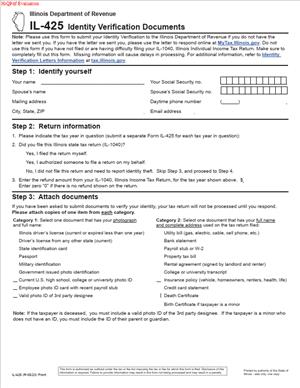
IL-425 Identity Verification Documents
Fill out nowJurisdiction: Country: United States | Province or State: Illinois
If you are completing tax-related paperwork in Illinois, you may come across the IL-425 Identity Verification Documents form. This document is used by the Illinois Department of Revenue to confirm your identity in connection with a tax filing or tax-related matter.
The IL-425 Identity Verification Documents form is not a tax return. It does not calculate what you owe or what you are owed. Instead, it supports a filing by helping the state confirm that the person submitting information is who they claim to be.
You are usually asked to complete this form after you file a return or submit tax information. The request often comes as part of a review process. It is a way for the state to reduce identity theft and fraudulent filings.
If you are about to fill it out, you likely received a notice asking for identity verification. Understanding what the form does and how to complete it can help you avoid delays in processing your tax matter.
What is IL-425 Identity Verification Documents?
Clear definition
The IL-425 Identity Verification Documents form is a supporting document used by the Illinois Department of Revenue to verify a taxpayer’s identity. It is typically requested when the department needs additional confirmation before processing a return, refund, or other tax-related submission.
This form allows you to provide identifying information and, in many cases, copies of documents that confirm who you are. It connects your identity to a specific tax filing or account.
The purpose is administrative. It helps the agency confirm that the filing is legitimate and tied to the correct person. It does not change your tax liability on its own.
Who typically uses this form?
Individual taxpayers most commonly use this form. If you filed an Illinois income tax return and the department needs more proof of identity, you may be asked to complete it.
Business owners may also encounter identity verification requests. This can happen if there are questions about a business tax return, account registration, or a change in account details.
In some situations, a personal representative, executor, or authorized agent may assist with completing the form. Even then, the identity of the taxpayer remains central to the process.
Why might you need this form?
You may need the IL-425 Identity Verification Documents form if the state flags your filing for review. This can happen for many reasons, including unusual activity, inconsistent information, or patterns that suggest possible identity theft.
If you are claiming a refund, especially a larger-than-usual amount, the department may request additional verification before releasing funds.
A recent change in address, name, or filing status may also trigger a review. The form gives you a structured way to confirm your details.
In some cases, the department may already have most of your information but requires supporting documentation to complete its internal checks.
Typical real-life scenarios
- You file your Illinois income tax return and expect a refund. A few weeks later, you receive a letter asking you to complete identity verification. The letter references your return and instructs you to provide documentation. In this situation, the IL-425 Identity Verification Documents form helps the department confirm that the return was filed by you.
- You recently moved and updated your address on your tax filing. The department notices that the address differs from prior years. To prevent potential fraud, it asks you to verify your identity. Completing the form and attaching proof helps connect the new address to your established tax record.
- Someone attempts to file a fraudulent return using your Social Security number. The department detects irregularities and pauses processing. You are notified and asked to complete identity verification. The form allows you to clarify that you are the legitimate taxpayer.
- You are managing the affairs of a deceased family member and submitting final tax documents. The department requests confirmation of identity and authority. In this context, the form may work alongside other documentation to confirm the correct individual is handling the tax matter.
When would you use IL-425 Identity Verification Documents?
You would use the IL-425 Identity Verification Documents form when the Illinois Department of Revenue specifically requests it. It is not typically submitted voluntarily with a regular tax return.
The most common trigger is a written notice. This notice usually references your recent filing or account activity and explains that identity verification is required before further action can be taken.
If you are waiting on a refund and receive a delay notice mentioning identity confirmation, this form may be part of the process. Completing it helps move your filing forward.
If you changed personal details such as your name due to marriage or divorce, or if you updated your Social Security information, the department may require confirmation. The form helps align your current details with your tax account history.
Business taxpayers may use it when there are discrepancies in ownership records or authorized signers. The department may need to confirm that the person interacting with the account has the proper identity connection.
In each case, the form is reactive rather than proactive. It responds to a request from the department rather than initiating a new tax action.
Legal characteristics of IL-425 Identity Verification Documents
The IL-425 Identity Verification Documents form is an administrative document. Its legal effect comes from its role in a tax review process, not from creating a contract or agreement between parties.
For the form to be effective, it must accurately reflect your identifying information. This includes details such as your full legal name, address, Social Security number or taxpayer identification number, and other information requested in the document.
The form is typically considered valid when it is completed fully, signed where required, and accompanied by any requested supporting documentation. Missing signatures, incomplete fields, or unclear copies of documents can cause delays or rejection.
A common problem arises when the information provided does not match what was included on the original filing. Even small inconsistencies in spelling, dates, or identification numbers may prompt further review.
Another issue is failing to respond within the time frame stated in the notice. Delays can affect processing timelines and may lead to additional correspondence.
While identity verification procedures are common across many states, the specific form number, format, and documentation requirements vary. In Illinois, the IL-425 Identity Verification Documents form serves that specific role for the state tax authority.
It is important to understand what this form does not do. It does not replace your tax return. It does not amend previously filed information. It does not automatically approve a refund or resolve a dispute. Its function is limited to confirming identity.
Is it legally binding?
The IL-425 Identity Verification Documents form is not a contract in the traditional sense. However, when you sign it, you are generally confirming that the information you provide is accurate and truthful.
By signing, you are making a formal representation to a government agency. Providing false information on a tax-related document can carry consequences under tax laws.
The form becomes legally significant because it is part of your official tax record. Once submitted, it may be retained by the department as evidence of identity verification.
Its binding nature relates to the statements you make within it. The signature confirms that you stand behind the information provided. It does not create new legal obligations beyond those already established under tax law.
How to fill out IL-425 Identity Verification Documents
Step 1 – Review the Notice That Requested the Form
Before you begin, read the notice you received from the Illinois Department of Revenue. Identify the tax year, account number, or reference number mentioned. This context helps ensure you are completing the form for the correct filing.
Pay attention to any deadlines and specific instructions about what documents to include. The notice often explains why identity verification is needed.
Step 2 – Enter Your Full Legal Name
Provide your full legal name exactly as it appears on your Social Security records or taxpayer identification documents. Avoid nicknames or shortened versions.
If your name has changed, use your current legal name and follow any instructions in the form about listing prior names. Consistency with official records reduces processing issues.
Step 3 – Provide Your Identification Number
Enter your Social Security number or other taxpayer identification number as requested. Double-check each digit before moving on.
Errors in this field are a common cause of delays. Make sure the number matches what was used on the related tax filing.
Step 4 – Confirm Your Current Address
Write your current mailing address clearly. If the address differs from the one on your recent tax return, ensure it matches the most up-to-date information you have provided to the department.
If the form asks for a prior address, include it as instructed. This helps connect past records to your current information.
Step 5 – Include Required Supporting Documents
Review the list of acceptable identity documents described in the instructions. These may include government-issued identification or other official records.
Provide clear copies if copies are requested. Ensure that names, dates, and identification numbers are readable. Illegible documents can lead to additional requests for information.
Step 6 – Answer Any Additional Verification Questions
Some versions of the IL-425 Identity Verification Documents form may include specific questions about your recent tax filing. Answer each question carefully and truthfully.
If a question does not apply, follow the form’s instructions on how to indicate that. Do not leave required fields blank.
Step 7 – Sign and Date the Form
Sign your name in the designated signature area. Use your usual legal signature.
Enter the date you sign the form. This confirms that you completed the verification statement.
If you are signing in a representative capacity, make sure the form allows for that role and that you indicate your title or relationship as required.
Step 8 – Submit the Form as Directed
Follow the submission instructions in the notice. This may include mailing the form or providing it through another authorized method.
Ensure all pages are included and that any required attachments are enclosed. Keep a copy of everything you submit for your records.
After submission, monitor your mail or account for any follow-up communication. The department may confirm receipt or request additional clarification before completing its review.
Legal terms you might encounter in IL-425 Identity Verification Documents
- Identity Verification: This refers to the process of confirming that you are who you say you are. On this document, it usually involves matching your name, identification number, and address with government records. The goal is to prevent fraud and unauthorized changes to tax accounts.
- Taxpayer Identification Number (TIN): This is the number the tax authority uses to identify you. It may be a Social Security number, Individual Taxpayer Identification Number, or federal employer identification number. You must enter it exactly as it appears on official records to avoid processing delays.
- Notice Number: This is a reference number printed on the letter that asked you to submit identity documents. Including it helps the agency match your response to the correct account or issue. If you leave it out, your paperwork may not be connected to your file.
- Supporting Documentation: These are copies of identification documents you submit with the form. They often include a government-issued photo ID, proof of address, or other documents listed in the notice. Clear and complete copies are essential for acceptance.
- Certification Statement: This is the section where you confirm that the information you provided is true and correct. By signing, you are stating that everything is accurate to the best of your knowledge. False information can lead to penalties or further investigation.
- Authorized Representative: This is a person who is legally allowed to act on your behalf. If someone else completes or signs the form for you, they must have proper authority, such as a power of attorney. The agency may require proof of that authority.
- Current Address of Record: This is the address the tax agency has on file for you. You may need to confirm or correct it. If your address has changed, make sure you update it properly to receive future notices.
- Verification Review: This refers to the internal review process after you submit the form. The agency compares your answers and documents against existing records. Processing times vary depending on workload and whether your submission is complete.
- Signature Date: This is the date you sign the form. It confirms when you certify the information. Some agencies require the form to be signed within a certain timeframe after receiving the notice.
FAQs
Why did I receive a request to complete IL-425 Identity Verification Documents?
You usually receive this request when the agency needs to confirm your identity before processing a return, issuing a refund, or making changes to your account. This can happen if there is unusual activity, mismatched information, or a suspected fraud risk. The notice you received explains what triggered the request and includes a reference number you should include in your response.
What identification documents do I need to attach?
The notice that came with this form lists the exact documents required. Common examples include a government-issued photo ID and proof of your current address. Make sure the copies are clear, show your full name, and are not expired. If the name on your ID differs from your tax records, include documentation that explains the difference, such as a name change record.
What if the name on my ID does not exactly match my tax records?
You need to explain and document the difference. For example, if you recently changed your name due to marriage or court order, include proof of that change. If there is a spelling error in the agency’s records, complete the name fields exactly as shown on your official ID and follow any instructions in the notice about correcting your account information.
Can someone else complete and sign this document for me?
Yes, but only if that person has legal authority to act for you. This may require a valid power of attorney or other written authorization already on file. If an authorized representative signs, they must provide their own identifying information and may need to attach proof of authority. Without proper authorization, the agency may reject the submission.
Where do I send this form and my documents?
The mailing address or submission instructions appear on the notice you received. Follow those instructions exactly. If electronic submission is allowed, use the method specified in the notice. Sending it to the wrong address can delay review because your documents may not be routed to the correct department.
How long does it take for the agency to review my submission?
Processing times depend on workload and whether your submission is complete. If information is missing or copies are unclear, you may receive another notice asking for more details. Keep a copy of everything you send so you can respond quickly if additional information is requested.
Will this form change my tax records?
This form itself verifies your identity. It does not automatically change your filing status, income information, or other tax details. However, if you also report an address change or correct identifying information, the agency may update its records based on the information and documents you provide.
What happens if I ignore the request?
If you do not respond, the agency may delay processing your return or refund. In some cases, it may place restrictions on your account until your identity is verified. Responding promptly helps prevent further complications and reduces the risk of additional notices.
Checklist: Before, During, and After IL-425 Identity Verification Documents
Before
- Read the entire notice carefully, including deadlines and reference numbers.
- Gather your government-issued photo ID.
- Collect proof of your current address if required.
- Locate your taxpayer identification number.
- Confirm your legal name as it appears on official documents.
- Check whether someone else has the authority to act for you.
- Make sure you understand how and where to submit the form.
- Set aside time to complete the form without rushing.
During
- Enter your name exactly as shown on your official ID.
- Carefully type or print your identification number without transposing digits.
- Confirm your current address matches your supporting documents.
- Double-check that the notice number is included if requested.
- Answer every question on the form, even if the answer is “not applicable.”
- Review the certification statement before signing.
- Sign and date the form in the correct place.
- Make clear copies of all documents before assembling your submission.
After
- Make a complete copy of the signed form and all attachments for your records.
- Submit the form using the method listed in the notice.
- Note the date you sent or uploaded the documents.
- Keep proof of mailing or confirmation of electronic submission.
- Watch for confirmation or additional notices in the mail.
- Respond promptly if the agency requests more information.
- Store your copy in a secure place with your tax records.
- Update your internal records if your address or name was corrected.
Common mistakes to avoid with IL-425 Identity Verification Documents
- Mistake: Sending blurry or cut-off copies of your ID because you scanned quickly; this often leads to rejection since the agency cannot read key details, so do not forget to check that every corner and line of text is clear.
- Mistake: Entering an incorrect identification number due to a simple typo; this happens when you rush, and it can delay verification or mismatch your records, so do not forget to compare each digit against your official document.
- Mistake: Forgetting to sign and date the form because you focus only on the attachments; unsigned forms are typically not processed, so do not forget to complete the certification section.
- Mistake: Omitting the notice or reference number because it seems unimportant; without it, your documents may not be matched to your case, so do not forget to include any requested reference details.
- Mistake: Using an outdated address without realizing it differs from your ID; this creates confusion during review, so do not forget to confirm your current address and update records if needed.
- Mistake: Letting someone else sign without proper authority because it feels convenient; this can result in rejection of the submission, so do not forget to provide valid authorization if a representative is involved.
What to do after filling out IL-425 Identity Verification Documents
Once you complete the form, pause before sending it. A careful final review can prevent weeks of delay. Look at each field and compare it directly to your identification documents and the notice you received.
Make sure all attachments are included. Confirm that copies are readable and that your name and identification number are consistent across every page. Small mismatches often cause follow-up letters.
Now take these practical steps:
- Step 1: Make a full copy of the signed form and every attachment for your records.
- Step 2: Assemble the documents in the order listed in the notice.
- Step 3: Submit the packet using the exact method provided in the notice, whether by mail or approved electronic method.
- Step 4: If mailing, use a method that provides delivery confirmation and keep the receipt.
- Step 5: If submitting electronically, save or print the confirmation screen or email acknowledgment.
- Step 6: Mark your calendar with the date you submitted the documents and the response deadline.
- Step 7: Monitor your mail and any official online accounts for updates or additional requests.
- Step 8: Respond quickly if you receive a follow-up request for more documents.
- Step 9: Store your copy of the form with your tax records for at least several years.
- Step 10: Update your personal files if your address, name, or contact information was corrected during this process.
After submission, allow a reasonable processing time. Avoid sending duplicate copies unless instructed. Duplicate submissions can slow down the review because multiple records may need to be reconciled.
If your identity is successfully verified, the agency will continue processing the related return, refund, or account change. Keep all related correspondence together. Organized records make it easier to resolve any future questions.
Disclaimer: This guide is provided for informational purposes only and is not intended as legal advice. You should consult a legal professional.