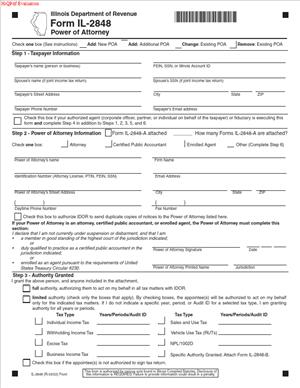
Form IL-2848 Power of Attorney
Fill out nowJurisdiction: Country: United States | Province or State: Illinois
Form IL-2848 Power of Attorney is a document used to authorize someone to represent you before the Illinois Department of Revenue. If you are dealing with Illinois tax matters and want another person to speak or act on your behalf, this is the form that creates that authority.
You might be preparing this form because you received a notice, are under review, or want help managing ongoing tax issues. It allows a trusted representative to communicate directly with the state tax agency about specific tax periods and matters.
This form is not a general power of attorney for all financial or legal issues. It is limited to Illinois tax matters described in the document. That distinction matters when you decide who to appoint and what authority to grant.
If you are about to complete Form IL-2848 Power of Attorney, it helps to understand what it does, when it takes effect, and how to fill it out accurately. Small errors can delay processing or limit your representative’s ability to act.
The sections below walk through the purpose of the form, when it is commonly used, how it becomes valid, and how to complete it step by step.
What is Form IL-2848 Power of Attorney?
Clear definition
Form IL-2848 Power of Attorney is an authorization document issued by the Illinois Department of Revenue. It allows you, as a taxpayer, to appoint another person to represent you in specific tax matters before that agency.
By signing this form, you grant defined authority to your representative. That authority may include receiving confidential tax information, discussing your account with the Department, and handling certain actions related to the listed tax types and periods.
The form limits the representative’s power to what you describe. It does not automatically cover all taxes, all years, or all issues. The scope depends on what you enter in the relevant sections.
Once properly completed and accepted, the form becomes part of your tax record with the Department. The agency will then recognize your representative as authorized for the matters listed.
Who typically uses this form?
Individual taxpayers use this form when they want help with personal Illinois income tax issues. This may include responding to notices, audits, assessments, or payment questions.
Business owners also use it. Corporations, partnerships, limited liability companies, and other entities may appoint a representative to handle sales tax, withholding tax, corporate income tax, or other state tax matters.
Common representatives include certified public accountants, tax preparers, attorneys, enrolled agents, and in some cases, trusted family members or employees. The person must be someone you trust to access your tax information.
This form is also used by estates or trusts when a fiduciary wants to designate someone to interact with the Department regarding estate or fiduciary income tax matters.
Why might you need this form?
You may need Form IL-2848 Power of Attorney if you cannot or prefer not to communicate directly with the Illinois Department of Revenue. Tax matters can involve technical language and deadlines. Having a representative can make communication more efficient.
If you are under audit or review, a representative can respond to document requests, attend meetings, and present information on your behalf. This can reduce misunderstandings and help organize your records.
You might also use the form if you are out of state, traveling, or otherwise unavailable. Authorizing someone locally allows tax issues to move forward without delay.
For businesses, appointing a representative can centralize tax communication. Instead of multiple employees responding to notices, one designated person handles interactions with the Department.
Typical real-life scenarios
- You receive a letter stating that your Illinois income tax return is being audited. The notice requests documentation and sets a response deadline. You decide to have your accountant manage the audit process. You complete Form IL-2848 Power of Attorney, so the accountant can communicate directly with the auditor.
- Your small business receives a notice about unpaid sales tax for prior quarters. You want your tax advisor to review the account transcripts and negotiate a payment arrangement. Filing this form allows the advisor to access information and speak with the Department about the listed tax periods.
- You moved to another state, but still have unresolved Illinois tax issues. Because you cannot easily attend meetings or make phone calls during business hours, you authorize a local attorney to represent you. The form gives that attorney the authority to handle discussions and submit certain documents on your behalf.
- An elderly parent is dealing with multiple tax notices and feels overwhelmed. With proper authorization, a family member or professional can use the form to manage communications and ensure responses are timely and organized.
When would you use Form IL-2848 Power of Attorney?
You would typically use this form when a tax matter requires direct contact with the Illinois Department of Revenue, and you want someone else to handle that contact.
This often happens during audits, appeals, collections activity, or disputes over assessments. The representative can request information, clarify issues, and provide supporting documents.
The form is also used when you want ongoing representation for routine matters. For example, a business may authorize its accountant to handle all sales tax filings and related correspondence for specified periods.
If you expect complex questions about deductions, credits, or business classifications, you may choose to appoint a professional who understands those areas. The form gives that person recognized authority in the eyes of the Department.
It can also be used when correcting past filings. If amended returns are involved, a representative may help prepare and submit them while communicating with the agency about adjustments.
In some cases, multiple representatives are appointed. For example, you might authorize both an attorney and an accountant. The form allows you to specify whether each can act independently or must act together, depending on how you complete it.
The key point is that the form is tied to specific Illinois tax matters. It is not used for federal tax issues or for non-tax legal matters.
Legal Characteristics of Form IL-2848 Power of Attorney
Form IL-2848 Power of Attorney becomes effective when it is properly completed, signed by the taxpayer or authorized business officer, and accepted by the Illinois Department of Revenue. The Department must receive and process the form before recognizing the representative.
For the form to be valid, it generally must clearly identify the taxpayer. This includes accurate names, identification numbers, and contact information. Errors in these details can cause delays or rejection.
The form must also clearly describe the tax types and periods covered. If the information is vague, incomplete, or inconsistent, the representative’s authority may be limited or questioned.
Signatures are critical. The taxpayer or an authorized individual for a business entity must sign and date the form. If the signer does not have proper authority within the business, the form may not be accepted.
Another common issue is incomplete representative information. The form typically requires the representative’s name, address, and identification details. Missing or incorrect entries can prevent the Department from recognizing the authorization.
Jurisdictional differences matter. This form applies to Illinois state tax matters only. It does not grant authority before the Internal Revenue Service or tax agencies in other states. Separate forms are often required for those agencies.
It is also important to understand what the form does not do. It does not transfer ownership of property. It does not allow the representative to make personal financial decisions unrelated to Illinois tax matters. It does not override court orders or create broad legal authority outside the scope described.
The authority granted can generally be limited or revoked. If you later submit a new power of attorney covering the same matters, the newer filing may replace the earlier one, depending on how it is completed.
Is it legally binding?
When properly executed and accepted, Form IL-2848 Power of Attorney is legally binding for the specific Illinois tax matters it lists. The Illinois Department of Revenue will treat your representative as authorized to act within the scope granted.
The binding effect depends on valid completion. If the taxpayer’s signature is missing, if required information is incomplete, or if the signer lacks authority, the form may not be enforceable.
For businesses, the person signing must typically have the legal capacity to bind the entity. This often includes corporate officers, partners, members, or other authorized individuals. If someone without authority signs, the Department may reject the form.
The representative’s authority is limited by the document itself. If a tax period or tax type is not listed, the representative generally does not have authority over that matter.
The form does not remove your own rights or responsibilities. You remain responsible for your tax obligations. The representative acts on your behalf, but the underlying liability remains yours or your entity’s.
How to fill out Form IL-2848 Power of Attorney
Step 1 – Identify the taxpayer
Enter your full legal name exactly as it appears on your Illinois tax filings. If you are an individual, include your Social Security number or other required taxpayer identification number in the space provided.
If you are completing the form for a business, enter the legal name of the entity and its employer identification number or other required identification number. Use the official registered name, not a trade name, unless specifically requested.
Provide your current mailing address and contact information. Make sure this matches your most recent filings to reduce processing delays.
Step 2 – Appoint your representative
Enter the full name of each person you are authorizing. Include their mailing address and any required identification numbers requested on the form.
If the form allows multiple representatives, list each one clearly. Pay attention to any checkboxes or fields that indicate whether each representative can act independently or whether copies of notices will be sent to them.
Ensure the information is accurate and complete. Misspelled names or incorrect addresses can interfere with the recognition of the authorization.
Step 3 – Specify the tax matters and periods
Carefully describe the type of tax involved. This may include individual income tax, corporate income tax, sales tax, withholding tax, or other Illinois taxes.
List the specific tax periods covered. This could mean calendar years, fiscal years, or particular quarters. Avoid broad phrases if the form requires exact dates or periods.
If you want the representative’s authority to cover multiple years, list each period as instructed. The scope of authority depends on what you write in this section.
Step 4 – Define the scope of authority
Review the section that describes what your representative is allowed to do. This may include receiving confidential information, representing you in discussions, and signing certain documents if permitted.
Some forms include options to grant or limit specific powers. Read each statement carefully and mark the appropriate boxes or complete any required fields.
If there is a section for special instructions, use it to clarify any limitations. Keep the language clear and consistent with the rest of the form.
Step 5 – Sign and date the form
Sign your name in the designated area. Enter the date of signing. The signature must match the capacity in which you are signing, such as individual taxpayer, corporate officer, partner, or member.
If you are signing on behalf of a business entity, include your title. This helps demonstrate that you have the authority to bind the entity.
Check that all required signatures are present before submission. An unsigned form is generally not valid.
Step 6 – Have the representative sign, if required
Some versions of the form require the representative to sign, acknowledging the appointment and agreeing to act within professional and legal standards.
If a representative signature is required, ensure each listed representative signs and dates the form in the appropriate section.
Confirm that all identification details for the representative are complete before finalizing the document.
Step 7 – Review and submit the completed form
Read through the entire form once more. Verify that names, identification numbers, tax types, and periods are correct and consistent.
Make sure all required sections are filled in and no mandatory fields are left blank. Confirm that signatures and dates are present.
Submit the completed Form IL-2848 Power of Attorney to the Illinois Department of Revenue using the submission method indicated on the form. Keep a copy for your records in case you need to reference it later.
Legal terms you might encounter in Form IL-2848 Power of Attorney
- Taxpayer Identification Number (TIN): This is the number the state uses to identify you in its tax system. For individuals, it is typically your Social Security number. For businesses, it may be an Employer Identification Number. You must enter it exactly as it appears on prior filings so your authorization matches the correct account.
- Representative: This is the person you authorize to act for you in tax matters. The form requires the representative’s full name, address, and contact details. The authority you grant applies only to the person you list, not to their firm or employer unless clearly stated.
- Tax Matters: This section defines what specific issues your representative can handle. You must list the type of tax, the form number if known, and the tax periods involved. If you leave this vague, the authority may be limited or rejected.
- Tax Periods: These are the specific years or filing periods covered by the authorization. You can list calendar years, fiscal years, or specific quarters. If you fail to specify them clearly, your representative may not be able to access older or future records.
- Scope of Authority: This explains what your representative is allowed to do. It can include receiving confidential information, signing agreements, or representing you in discussions. The form lets you grant broad authority or limit it to certain actions.
- Revocation: When you sign a new power of attorney covering the same tax matters and periods, it may cancel a prior authorization. The form may also allow you to state whether you intend to revoke earlier powers. You should review this section carefully if you have appointed someone before.
- Declaration of Representative: This is the statement your representative signs to confirm they are eligible and agree to act for you. It often includes their professional status, such as attorney or certified public accountant. Without this signature, the authorization may not be processed.
- Confidential Tax Information: This refers to your private tax data held by the state. By signing this document, you allow the listed representative to access that information. The access is limited to the matters and periods you describe.
- Signature Authority: This determines whether your representative can sign certain tax documents on your behalf. The form may restrict this power unless you clearly authorize it. If you want your representative to sign returns or agreements, you must confirm that the scope allows it.
- Withdrawal: This occurs when a representative chooses to end their authority. The representative may need to notify the tax agency in writing. Once withdrawn, they can no longer receive information or act for you under the form.
FAQs
When does the authority I grant on Form IL-2848 Power of Attorney become effective?
The authority generally becomes effective when the tax agency receives and processes this document. There is no separate “start date” field in most cases, so effectiveness depends on submission and acceptance. If you need representation for a specific period, make sure the tax years or quarters are clearly listed so there is no delay in access.
Can I limit what my representative is allowed to do?
Yes. You control the scope of authority by how you complete the tax matters and authorization sections. If you want your representative to discuss your account but not sign agreements, you must avoid granting signing authority. Review the language carefully before you sign so the permissions match your intent.
What happens if I list the wrong tax period?
If you list the wrong year or leave a period out, your representative may not be able to access those records. The agency will only recognize the exact periods written on this form. You may need to submit a corrected document to expand or fix the coverage.
Do I need to attach anything when I file this document?
In most cases, no additional documents are required if all sections are completed properly. However, if you are signing on behalf of a business or as a fiduciary, you must ensure your title or authority is clearly stated. Incomplete identification details can cause processing delays.
Will filing Form IL-2848 Power of Attorney cancel an earlier power of attorney?
It can. If the new authorization covers the same tax matters and periods, it may revoke a prior one. Review the revocation section carefully and confirm whether you intend to replace or keep earlier authorizations. If you want multiple representatives, make sure they are all listed.
Can my representative sign my tax return for me?
Only if the scope of authority allows it and the agency rules permit it. You must clearly grant signing authority if that is your intention. If you do not, your representative may still discuss and negotiate issues, but not sign binding documents on your behalf.
What if my name or identification number does not exactly match state records?
A mismatch can prevent your authorization from being linked to your account. Check that your name and taxpayer identification number match your most recent tax return or official notice. Even small errors can delay acceptance.
How do I know if this document has been accepted?
The agency may not always send a formal confirmation. Your representative can attempt to contact the agency to confirm they are recognized. If access is denied, it may mean the document was incomplete, incorrect, or not yet processed.
Checklist: Before, During, and After Form IL-2848 Power of Attorney
Before
- Confirm the exact legal name and taxpayer identification number on your most recent filing.
- Decide which tax types and years you want covered.
- Choose a representative who is qualified and willing to act.
- Discuss the scope of authority you intend to grant.
- Check whether you already have a power of attorney on file.
- Gather prior notices or letters related to the tax matter.
- Verify the representative’s full contact information.
- Clarify whether a signing authority is necessary.
During
- Enter your name and identification number exactly as on state records.
- Clearly list each tax type and the specific periods.
- Avoid vague terms like “all years” unless the form allows it.
- Review the scope of authority section line by line.
- Confirm whether you are revoking prior authorizations.
- Sign and date the form in the correct place.
- Ensure the representative completes and signs their declaration.
- Double-check for missing fields before finalizing.
After
- Make a complete copy for your records.
- Provide a copy to your representative.
- Submit the form using the accepted filing method.
- Track when and how you submitted it.
- Follow up to confirm it has been processed.
- Keep related tax notices together with the authorization copy.
- Update your internal records to reflect the appointment.
- Replace the form if your representative’s details change.
Common mistakes to avoid with Form IL-2848 Power of Attorney
- Mistake: Listing incorrect or incomplete tax periods because you assume “all years” is automatically covered, which can limit your representative’s access and delay resolution; do not forget to specify each exact year or quarter.
- Mistake: Misspelling your legal name or entering the wrong identification number due to copying from memory, which can cause rejection or misfiled authority; do not forget to match your most recent official tax document.
- Mistake: Forgetting the representative’s signature in the declaration section because you focus only on your own signature, which can make the form invalid; do not forget that both parties may need to sign.
- Mistake: Failing to review the revocation section because you overlook prior authorizations, which can unintentionally cancel an existing representative; do not forget to confirm your intent about earlier powers of attorney.
- Mistake: Granting broader authority than intended because you do not read the scope carefully, which can allow actions you did not anticipate; do not forget to limit powers clearly if needed.
- Mistake: Submitting the form without keeping a copy because you assume it will always be accessible later, which can create confusion if questions arise; do not forget to store a complete, signed version.
- Mistake: Leaving blank fields assuming they are optional, which can result in processing delays or rejection; do not forget to review every section before submission.
- Mistake: Appointing someone without confirming their willingness or qualifications, which can lead to withdrawal or ineffective representation; do not forget to discuss expectations in advance.
What to do after filling out Form IL-2848 Power of Attorney
Once you complete and sign the document, slow down and review it one more time. Check every name, number, and listed tax period. Small errors can delay recognition of your representative.
Make at least one full copy for yourself. If the matter is complex, keep both a digital and paper version. Store it with your recent tax returns and any notices related to the covered years.
- Step 1: Confirm that all required signatures are present and dated correctly.
- Step 2: Deliver or submit the form using the accepted submission method.
- Step 3: Note the date and method of submission in your records.
- Step 4: Provide a copy to your representative immediately.
- Step 5: Organize your tax documents so your representative can access them quickly.
- Step 6: Monitor for confirmation through successful account access or agency communication.
- Step 7: Respond promptly if the agency requests clarification or correction.
- Step 8: Update your records if you later change representatives or expand tax periods.
- Step 9: Revoke or replace the authorization in writing if your situation changes.
- Step 10: Keep the document accessible until all covered tax matters are resolved.
Stay proactive after submission. If your representative cannot access your information within a reasonable time, follow up. Processing delays can happen, especially if information does not match exactly.
If your tax issue resolves, consider whether you still need the authorization in place. You can limit future confusion by formally revoking it if representation is no longer necessary.
Finally, treat this document as part of your official tax file. Keeping organized records makes future filings, audits, or inquiries easier to manage.
Disclaimer: This guide is provided for informational purposes only and is not intended as legal advice. You should consult a legal professional.