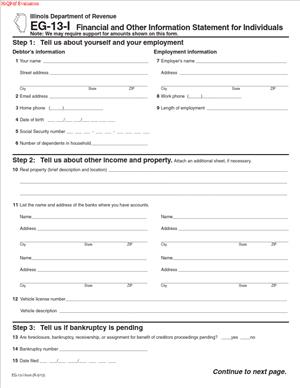
EG-13-I Financial and Other Information Statement for Individuals
Fill out nowJurisdiction: Country: United States | Province or State: Illinois
The EG-13-I Financial and Other Information Statement for Individuals is a detailed financial disclosure form used in Illinois. You complete this document when a state agency needs a full picture of your financial situation. It asks for income, assets, debts, and other relevant financial details.
This form is often requested when you owe money to a state agency and cannot pay the full amount at once. It helps the agency understand what you can realistically afford. Your answers may affect payment arrangements or other decisions about your account.
You are expected to provide accurate and complete information. The form is designed to show your overall financial condition, not just one part of it. That includes what you earn, what you own, and what you owe.
Filling out the EG-13-I Financial and Other Information Statement for Individuals can feel overwhelming at first. It asks for specific numbers and supporting details. Once you understand what each section is looking for, the process becomes more manageable.
This guide explains what the form is, when it is used, and how to complete it step by step. It is written for people handling the process on their own.
What is the EG-13-I Financial and Other Information Statement for Individuals?
Clear definition
The EG-13-I Financial and Other Information Statement for Individuals is a financial disclosure document used by a state agency in Illinois. It gathers detailed information about your personal financial condition. This includes income from all sources, monthly expenses, bank accounts, property, and outstanding debts.
The purpose of the form is to assess your ability to pay a debt. It presents a structured way for you to show what you can and cannot afford. The agency reviewing it uses your disclosures to evaluate payment options or collection decisions.
This form is not a simple summary. It typically requires exact amounts, account balances, and descriptions of property. You may need to refer to pay stubs, bank statements, loan statements, and tax records to complete it accurately.
Who typically uses this form?
Individuals who owe money to a state agency in Illinois often use this form. This may include people with unpaid taxes, penalties, interest, or other state-assessed obligations.
You might be asked to complete it if you request a payment plan or other financial arrangement. It is commonly used when the agency needs proof that you cannot pay the balance in full.
Self-employed individuals may also need to complete this form. In those cases, you may need to provide business income and expense information in addition to personal financial details.
In some situations, married individuals are asked to include information about a spouse’s income and assets, even if the debt is in one person’s name. The form may request household-level information to assess total financial capacity.
Why might you need this form?
You may need the EG-13-I Financial and Other Information Statement for Individuals if you are seeking relief from immediate payment demands. The agency may require financial disclosure before considering alternatives such as installment arrangements.
The form helps determine whether you qualify for a reduced payment plan. It may also be used to evaluate whether collection activity should continue or be modified.
If your financial situation has changed, this form provides a structured way to explain that change. For example, job loss, medical expenses, or reduced income may affect your ability to pay.
In some cases, the agency may request this form before agreeing to delay enforcement actions. The information you provide becomes part of your account record.
Typical real-life scenarios
- You receive a notice stating that you owe back taxes and cannot pay the full amount. You contact the agency to request a payment plan. They ask you to complete the form so they can evaluate your request.
- You recently lost your job and have limited income. You owe a state debt that has been referred for collection. You are asked to submit a financial statement to show your current hardship.
- You operate a small business as a sole proprietor. Your business income varies each month. The agency requests this document to understand both your personal and business finances.
- You have significant medical expenses that limit your ability to make large payments. The form allows you to list those ongoing obligations so they are considered in any decision about repayment terms.
When would you use the EG-13-I Financial and Other Information Statement for Individuals?
You would use the EG-13-I Financial and Other Information Statement for Individuals when a state agency requests detailed financial information to evaluate your ability to pay a debt. It is typically not filed on its own. Instead, it is submitted in response to a request or as part of a negotiation.
Often, you use this form after receiving a notice of balance due. If you contact the agency to discuss payment options, they may instruct you to complete and return the document. The timing usually follows an initial billing or collection notice.
You may also use it when requesting an installment agreement. The agency needs to see your income and expenses before deciding how much you can pay each month. Your submission supports your proposal for manageable payments.
In some cases, the form is used during ongoing collection activity. If your account has progressed to enforcement measures, financial disclosure may be required before changes are considered.
Self-employed individuals may use the form when their income fluctuates and standard payment amounts do not reflect their actual ability to pay. The document allows you to present a complete financial picture rather than relying on estimated averages.
If you are experiencing financial hardship, such as unemployment or unexpected expenses, you may be asked to complete this form to document your situation. The agency reviews the information to determine what action is appropriate.
Legal Characteristics of EG-13-I Financial and Other Information Statement for Individuals
This form is a formal financial disclosure document. When you sign it, you are generally certifying that the information provided is true and complete to the best of your knowledge. Accuracy matters because the agency relies on your statements to make decisions.
For the form to be effective, it must be fully completed. Missing sections, incomplete answers, or unexplained gaps can delay review. Inconsistent figures, such as income that does not match listed expenses, may raise questions and require clarification.
Supporting documentation is often expected. While the form itself collects summary information, the agency may request proof such as pay stubs, bank statements, or loan documents. Failure to provide the requested documentation may affect how your submission is evaluated.
High-level procedural requirements can vary by agency and situation. Some submissions may need to be mailed, while others may be delivered electronically. Deadlines may apply if the form is requested in connection with active collection proceedings.
This document does not erase a debt by itself. It does not automatically stop collection activity. It provides information that may influence how the agency proceeds.
The form also does not function as a settlement agreement. Any payment plan or modification generally requires separate confirmation. The financial statement supports the decision-making process, but is not the final agreement.
Is it legally binding?
The EG-13-I Financial and Other Information Statement for Individuals is not a contract in the traditional sense. It does not create a new payment obligation by itself. However, it carries legal weight because you are making formal representations about your finances.
When you sign the form, you are typically declaring that the information is accurate. Providing false or misleading information can lead to serious consequences. The agency may rely on your statements when determining how to proceed with your account.
While the form itself does not bind the agency to accept your proposal, your signed statements become part of your official record. They may be referenced in future discussions or reviews.
If a payment arrangement is later approved, that separate agreement may be legally binding. The financial statement serves as the foundation for evaluating whether such an arrangement is appropriate.
How to fill out the EG-13-I Financial and Other Information Statement for Individuals
Step 1 – Review the entire form before you begin
Start by reading through the entire document. This helps you understand what information is required and what documents you may need. Take note of sections that ask for detailed financial data.
Gather recent pay stubs, bank statements, loan balances, and monthly bills before filling it out. Having these records nearby reduces errors and saves time.
Step 2 – Provide your personal identification information
Enter your full legal name, current address, and contact information exactly as requested. Include any account or case number associated with your debt. This ensures your submission is matched to the correct file.
If the form asks for additional identifying details, such as a taxpayer identification number, enter them carefully. Double-check for accuracy before moving on.
Step 3 – Disclose all sources of income
List every source of income you receive. This may include wages, self-employment earnings, rental income, retirement benefits, or other regular payments.
Use gross or net amounts as instructed by the form. If you are self-employed, you may need to calculate your average monthly income based on recent records. Keep your numbers consistent with supporting documents.
Step 4 – Detail your monthly living expenses
Enter your regular monthly expenses in each category provided. This may include housing, utilities, food, transportation, insurance, medical costs, and loan payments.
Use realistic and current figures. Avoid estimating without checking actual bills when possible. The goal is to present an accurate picture of your household’s financial obligations.
Step 5 – List bank accounts and cash on hand
Provide information about checking, savings, and other financial accounts. Include the name of the financial institution and the current balance.
If you have cash on hand or other liquid funds, report them as requested. Do not omit accounts, even if the balance is low.
Step 6 – Disclose real estate and personal property
Identify any real estate you own, including your primary residence or other property. The form may ask for estimated values and outstanding loan balances.
You may also need to list vehicles, valuable personal property, or business assets. Provide reasonable estimates based on available information.
Step 7 – Report outstanding debts and liabilities
List all debts you owe. This may include mortgages, car loans, credit cards, medical bills, and other obligations.
Include the creditor’s name, total balance owed, and monthly payment amount. This helps show your overall financial commitments.
Step 8 – Provide information about dependents and household members
If the form asks about dependents, list each person supported by your income. Include their relationship to you and any relevant financial details requested.
Household size can affect how your financial capacity is evaluated. Make sure this section reflects your current living situation.
Step 9 – Review your entries for consistency
Before signing, review the entire form carefully. Check that income and expense totals make sense together. Ensure there are no blank sections unless clearly marked as not applicable.
Confirm that figures match the documents you used for reference. Correct any errors before submission.
Step 10 – Sign and date the form
Read the declaration statement near the signature line. By signing, you are confirming that the information is accurate and complete.
Sign and date the form as required. If additional documentation is requested, attach it in an organized manner. Once complete, submit the document according to the provided instructions.
Legal terms you might encounter in EG-13-I Financial and Other Information Statement for Individuals
- Gross Income: This is your total income before taxes or other deductions are taken out. On this form, you must report all sources of gross income, including wages, self-employment earnings, rental income, and benefits. The form expects full disclosure, not just take-home pay.
- Net Income: This is the amount you receive after taxes and mandatory deductions. Some sections may ask for net monthly income to compare against your living expenses. Make sure you understand whether the form is asking for gross or net figures in each section.
- Assets: Assets are items you own that have value. This includes cash, bank accounts, vehicles, real estate, investments, and valuable personal property. You must list both sole and jointly owned assets if requested.
- Liabilities: Liabilities are debts you owe. These may include credit cards, loans, mortgages, medical bills, and tax debts. The form typically asks for the total balance owed and your required monthly payment.
- Monthly Living Expenses: This refers to your regular, recurring household costs. Examples include rent or mortgage payments, utilities, food, transportation, insurance, and child support. You should use actual average monthly amounts, not estimates that are too low.
- Dependent: A dependent is a person who relies on you financially, such as a child or other family member. The form may ask for the number of dependents and their relationship to you. This information helps determine your financial capacity.
- Financial Institution: A financial institution is any bank, credit union, or similar entity where you hold accounts. You will need to provide the name of the institution, account type, and current balance. Accuracy here is important because these balances may be verified.
- Real Property: Real property means land and anything permanently attached to it, such as a house. If you own real estate, the form may require the property address, estimated value, and loan balance. Include property even if it is jointly owned.
- Personal Property: Personal property includes movable items you own, such as vehicles, boats, jewelry, or business equipment. The form may ask for a description and an estimated value. Do not overlook items with significant resale value.
- Verification or Supporting Documentation: This refers to documents that confirm the information you provide. Examples include pay stubs, bank statements, tax returns, and loan statements. You may need to attach copies or have them ready if requested.
FAQs
What date should I use when reporting my financial information?
Use the most current and accurate information available as of the date you sign the document. If a section asks for “current balance” or “current monthly income,” use figures that reflect your present situation, not last year’s numbers. If your income changes from month to month, calculate a reasonable monthly average and keep notes on how you arrived at that number in case you need to explain it.
Do I need to attach proof of the income and expenses I list?
In many cases, yes. This form is designed to give a complete financial picture, and the agency reviewing it may request supporting documents. Gather recent pay stubs, bank statements, benefit letters, mortgage statements, lease agreements, and bills that support the numbers you entered. Make sure the documents match the amounts you reported and that the dates are recent.
What happens if I leave out an asset or debt by accident?
If you discover the mistake before submitting the EG-13-I Financial and Other Information Statement for Individuals, correct it immediately and initial any changes if required. If you notice the omission after submission, provide updated information as soon as possible. Leaving out assets or debts can delay processing and may raise concerns about accuracy, so review your entries carefully before signing.
Should the name on this document match my tax records exactly?
Yes. Use your full legal name exactly as it appears on your tax filings and identification. If you have changed your name, ensure consistency across all sections and attach any required documentation that explains the change. Mismatched names can cause processing delays or confusion when your records are reviewed.
How do I report income if I am self-employed?
List your average monthly gross income from self-employment. Use recent business records to calculate this figure. You may need to provide profit and loss statements or recent tax returns to support the number. Be clear about business expenses if the form asks for them separately, and do not mix personal and business expenses unless instructed.
Is this document legally binding once I sign it?
When you sign the EG-13-I Financial and Other Information Statement for Individuals, you are confirming that the information is true and complete to the best of your knowledge. Your signature typically includes a declaration that the information is accurate. Providing false or incomplete information can lead to penalties or rejection of your request, so review everything carefully before signing.
How will I know if my submission has been accepted?
Acceptance procedures vary, but you should receive confirmation that the document was received and is under review. Keep proof of submission, such as a receipt, confirmation number, or stamped copy. If you do not receive acknowledgment within a reasonable time, follow up using the contact method provided in the instructions.
What should I do if my financial situation changes after I submit this form?
If your income, expenses, or assets change significantly after submission, notify the reviewing agency promptly. Provide updated figures and any required documentation. Keeping your information current helps prevent misunderstandings and ensures that decisions are based on accurate data.
Checklist: Before, During, and After EG-13-I Financial and Other Information Statement for Individuals
Before
- Gather recent pay stubs, benefit letters, and proof of all income sources.
- Collect bank statements for all checking, savings, and investment accounts.
- Locate statements for mortgages, vehicle loans, credit cards, and other debts.
- Prepare a list of monthly household expenses with realistic averages.
- Confirm the current balances and estimated values of major assets.
- Review prior tax returns for consistency in income reporting.
- Set aside uninterrupted time to complete the form carefully.
During
- Read each question fully before entering information.
- Use exact figures from documents rather than guessing.
- Double-check that totals match supporting documents.
- Include all assets and liabilities, even if jointly owned.
- Write clearly and legibly if completing a paper version.
- Ensure your name and identifying information are consistent throughout.
- Review each page before moving to the next section.
After
- Make a complete copy of the signed form and all attachments.
- Organize supporting documents in the same order as referenced in the form.
- Submit the form using the method specified in the instructions.
- Keep proof of mailing, delivery, or electronic submission.
- Monitor for written confirmation or follow-up requests.
- Respond promptly to any request for additional documentation.
- Store your copy in a secure place for future reference.
Common mistakes to avoid with the EG-13-I Financial and Other Information Statement for Individuals
- Mistake: Reporting net income when the form asks for gross income because the terms seem interchangeable, which can understate your earnings and affect how your financial capacity is evaluated, so do not forget to confirm which figure is requested in each section.
- Mistake: Forgetting to list jointly owned bank accounts or property because you assume partial ownership does not count, which can make your disclosure incomplete and delay review, so do not forget to include all shared assets.
- Mistake: Underestimating monthly expenses to appear more financially strained, which can create inconsistencies if compared to bank statements and bills, so do not forget to use accurate, document-supported averages.
- Mistake: Leaving sections blank because they seem inapplicable without writing “N/A,” which may lead reviewers to believe you skipped the question, so do not forget to clearly indicate when something does not apply.
- Mistake: Failing to sign and date the form because you focus on financial details and overlook the signature page, which can result in rejection of your submission, so do not forget to complete the declaration section.
- Mistake: Attaching outdated supporting documents due to convenience, which may cause questions about your current situation, so do not forget to provide the most recent statements available.
- Mistake: Providing inconsistent numbers across sections because you revise one figure and forget to update related totals, which can undermine credibility, so do not forget to recheck all calculations before submitting.
- Mistake: Ignoring follow-up correspondence after submission because you assume silence means approval, which can stall your matter, so do not forget to monitor and respond to all communications promptly.
What to do after filling out the EG-13-I Financial and Other Information Statement for Individuals
Once you finish the form, pause before you submit it. A careful review now can prevent delays later. Compare every number against your supporting documents. Make sure totals are correct and consistent.
- Step 1: Review every page for completeness.
- Step 2: Confirm your name, identification numbers, and contact details are accurate.
- Step 3: Check that all required attachments are included.
- Step 4: Sign and date the declaration section.
- Step 5: Make a full copy of the signed form and all attachments.
- Step 6: Organize your copy in a secure file for your records.
- Step 7: Submit the form using the approved delivery method.
- Step 8: Obtain and keep proof of submission.
- Step 9: Track any confirmation or case number you receive.
Step 10: Calendar a reminder to follow up if you do not receive acknowledgment within a reasonable time.
After submission, stay organized. If you are contacted for additional information, respond quickly and provide exactly what is requested. Keep copies of all follow-up correspondence. If your financial circumstances change, prepare updated figures and documentation so you are ready to provide accurate information.
Treat this form as part of your official financial record. Store your copy with tax returns and important financial documents. This will make future updates easier and help you maintain consistency in any related filings.
Disclaimer: This guide is provided for informational purposes only and is not intended as legal advice. You should consult a legal professional.