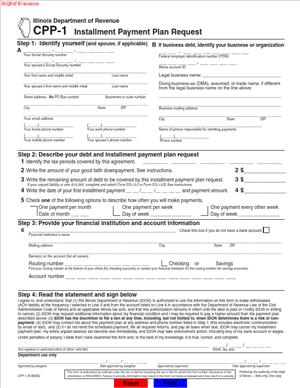
CPP-1 Installment Payment Plan Request
Fill out nowJurisdiction: Country: United States | Province or State: Illinois
If you owe state taxes and cannot pay the full amount at once, the CPP-1 Installment Payment Plan Request is the form used to ask for a monthly payment arrangement. It allows you to propose a structured plan to pay what you owe over time instead of in a single lump sum.
This document is used in Illinois when you have an outstanding balance with the state tax authority. It helps you formally request approval to break that balance into manageable payments.
Filling out the CPP-1 Installment Payment Plan Request carefully matters. The information you provide is used to evaluate whether your proposed payment plan is reasonable and realistic. Incomplete or inaccurate details can delay review or result in denial.
Before you start writing, it helps to understand what the form is designed to do and what it does not do. This overview walks you through the purpose of the form, when it is used, and how to complete it clearly and correctly.
What is the CPP-1 Installment Payment Plan Request?
Clear definition
The CPP-1 Installment Payment Plan Request is a formal written request asking the Illinois Department of Revenue to allow you to pay a tax debt in installments. It outlines your current balance, the payment amount you are proposing, and the schedule you believe you can meet.
This form is not the payment plan itself. It is the request that starts the review process. The agency reviews your financial information and decides whether to accept, modify, or deny your proposal.
The document creates a written record of your request. It also shows that you acknowledge the debt and are seeking a structured way to resolve it.
Who typically uses this form?
Individuals who owe personal income tax and cannot pay the full balance often use this form. Small business owners may also use it if their business has an outstanding tax liability.
It is commonly used by taxpayers who have received a notice demanding payment and need additional time. Both self-employed individuals and wage earners may submit it.
In some cases, representatives such as accountants or authorized agents prepare the form on behalf of the taxpayer. However, the request is still made in the taxpayer’s name.
Why might you need this form?
You might need this form if paying your entire tax bill at once would create financial hardship. An installment arrangement can spread payments over several months.
It can also be relevant if you want to avoid enforced collection actions. Requesting a payment plan signals that you are trying to resolve the balance.
This form provides a structured way to present your financial situation. Instead of informal calls or partial payments without agreement, you submit a clear written proposal.
Typical real-life scenarios
- You filed your Illinois income tax return and later received a bill for additional tax, penalties, and interest. You cannot pay the full amount before the due date, so you complete this request to propose monthly payments.
- Your small business fell behind on sales tax during a slow period. The balance has grown, and you need time to catch up while keeping the business operating.
- You experienced a job loss or medical emergency. As a result, you owe taxes but do not have enough savings to pay everything immediately. An installment plan may help you manage the debt gradually.
- You previously made partial payments without a formal agreement. Now you want an approved schedule that clearly defines how much to pay and when.
When would you use the CPP-1 Installment Payment Plan Request?
You would use this form after a tax liability has been assessed and you have a defined balance due. It is typically used once you know the total amount owed.
It is appropriate when you can make regular payments, but not a full lump-sum payment. The key factor is the ability to pay over time rather than immediately.
Taxpayers often submit this request after receiving a billing notice or collection letter. The form allows you to respond in writing with a structured proposal.
Business owners may use it when business cash flow is limited but expected to improve. Individuals may use it when income covers basic expenses but leaves limited funds for large one-time payments.
The form is generally not used to dispute the amount owed. If you disagree with the assessment, a different process usually applies. This request assumes the balance is correct and focuses on how it will be paid.
Legal Characteristics of the CPP-1 Installment Payment Plan Request
The CPP-1 Installment Payment Plan Request is an administrative document. Its effectiveness depends on providing complete and accurate information. Missing financial details, unsigned sections, or unclear payment amounts can cause delays or rejection.
To be considered valid, the form must be properly filled out and signed. The payment amount proposed must typically be specific, and the start date should be clear. Vague statements such as “I will pay what I can” are generally not sufficient.
Approval is not automatic. The reviewing authority evaluates your income, expenses, and total debt. If the proposed amount is too low compared to your financial capacity, the agency may request adjustments.
This form does not stop penalties or interest from accruing unless a separate policy applies. It also does not erase the debt. It is a request for structured repayment, not debt forgiveness.
Requirements and review standards can vary by jurisdiction. In Illinois, state tax procedures govern how installment plans are evaluated and monitored. Federal tax payment plans follow different rules and use different forms.
Is it legally binding?
The form itself is a request, not a binding agreement. It becomes part of a binding arrangement only if the payment plan is approved and accepted by the appropriate authority.
Once approved, the terms of the installment agreement typically become enforceable. Failing to follow the agreed payment schedule can result in cancellation of the arrangement.
Signing the request confirms that the information you provide is accurate to the best of your knowledge. Providing false financial details may have legal consequences.
The binding effect comes from the approved agreement, not from the submission alone. Until approval is granted, you remain responsible for the full balance.
How to fill out the CPP-1 Installment Payment Plan Request
Step 1 – Enter your identifying information
Begin by writing your full legal name, mailing address, and contact information exactly as they appear on your tax records. If the request involves a business, include the legal business name and identification number. Accurate identification ensures your request is matched to the correct account.
Step 2 – Provide your account or tax identification number
Enter the required taxpayer identification number, such as a Social Security number or business tax number, in the space provided. Double-check the number for accuracy. Even a small error can delay processing.
Step 3 – State the type of tax and period involved
Identify the specific tax type connected to the debt, such as income tax or sales tax. Include the relevant tax years or reporting periods. This clarifies exactly which balance you are addressing.
Step 4 – List the total amount owed
Write the current balance due, including tax, penalties, and interest if known. Use the most recent notice as a reference. This amount forms the basis of your proposed payment schedule.
Step 5 – Propose your monthly payment amount
Enter the dollar amount you plan to pay each month. Choose a realistic figure based on your income and essential expenses. The amount should be consistent and sustainable over time.
Step 6 – Select the payment due date and start date
Indicate when you will begin making payments and the day of the month payments will be made. Clear dates help establish a predictable schedule.
Step 7 – Provide financial information if required
Some versions of the form request details about your income, expenses, assets, and liabilities. Complete each section carefully. Use accurate monthly figures rather than rough estimates whenever possible.
Step 8 – Review the terms and declarations
Read any statements regarding accuracy and compliance. These sections confirm that the information is true and complete. Make sure you understand what you are affirming before signing.
Step 9 – Sign and date the form
Sign your name in the designated area and enter the date of signing. If a representative prepared the document, include any required authorization details. An unsigned form is typically not processed.
Step 10 – Prepare for submission
Make a copy of the completed document for your records. Ensure all required pages are included and that attachments, if any, are clearly labeled. Your request is ready for submission once it is complete and signed.
Legal terms you might encounter in the CPP-1 Installment Payment Plan Request
- Installment Agreement: This is the core arrangement you are requesting. It means you will pay your tax debt in smaller, scheduled payments instead of one lump sum. On this form, you are asking the Illinois Department of Revenue to approve that structured payment plan.
- Outstanding Liability: This refers to the total amount you owe at the time you complete the form. It may include tax, penalties, and interest. You must enter this amount accurately because your proposed payment plan is based on it.
- Penalty: A penalty is an added charge for late filing or late payment. The balance listed on your account may include penalties. When you propose your monthly payment, remember that penalties may continue until the balance is paid in full.
- Interest: Interest accrues on unpaid tax balances over time. Even after you submit this document, interest may continue to grow until your debt is satisfied. This affects how long your payment plan will last and the total you will ultimately pay.
- Default: Default happens when you fail to follow the terms of the approved agreement. Missing payments, making late payments, or failing to file future returns can put you in default. This can cancel your payment plan and trigger collection actions.
- Collection Action: This refers to steps the state may take to recover unpaid taxes. It can include liens, levies, or wage garnishments. An approved installment agreement may pause or limit certain collection efforts as long as you stay compliant.
- Financial Disclosure: Some applicants must provide details about income, expenses, assets, and debts. This information helps the agency decide whether your proposed payment amount is reasonable. An incomplete or inaccurate financial disclosure can delay review.
- Compliance: Compliance means staying current with all filing and payment obligations. To qualify for and keep a payment plan, you generally must have filed all required returns. Ongoing compliance is usually a condition of approval.
- Automatic Withdrawal: This is an option where payments are electronically deducted from your bank account on a set date. If you select this method, you must provide accurate banking details. Errors can result in rejected payments and possible default.
FAQs
What happens after I submit this form?
After you submit this document, the agency reviews your account to confirm the amount owed and whether you qualify for a payment plan. They may compare your proposed monthly payment to your balance and any financial information you provided. You will usually receive written confirmation if the request is approved, denied, or if more information is needed.
How do I know what monthly payment amount to propose?
Start by looking at your total balance due. Divide it by the number of months you realistically need to pay it off, keeping in mind that interest may continue to accrue. If the form asks for financial details, use your actual income and expenses to calculate an amount you can consistently afford.
Can I change the payment amount after submitting the CPP-1 Installment Payment Plan Request?
You generally cannot assume changes are automatic. If your financial situation changes, you may need to contact the agency and formally request a modification. Do not simply send a different payment amount without confirmation, as that could put your agreement at risk.
Do I need to attach financial documents to this form?
If the form requests financial disclosure, you should attach supporting documents such as pay statements or expense summaries. Only provide what is specifically requested. Missing attachments can delay processing or lead to denial.
When does the payment plan become effective?
The plan typically becomes effective only after the agency approves it. The start date is often based on your proposal, but it may be adjusted in the approval notice. Do not assume the plan is active until you receive confirmation.
Will collection actions stop once I file the CPP-1 Installment Payment Plan Request?
Filing this form does not automatically stop collection efforts. Collection activity may continue while your request is under review. If your plan is approved and you make payments on time, certain actions may be suspended.
What if I miss a payment after my plan is approved?
Missing a payment can place you in default. This may cancel your agreement and make the full balance immediately due. If you anticipate a missed payment, contact the agency before the due date to discuss options.
Do I need to sign this document if I am a business owner?
Yes. If you are submitting the request on behalf of a business, the form must be signed by someone authorized to act for the business. Make sure the signer’s title matches the authority listed in your business records to avoid rejection.
Checklist: Before, During, and After CPP-1 Installment Payment Plan Request
Before
- Confirm the total balance due, including tax, penalty, and interest.
- Make sure all required tax returns have been filed.
- Review your monthly income and necessary living or business expenses.
- Decide on a realistic monthly payment amount you can sustain.
- Gather any required financial documents or account statements.
- Verify your current mailing address and contact information.
- Check whether you want to use automatic withdrawal and have your bank details ready.
During
- Enter your full legal name exactly as it appears on your tax account.
- Provide the correct identification number or account number.
- Clearly state the tax type and period involved.
- Write the full outstanding balance as shown on your notice or account.
- Propose a specific monthly payment amount, not a range.
- Select a payment due date you can consistently meet.
- Complete all financial disclosure sections, if required.
- Review the terms and conditions carefully before signing.
- Sign and date the form with proper authority.
After
- Make a complete copy of the signed form and attachments for your records.
- Submit the form using the approved delivery method.
- Monitor your mail or online account for confirmation.
- Begin making payments only as instructed in the approval notice.
- Mark payment due dates on your calendar.
- Keep proof of each payment made.
- Stay current on all new tax filings and payments.
- Respond promptly to any follow-up requests for information.
Common mistakes to avoid with the CPP-1 Installment Payment Plan Request
- Mistake: Proposing a payment you cannot afford because you want fast approval, which often happens when you underestimate living or operating costs; this can lead to missed payments and default, so do not forget to calculate your real monthly budget first.
- Mistake: Listing the wrong balance due to relying on an outdated notice; this happens when you do not check your most recent statement, and can cause processing delays, so do not forget to confirm the current total, including interest.
- Mistake: Leaving financial sections blank, assuming they are optional; this often occurs when instructions are skimmed and may result in rejection, so do not forget to complete every required field.
- Mistake: Failing to sign the form or having an unauthorized person sign it; this happens in business filings and leads to automatic denial, so do not forget to verify signer authority and include a signature and date.
- Mistake: Missing required attachments because you assume the agency already has the information; this can delay review or cause denial, so do not forget to attach any requested supporting documents.
- Mistake: Assuming collection stops immediately after submission; this misunderstanding can lead to surprise enforcement actions, so do not forget that approval must occur before protections apply.
- Mistake: Choosing a payment date that does not align with your pay cycle; this often results in insufficient funds and returned payments, so do not forget to match the due date with when you receive income.
- Mistake: Ignoring future filing obligations while on a plan; this happens when focus stays on old debt and can cause default, so do not forget to file and pay all new taxes on time.
What to do after filling out the CPP-1 Installment Payment Plan Request
Once you complete the form, slow down and review it line by line. Check names, numbers, and payment amounts. Small errors can cause delays.
- Step 1: Make a full copy of the signed form and every attachment.
- Step 2: Organize your supporting documents in the same order listed on the form.
- Step 3: Submit the form using the method allowed, such as mail or any approved submission channel listed in the instructions.
- After submission, track the date you sent it. If you mailed it, note the mailing date and keep proof of delivery if available. If you submitted it electronically, save the confirmation screen or receipt number.
- Step 4: Wait for written confirmation before assuming the agreement is active.
- Step 5: Carefully read the approval or denial notice when it arrives.
- Step 6: Confirm the approved monthly amount, due date, and start date match your understanding.
- If the agency adjusts your proposed payment or start date, update your records immediately. Do not rely on memory.
- Step 7: Set calendar reminders a few days before each payment due date.
- Step 8: If using automatic withdrawal, confirm the first deduction clears your bank account.
- Step 9: Keep proof of each payment, such as bank statements or transaction confirmations.
Continue to file all required tax returns on time. A payment plan for past debt does not replace your obligation to stay current going forward.
Step 10: Review your balance periodically to see how much remains and confirm payments are being applied correctly.
If your financial situation changes, act early. Contact the agency before missing a payment. Taking action quickly can prevent default and additional enforcement measures.
Staying organized is your best protection. Keep a dedicated folder, digital or paper, for all correspondence, copies, and payment records related to this agreement.
Disclaimer: This guide is provided for informational purposes only and is not intended as legal advice. You should consult a legal professional.