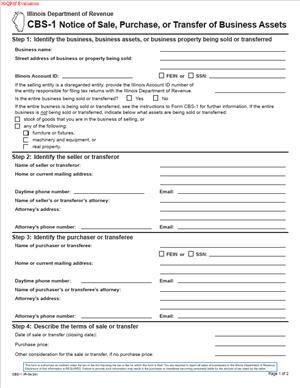
CBS-1 Notice of Sale, Purchase, or Transfer of Business Assets
Fill out nowJurisdiction: Country: United States | Province or State: Illinois
The CBS-1 Notice of Sale, Purchase, or Transfer of Business Assets is a filing used when a business or its assets change hands in Illinois. It alerts the state that ownership is shifting and that tax responsibilities may also shift. If you are buying or selling business assets, this document helps document that transition.
This form matters because business taxes do not automatically disappear when ownership changes. Certain tax liabilities can follow the business assets. The filing creates a record of who was responsible before and who may be responsible after the transfer.
You may encounter the CBS-1 Notice of Sale, Purchase, or Transfer of Business Assets if you are closing a business, selling equipment or inventory, or buying an existing operation. It is commonly connected to sales tax accounts and other state tax registrations.
If you are about to complete this form, you likely want clarity. You want to know what information is required, what the filing accomplishes, and how it affects you. This guide walks through those points in plain language so you understand what you are submitting and why it matters.
What is the CBS-1 Notice of Sale, Purchase, or Transfer of Business Assets?
Clear definition
The CBS-1 Notice of Sale, Purchase, or Transfer of Business Assets is a written notice submitted to the Illinois Department of Revenue when a business owner sells, purchases, or otherwise transfers business assets. It reports the details of that transaction.
The document identifies the seller, the buyer, the business involved, and the date of transfer. It may also ask about the type of assets transferred, such as inventory, furniture, fixtures, or equipment.
At its core, this filing connects a change in ownership to the business’s tax account. It helps the state determine whether taxes are owed and who may be responsible for paying them.
Who typically uses this form?
This form is commonly used by business sellers who are closing or transferring operations. If you are selling your inventory, equipment, or the entire business entity, you may need to complete it.
Buyers also use this form. If you are purchasing assets from an existing business, you may be required to provide information about the transaction to the state.
Accountants, bookkeepers, and attorneys sometimes prepare the form on behalf of a client. However, the responsibility for accurate information remains with the parties involved in the sale or transfer.
Small business owners often encounter this filing when selling retail stores, restaurants, service companies, or other operations that collect sales tax.
Why might you need this form?
You may need this form because tax liability can attach to business assets. If the seller owes certain state taxes, the state may seek payment from the assets that were transferred.
Filing the notice informs the state that a transfer is happening. This allows the state to review the seller’s account and determine whether there are outstanding taxes.
For buyers, the form can be part of protecting themselves from unexpected tax debts tied to the purchased assets. It creates a record of the transaction and the timing.
For sellers, it signals that you are ending or transferring your business activity. This can help close out tax accounts connected to the business.
Typical real-life scenarios
- You own a retail store and decide to retire. You sell your inventory, display shelves, and cash registers to a new owner. The transaction involves physical business assets and an ongoing operation. This is a common situation where the form is used.
- You operate a restaurant as a sole proprietor. You sell the kitchen equipment and transfer the lease to another operator. Even if you do not sell the legal entity itself, the sale of assets can trigger the need for notice.
- You purchase the assets of a landscaping company. You are not buying the corporation, only the trucks, tools, and customer contracts. The asset transfer still connects to tax accounts, so the filing may be required.
- You close your business and liquidate the remaining inventory to another company. Even though the sale is part of shutting down, it involves transferring business assets, which can require notice.
- In each of these examples, the key issue is the movement of business property from one party to another. The form documents that movement and ties it to the relevant tax records.
When would you use the CBS-1 Notice of Sale, Purchase, or Transfer of Business Assets?
You would use the CBS-1 Notice of Sale, Purchase, or Transfer of Business Assets when there is a sale, purchase, or transfer of tangible business property connected to an Illinois business tax account. The timing is usually close to the date of the transaction.
If you are the seller, you may use it when you stop operating and transfer ownership of your inventory, equipment, or other assets. The form signals that your role as the active operator has changed.
If you are the buyer, you may use it when acquiring assets from an existing business that was registered for state taxes. This can apply whether you continue the same type of business or start a different one using the purchased assets.
The form is often used during asset purchase transactions rather than stock or membership interest sales. In an asset purchase, the buyer acquires specific property of the business instead of taking over the legal entity itself.
It may also be used when there is a transfer between related parties, such as from one family member to another, if business assets are being reassigned. The reason for the transfer does not remove the need to report it.
In practice, this filing is connected to business transitions. If you are changing who owns the physical and operational components of a business, this form is often part of that process.
Legal Characteristics of CBS-1 Notice of Sale, Purchase, or Transfer of Business Assets
This form is an official notice to a state agency. Its effectiveness depends on accurate and complete information. Missing names, incorrect identification numbers, or wrong dates can create delays or follow-up questions.
The document generally requires identifying details such as the legal name of the seller, the business name, the address, and the tax account number. It also typically asks for the buyer’s information and the date of transfer. These details allow the state to match the transaction to existing tax records.
A common issue arises when the transfer date on the form does not match the date in the purchase agreement. Inconsistent information can raise questions about when responsibility changed.
Another problem can occur if the seller has outstanding tax returns or unpaid balances. Filing the notice does not erase those obligations. It may trigger a review of the account.
Different states handle business asset transfers in different ways. Some require clearance certificates or formal tax approvals before a sale is finalized. In Illinois, the notice functions as a reporting mechanism tied to tax enforcement and account management. The exact process may vary depending on the type of tax involved.
It is important to understand what this form does not do. It does not replace a purchase agreement. It does not transfer title to property. It does not register a new business entity. It does not serve as a general business license.
The form is administrative in nature. It supports the state’s ability to track tax liability during ownership changes.
Is it legally binding?
The CBS-1 Notice of Sale, Purchase, or Transfer of Business Assets is not a contract between buyer and seller. It does not create the sale itself. The binding agreement is usually a separate purchase contract signed by both parties.
However, the statements made on the form carry legal significance. When you sign and submit it, you are certifying that the information provided is true to the best of your knowledge. Providing false information can have consequences under general laws governing state filings.
The filing can affect how tax liability is handled. In that sense, it has a legal impact. It may influence whether the state pursues the seller, the buyer, or the assets themselves for unpaid taxes.
Its legal force comes from its role in the tax system. It does not create private rights between the parties, but it can shape how the state treats the transaction.
How to fill out the CBS-1 Notice of Sale, Purchase, or Transfer of Business Assets
Step 1 – Identify the seller
Begin by entering the full legal name of the seller. Use the name that appears on the business’s tax registration, not just a trade name. Include the business address and any required identification numbers, such as the state tax account number. This ensures the filing is matched to the correct account.
Step 2 – Provide the business details
Enter the business name, including any “doing business as” name, if applicable. Confirm the physical location where the business operated. If the sale involves a specific location among several, identify that location clearly. Accurate address information helps prevent confusion with other accounts.
Step 3 – Identify the buyer
Provide the full legal name of the buyer. If the buyer is a business entity, use its registered legal name. Include the buyer’s address and any requested identification numbers. This section connects the new owner to the transferred assets.
Step 4 – Describe the type of transfer
Indicate whether the transaction is a sale, purchase, or other transfer. Specify what is being transferred, such as inventory, equipment, or the entire business operation. Clear descriptions reduce the risk of follow-up questions about the scope of the transaction.
Step 5 – Enter the date of transfer
State the exact date when the transfer took effect. This date is often the closing date in the purchase agreement. Make sure it matches your other records. The transfer date helps determine the period for which each party may be responsible for taxes.
Step 6 – Provide financial details if requested
If the form asks for the purchase price or value of the assets, enter the agreed amount. Use figures that match the underlying transaction documents. Financial details may be used in reviewing tax obligations related to the transfer.
Step 7 – Review for accuracy
Before signing, read each section carefully. Confirm that names are spelled correctly, identification numbers are accurate, and dates are consistent. Small errors can delay processing or create confusion about responsibility.
Step 8 – Sign and date the form
Sign the form in the space provided. The signature confirms that the information is complete and accurate to the best of your knowledge. Include the date of signing. If a representative completes the form, ensure the appropriate signature line is used.
Step 9 – Submit the form as directed
Follow the submission instructions provided with the form. This may involve mailing or otherwise delivering the document to the appropriate office. Keep a copy for your records, so you have proof of what was submitted and when.
Legal terms you might encounter in CBS-1 Notice of Sale, Purchase, or Transfer of Business Assets
- Transferor: This is the person or entity selling or transferring the business assets. On this form, you must list the transferor’s exact legal name as it appears on tax records. If the name does not match state records, processing can be delayed.
- Transferee: This is the person or entity buying or receiving the business assets. The transferee’s full legal name and contact information must be accurate because the state may send follow-up notices to this party.
- Business Assets: These are the items being transferred. They can include equipment, inventory, furniture, vehicles, and sometimes intangible assets like goodwill. This document focuses on assets connected to a business that has tax obligations.
- Bulk Sale: A bulk sale usually means selling a large portion or all of a business’s assets outside the ordinary course of business. This term matters because tax authorities often review bulk sales to ensure taxes are paid before ownership changes.
- Tax Liability: This refers to any unpaid taxes owed by the business. The form alerts the state to check whether the seller has outstanding liabilities before or at the time of transfer.
- Effective Date of Transfer: This is the date when ownership of the assets officially changes hands. You must enter this date clearly. It determines when the buyer becomes responsible for certain tax obligations going forward.
- Account ID or Tax ID Number: This is the identification number assigned to the business by the tax authority. It helps the state match the notice to the correct account. Entering the wrong number can link the transfer to the wrong business.
- Consideration: Consideration means what the buyer is giving in exchange for the assets. It may be money, assumption of debt, or other value. The form may ask for the purchase price or the total value involved in the transaction.
- Successor Liability: This concept means the buyer may become responsible for certain unpaid taxes of the seller. The purpose of this notice is to allow the state to review the account and address any issues before the transfer is finalized.
- Assumed Liabilities: These are debts or obligations that the buyer agrees to take over as part of the sale. If the form asks whether liabilities are being assumed, you must answer carefully and consistently with your sale agreement.
FAQs
Do I need to file a CBS-1 Notice of Sale, Purchase, or Transfer of Business Assets if I am only selling part of my equipment?
You need to review whether the sale qualifies as a transfer of business assets rather than a routine sale in the normal course of business. This form is generally used when you sell a significant portion or all of the assets tied to a business location or account. If you are unsure, look at whether the sale affects the business’s ability to continue operating in the same way and whether the tax account will close or change.
What exact date should I enter as the effective date of transfer?
Enter the date when ownership of the assets legally changes from seller to buyer. This is usually stated in your sale agreement or closing documents. Do not guess or use the date you signed the contract unless that is also the official closing date. The date you list controls when the state reviews tax responsibility.
Whose name should appear if the business operates under a trade name?
You should list the full legal name of the owner as it appears on tax registration records, even if the business uses a different trade name. If the form has a space for a doing-business-as name, include it there. Make sure the legal name matches prior filings to avoid confusion or rejection.
What identification number should I use on this document?
Use the business’s state tax account number or identification number assigned by the revenue agency. Check prior tax returns, registration letters, or official notices to confirm the exact number. Do not substitute a federal employer identification number unless the form specifically asks for it.
Does the buyer need to sign this form?
Review the signature section carefully. If the document provides spaces for both transferor and transferee, each listed party should sign in the appropriate place. Make sure the person signing has authority to act for the business, such as an owner, officer, or authorized representative.
What happens after I submit the CBS-1 Notice of Sale, Purchase, or Transfer of Business Assets?
After submission, the state reviews the seller’s tax account to determine whether any taxes are due. The agency may contact the parties if additional information is needed. Keep proof of submission in case you need to confirm the filing date or respond to follow-up questions.
Can I file this form before the sale actually closes?
You may complete and prepare the document in advance, but you should ensure the effective date and financial details are accurate and final. If the closing terms change, update the form before submitting it. Filing with incorrect dates or amounts can create unnecessary issues.
What if I discover an error after filing?
If you notice a mistake, prepare a corrected version as soon as possible and follow the same submission method used for the original. Clearly indicate that it is a correction. Keep copies of both versions and document the date you sent the updated information.
Checklist: Before, During, and After CBS-1 Notice of Sale, Purchase, or Transfer of Business Assets
Before
- Review your sale agreement to confirm asset details and the effective date.
- Gather the seller’s exact legal name and tax account number.
- Confirm the buyer’s full legal name and mailing address.
- Identify whether any liabilities are being assumed by the buyer.
- Verify the total purchase price or value of transferred assets.
- Check prior tax filings to ensure names and numbers match state records.
- Confirm who has the authority to sign for each party.
During
- Enter names exactly as registered with the state.
- Double-check all identification numbers before moving to the next section.
- Clearly describe the type of transfer and assets involved.
- Insert the correct effective date of transfer.
- Provide accurate financial figures consistent with the sale agreement.
- Review each section for blanks or incomplete answers.
- Ensure all required signatures are included.
- Date the signatures correctly.
After
- Make copies of the completed and signed form for both parties.
- Submit the form using the approved filing method.
- Keep proof of submission, such as confirmation or receipt.
- Monitor mail or electronic messages for follow-up notices.
- Respond promptly if the state requests additional documents.
- Retain the form and related sale documents with your tax records.
- Update internal accounting records to reflect the transfer.
- Close or update business tax accounts as appropriate.
Common mistakes to avoid with CBS-1 Notice of Sale, Purchase, or Transfer of Business Assets
- Mistake: Using a trade name instead of the legal name because it is more familiar, which can cause processing delays or mismatched records, so do not forget to confirm the exact registered name before filing.
- Mistake: Entering the wrong tax identification number due to copying from an old or unrelated document, which can link the notice to the wrong account and delay review, so do not forget to verify the number against recent official correspondence.
- Mistake: Guessing the effective date of transfer because the closing timeline is unclear, which may affect tax responsibility and create disputes, so do not forget to confirm the date in the signed sale agreement.
- Mistake: Leaving financial fields blank because you believe they are optional, which can result in follow-up requests or rejection, so do not forget to complete every required section or clearly indicate if something does not apply.
- Mistake: Failing to obtain all required signatures because you assume one party is enough, which can invalidate the submission, so do not forget to check the signature section carefully.
- Mistake: Not keeping proof of submission because you expect no issues, which makes it harder to resolve disputes later, so do not forget to retain confirmation and copies in your records.
- Mistake: Submitting the form after the transfer is fully completed and accounts have changed, which may complicate tax clearance review, so do not forget to plan the timing of submission around the closing date.
- Mistake: Ignoring follow-up correspondence from the state because you believe the filing is complete, which can lead to unresolved liabilities, so do not forget to monitor and respond promptly to any notices.
What to do after filling out the CBS-1 Notice of Sale, Purchase, or Transfer of Business Assets
Once you complete the form, pause and review it line by line. Make sure every name, number, and date matches your supporting documents. Small inconsistencies can slow down processing.
- Step 1: Make at least two copies of the signed form, one for the seller and one for the buyer.
- Step 2: Attach any required supporting documents, such as a summary of assets transferred if the form requires clarification.
- Step 3: Confirm the correct submission method, whether by mail or electronic filing, and use the official contact information provided in the instructions.
- Step 4: Submit the form before or promptly after the effective date of transfer, consistent with the transaction timeline.
- Step 5: Save proof of mailing, electronic confirmation, or delivery receipt in your permanent records.
- Step 6: Monitor communications from the tax authority for confirmation, requests for additional details, or notices about outstanding balances.
- Step 7: If contacted, respond in writing and keep copies of all correspondence.
- Step 8: Update your internal records to reflect the change in ownership, including accounting systems and tax registration details.
- Step 9: Ensure that the seller’s tax accounts are properly closed or updated and that the buyer registers for any necessary new accounts.
- Step 10: Store the completed form with your sale agreement and financial records for future reference, especially if questions arise about tax liability.
By staying organized and proactive, you reduce the risk of unexpected tax issues after the business assets change hands. Careful follow-through protects both parties and helps ensure a clean transition.
Disclaimer: This guide is provided for informational purposes only and is not intended as legal advice. You should consult a legal professional.