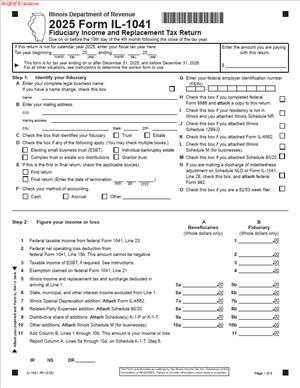
2025 Form IL-1041 – Fiduciary Income and Replacement Tax Return
Fill out nowJurisdiction: Country: United States | Province or State: Illinois
Revision Date: 12/2025
The 2025 Form IL-1041 – Fiduciary Income and Replacement Tax Return is the Illinois income tax return used by estates and trusts. If you are managing money or property for someone who has passed away, or administering a trust, this is the form you may need to file at the state level.
This document reports income earned by the estate or trust during the tax year. It also calculates any Illinois income tax or replacement tax owed. In some cases, it shows a refund due.
If you are serving as an executor, administrator, or trustee, this filing becomes part of your regular administrative duties. It connects the estate or trust’s federal tax reporting to its Illinois tax obligations.
Understanding how the 2025 Form IL-1041 – Fiduciary Income and Replacement Tax Return works helps you avoid processing delays, notices, or penalties. When you are already managing assets, beneficiaries, and deadlines, clear tax reporting makes the overall process smoother.
What is the 2025 Form IL-1041 – Fiduciary Income and Replacement Tax Return?
Clear definition
The 2025 Form IL-1041 – Fiduciary Income and Replacement Tax Return is the annual Illinois tax return for estates and trusts. It reports income received by the fiduciary entity and calculates Illinois income tax and, in some cases, replacement tax.
An estate is generally created when a person dies and their assets are managed during probate. A trust is a legal arrangement where a trustee manages assets for beneficiaries. Both may earn income such as interest, dividends, rental income, or business income.
This form focuses only on the Illinois side of the filing. It is separate from the federal fiduciary income tax return, even though the Illinois calculation often starts with federal figures.
Who typically uses this form?
You use this form if you are acting as a fiduciary for an estate or trust with Illinois filing obligations. A fiduciary is the person or institution responsible for managing the entity’s financial matters.
Executors and administrators of estates commonly file this return. Trustees of revocable and irrevocable trusts may also file it when the trust earns income.
In some situations, a professional fiduciary, attorney, or accountant prepares the return. Even if someone else completes it, you remain responsible for the accuracy of the information as the named fiduciary.
Why might you need this form?
You may need this form if the estate or trust earned income during the tax year and has a filing requirement in Illinois. Income can come from bank accounts, investments, real estate, or a business interest.
If the estate or trust has Illinois source income, it may trigger a filing even if the fiduciary or beneficiaries live in another state. Residency of the estate or trust can also affect whether the full income or only Illinois-source income is reported.
This form may also be necessary to report tax withheld, estimated tax payments made during the year, or to claim a refund. If no return is filed when one is required, the estate or trust can receive notices or penalties.
Typical real-life scenarios
- A person passes away in Illinois and leaves behind investment accounts. During the year of administration, those accounts earn interest and dividends. The executor collects the income and later distributes part of it to beneficiaries. The estate may need to report that income using this return.
- A trust created years ago holds rental property in Illinois. The property generates rental income throughout the year. The trustee manages expenses and distributions. The trust may file this return to report net income and calculate tax due.
- An Illinois resident creates an irrevocable trust for children. The trust holds stocks and mutual funds that generate capital gains. Even if the beneficiaries live elsewhere, the trust may still have Illinois filing responsibilities.
- An estate is open for more than one year because of ongoing litigation or asset sales. Each year that the estate earns income, the fiduciary may need to file a separate annual return until the estate is closed.
When would you use the 2025 Form IL-1041 – Fiduciary Income and Replacement Tax Return?
You would use this form for the 2025 tax year if the estate or trust has a filing requirement in Illinois. This typically happens when there is taxable income, Illinois source income, or other triggers under state law.
The timing usually follows the tax year of the estate or trust. Some estates and trusts use a calendar year. Others use a fiscal year that ends in a different month. The filing deadline depends on the tax year structure.
You may also use this form if the estate or trust made estimated tax payments during the year. Filing allows you to reconcile those payments against the actual tax owed.
If tax was withheld on behalf of the estate or trust, this form is used to claim credit for that withholding. Without filing, those amounts may not be applied or refunded.
You might also use this return when closing an estate or terminating a trust. In that case, it serves as the final Illinois fiduciary income tax return for the entity.
Legal characteristics of 2025 Form IL-1041 – Fiduciary Income and Replacement Tax Return
This form is an official state tax return. It becomes effective when it is properly completed, signed by the fiduciary, and submitted to the Illinois Department of Revenue.
For the return to be processed smoothly, the information must match the estate’s or trust’s identifying details. This includes the correct name, federal employer identification number, and tax year. Mismatched or incomplete identification information often leads to delays.
Calculations must align with the underlying records. Errors in transferring amounts from the federal fiduciary return can result in notices or adjustment letters. Arithmetic mistakes or missing schedules are also common reasons for processing issues.
If the return is not signed by the fiduciary, it may be treated as incomplete. An unsigned submission can delay assessment or refund processing.
Illinois rules on residency and source income can affect what income is taxed. Estates and trusts may be treated differently depending on factors such as where the decedent lived or where the trust is administered. These distinctions can change how much income is subject to Illinois tax.
This form does not replace the federal fiduciary income tax return. It also does not distribute assets to beneficiaries or close an estate. It strictly reports and calculates state tax obligations for the tax year.
Is it legally binding?
Yes, this return is legally binding once it is signed and submitted. By signing, you are declaring that the information is true and correct to the best of your knowledge.
The signature confirms that you, as a fiduciary, take responsibility for the reported income and tax calculation. If the return is inaccurate, the estate or trust may be subject to additional tax, interest, or penalties.
The binding effect applies to the tax matters reported on the return. It does not change the terms of the will or trust document. It also does not settle disputes between beneficiaries. Its legal impact is limited to state tax reporting and assessment for that year.
How to fill out 2025 Form IL-1041 – Fiduciary Income and Replacement Tax Return
Step 1 – Gather basic entity information
Start by collecting the estate’s or trust’s legal name, mailing address, and federal employer identification number. Confirm the tax year you are reporting. Check whether the entity uses a calendar year or a fiscal year. Having this information ready prevents identification errors at the top of the form.
Step 2 – Confirm residency and filing status
Review whether the estate or trust is treated as a resident or nonresident for Illinois purposes. This affects which income must be reported. Determine if you are filing an original return or an amended return, and mark the appropriate box on the form.
Step 3 – Transfer federal income amounts
Locate the federal fiduciary income tax return for the same tax year. Many Illinois calculations begin with federal taxable income. Carefully transfer the required figures to the corresponding lines on the Illinois form. Double-check each entry to avoid transcription errors.
Step 4 – Add Illinois modifications and adjustments
Apply any Illinois-specific additions or subtractions to income. These adjustments modify the federal starting point to arrive at the Illinois base income. Follow the line instructions for each adjustment and ensure supporting schedules are completed if required.
Step 5 – Calculate Illinois taxable income
After applying all required modifications, compute Illinois taxable income according to the form’s instructions. If the estate or trust has Illinois source income only, confirm that only the appropriate portion is included in the calculation.
Step 6 – Compute tax and replacement tax
Use the applicable tax rates shown in the form instructions to calculate the income tax due. If the entity is subject to replacement tax, compute that amount as directed. Enter each figure on the correct line to show the total tax liability.
Step 7 – Apply credits, withholding, and estimated payments
Enter any Illinois tax withheld on behalf of the estate or trust. Include estimated tax payments made during the year. Subtract these amounts from the total tax to determine whether a balance is due or a refund is available.
Step 8 – Review, sign, and date the return
Carefully review every line for accuracy and completeness. Confirm that identification numbers, income amounts, and payment figures are correct. Sign and date the return as fiduciary. If a paid preparer completed the form, ensure the preparer section is also completed before submission.
Legal terms you might encounter in 2025 Form IL-1041 – Fiduciary Income and Replacement Tax Return
- Fiduciary: A fiduciary is the person or entity responsible for managing a trust or estate. On this form, you are the fiduciary if you sign and file the return for the estate or trust. Your name and title must appear exactly as your appointment documents state.
- Estate: An estate is the legal entity created when someone dies. It exists to gather assets, pay debts, and distribute property to beneficiaries. If you are administering an estate, this form reports its income during the tax year.
- Trust: A trust is a legal arrangement where a trustee manages assets for beneficiaries. The trust can earn income from investments, property, or business interests. This return reports the income and calculates the Illinois tax owed.
- Beneficiary: A beneficiary is a person or organization entitled to receive income or principal from the trust or estate. Information about distributions to beneficiaries affects how taxable income is calculated on this return. Some income may be taxed to the beneficiary instead of the estate or trust.
- Distributable Net Income (DNI): DNI is a tax concept that limits the amount of income that can be taxed to beneficiaries. It determines how much income the estate or trust can deduct for distributions. You will rely on federal calculations to complete the related sections on this form.
- Illinois Replacement Tax: This is a separate tax imposed on certain entities, including trusts and estates, in addition to regular income tax. It replaces the personal property tax that businesses used to pay. You calculate it as a percentage of Illinois net income on this return.
- Illinois Base Income: This starts with federal taxable income and is then adjusted by Illinois-specific additions and subtractions. You must transfer amounts from the federal fiduciary return and apply state modifications. The result determines your Illinois taxable income.
- Additions and Subtractions: These are adjustments required under Illinois law. Additions increase your Illinois base income, and subtractions reduce it. You must carefully review each line to see which federal items must be adjusted for state purposes.
- Nonresident Estate or Trust: This refers to an estate or trust that is not considered an Illinois resident but earns income from Illinois sources. Special allocation rules apply. You must complete the correct schedules to show what portion of your income is taxable in Illinois.
- Estimated Tax Payments: These are payments made during the year toward expected tax liability. If the estate or trust made quarterly payments, you must report them on this return. They reduce the final amount owed or increase the refund.
FAQs
Do I need to attach a copy of the federal fiduciary return when filing the 2025 Form IL-1041 – Fiduciary Income and Replacement Tax Return?
In most cases, you should have a completed federal fiduciary income tax return before finishing this document because many lines flow directly from federal figures. If the instructions require a copy of the federal return or specific schedules, include them with your filing. Review the attachment checklist carefully so the state can verify the amounts you transferred.
What tax year does this form cover, and how do I confirm I am using the correct year?
Check the tax year printed at the top of the document and confirm the beginning and ending dates of the estate or trust’s tax year. If the estate or trust uses a fiscal year, make sure the dates you enter match the federal return exactly. Using the wrong year can delay processing or misapply payments.
Who is authorized to sign this document?
The fiduciary must sign the return. This means the executor, administrator, or trustee is officially appointed to manage the estate or trust. Confirm your authority by reviewing the court appointment papers or trust agreement, and make sure the name you sign matches the name listed in the fiduciary section of this form.
What happens if the estate or trust changed its name or address during the year?
You must report the current legal name and address exactly as they appear in official records. If there was a change, check the appropriate box and provide the updated information as instructed. This ensures notices and refunds are sent to the correct location.
How do I know if the estate or trust owes replacement tax in addition to income tax?
Review the section that calculates the replacement tax based on Illinois net income. If the estate or trust has taxable income after Illinois adjustments, you generally compute both income tax and replacement tax. Follow the line-by-line instructions to avoid skipping this calculation.
What if I made estimated payments but cannot find proof of them?
Check bank records, prior payment confirmations, or account transcripts to verify the amounts and dates. Enter only the payments that were actually made for the tax year shown on this document. Incorrectly claiming estimated payments can lead to notices or delays.
Do I need to provide information about beneficiaries on this form?
Yes, distributions to beneficiaries affect the income calculation. Make sure the amounts reported as distributed match the federal return and any schedules provided to beneficiaries. Keep copies of beneficiary statements because the state may compare them with what beneficiaries report individually.
What should I do if I discover an error after I file this document?
If you realize you made a mistake, review whether an amended return is required. Use the amended return checkbox and provide corrected figures along with a clear explanation of the change. Keep documentation showing why the correction was necessary in case the agency requests support.
Checklist: Before, During, and After 2025 Form IL-1041 – Fiduciary Income and Replacement Tax Return
Before
- Confirm the legal name and employer identification number of the estate or trust.
- Verify your appointment as fiduciary and gather proof of authority.
- Complete the federal fiduciary income tax return first.
- Collect records of all income, deductions, and distributions.
- Gather documentation for Illinois additions and subtractions.
- Locate records of estimated payments and withholding.
- Confirm the correct tax year and filing period.
- Review prior-year returns for carryforwards or credits.
During
- Enter entity information exactly as shown on official records.
- Transfer federal income amounts carefully to the correct lines.
- Apply Illinois additions and subtractions using supporting worksheets.
- Allocate income properly if the estate or trust is nonresident.
- Calculate Illinois base income and then taxable income step by step.
- Compute both income tax and replacement tax where required.
- Apply credits, withholding, and estimated payments accurately.
- Double-check all math and verify totals before signing.
- Ensure required schedules and attachments are included.
After
- Make a complete copy of the signed return and all attachments.
- Submit the return using the approved filing method.
- Pay any balance due by the deadline to reduce penalties.
- Record the date of filing and method of submission.
- Monitor for confirmation or acknowledgment of receipt.
- Respond promptly to any notices requesting clarification.
- Store records in a secure file for future reference.
- Update internal accounting records to reflect the filing.
Common mistakes to avoid with 2025 Form IL-1041 – Fiduciary Income and Replacement Tax Return
- Mistake: Using incorrect federal figures because you did not complete the federal return first, which happens when you rush the process, leading to mismatched income and possible notices, so do not forget to finalize federal amounts before transferring them.
- Mistake: Entering the wrong employer identification number, often due to copying errors from old documents, which can delay processing or misapply payments, so do not forget to verify the number against official IRS correspondence.
- Mistake: Ignoring Illinois additions and subtractions because they seem minor, which happens when you assume federal income is the same as state income, resulting in underpayment or overpayment, so do not forget to review each modification line carefully.
- Mistake: Forgetting to calculate replacement tax, often because you focus only on income tax, which can create an unexpected balance due with penalties, so do not forget to complete every tax computation section.
- Mistake: Claiming estimated payments for the wrong year, which occurs when payments overlap calendar years, causing refund delays or billing notices, so do not forget to match each payment to the correct tax period.
- Mistake: Failing to sign the return as a fiduciary, which happens when you assume a preparer’s signature is enough, making the return invalid, so do not forget to sign and date the form in the designated area.
- Mistake: Leaving out required schedules for nonresident allocation, often due to a misunderstanding of residency rules, which can trigger correspondence audits, so do not forget to attach all allocation and apportionment schedules.
- Mistake: Not keeping copies of beneficiary distribution statements, which happens when you rely only on summary totals, leading to difficulty proving reported amounts, so do not forget to retain detailed supporting documents.
What to do after filling out the 2025 Form IL-1041 – Fiduciary Income and Replacement Tax Return
Once you complete the return, pause before submitting it. Review every page slowly. Confirm names, identification numbers, and totals. Make sure your signature appears where required.
- Step 1: Make a full copy of the signed return, including all schedules and attachments.
- Step 2: Assemble payment, if any is due, using the correct voucher or electronic payment method.
- Step 3: Choose the proper filing method and submit the return by the deadline.
- Step 4: If filing electronically, save the submission confirmation number and a PDF of the filed return.
- Step 5: If filing by mail, use the correct mailing address and consider a method that provides delivery confirmation.
- Step 6: Record the date you filed and the amount paid in the estate or trust accounting records.
- Step 7: Monitor bank statements to confirm that any payment clears.
- Step 8: Watch for acknowledgment or refund notices and compare them to your filed amounts.
- Step 9: Respond quickly to any correspondence requesting additional information.
- Step 10: Store copies of the return and supporting documents with the estate or trust’s permanent tax records.
Keep all documentation that supports income, deductions, credits, and distributions. This includes bank statements, brokerage statements, closing statements, and beneficiary reports. Organized records make it easier to respond if questions arise later.
Finally, update the estate or trust’s internal ledger to reflect the taxes paid or refunds received. This keeps your fiduciary accounting accurate and helps you prepare the next year’s return with confidence.
Disclaimer: This guide is provided for informational purposes only and is not intended as legal advice. You should consult a legal professional.