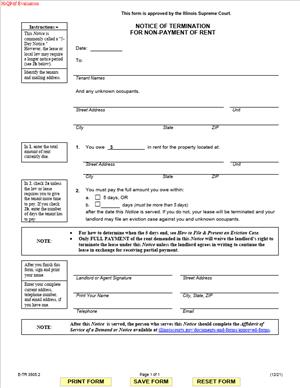
E-TR 3505 – Notice of Termination for Non-Payment of Rent
Fill out nowJurisdiction: Country: United States | Province or State: Illinois
The E-TR 3505 – Notice of Termination for Non-Payment of Rent is a court-related document used in landlord and tenant matters in Illinois. It is designed for situations where rent has not been paid, and the landlord is starting the formal process to end the tenancy.
If you are about to complete this form, you likely need to understand what it does, how it works, and what information it requires. This document is not just a reminder about unpaid rent. It is a formal notice that can lead to a court case.
This form is connected to eviction proceedings in the Illinois Circuit Court. It creates a written record that the tenant was notified about the unpaid rent and that the rental agreement may be terminated if payment is not made.
Because this document can affect housing and legal rights, accuracy matters. Small mistakes in names, dates, or amounts can cause delays or require you to start over.
Understanding the purpose and structure of the E-TR 3505 – Notice of Termination for Non-Payment of Rent helps you complete it clearly and correctly.
What is E-TR 3505 – Notice of Termination for Non-Payment of Rent?
Clear definition
The E-TR 3505 – Notice of Termination for Non-Payment of Rent is a written notice used by a landlord to inform a tenant that rent has not been paid and that the rental agreement may be terminated because of that non-payment.
In Illinois, a landlord generally must provide proper written notice before filing an eviction case for unpaid rent. This form serves as that written notice. It states the amount owed and gives the tenant a limited period to pay or face termination of the tenancy.
The document is part of the landlord and tenant process in the Illinois Circuit Court system. It is often used before a formal eviction complaint is filed.
Who typically uses this form?
This form is typically used by landlords or property owners. It may also be completed by a property manager acting on behalf of the landlord.
In some cases, an attorney prepares the document. In other cases, landlords who represent themselves complete and serve the notice without legal representation.
Tenants do not usually complete this form. Instead, they receive it. However, tenants may review it carefully to understand the claims being made about unpaid rent.
Why might you need this form?
You might need this form if rent has not been paid by the due date stated in the lease or rental agreement. When informal reminders do not resolve the issue, a formal written notice may be required before further legal steps.
This document is often a required step before filing an eviction case for non-payment. Without proper notice, a court may refuse to proceed with the case.
The form helps establish a timeline. It shows when the tenant was notified, how much was claimed as unpaid, and when the tenancy could end if payment is not made.
Typical real-life scenarios
- A tenant misses one month of rent and does not respond to calls or messages. The landlord decides to send a formal notice stating the amount due and the deadline for payment.
- A tenant partially pays rent but still owes a balance. The landlord uses the notice to clearly state the remaining amount and the consequences if it is not paid within the required period.
- A written lease requires monthly payments on the first of each month. After several late payments, the tenant stops paying entirely. The landlord uses the notice as the first step toward ending the tenancy.
- A property manager oversees several rental units. When one tenant falls behind, the manager prepares and serves the notice to document the unpaid rent before starting a court case.
When would you use E-TR 3505 – Notice of Termination for Non-Payment of Rent?
You would use this form after rent becomes overdue under the terms of the rental agreement. The lease usually states the amount of rent, the due date, and any grace period. Once those terms are not met, the landlord may begin the notice process.
This document is commonly used when the landlord intends to terminate the tenancy because of non-payment. It is not used for other lease violations, such as property damage or unauthorized occupants. Different notices may apply in those situations.
The form is often used shortly before filing an eviction case in the Illinois Circuit Court. In many situations, proper written notice is required before the court will consider an eviction filing based on unpaid rent.
Landlords who manage their own properties may complete the form themselves. Larger property owners may have staff or agents prepare it as part of a standard rent collection process.
The timing of this notice is important. It is typically used after rent is late but before the landlord files a lawsuit. Once a case is filed, different documents are used in court.
Legal characteristics of E-TR 3505 – Notice of Termination for Non-Payment of Rent
This form functions as a formal legal notice. For it to be effective, it generally must include accurate information about the parties, the rental property, the amount of unpaid rent, and the time allowed for payment.
Clarity matters. The amount claimed must match the actual unpaid rent. Including incorrect fees or vague descriptions can create problems if the matter reaches court.
Proper delivery is also a key factor. Courts often look at whether the notice was served in a way that complies with applicable rules. If the service is not done correctly, the notice may be challenged.
The document typically sets a specific deadline. In Illinois, non-payment notices commonly provide a short period to pay the full amount due. If the tenant pays within that period, the tenancy may continue under the original agreement.
This notice does not itself remove a tenant from the property. It does not authorize a landlord to change locks, remove belongings, or force a tenant out. A court order is usually required for physical eviction.
Mistakes that often cause issues include incorrect tenant names, wrong property addresses, inaccurate rent calculations, or missing dates. Any of these can delay a case or require a new notice.
Although the basic concept is similar in many states, notice periods and formatting requirements can vary. The form used in Illinois is specific to the Illinois Circuit Court process and may differ from forms used elsewhere.
Is it legally binding?
The E-TR 3505 – Notice of Termination for Non-Payment of Rent is legally significant when it is properly completed and delivered. It serves as a formal notice that the landlord intends to terminate the rental agreement due to unpaid rent.
It becomes part of the legal record if an eviction case is filed. The court may review it to confirm that proper notice was given before the lawsuit began.
However, the notice itself does not create a court judgment. It does not automatically end the tenancy on the day it is served. Its legal effect depends on what happens next, such as whether payment is made or whether a court case is filed and decided.
If the tenant pays the full amount within the stated period, the rental agreement may continue as if the notice had not been issued. If payment is not made, the landlord may proceed with filing an eviction action.
How to fill out E-TR 3505 – Notice of Termination for Non-Payment of Rent
Step 1 – Identify the parties
Enter the full legal name of the landlord or property owner as it appears on the lease or deed. Then enter the full legal name of each tenant listed on the rental agreement. Use complete names rather than nicknames to avoid confusion later.
Step 2 – Provide the rental property address
Write the complete address of the rental property, including the unit or apartment number if applicable. The address must clearly identify the specific premises covered by the rental agreement.
Step 3 – State the amount of unpaid rent
Enter the exact dollar amount of rent that is currently unpaid. This amount should reflect only rent owed under the agreement. Double-check your calculation to ensure it matches your payment records.
Step 4 – Specify the rental period involved
Indicate the time period for which rent is owed, such as the specific month or range of dates. This helps clarify what payments are being referenced and avoids disputes about earlier or later balances.
Step 5 – Insert the payment deadline
State the deadline by which the tenant must pay the full amount to avoid termination. The time frame must align with the notice period required for non-payment situations in Illinois. Clearly write the final date so there is no ambiguity.
Step 6 – Describe the consequence of non-payment
Include the statement that the tenancy will terminate if the full amount is not paid within the stated period. The language should reflect that failure to pay may lead to termination and further legal action.
Step 7 – Date the notice
Write the date on which the notice is completed. This date is important because it connects to the start of the notice period. Make sure it matches your records of when the notice will be delivered.
Step 8 – Sign the document
The landlord or authorized agent signs the form. Print your name clearly below the signature if there is space provided. If you are signing as an agent, indicate your role or authority when appropriate.
Step 9 – Prepare for service
After completing the form, make copies for your records. Ensure the final version is the one that will be delivered to the tenant. Accurate recordkeeping at this stage helps maintain a clear timeline if the matter proceeds to court.
Legal terms you might encounter in E-TR 3505 – Notice of Termination for Non-Payment of Rent
- Non-Payment of Rent: This refers to the tenant’s failure to pay rent when it is due under the lease. In this document, non-payment is the reason you are terminating the tenancy. You must clearly state the amount owed and the time period it covers.
- Notice of Termination: This is a written statement that the rental agreement will end if the tenant does not correct the problem. On this form, you are formally telling the tenant that the lease will terminate unless payment is made within the required time.
- Cure Period: This is the number of days the tenant has to fix the problem by paying the rent. The form requires you to state a clear deadline. The cure period must be counted carefully so the date is accurate.
- Service of Notice: Service means how the tenant receives the document. The method you use to deliver the notice matters because it affects whether the court will accept that proper notice was given.
- Rental Period: This is the specific month or time frame for which rent is owed. The form requires you to list the rental period so there is no confusion about what payment is missing.
- Lease Agreement: This is the written or oral contract between you and the tenant. The notice refers to the lease because it is the agreement that sets the rent amount, due date, and other obligations.
- Termination Date: This is the date the tenancy will end if payment is not made. It must be clearly stated in the document so the tenant understands when their right to occupy the property ends.
- Possession: Possession refers to the legal right to occupy the rental property. If the tenant does not pay and does not move out, you may later ask the court to return possession of the property to you.
- Past-Due Rent: This is the total amount of unpaid rent that should have already been paid. On this form, you must calculate and enter the exact dollar amount owed, without guessing or rounding.
- Authorized Agent: This is someone legally allowed to act on behalf of the landlord. If you are not the property owner but are signing the form, you must have authority to do so and may need to identify your role.
FAQs
How do I calculate the correct deadline date to put in the notice?
Start by identifying the day you plan to deliver the notice. Then count the required number of days allowed for payment. Do not guess. Count each calendar day carefully and write the exact final date in the space provided. The deadline should match your count exactly, so there is no confusion.
What if I realize I wrote the wrong amount of rent owed?
If the amount is incorrect, it is safer to prepare a new notice with the correct total rather than crossing out numbers. The amount listed must match your rent records. If the number is wrong, a court may reject your claim later because the tenant was not given accurate information.
Do I need to attach a copy of the lease to this document?
The form itself does not require you to attach the lease when you give notice. However, you should review the lease before completing the document to confirm the rent amount, due date, and tenant names. Keep a copy of the lease in your records in case you need it later.
Who should sign the notice?
The landlord or an authorized agent must sign. If you are a property manager or another representative, make sure your authority to act is clear. Sign your full legal name and, if applicable, include your title or role so there is no doubt about who issued the notice.
What if there are multiple tenants listed on the lease?
List every tenant named on the lease. Each tenant should receive notice. If you leave someone out, that person may argue they were not properly notified, which can delay the process.
Can I accept partial payment after serving E-TR 3505 – Notice of Termination for Non-Payment of Rent?
If you accept partial payment, it may affect how the notice is interpreted. The document is based on a specific amount owed. If the tenant pays part of it, you should clearly document what was paid and what remains due so your records match the situation.
What address should I use for the tenant?
Use the full address of the rental property covered by the lease. Include the unit number if there is one. This ensures the notice clearly identifies the property connected to the unpaid rent.
Does E-TR 3505 – Notice of Termination for Non-Payment of Rent get filed with the court right away?
This document is typically served on the tenant first. It is not the same as filing a court case. You would only bring it to court later if you need to start a case for possession or unpaid rent.
Checklist: Before, During, and After E-TR 3505 – Notice of Termination for Non-Payment of Rent
Before
- Review the lease to confirm the exact rent amount and due date.
- Check your payment records to calculate the full unpaid balance.
- Confirm the full legal names of all tenants on the lease.
- Verify the complete rental property address, including unit number.
- Decide on the date you will serve the notice.
- Count the correct number of days for the payment deadline.
- Prepare a clean, legible copy of the form.
During
- Write each tenant’s full name exactly as it appears on the lease.
- Enter the full rental property address without abbreviations that create confusion.
- State the exact dollar amount of past-due rent.
- Specify the rental period the unpaid rent covers.
- Clearly write the deadline date for payment.
- Sign your full legal name.
- Add your title if you are signing as an authorized agent.
- Double-check all numbers and dates before making copies.
After
- Make at least two copies of the completed notice.
- Keep one signed copy for your records.
- Serve the notice using a method that allows you to confirm delivery.
- Record the date and method of service in your files.
- Keep proof of service if available.
- Monitor whether payment is received before the deadline.
- Document any communication with the tenant.
- Update your rent ledger to reflect any payments made.
Common mistakes to avoid with E-TR 3505 – Notice of Termination for Non-Payment of Rent
- Mistake: Listing the wrong rent amount because you relied on memory instead of checking your ledger, which can invalidate the notice and delay your case; do not forget to verify the exact total owed before signing.
- Mistake: Miscounting the deadline date because you rushed the calculation, which may result in giving too little time and forcing you to start over; do not forget to count each day carefully.
- Mistake: Leaving out one of the tenants named on the lease because you assumed only one person needed notice, which can weaken your position in court; do not forget to include every adult tenant.
- Mistake: Using an incomplete property address because you thought the tenant would “know what you mean,” which can create confusion in legal proceedings; do not forget the full address and unit number.
- Mistake: Forgetting to sign the document because you focused on the financial details, which can make the notice defective; do not forget your full legal signature.
- Mistake: Accepting payment without documenting it because you wanted to resolve things informally, which can create disputes about the remaining balance; do not forget to update your written records immediately.
- Mistake: Altering the form after signing because you noticed a small error, which can raise questions about authenticity; do not forget to prepare a new, clean copy if corrections are needed.
- Mistake: Failing to keep proof of service because you assumed the tenant would admit receiving it, which can create problems later; do not forget to document how and when you delivered the notice.
What to do after filling out E-TR 3505 – Notice of Termination for Non-Payment of Rent
Once you complete the form, your next steps matter just as much as the wording inside it. A properly prepared notice must also be properly delivered and documented. Think of this stage as building your record.
Start by reviewing the completed document one more time. Confirm names, amounts, dates, and signatures. Small errors can slow you down later.
- Step 1: Make at least two clear copies of the signed notice.
- Step 2: Keep one copy in your rental file for that tenant.
- Step 3: Serve the tenant using your chosen delivery method.
- Step 4: Write down the exact date and time you served the notice.
- Step 5: Note the method of service in your records.
- Step 6: Keep any proof that shows delivery occurred.
- Step 7: Mark the payment deadline on your calendar.
- Step 8: Monitor whether full payment is made before the deadline.
- Step 9: Update your rent ledger to reflect payment in full or partial payment.
- Step 10: If no payment is made by the deadline, gather your lease, payment records, and a copy of the notice in case you decide to start a court case.
If the tenant pays the full amount before the deadline, document that clearly. Provide a written receipt. Update your internal records so the balance shows zero for that rental period. Keep everything together in one file.
If the tenant does not pay and does not move out, you may decide to begin a formal court process. At that point, the accuracy of your notice, your service records, and your payment history will become important. Organized documentation makes the next step smoother.
Stay consistent. Keep written records of all communication. Maintain a clear timeline. The more precise your documentation, the more confident you will feel if the matter continues.
Disclaimer: This guide is provided for informational purposes only and is not intended as legal advice. You should consult a legal professional.