E-TN 3506 – Notice of Non-Renewal of Lease or Termination of Tenancy
Fill out nowJurisdiction: Country: United States | Province or State: Illinois
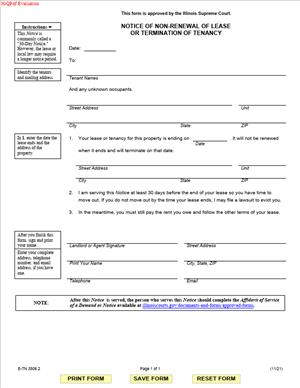
The E-TN 3506 – Notice of Non-Renewal of Lease or Termination of Tenancy is a court-related document used in Illinois landlord-tenant matters. It is commonly associated with the Illinois Circuit Court process involving rental property disputes. This form helps formally notify a tenant or landlord that a rental arrangement is ending.
If you are about to complete this document, you are likely dealing with the end of a lease term or a tenancy. You may be a landlord preparing to end a lease. You may also be a tenant who plans to move out and wants to provide written notice.
This form matters because ending a tenancy requires clear communication. A written notice creates a record of what was said, when it was said, and who received it. Without proper notice, misunderstandings can lead to disputes or court filings.
The E-TN 3506 – Notice of Non-Renewal of Lease or Termination of Tenancy is not just a letter. It is structured to meet court expectations. That structure helps show that notice was given in a clear and documented way.
Before you fill it out, you need to understand what it does, when it is used, and how each section works. The details matter, including dates, names, and property information.
What is E-TN 3506 – Notice of Non-Renewal of Lease or Termination of Tenancy?
Clear definition
The E-TN 3506 – Notice of Non-Renewal of Lease or Termination of Tenancy is a formal written notice used to inform the other party that a lease will not continue or that a tenancy is ending. It is typically connected to residential rental property.
“Non-renewal” usually applies when a fixed-term lease is about to expire. One party informs the other that the lease will not continue beyond the end date. “Termination” often applies to a month-to-month or periodic tenancy, where one party gives advance notice that the rental arrangement will end on a specific date.
This document creates a clear record. It identifies the parties, the property, and the intended end date of the tenancy. It may later be filed or referenced in court if there is a dispute about possession of the property.
Who typically uses this form?
Landlords frequently use this form. A landlord may decide not to renew a lease at the end of its term. A landlord may also choose to terminate a month-to-month tenancy by providing written notice within the required timeframe.
Tenants also use similar notice forms. A tenant who plans to move out at the end of a lease may provide written notice of non-renewal. A tenant in a month-to-month arrangement may give written notice to terminate the tenancy before moving.
Property managers sometimes complete the form on behalf of a property owner. In that case, the manager’s role and authority are usually stated in the document.
In court-related situations, this form may become part of an eviction or possession case. The court may review it to determine whether proper notice was given before filing a lawsuit.
Why might you need this form?
You might need this form when a lease is ending, and you do not want it to renew automatically. Many leases renew unless one party gives timely written notice. This document helps show that notice was given.
You may also need it when you want to end a month-to-month tenancy. Periodic tenancies continue until one party ends them with proper notice. A written notice sets a clear termination date.
This form can also help reduce conflict. When the end date is clearly stated in writing, both parties know when the tenant is expected to vacate the property. That clarity can prevent confusion about rent, keys, or move-out procedures.
In some situations, this notice is a required step before filing a court case for possession. If the tenant does not move out by the date stated in the notice, the landlord may rely on the notice as part of a later filing.
Typical real-life scenarios
- A landlord has a one-year lease with a tenant. The lease ends on June 30. The landlord decides not to renew the lease for another year. The landlord completes the form, states that the lease will end on June 30, and delivers the notice before the deadline required by the lease or law.
- A tenant is renting an apartment on a month-to-month basis. The tenant plans to move to another city. The tenant prepares a written notice stating that the tenancy will end 30 days from the date of notice and includes the final move-out date. The form provides a structured way to communicate that decision.
- A property owner plans to sell a rental property after the current lease expires. The owner sends a non-renewal notice so the tenant understands the lease will not continue. The written notice helps avoid assumptions that the lease will automatically extend.
- A landlord and tenant disagree about future rent increases. Instead of renewing the lease under new terms, the landlord chooses not to renew the existing lease. The landlord uses the form to state clearly that the tenancy will end at the conclusion of the current lease term.
- In each of these situations, the key issue is timing. The notice must be given before the lease ends or within the appropriate notice period for a month-to-month tenancy. The form helps document that timing.
When would you use E-TN 3506 – Notice of Non-Renewal of Lease or Termination of Tenancy?
You would use this form when a rental agreement is coming to an end, and one party does not intend to continue the tenancy. The specific timing depends on whether the lease is for a fixed term or is periodic.
For a fixed-term lease, this form is commonly used near the end of the lease period. The notice tells the other party that the lease will expire on its stated end date and will not be renewed. It does not usually shorten the lease. Instead, it confirms that the lease will end as scheduled.
For a month-to-month tenancy, this form is often used to provide advance notice of termination. The notice states a future date when the tenancy will end. That date must align with the required notice period for that type of tenancy.
Landlords often use the form before starting a court case for possession. If a tenant remains in the property after the notice period ends, the landlord may rely on the completed notice as part of the court record. The court may review whether proper notice was given.
Tenants use similar notices when they want to leave without violating the lease terms. Giving written notice within the required timeframe can help avoid claims for additional rent beyond the move-out date.
This form is not generally used for immediate termination due to serious lease violations. Those situations often involve different types of notices. This form focuses on non-renewal or ending a tenancy with advance notice.
Legal characteristics of E-TN 3506 – Notice of Non-Renewal of Lease or Termination of Tenancy
For this document to be effective, it must clearly identify the parties. It typically includes the landlord’s name, the tenant’s name, and the address of the rental property. If the property has a unit number, that detail must be accurate.
The notice must state a specific termination or non-renewal date. Vague language such as “soon” or “at the end of the month” can create confusion. A precise calendar date reduces disputes about when the tenancy ends.
Timing is critical. The notice usually must be delivered within a certain number of days before the intended end date. If the notice period is too short, the termination date may not be valid. This can delay further action.
Delivery method also matters. Some leases describe how notices must be delivered, such as by personal delivery or mail. If the lease contains notice requirements, the form is typically completed and delivered in a way that matches those terms.
Common problems include incorrect dates, wrong property addresses, or failure to sign the document. An unsigned notice may raise questions about authenticity. Missing information can weaken the document’s usefulness in court.
Jurisdictional differences may affect notice periods and delivery rules. In Illinois, local practices and court expectations can influence how the form is reviewed. The court may look at whether the notice complies with both the lease and general state requirements.
It is important to understand what this document does not do. It does not, by itself, remove a tenant from the property. It does not create an eviction order. If the tenant does not move out by the stated date, additional court steps are typically required.
The notice also does not change the financial terms of the lease. Rent remains due through the termination date unless otherwise agreed. Security deposit handling is addressed separately under lease terms and applicable rules.
Is it legally binding?
The E-TN 3506 – Notice of Non-Renewal of Lease or Termination of Tenancy can have legal effect when it is properly completed and delivered. Its binding nature depends on whether it meets the required notice standards and accurately reflects the lease terms.
When a lease states that either party may end the tenancy with written notice, a properly completed and delivered notice can activate that provision. In that sense, the notice becomes part of the contractual process of ending the agreement.
However, the document itself does not guarantee a specific outcome. If the receiving party disputes the notice, a court may review whether it was timely, clear, and properly delivered. The court may also examine the lease language.
If the notice meets the applicable requirements and the termination date passes, the tenancy is generally considered ended. If the tenant remains in possession after that date, the landlord may use the notice as evidence in a court filing for possession.
The document’s legal strength depends on accuracy and compliance. Errors in dates, names, or timing can reduce its effectiveness. Careful completion helps ensure that the notice serves its intended purpose.
How to fill out E-TN 3506 – Notice of Non-Renewal of Lease or Termination of Tenancy
Step 1 – Identify the court and case information
At the top of the form, you may see space for court information. Enter the name of the appropriate Illinois Circuit Court if the form is being prepared for filing or court use. If a case number has already been assigned, write it exactly as it appears on other court documents.
Step 2 – Enter the names of the parties
Fill in the full legal name of the landlord and the full legal name of each tenant listed on the lease. Use the same names that appear on the rental agreement. Consistency avoids confusion later.
Step 3 – Provide the rental property address
Write the complete address of the rental property. Include the street number, street name, city, state, and ZIP code. If the property includes a unit or apartment number, include that detail.
Step 4 – Specify the type of notice
Indicate whether the notice is for non-renewal of a fixed-term lease or termination of a periodic tenancy. The wording should make clear whether the lease is ending at its scheduled expiration or before continuation of a month-to-month arrangement.
Step 5 – State the termination or non-renewal date
Enter the exact calendar date when the tenancy will end. Double-check that this date matches the required notice period and the lease terms. The date should be clear and specific.
Step 6 – Reference the lease if applicable
If the notice relates to a written lease, include the original lease date or term. This connects the notice to the correct agreement. It helps show that the notice applies to that specific rental contract.
Step 7 – Sign and date the form
The person giving the notice must sign the document. Print the name clearly below the signature if there is space provided. Add the date of signing, which may be relevant to calculating the notice period.
Step 8 – Complete any certificate of service section
If the form includes a section confirming delivery, fill it out carefully. Indicate how the notice was delivered and on what date. This creates a record of service that may be reviewed later.
Step 9 – Make copies and retain records
After completing and signing the form, make copies for your records. Keep a copy of the signed document and any proof of delivery. These records can be important if questions arise about whether notice was properly given.
Legal terms you might encounter in E-TN 3506 – Notice of Non-Renewal of Lease or Termination of Tenancy
- Non-Renewal: This means the lease will end on its scheduled expiration date and will not continue for another term. On this form, you are formally stating that you do not intend to extend the rental agreement. The tenancy ends because the contract period ends, not because of a violation.
- Termination of Tenancy: Termination refers to ending a rental agreement before or at the end of its term, depending on the situation. This document records the date the tenancy will legally end. It sets a clear cutoff for possession of the property.
- Tenancy at Will: A tenancy at will has no fixed end date and continues until either party gives proper notice. If this applies, the notice period becomes especially important. The form helps document that the required notice was given.
- Fixed-Term Lease: A lease with a specific start and end date. If you are not renewing a fixed-term lease, you must clearly state the final date of occupancy. This form confirms that the agreement will be concluded as written.
- Notice Period: The amount of time you must give before the tenancy ends. The length of this period depends on the type of tenancy. The termination date you enter must reflect the full notice period.
- Service of Notice: Service means delivering the notice to the other party in a legally recognized way. The certificate of service section records how and when delivery occurred. Proper service is critical because the timeline starts from the date of delivery.
- Possession: Possession refers to who has the legal right to occupy the rental property. When the termination date arrives, the tenant must surrender possession. This form signals when that transfer should happen.
- Premises: The premises are the rental property itself. You must list the full address exactly as it appears in the lease or court documents. Accuracy avoids confusion about which property is affected.
- Certificate of Service: This is a statement confirming that the notice was delivered. You sign it to verify the method and date of service. Courts rely on this section to confirm that notice requirements were met.
- Party of Record: This refers to the official landlord or tenant named in the lease or court file. The names on the form must match the lease or case caption exactly. Even small spelling differences can create issues.
FAQs
Do I need to file E-TN 3506 – Notice of Non-Renewal of Lease or Termination of Tenancy with the court?
In many situations, this document is first served on the other party rather than immediately filed. If there is already a court case, you may need to file it in that case. Check whether your situation involves an active case number. If it does, make sure the case caption and number match exactly before submitting it.
What date should I list as the termination date?
You should enter the exact calendar date when the tenancy will end. Count the full notice period required for the type of lease involved. Do not estimate or use vague wording like “30 days from today.” Write the specific month, day, and year so there is no confusion.
What happens if the names on this document do not exactly match the lease?
The names must match the lease or court record word for word. If they do not, the other party may argue that the notice is defective. Before signing, compare the spelling and formatting to the original lease. Correct even small errors, such as missing middle initials, if they appear in the official documents.
Who is allowed to sign this form?
The landlord, tenant, or an authorized agent may sign, depending on who is giving notice. If you are signing as an agent, make sure you clearly indicate your role. Your signature confirms the accuracy of the information and the intent to end or not renew the tenancy.
Do I need to attach a copy of the lease?
This document does not always require attachments, but attaching a copy of the lease can clarify the lease term and property address. If the tenancy terms are important to understanding the notice, including the lease, can prevent disputes. Keep a copy of everything you attach for your records.
What if the other party refuses to accept the notice?
Refusal to accept does not automatically invalidate service. What matters is whether you used an acceptable delivery method and documented it properly. Complete the certificate of service carefully and keep proof of delivery, such as a receipt or written confirmation.
Can I change the termination date after serving the notice?
Once served, the termination date stated in this form controls the timeline. Changing it usually requires issuing a new notice that meets the full notice period again. Avoid guesswork when choosing the date so you do not have to restart the process.
Does this form automatically remove a tenant from the property?
No. This form gives formal notice that the tenancy will end. If the tenant does not vacate by the stated date, additional legal steps may be required. The document records your compliance with notice requirements, which may be necessary if further action is taken.
Checklist: Before, During, and After E-TN 3506 – Notice of Non-Renewal of Lease or Termination of Tenancy
Before
- Review the lease to confirm the tenancy type and end date.
- Verify the full legal names of all parties.
- Confirm the complete property address, including unit number.
- Calculate the correct notice period.
- Determine whether there is an existing court case number.
- Decide on the method of service you will use.
- Gather any supporting documents you may want to attach.
During
- Enter the case caption exactly as it appears in court records, if applicable.
- Print or type all names clearly and consistently.
- Write the full property address without abbreviations that create confusion.
- State the exact termination or non-renewal date.
- Indicate whether the notice applies to a fixed-term lease or other tenancy.
- Sign your full legal name.
- Date the signature accurately.
- Complete the certificate of service with the method and date of delivery.
After
- Make at least two copies of the signed document.
- Serve the notice using your chosen method.
- Retain proof of service.
- File the notice with the court if required.
- Store a copy with the original lease agreement.
- Mark the termination date on your calendar.
- Prepare for property inspection or key return if applicable.
- Document all communications related to the notice.
Common mistakes to avoid with E-TN 3506 – Notice of Non-Renewal of Lease or Termination of Tenancy
- Mistake: Listing the wrong termination date because you miscounted the notice period, which happens when you guess instead of calculating carefully, leading to an invalid notice and forcing you to restart the process, do not forget to count full calendar days.
- Mistake: Misspelling a party’s name because you rely on memory instead of the lease, which can cause disputes about proper notice, so do not forget to copy names exactly as written in official documents.
- Mistake: Leaving out the unit number in a multi-unit building because you assume the street address is enough, which can create confusion about the premises, so do not forget to include the full address.
- Mistake: Failing to complete the certificate of service because you focus only on the main notice section, which can undermine proof of delivery, so do not forget to document how and when the service occurred.
- Mistake: Signing without dating the document because you overlook the signature block details, which can raise questions about timing, so do not forget to include the correct signature date.
- Mistake: Using informal delivery methods without proof because they seem convenient, which may make it difficult to prove notice was given, so do not forget to use a method that provides confirmation.
What to do after filling out E-TN 3506 – Notice of Non-Renewal of Lease or Termination of Tenancy
Once you complete the form, your next focus is proper delivery and documentation. The effectiveness of your notice depends on what you do next.
- Step 1: Review the completed form one more time for accuracy, including dates, names, and the property address.
- Step 2: Make at least two copies—one for you and one for the other party, plus an extra for court filing if needed.
- Step 3: Serve the notice using your selected method and note the exact date of service.
- Step 4: Complete and sign the certificate of service immediately after delivery.
- Step 5: If there is an active court case, file the document with the clerk under the correct case number.
- Step 6: Keep proof of delivery with your copy, such as a mailing receipt or written acknowledgment.
- Step 7: Record the termination date in your calendar and set reminders leading up to that date.
- Step 8: Prepare for next steps, such as scheduling a move-out inspection or arranging for the return of keys.
- Step 9: Maintain a communication log of any responses or discussions related to the notice.
- Step 10: Store the signed original and proof of service in a secure location with your lease records.
Staying organized protects you. Clear documentation helps prevent disputes and shows that you followed required procedures. Treat this form as part of a larger record of your rental relationship.
Disclaimer: This guide is provided for informational purposes only and is not intended as legal advice. You should consult a legal professional.