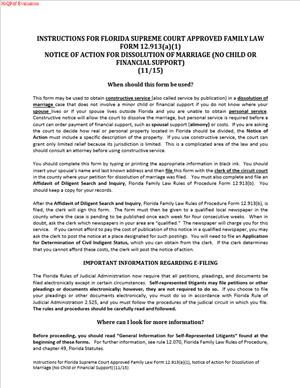
Form 12.913(a)(1) – Notice of Action for Dissolution of Marriage (No Child or Financial Support)
Fill out nowJurisdiction: Country: United States | Province or State: Florida
If you are filing for divorce and cannot locate your spouse, you may come across Form 12.913(a)(1) – Notice of Action for Dissolution of Marriage (No Child or Financial Support). This form is used in specific situations where personal service is not possible.
This document is part of the Florida family law court process. It helps move your case forward when you have been unable to formally deliver divorce papers to your spouse.
The form is not the divorce petition itself. Instead, it is a public notice that informs your spouse about the case and gives them a deadline to respond.
Understanding how this form works is important before you complete and file it. If you are representing yourself, knowing what the court expects can prevent delays.
This guide explains what the form is, when it is used, and how to fill it out correctly in Florida.
What is Form 12.913(a)(1) – Notice of Action for Dissolution of Marriage (No Child or Financial Support)?
Clear definition
Form 12.913(a)(1) – Notice of Action for Dissolution of Marriage (No Child or Financial Support) is a court-approved notice used in Florida divorce cases. It is designed for situations where there are no minor or dependent children and no request for financial support.
The form is used when a spouse cannot be personally served with divorce papers. Instead of hand delivery by a sheriff or process server, the court allows notice by publication or posting.
This form officially notifies the other spouse that a divorce case has been filed. It also states that the spouse must file a written response within a specific time period.
Who typically uses this form?
This form is commonly used by a spouse who has filed for divorce but cannot locate the other spouse. Often, the filing spouse has made efforts to find the other party but does not know their current address.
Self-represented individuals frequently use this form. It is part of the standard family law forms provided for use in Florida circuit courts.
It applies only in cases without minor children and without claims for alimony or child support. If financial support or children are involved, a different version of the notice is typically required.
Why might you need this form?
You may need this form if traditional service of process has failed. Courts generally require that the other spouse be formally notified of the divorce filing.
If your spouse’s location is unknown after reasonable efforts to find them, the court may allow constructive service. Constructive service usually means publishing a notice in a newspaper or posting it in a designated public place.
This form provides the language required to inform your spouse about the case and their right to respond. Without proper notice, the court cannot move forward with your divorce.
Using the correct notice form ensures that your case complies with Florida Family Law Rules of Procedure.
Typical real-life scenarios
- You have been separated for several years and have lost contact with your spouse. You do not know where they live and cannot reach them by phone or mail.
- Your spouse moved out of state and stopped communicating. You do not have a current address despite checking with friends or relatives.
- You were married briefly, have no children together, and have no shared assets or debts. You want to dissolve the marriage, but you cannot locate your spouse to serve the papers.
- Your spouse left the country and has not provided contact information. You still want to finalize the divorce so you can move forward legally.
- In each of these situations, this notice form may become part of the process if the court allows service by publication or posting.
When would you use Form 12.913(a)(1) – Notice of Action for Dissolution of Marriage (No Child or Financial Support)?
You would use this form after filing a petition for dissolution of marriage and attempting to serve your spouse. If personal service is unsuccessful and you cannot find your spouse after reasonable efforts, you may request permission from the court to use constructive service.
This form is used only in cases without minor children and without claims for financial support. It is generally limited to dissolving the marital status itself. Issues like property division may be affected when service is by publication.
The filing spouse prepares the notice. Once approved, the notice is published in a qualifying newspaper or posted as directed by the clerk of court.
The notice gives the other spouse a specific number of days to file a written response with the clerk. If no response is filed within that time, the case may proceed without the spouse’s participation.
This form is not used if your spouse can be personally served. It is also not used if you know your spouse’s address and can serve them by other approved methods.
Legal characteristics of Form 12.913(a)(1) – Notice of Action for Dissolution of Marriage (No Child or Financial Support)
This form follows the structure required by Florida family law procedure. It contains specific language that informs the respondent about the case and the consequences of failing to respond.
For the notice to be effective, it must be completed accurately. The names of both parties, the case number, and the court information must match the petition exactly.
The notice must also be published or posted according to court rules. If the publication does not run for the required time or in the correct format, the court may require you to start over.
Common problems include incorrect case numbers, misspelled names, or missing deadlines. These errors can delay your case.
This form does not resolve property disputes, award alimony, or address child-related matters. When service is by publication, the court’s authority may be limited to dissolving the marriage itself.
There can be differences in how circuits handle publication logistics. The clerk’s office may provide procedural guidance about where and how the notice is published, but the required language of the form remains consistent under Florida rules.
Is it legally binding?
The form itself is not a binding agreement. It is a procedural notice.
However, once properly completed and published according to court rules, it satisfies the legal requirement to notify the other spouse through constructive service.
If the responding spouse does not file a written response within the time stated in the notice, the court may proceed. In many cases, this can lead to a default and eventually a final judgment of dissolution of marriage.
The legal effect comes from following the required process. If the steps are incomplete or incorrect, the notice may not support a valid final judgment.
How to fill out Form 12.913(a)(1) – Notice of Action for Dissolution of Marriage (No Child or Financial Support)
Step 1 – Enter the court information
At the top of the form, fill in the name of the circuit court, the county, and the division, if applicable. Copy this information exactly as it appears on your filed petition for dissolution of marriage.
Step 2 – Fill in the case number and division
Insert the case number assigned by the clerk when you filed your petition. Include the division if one is listed. This information must match the court record.
Step 3 – Identify the parties
Enter your full legal name as the petitioner and your spouse’s full legal name as the respondent. Use the same names that appear on your original petition.
Step 4 – Provide the respondent’s last known address
In the section requesting the respondent’s last known address, enter the most recent address you have, if any. If the address is unknown, follow the form’s instructions for indicating that it is unknown.
Step 5 – Review the response deadline language
The form includes a statement telling the respondent how many days they have to file a written response after the first date of publication. Review this section carefully to ensure the time frame matches the standard language in the form.
Step 6 – Include required warnings
The notice contains language explaining that failure to respond may result in a default and the granting of the relief requested in the petition. Do not alter this wording. It must remain as written in the approved form.
Step 7 – Add the petitioner’s contact information
Provide your mailing address and any other required contact details in the designated section. This allows the respondent to serve a copy of their response if they choose to file one.
Step 8 – Sign if required and submit for clerk processing
Some portions of the notice may be completed by the clerk, especially information related to publication. Review the form to determine where your signature is required. After completing your sections, file the form with the clerk so the publication or posting process can begin.
Step 9 – Confirm publication details
After filing, confirm that the notice will be published or posted as required by the court. Keep copies of any proof of publication provided, as this may be needed before a final hearing can be scheduled.
Legal terms you might encounter in Form 12.913(a)(1) – Notice of Action for Dissolution of Marriage (No Child or Financial Support)
- Petitioner: The person who filed the petition for dissolution of marriage. In this document, you are usually the petitioner. Your name must appear exactly as it does on the original petition and other court filings.
- Respondent: The spouse who did not file the case. This document is directed to the respondent. It notifies them that a divorce case has been filed and that they must respond within a specific time.
- Notice of Action: A formal public notice is used when you cannot personally serve the respondent. Instead of hand-delivering court papers, you publish this notice in an approved way. It informs the respondent that the case exists and explains what they must do to protect their rights.
- Service by Publication: A method of service allowed when you cannot locate the respondent after a diligent search. You publish the notice in a qualified newspaper or approved publication. This form is used specifically for that purpose.
- Dissolution of Marriage: The legal term for divorce. This document relates only to a dissolution case with no children and no request for financial support. The wording must match the type of petition you filed.
- No Child or Financial Support: A limitation stated in the title of this document. It means the case does not involve minor or dependent children and does not request child support or spousal support. This restriction affects what the court can decide if the respondent does not answer.
- Response Deadline: The specific number of days the respondent has to file a written response after the first publication date. This deadline is printed in the notice. It is critical because the court may move forward without the respondent if they do not respond in time.
- Clerk of Court: The court official who processes filings and maintains the case record. The clerk issues or approves the notice for publication. You file this document with the clerk before it is published.
- Proof of Publication: A document from the newspaper or publication provider confirming that the notice ran for the required time. You must file this proof with the court. Without it, the judge cannot finalize the divorce based on publication.
- Diligent Search: A good-faith effort to locate the respondent before using publication. Courts usually require you to complete and file a separate affidavit describing the steps you took. This shows the court you did not skip the easier methods of service.
FAQs
When should I use Form 12.913(a)(1) – Notice of Action for Dissolution of Marriage (No Child or Financial Support)?
You use this form when you cannot locate your spouse after making a diligent search and therefore cannot serve them personally. It applies only if your case does not involve minor children and you are not asking for financial support. Before completing it, confirm that your petition matches those limits and that you have filed any required diligent search affidavit.
What information must match exactly between this document and my petition?
The case number, division, court name, and both parties’ names must be identical to what appears on your petition. Even small differences, such as a missing middle initial or different spelling, can cause delays. Check the caption at the top of your petition and copy it exactly onto this document.
How do I calculate the response deadline listed in the notice?
The deadline usually runs from the first date of publication, not the date you filed the notice. You must confirm the required number of days stated in the notice language. When arranging publication, verify the first publication date so you can determine the final response date accurately and ensure the wording reflects the correct timeline.
Do I need to sign this form before filing it?
In many situations, the clerk prepares or issues the notice once you request service by publication. Review the signature lines carefully to see whether your signature is required or whether the clerk signs and seals it. Do not assume it is complete until you confirm who must sign and whether a court seal is necessary.
What happens if the respondent does not respond by the deadline?
If the respondent does not file a written answer with the clerk by the stated deadline, you may be able to request a default. A default allows the court to move forward without the respondent’s participation. You must check the docket to confirm no response was filed before asking the clerk to enter a default.
What proof do I need to show that the publication was completed?
After the notice runs for the required time, the newspaper or publication provider issues a proof or affidavit of publication. You must file that proof with the clerk in your case. Without it, the court record will not show that proper notice was given.
Can I request property division using this form?
You can request relief that was included in your original petition, but you cannot expand the case beyond what service by publication allows. Because this document is limited to cases without children or financial support, the court’s authority may be restricted if the respondent never appears. Review your petition to ensure it reflects only what is permitted under this type of notice.
What if I later find my spouse’s address after starting publication?
If you locate a valid address before the process is complete, you may need to consider personal service instead. Inform the clerk or review your options before continuing with publication. Using the correct method of service protects your final judgment from being challenged later.
Checklist: Before, During, and After Form 12.913(a)(1) – Notice of Action for Dissolution of Marriage (No Child or Financial Support)
Before
- Confirm your case involves no minor children and no request for financial support.
- Complete and file a diligent search affidavit if required.
- Verify the exact spelling of both parties’ names from your petition.
- Confirm the case number and division assigned by the clerk.
- Review the petition to ensure it requests only allowable relief.
- Check local publication requirements and approved newspapers.
- Prepare funds for publication costs.
- Make copies of your filed petition for reference.
During
- Fill in the court name, case number, and division exactly as assigned.
- Insert the respondent’s name exactly as it appears on the petition.
- Include the correct response deadline language.
- Confirm the clerk’s role in issuing or signing the notice.
- Submit the document to the clerk for processing.
- Arrange publication with an approved newspaper.
- Verify the first publication date.
- Track the publication schedule to ensure all required insertions run.
After
- Obtain the proof or affidavit of publication from the newspaper.
- File the proof of publication with the clerk promptly.
- Calculate and calendar the response deadline.
- Monitor the case docket for any response filed by the respondent.
- Request a clerk’s default if no response is filed by the deadline.
- Keep stamped copies of all filings in your records.
- Prepare any additional documents needed for a final hearing.
- Confirm the court file reflects completion of service by publication.
Common mistakes to avoid with Form 12.913(a)(1) – Notice of Action for Dissolution of Marriage (No Child or Financial Support)
- Mistake: Using this form in a case that involves minor children or requests support, which happens when you overlook the title limitations, leading to rejection or an invalid judgment, so do not forget to confirm your petition matches the form’s scope.
- Mistake: Misspelling a party’s name or listing a different version than in the petition, which often occurs from copying from memory, causing inconsistencies in the court record, do not forget to copy the caption exactly.
- Mistake: Calculating the response deadline from the wrong date, usually the filing date instead of the first publication date, which can result in requesting default too early, so do not forget to verify the actual first publication date.
- Mistake: Failing to file the proof of publication, which happens when you assume the newspaper sends it automatically to the court, preventing the judge from finalizing the case, so do not forget to obtain and file it yourself.
- Mistake: Skipping a documented diligent search before publication, often due to urgency, which can allow the respondent to challenge the service later, so do not forget to complete and file the required affidavit.
- Mistake: Not checking the docket for a late-filed response, which can occur if you rely only on mail notices, leading to improper default requests, so do not forget to review the official court record before moving forward.
What to do after filling out Form 12.913(a)(1) – Notice of Action for Dissolution of Marriage (No Child or Financial Support)
Once you complete the document, your focus shifts to proper filing and tracking. Accuracy and timing matter at this stage. Small oversights can delay your case or create problems later.
Start by reviewing every entry. Confirm that names, case number, and division match the court record exactly. Check that the response deadline language is complete and clear.
- Step 1: Make at least two copies of the completed notice for your records before submitting it.
- Step 2: File the original with the clerk of the court in your case.
- Step 3: Confirm whether the clerk must sign, seal, or issue the notice before publication.
- Step 4: Arrange publication with an approved newspaper or publication provider.
- Step 5: Confirm the exact first date of publication and write it down.
- Step 6: Track all required publication dates to ensure the notice runs the full required period.
- Step 7: Obtain the affidavit or proof of publication immediately after the final run.
- Step 8: File the proof of publication with the clerk and keep a stamped copy.
- Step 9: Calculate the response deadline based on the first publication date and mark it on your calendar.
- Step 10: After the deadline passes, review the court docket to confirm no response was filed.
- Step 11: If appropriate, file a request for clerk’s default.
- Step 12: Prepare and file any documents needed to move your case toward final judgment.
Keep a dedicated folder, physical or digital, with every document related to service by publication. Include your diligent search affidavit, the issued notice, proof of publication, and any default paperwork. Clear records protect you if questions arise later about whether notice was properly given.
Finally, continue checking your case status until a final judgment is entered. Service by publication is only one step in the process. You must complete all remaining procedural requirements before your divorce can be finalized.
Disclaimer: This guide is provided for informational purposes only and is not intended as legal advice. You should consult a legal professional.