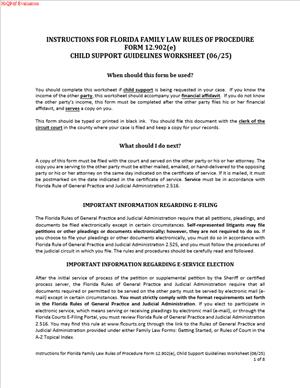
Form 12.902(e) – Child Support Guidelines Worksheet
Fill out nowJurisdiction: Country: United States | Province or State: Florida
The Form 12.902(e) – Child Support Guidelines Worksheet is a required financial document used in many Florida family law cases involving children. If you are asking a court to set or change child support, this form helps calculate the amount under Florida’s child support guidelines.
When you fill out this form, you are not simply estimating support. You are showing the court how you arrived at a specific monthly amount based on income, health insurance costs, daycare expenses, and the number of overnight stays each parent has with the child.
If you are representing yourself, this worksheet can feel technical. It involves numbers, adjustments, and careful calculations. Still, it follows a structured format, and each section builds on the last.
Understanding how this form works will help you avoid common mistakes. It also helps you see how your income and parenting time affect the final support figure.
What is Form 12.902(e) – Child Support Guidelines Worksheet?
Clear definition
Form 12.902(e) – Child Support Guidelines Worksheet is a standardized Florida court form used to calculate child support under the state’s guideline formula. It breaks down each parent’s income, applies required deductions, and uses a statutory chart to determine a base support amount.
The worksheet reflects Florida’s guideline model. This model considers the combined net income of both parents and the number of children. It then assigns each parent a percentage share of the total support obligation based on income.
The form includes sections for gross income, allowable deductions, health insurance premiums for the child, child care costs, and adjustments for substantial parenting time. By the end of the worksheet, a final monthly obligation is calculated.
Who typically uses this form?
This form is commonly used by parents involved in divorce cases that include minor children. It is also used in paternity actions, cases involving unmarried parents, and post-judgment modification proceedings.
Both parents usually complete and exchange financial information. In some cases, each parent may prepare a worksheet. The court may compare them or use the numbers it finds most credible.
Self-represented individuals frequently use this form when filing or responding to petitions involving child support. Attorneys also use it as part of standard family law filings.
Why might you need this form?
You may need this form anytime child support must be set or recalculated. Courts in Florida generally rely on the guideline worksheet to determine the appropriate amount.
If you are requesting support, the worksheet shows how you calculated the amount you are asking for. If you are responding, it shows your view of the correct amount based on your income and expenses.
The form may also be required when modifying an existing support order. A significant change in income, employment, health insurance costs, or parenting time can lead to a new calculation.
Without this worksheet, the court may not have enough financial detail to determine a guideline-based support amount.
Typical real-life scenarios
- You are filing for divorce and have two minor children. As part of your financial paperwork, you complete the worksheet to show the court the guideline amount based on both incomes and the children’s daycare expenses.
- You were never married to the other parent, and you are establishing paternity and child support for the first time. The worksheet is used to calculate the proposed monthly support figure.
- You lost your job, and your income decreased significantly. You file a request to modify child support, and you submit a new worksheet reflecting your current earnings.
- The parenting plan changed, and the children now spend substantially more overnight time with you. The worksheet accounts for this shift and may adjust the final support amount accordingly.
When would you use Form 12.902(e) – Child Support Guidelines Worksheet?
Use Florida Family Law Rules of Procedure Form 12.902(e), Child Support Guidelines Worksheet, whenever child support is being established or recalculated under Florida law. This includes initial dissolution of marriage, paternity, and child-support proceedings, as well as later requests to modify an existing support order.
In a divorce involving minor or dependent children, the worksheet provides the numerical basis for determining each parent’s support obligation. The calculation generally considers both parents’ monthly net incomes, allowable deductions, childcare expenses, health-insurance costs, uncovered medical expenses, and the parenting schedule. Each parent must ordinarily provide an appropriate financial affidavit and supporting income information so that the worksheet can be completed accurately.
The worksheet is also commonly required in paternity proceedings. Once parentage has been established or acknowledged, the court may determine child support and related financial responsibilities. Form 12.902(e) shows how the parents’ financial information produces the guideline support amount.
Use a newly completed worksheet when requesting modification of an existing child-support order. The applicant generally must establish a legally sufficient change in circumstances, and the updated worksheet helps the court compare the current guideline calculation with the amount ordered previously. Changes in income, childcare expenses, health-insurance costs, or the number of overnights exercised by each parent may affect the calculation.
A worksheet may still be required when both parents agree on child support. The court generally must know the guideline amount before deciding whether to approve the agreement. If the proposed support differs from the guideline calculation, the parties should identify the deviation and explain why it is appropriate. Under Florida law, a deviation of more than five percent generally requires written findings explaining why the guideline amount would be unjust or inappropriate.
If you know the other parent’s income, complete the worksheet using the available financial information. If that information is not yet available, the worksheet may be completed after receiving the other parent’s financial affidavit. Follow the applicable filing and service instructions so the completed worksheet is before the court when required.
The worksheet does not itself establish or change child support. It documents the guideline calculation for consideration by the court; the enforceable obligation is created by the signed support order.
Legal characteristics of Form 12.902(e) – Child Support Guidelines Worksheet
This form is tied to Florida’s child support guidelines. The guidelines use a mathematical formula based on statute. The worksheet is designed to apply that formula consistently.
For the worksheet to be effective, it must be accurate and complete. Income must be reported correctly. Required deductions must be properly calculated. Supporting financial documents are often filed separately to back up the numbers entered.
Common problems include failing to include all sources of income, miscalculating net income, or entering incorrect health insurance or child care costs. Mathematical errors can also affect the final support figure.
The worksheet itself does not create a support order. It is a calculation tool. The court reviews it, may adjust figures based on evidence, and then enters a formal order setting the support obligation.
While Florida follows a guideline model, details such as parenting time adjustments and allowable deductions are specific to state law. Other states use different formulas and worksheets. This document is tailored to Florida’s Family Law Rules of Procedure.
Is it legally binding?
The worksheet by itself is not a binding order. It becomes meaningful when the court adopts the calculation and includes the support amount in a signed judgment or order.
If both parents agree on the numbers and the court approves them, the resulting support order is enforceable. If there is disagreement, the judge decides which figures to use and what amount to order.
Once the court signs a child support order based on the worksheet, that order is legally enforceable. The worksheet serves as the financial foundation for that decision, but it is the court’s signed order that carries legal force.
How to fill out Form 12.902(e) – Child Support Guidelines Worksheet
Step 1 – Enter case information and party names
At the top of the form, fill in the court information, case number, and division, if assigned. Enter the names of the parties exactly as they appear in your case. This ensures the worksheet matches your court file.
Step 2 – List each parent’s gross monthly income
In the income section, enter each parent’s gross monthly income. This includes wages, salary, bonuses, commissions, and other sources such as self-employment income, rental income, or certain benefits. Use monthly amounts, even if you are paid weekly or biweekly, and convert carefully.
Step 3 – Calculate allowable deductions
Subtract permitted deductions from gross income to reach net monthly income. These often include federal income tax, Social Security, Medicare, mandatory retirement payments, and court-ordered support for other children. Enter each deduction in the correct line and total them accurately.
Step 4 – Determine each parent’s net monthly income and percentage share
After subtracting deductions, write each parent’s net monthly income. Then combine both net incomes to get a total. Divide each parent’s net income by the combined total to calculate each parent’s percentage share of the support obligation.
Step 5 – Find the basic child support obligation
Using the combined net income and the number of minor children, locate the basic support amount from the guideline chart referenced in the form. Enter that base amount in the appropriate line. This figure represents the total support needed for the children before additional adjustments.
Step 6 – Add child care and health insurance costs
Include monthly child care costs related to employment or job search. Add the portion of health insurance premiums that applies to the child or children. Combine these with the base obligation to reach a new subtotal support need.
Step 7 – Allocate the total support needed between the parents
Multiply the total support need by each parent’s percentage share. This assigns each parent a portion of the total obligation based on income. The parent who does not have the majority of overnights typically pays their share to the other parent.
Step 8 – Apply parenting time adjustments if applicable
If the parenting schedule involves substantial shared overnight time, complete the adjustment section. Enter the number of overnights each parent has per year, as required by the form. The calculation may adjust the support amount to reflect shared expenses.
Step 9 – Calculate the final child support obligation
After all adjustments, determine the final monthly support amount. This is the figure that may be requested in your petition or reflected in a proposed order. Review each line for math accuracy before submitting the form as part of your filing.
Legal terms you might encounter in Form 12.902(e) – Child Support Guidelines Worksheet
- Gross Income: This is the total income a parent earns before taxes or deductions. On this form, you must list all sources of monthly income, including wages, bonuses, commissions, rental income, and certain benefits. The number you enter here directly affects the support calculation. Leaving out income can lead to corrections or court sanctions.
- Allowable Deductions: These are specific expenses the guidelines permit you to subtract from gross income to reach net income. They often include federal taxes, mandatory retirement contributions, health insurance premiums for the parent, and court-ordered support for other children. You cannot subtract personal bills like rent or car payments. Only deductions recognized by the guidelines count.
- Net Monthly Income: This is your gross income minus allowable deductions. The worksheet uses each parent’s net income to calculate their percentage share of the total child support obligation. Accuracy matters here because even small errors change the final support amount.
- Combined Net Income: This is the total of both parents’ net monthly incomes. The worksheet uses this figure to look up the basic child support obligation in the statutory guidelines chart. If this number is wrong, every later calculation will also be wrong.
- Basic Child Support Obligation: This is the starting support amount based on combined net income and the number of children. It reflects what the guidelines say parents together should contribute monthly. The worksheet provides space to enter the correct amount from the chart.
- Health Insurance Costs for the Child: This refers to the portion of the health insurance premium that covers the child, not the parent. You must enter the actual monthly amount attributable to the child. This cost is added to the basic obligation and then divided between the parents.
- Child Care Costs: These are work-related child care expenses necessary for a parent to maintain employment or job search. The worksheet allows you to add reasonable monthly child care costs to the support calculation. You should use average monthly figures if costs vary.
- Parenting Time Adjustment: If the child spends a substantial number of overnights with each parent, the guidelines may adjust the support amount. The worksheet includes a section to calculate this credit based on the number of overnights. You must count carefully and use accurate annual totals.
- Imputed Income: This is income the court assigns to a parent who is unemployed or underemployed without a valid reason. Even if you do not actually earn that amount, it can be used in the calculation. The worksheet may reflect this number if the court determines it applies.
- Deviation: A deviation is a change from the guideline amount. The court may approve a higher or lower amount if certain factors justify it. The worksheet shows the guideline figure, even if a different final amount is later ordered.
FAQs
Do both parents have to complete and file this document?
In most cases, yes. Each parent provides financial information, and a worksheet is prepared based on those numbers. Sometimes one party prepares it and the other reviews it. You should confirm whether both signatures are required before filing.
What income documents should I gather before completing this form?
You should collect recent pay stubs, tax returns, proof of bonuses or commissions, documentation of health insurance premiums, and proof of child care expenses. The numbers you enter must match what you can show on paper. If your income changes month to month, calculate a reliable monthly average.
What if my income recently changed?
Use your current monthly income at the time you complete this document. If the change is very recent, be prepared to explain when it started and whether it is permanent. The court looks at present ability to pay, not just past earnings.
How do I know which health insurance amount to enter?
Only include the portion of the premium that covers the child. If your employer deducts one lump sum for family coverage, ask for a breakdown. You should not list the entire premium if part of it covers you or a new spouse.
Does the Form 12.902(e) – Child Support Guidelines Worksheet set the final support amount?
This form calculates the guideline amount based on the numbers entered. The judge reviews it along with other evidence. The final court order may match the worksheet or differ if the court finds a valid reason to adjust it.
What happens if the other parent disagrees with my numbers?
Each parent can submit their own version of this document using their understanding of the income and expenses. The court compares both worksheets and supporting documents. The judge decides which figures are accurate and may prepare or approve a corrected version.
Do I need to sign this worksheet?
You generally must sign the document to confirm that the information is true and correct. Your signature shows you stand behind the numbers provided. If you knowingly include false information, it can affect your credibility and the outcome of your case.
Will the amounts on this form become part of the public court record?
Yes. Once filed, the completed Form 12.902(e) – Child Support Guidelines Worksheet usually becomes part of the court file. The income and expense figures you list are included in that record. You should review everything carefully before submission because it reflects your sworn financial position.
Checklist: Before, During, and After Form 12.902(e) – Child Support Guidelines Worksheet
Before
- Gather your last three to six months of pay stubs.
- Collect your most recent federal tax return.
- Obtain proof of health insurance premiums showing the child’s portion.
- Calculate average monthly child care costs.
- List any court-ordered support you pay for other children.
- Review prior financial affidavits for consistency.
- Confirm the correct case number and party names.
During
- Enter each parent’s name exactly as it appears on court documents.
- Use monthly figures, not weekly or annual amounts, unless converted.
- Double-check all math when subtracting deductions.
- Verify the combined net income before using the guideline chart.
- Enter the correct number of minor children covered.
- Apply parenting time adjustments only if the overnight threshold is met.
- Review each line to ensure no required field is blank.
After
- Recalculate totals to confirm accuracy.
- Sign and date the worksheet where required.
- Make copies for yourself and the other parent.
- Attach supporting financial documents if required.
- File the worksheet with the clerk or submit it as instructed.
- Confirm the document was accepted and stamped if filing in person.
- Bring a copy to any scheduled hearing.
Common mistakes to avoid with Form 12.902(e) – Child Support Guidelines Worksheet
- Mistake: Listing net pay from your paycheck as gross income because it looks easier, which happens when you rely only on take-home pay; this lowers the calculated obligation incorrectly and can lead to recalculation, so do not forget to use pre-tax income.
- Mistake: Subtracting personal living expenses as deductions because you assume all bills count; this inflates your deductions and reduces support unfairly, and the court may reject your worksheet, so do not forget only guideline-approved deductions apply.
- Mistake: Guessing at health insurance costs for the child because you do not have the breakdown; this leads to inaccurate allocations and possible disputes, so do not forget to confirm the exact child-only premium amount.
- Mistake: Using outdated income figures from last year’s tax return when your earnings have changed; this misrepresents your current financial situation and may delay your case, so do not forget to update all numbers to present monthly income.
- Mistake: Miscounting overnights for parenting time because you estimate instead of counting actual days; this can significantly change the support amount and damage credibility, so do not forget to calculate the yearly total carefully.
- Mistake: Leaving sections blank when they do not apply without marking them appropriately; this creates confusion about whether information is missing and may cause the clerk to question the filing, so do not forget to complete every line clearly.
- Mistake: Failing to review the math after completing the worksheet because you trust your first calculation; small arithmetic errors can change the final obligation and require correction, so do not forget to verify each total step by step.
- Mistake: Not signing the form before filing because you assume it is just a calculation sheet; an unsigned worksheet may not be accepted or may weaken your position, so do not forget to sign and date where required.
What to do after filling out Form 12.902(e) – Child Support Guidelines Worksheet
Once you complete the worksheet, pause before filing it. Review every number. Make sure your entries match your financial affidavit and supporting documents. Inconsistent numbers raise questions and can slow down your case.
- Step 1: Review all calculations line by line, including additions and subtractions.
- Step 2: Confirm that all monthly figures are truly monthly and not weekly or annual amounts.
- Step 3: Check that each parent’s name and the case number match the court file exactly.
- Step 4: Sign and date the worksheet in the designated area.
- Step 5: Make at least two copies—one for you and one for the other parent.
- Step 6: Attach any required supporting documents, such as proof of income and insurance costs.
- Step 7: File the original with the clerk of court or submit it according to your case instructions.
- Step 8: If you file in person, ask the clerk to stamp your copy as proof of filing.
- Step 9: If you file electronically, save the confirmation receipt and a digital copy.
- Step 10: Bring a copy of the filed worksheet to mediation, settlement conferences, or hearings.
After filing, organize your paperwork. Keep the worksheet together with your financial affidavit and income documents. If your income changes before your hearing, update your numbers and prepare a revised worksheet if required. Staying organized helps you respond quickly to questions from the court.
If the judge signs an order setting child support, compare the ordered amount with your worksheet. Make sure you understand any differences. Update your personal budget to reflect the new obligation or expected payment. Clear records now prevent confusion later.
Disclaimer: This guide is provided for informational purposes only and is not intended as legal advice. You should consult a legal professional.