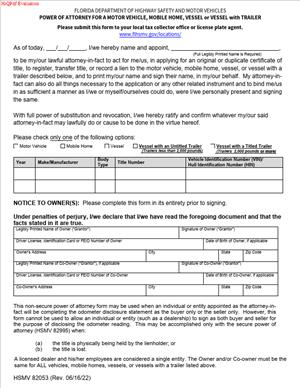
HSMV 82053 – Power Of Attorney for a Motor Vehicle, Mobile Home, Vessel or Vessel with Trailer
Fill out nowJurisdiction: Country: United States | Province or State: Florida
HSMV 82053 – Power Of Attorney for a Motor Vehicle, Mobile Home, Vessel, or Vessel with Trailer is a Florida form that lets you authorize someone else to handle specific vehicle, vessel, or mobile home paperwork for you. It is focused on transactions involving title, registration, or ownership records. It does not cover general financial or personal decisions.
This document matters when you cannot be present to sign the required paperwork. That may be because of travel, scheduling conflicts, health issues, or distance. The form creates a clear paper trail showing that another person is allowed to act in your place for a defined purpose.
People often encounter this form when dealing with the Florida Department of Highway Safety and Motor Vehicles. Clerks and processing offices commonly rely on it to confirm authority before accepting documents signed by someone other than the owner.
If you are about to fill out this form, your main goal is accuracy. Small mistakes can delay processing. Understanding what the form does and what it does not do helps you complete it with confidence.
This document is narrow by design. It gives power only for the vehicle, vessel, or mobile home described. That limitation protects both you and the person you name.
What is HSMV 82053 – Power Of Attorney for a Motor Vehicle, Mobile Home, Vessel or Vessel with Trailer?
Clear definition
HSMV 82053 – Power Of Attorney for a Motor Vehicle, Mobile Home, Vessel or Vessel with Trailer is a written authorization. It allows one person, called the principal, to give another person, called the attorney-in-fact, authority to sign and submit specific motor vehicle, vessel, or mobile home documents.
The authority is limited to the property listed on the form. It usually applies to title transfers, registration matters, and related filings. The power does not extend beyond what is written.
This form is standardized. That means agencies and processing offices recognize its format and expect to see certain information completed in a specific way.
Who typically uses this form?
Vehicle owners commonly use this form when selling or buying a car, but cannot attend the transaction in person. It is also used by people who own boats, trailers, or mobile homes registered in Florida.
Businesses sometimes use this form when an employee handles paperwork on behalf of an owner. Families also use it when one member helps another with administrative tasks.
The person receiving authority is often a trusted individual. That may be a family member, a business representative, or another responsible adult.
Why might you need this form?
You might need this form when a title must be signed, but you are unavailable. Florida processing offices generally require proper authorization before accepting a signature from someone else.
The form helps prevent delays. Without it, paperwork may be rejected or placed on hold until the owner signs personally.
It also provides clarity. Everyone involved can see exactly who is authorized and for which property.
Typical real-life scenarios
- A vehicle owner moves out of state before completing a title transfer. The buyer needs the paperwork finished in Florida. The owner signs this form to let another person complete the process.
- A boat owner is traveling during the registration renewal period. A family member handles the filing using the power granted in the document.
- A mobile home owner sells the property but cannot attend the closing. The authorized person signs title documents at the appropriate office.
- A person is hospitalized or otherwise unavailable for a limited time. The form allows a trusted individual to manage a specific transaction without broader authority.
When would you use HSMV 82053 – Power Of Attorney for a Motor Vehicle, Mobile Home, Vessel or Vessel with Trailer?
You would use this form when a Florida motor vehicle, vessel, or mobile home transaction requires an owner’s signature. The key factor is your absence or inability to sign in person.
This form is commonly used during sales, transfers, or registration updates. It may also appear in situations involving corrections to records or replacement titles.
The timing matters. The power is usually granted before the paperwork is submitted. Processing offices typically expect the signed power of attorney to accompany the related documents.
The roles are straightforward. One person grants authority. Another person accepts it and signs documents as permitted. Each role must be clearly identified on the form.
Legal characteristics of HSMV 82053 – Power Of Attorney for a Motor Vehicle, Mobile Home, Vessel or Vessel with Trailer
This document has legal effect when completed and signed as required. Its effectiveness depends on accurate identification of the parties and the property involved.
Problems often arise from incomplete fields, mismatched names, or missing signatures. Even small errors can lead to rejection during submission.
While the form is specific to Florida, power of attorney concepts can vary by state. This form is designed to meet Florida administrative expectations for vehicle and vessel matters.
The document does not grant unlimited authority. It does not allow the attorney-in-fact to make unrelated financial decisions or manage other property.
Is it legally binding?
Yes, the form is legally binding when properly executed. It creates a recognized authorization for the limited actions described.
Its binding effect applies only within the scope written on the form. Actions outside that scope are not covered by the authorization.
The form remains effective for the transaction described, unless limited by its terms or revoked in a separate written manner.
How to fill out HSMV 82053 – Power Of Attorney for a Motor Vehicle, Mobile Home, Vessel or Vessel with Trailer
Step 1 – Identify the principal
Begin by entering the full legal name of the person granting authority. Use the name exactly as it appears on the title or registration. Consistency helps avoid processing delays.
Include the principal’s address as requested. This information connects the authorization to the correct owner record.
Step 2 – Identify the attorney-in-fact
Enter the full legal name of the person receiving authority. This person will be allowed to sign documents related to the property described.
Accuracy matters here. Processing offices rely on this name to verify who is authorized to act.
Step 3 – Describe the vehicle, vessel, or mobile home
Provide complete identifying details for the property. This may include a vehicle identification number, hull identification number, or other required identifiers.
The description limits the scope of the power. Only the listed property is covered by the authorization.
Step 4 – Specify the authority granted
The form includes language describing what the attorney-in-fact may do. Read this section carefully as you complete it.
The authority is tied to title, registration, or ownership-related filings. It does not extend beyond those tasks.
Step 5 – Review the form for completeness
Before signing, review every section. Check spelling, numbers, and names for consistency.
Incomplete or unclear entries commonly cause rejection or delays during submission.
Step 6 – Sign the form
The principal must sign in the space provided. The signature confirms the grant of authority.
Signatures must match the principal’s name as written on the form and related records.
Step 7 – Complete notarization if required
Some transactions require notarization. If applicable, the signing must occur in the presence of a notary.
The notary completes their section after witnessing the signature.
Step 8 – Provide the form to the attorney-in-fact
Once completed, give the signed form to the authorized person. They will present it with the related paperwork.
The form is typically submitted together with the title or registration documents.
Step 9 – Submit the transaction paperwork
The attorney-in-fact submits the power of attorney along with the required filings. Processing offices review it as part of the transaction.
Acceptance depends on accuracy, completeness, and alignment with the accompanying documents.
Legal terms you might encounter in HSMV 82053 – Power Of Attorney for a Motor Vehicle, Mobile Home, Vessel or Vessel with Trailer
- Principal: This is you, the owner or person with authority over the vehicle, vessel, or mobile home. Your legal name must match the name already associated with the asset. The form records that you are giving someone else limited authority to act for you.
- Attorney-in-Fact: This is the person you authorize to act on your behalf for the specific transaction listed. They do not need to be a lawyer. Their name and address must be written clearly because agencies rely on this section to confirm who can sign and submit documents.
- Power of Attorney: This document gives limited permission to another person to handle a defined task. In this form, the power is narrow and tied to a specific vehicle, vessel, or mobile home. It does not grant broad or ongoing authority beyond what is written.
- Vehicle Identification Number (VIN): This is the unique number assigned to a motor vehicle. It must be entered exactly as it appears on the title or registration. A single incorrect character can cause the transaction to be rejected.
- Hull Identification Number (HIN): This number identifies a vessel in the same way a VIN identifies a vehicle. You must copy it exactly from the vessel documentation. Agencies use this number to link the authority you grant to the correct record.
- Mobile Home Identification Number: This number appears on the mobile home’s title or decal. It confirms which mobile home the authority applies to. Missing or incomplete numbers can delay processing.
- Lien: A lien reflects a security interest held by a lender. If a lien exists, it may affect what the attorney-in-fact can complete using this document. The form may be used in lien-related transactions only if the authority matches the purpose.
- Title: The title is the legal record showing ownership. This form is often used to allow someone else to sign title-related paperwork for you. The information on the form must align with the title exactly.
- Notarization: This is the process where a notary verifies your identity and witnesses your signature. If required, the notarization confirms that you signed voluntarily. Without it, the form may not be accepted.
FAQs
Can I use HSMV 82053 – Power Of Attorney for a Motor Vehicle, Mobile Home, Vessel or Vessel with Trailer for more than one vehicle or vessel?
No. This form is designed for one specific vehicle, vessel, or mobile home at a time. You must list identifying details that tie the authority to a single record. If you need authority for multiple items, each one needs its own document with its own identifying numbers.
Does this document let the attorney-in-fact do anything they want with my vehicle?
No. This document only grants the authority you describe on the form and only for the item listed. Agencies look at the written scope to decide what actions are allowed. Anything not written is not included.
What name should I use if my name recently changed?
You should use the name that matches the title or registration record. This helps the agency connect the document to the existing record without confusion. If your name has changed but the record has not, mismatches can delay acceptance.
When does this form become effective?
It becomes effective when you sign it, and any required notarization is completed. There is no delayed start date unless the transaction itself is delayed. Agencies rely on the signature date to confirm timing.
Does the attorney-in-fact have to sign this document?
Typically, only you are required to sign. The attorney-in-fact’s role is established by listing their information clearly. They will usually sign other transaction documents later when acting under the authority.
Can I revoke this document after signing it?
You can stop relying on this document by not allowing it to be used and by notifying the person you named. If the transaction has already been completed, revocation will not undo it. Keep track of where you submitted copies, so you know what has already been acted on.
Do I need to attach anything to this form?
You may need to submit it together with the title, registration, or application paperwork. The form itself does not replace those documents. Make sure the identifying numbers on all papers match exactly.
Will this document change the public ownership record?
By itself, it does not. It allows someone else to sign or submit paperwork that may change the record. The public record updates only after the related transaction is processed and accepted.
Checklist: Before, During, and After HSMV 82053 – Power Of Attorney for a Motor Vehicle, Mobile Home, Vessel or Vessel with Trailer
Before
- Confirm the exact name on the title or registration
- Gather the VIN, HIN, or mobile home identification number
- Decide exactly what authority you want to grant
- Verify the attorney-in-fact’s legal name and address
- Check whether notarization will be required for your transaction
- Review related paperwork that will be submitted with the form
- Plan how you will deliver the signed document
During
- Write all names clearly and without abbreviations
- Enter identification numbers carefully, character by character
- Describe the authority granted in plain, specific terms
- Review the completed form for blank spaces
- Sign the document using your usual legal signature
- Complete notarization if applicable
- Make a copy immediately after signing
After
- Provide the original to the attorney-in-fact if they need it
- Submit the form with the transaction paperwork as required
- Confirm that the receiving office accepted the document
- Keep a copy with your personal records
- Note the date and purpose of the authority granted
- Track when the transaction is completed
- Secure or destroy unused copies once no longer needed
Common mistakes to avoid with HSMV 82053 – Power Of Attorney for a Motor Vehicle, Mobile Home, Vessel or Vessel with Trailer
- Mistake: Using a nickname or shortened name, which happens out of habit, can cause rejection because records will not match, so do not forget to use the exact legal name from the title.
- Mistake: Entering an incorrect VIN or HIN, often due to copying from memory, can link the authority to the wrong record, so always verify directly from official documents.
- Mistake: Leaving authority language vague, which happens when you rush, can limit what the attorney-in-fact can do, so do not forget to clearly describe the task.
- Mistake: Skipping notarization when required, which happens due to assumptions, can invalidate the form, so confirm signature requirements before signing.
- Mistake: Submitting a photocopy when an original is expected, which happens for convenience, can delay processing, so do not forget to ask what version is needed.
- Mistake: Forgetting to keep a copy, which happens after submission, can leave you without proof of what was authorized, so always retain a copy.
- Mistake: Using one form for multiple assets, which happens to save time, can void the document, so do not forget each asset needs its own form.
- Mistake: Allowing outdated authority to circulate, which happens after the transaction ends, can create confusion, so retrieve or destroy unused copies.
What to do after filling out HSMV 82053 – Power Of Attorney for a Motor Vehicle, Mobile Home, Vessel or Vessel with Trailer
Once the form is completed and signed, your next steps matter just as much as how you filled it out. This document works only when it is paired with the correct transaction and delivered to the right place. Staying organized will save you time and follow-up later.
- Step 1: Make at least two copies of the fully signed document. One copy is for your records. One is a backup in case the original is misplaced.
- Step 2: Give the original to the attorney-in-fact if they are the one submitting paperwork. Explain exactly what they are allowed to do so there is no confusion.
- Step 3: Attach the document to the related transaction paperwork. This may include title applications, transfer forms, or registration documents. Keep everything together.
- Step 4: Submit the paperwork using the method required for the transaction. This could be in person, by mail, or through an authorized agent. Make sure the submission method matches the transaction type.
- Step 5: Ask for confirmation that the paperwork was accepted. This might be a receipt, stamped copy, or tracking confirmation. Save it with your copy.
- Step 6: Monitor the status of the transaction. If processing takes time, note expected completion dates so you know when the authority has likely been used.
- Step 7: Once the transaction is complete, confirm the public record reflects the intended change. This ensures the authority was applied correctly.
- Step 8: Retrieve or invalidate any unused copies of the document. This reduces the risk of unintended use later.
- Step 9: Update your personal records to note when and why you granted this authority. This helps if questions come up in the future.
- Step 10: Store your copy securely with other important ownership documents so everything is easy to find when you need it.
Disclaimer: This guide is provided for informational purposes only and is not intended as legal advice. You should consult a legal professional.