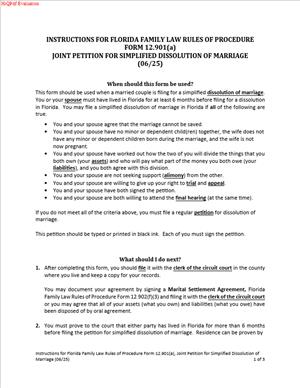
Form 12.901(a) – Joint Petition for Simplified Dissolution of Marriage
Fill out nowJurisdiction: Country: United States | Province or State: Florida
Form 12.901(a) – Joint Petition for Simplified Dissolution of Marriage is a court document used by married couples in Florida who want to end their marriage together, without a contested court battle. It starts a simplified divorce process where both spouses agree on all major issues.
This form is designed for situations where there are no disputes about property, debts, or support. Both spouses sign the same petition and file it together. That joint filing tells the court you are asking for a divorce as a team.
If you are about to complete this document, you need to understand what it does and what it does not do. It is more than a formality. It is your formal request for the court to dissolve your marriage under specific conditions.
Using the correct form matters. Filing the wrong petition or leaving out required information can delay your case or result in rejection by the clerk. Knowing the purpose and structure of this form helps you avoid common mistakes.
This document belongs to the Florida Judicial Circuit under the Family Law Rules of Procedure. That means it follows specific formatting and content requirements set by Florida courts.
What is Form 12.901(a) – Joint Petition for Simplified Dissolution of Marriage?
Clear definition
Form 12.901(a) – Joint Petition for Simplified Dissolution of Marriage is a written request filed in a Florida circuit court asking a judge to legally end a marriage through a simplified process. It is called a “joint petition” because both spouses file it together.
Unlike a regular divorce petition filed by one spouse against the other, this form reflects mutual agreement. Both parties confirm that the marriage is irretrievably broken and that they meet the requirements for a simplified dissolution.
The document includes basic information about you, your spouse, your marriage, and your property. It also confirms that there are no minor or dependent children of the marriage and that certain other conditions are met.
Who typically uses this form?
This form is commonly used by couples who have been married for a relatively short time and have limited shared assets or debts. It is also used by couples who have already divided everything informally and have no disagreements left.
Spouses who do not have minor or dependent children together often qualify for this process. It may also be used where the wife is not pregnant at the time of filing.
People who want a faster and more straightforward court process often choose this route. Both spouses must be willing to appear together at a final hearing and sign the required paperwork.
Why might you need this form?
You need this form if you and your spouse want to end your marriage in Florida using the simplified dissolution procedure. It is the official way to start that process.
Without filing this document, the court does not have the authority to grant a simplified divorce. The form acts as your formal request for judicial action.
It also confirms that you both waive certain rights. For example, in many simplified cases, spouses give up the right to a trial and the right to appeal. The form documents that understanding.
Using the correct petition ensures the clerk processes your case under the simplified track rather than the standard divorce procedure.
Typical real-life scenarios
- A couple marries, lives together for a few years, and later decides they are no longer compatible. They have no children and rent their home. They divide their bank account and personal property by agreement. In that case, they may use this form to request a simplified dissolution.
- Another example is a couple who owns a car and some household furniture but no real estate. They agree that one spouse will keep the car and assume the remaining loan. Because there is no dispute, they file jointly using this document.
- In some situations, spouses have been separated for a long time and have already handled their finances independently. They may simply want a legal end to the marriage without revisiting old disagreements. A joint petition can reflect that agreement.
- There are also cases where both spouses prefer to avoid a lengthy court process. They communicate well, agree on all issues, and want a single court appearance to finalize the divorce. The simplified petition is structured for that purpose.
When would you use Form 12.901(a) – Joint Petition for Simplified Dissolution of Marriage?
You would use this form when you and your spouse meet the eligibility requirements for a simplified dissolution in Florida. One key condition is that at least one spouse has lived in Florida for the required residency period before filing.
This form is used when there are no minor or dependent children born of the marriage and none are expected. If there are children under 18 or dependent due to disability, the simplified process is generally not available.
You would also use this document when both spouses agree on how to divide assets and debts. The court does not resolve disputes in a simplified case. Agreement is central to the process.
Another important factor is spousal support. In many simplified dissolutions, neither spouse is seeking alimony. If either party wants ongoing financial support from the other, a different type of divorce filing is often required.
Both spouses must be willing to sign the petition and appear together at the final hearing. If one spouse is uncooperative or cannot be located, this joint form is not appropriate.
In practical terms, this form is used by couples who want a streamlined court process, have resolved all financial matters, and are prepared to confirm those facts under oath.
Legal characteristics of Form 12.901(a) – Joint Petition for Simplified Dissolution of Marriage
This document is a sworn court filing. When you sign it, you confirm that the information provided is true. False statements can create serious legal consequences.
For the petition to be effective, it must be completed accurately and filed with the correct circuit court. Required details typically include full legal names, addresses, date of marriage, and confirmation of residency.
Both spouses must sign the petition. Signatures may need to be notarized or signed in front of a deputy clerk, depending on local court procedures. Missing signatures are a common reason for rejection.
The simplified process has strict eligibility criteria. If the form indicates that there are minor children, a request for alimony, or unresolved property disputes, the clerk may refuse to process it as a simplified case.
This form does not itself divide property in detail. It confirms that you have already resolved those issues. If your agreement is unclear or incomplete, the court may ask questions at the final hearing.
Requirements can vary slightly by judicial circuit in terms of scheduling, additional cover sheets, or required financial affidavits. However, the core structure of the petition is consistent across Florida because it is governed by statewide family law rules.
It is important to understand what this form does not do. It does not automatically transfer title to the property. It does not change beneficiary designations. It does not modify existing court orders unrelated to the marriage. It simply asks the court to dissolve the marriage under the simplified framework.
Is it legally binding?
Once the judge signs a final judgment of dissolution based on your joint petition, the divorce becomes legally binding. At that point, your marriage is legally terminated.
The petition itself becomes part of the court record. Statements you made in it can be relied upon by the court in granting the dissolution.
Before the judge signs the final judgment, the petition represents your sworn request. You may be asked at the hearing to confirm that everything in the document is accurate and that you still agree.
If both spouses voluntarily sign and file the petition, and the court grants the dissolution, the result carries the same legal effect as a divorce obtained through a standard process. The difference lies in the procedure, not in the legal validity of the final judgment.
How to fill out Form 12.901(a) – Joint Petition for Simplified Dissolution of Marriage
Step 1 – Complete the case caption
At the top of the form, fill in the name of the circuit court and the county where you are filing. Leave the case number blank if you have not yet filed, as the clerk usually assigns it. List both spouses’ full legal names exactly as they appear on official identification.
Step 2 – Provide information about the marriage
Enter the date of your marriage and the city and state or country where it took place. This establishes the basic facts of the marital relationship, the court is being asked to dissolve.
Step 3 – Confirm residency
State that at least one spouse has lived in Florida for the required period before filing. The form typically includes a statement confirming residency. Make sure the information matches any supporting proof you may present at the hearing.
Step 4 – Address the children of the marriage
Indicate that there are no minor or dependent children born of the marriage and that the wife is not currently pregnant. Read this section carefully before signing, as eligibility for the simplified process depends on these statements being true.
Step 5 – Confirm agreement on property and debts
State that you and your spouse have divided your marital assets and liabilities by agreement. The form usually does not require detailed listings, but your statement confirms that no unresolved financial issues remain.
Step 6 – Address spousal support
Confirm that neither spouse is seeking alimony. This section reflects one of the key conditions of a simplified dissolution. Ensure that both parties understand and agree with this statement before signing.
Step 7 – Acknowledge waiver of certain rights
Read the section where you waive the right to a trial and, in many cases, the right to appeal. By signing, you confirm that you understand you are choosing a simplified court process instead of a contested one.
Step 8 – Sign the petition
Both spouses must sign the form. Signatures are often required in the presence of a notary or deputy clerk. Do not sign until you are in front of the appropriate official if notarization is required.
Step 9 – Prepare for filing and hearing
After completing and signing the form, file it with the clerk of the circuit court in the proper county. You will typically receive a hearing date. Both spouses must attend the final hearing, where the judge reviews the petition and may ask brief questions before entering a final judgment.
Legal terms you might encounter in Form 12.901(a) – Joint Petition for Simplified Dissolution of Marriage
- Petitioner: In most family law cases, one spouse files as the petitioner. In this simplified process, both of you file together. You are both petitioners, which means you are jointly asking the court to end your marriage.
- Respondent: In a typical divorce, the respondent is the spouse who answers the petition. In this simplified case, there is no respondent because you are filing together. This matters because it removes the need for formal service of process.
- Simplified Dissolution: This is a faster process for couples who meet specific requirements. It is designed for situations with no minor or dependent children and full agreement on property and debts. By signing the petition, you confirm you qualify for this streamlined procedure.
- Irretrievably Broken: This phrase means the marriage cannot be repaired. The form asks you to confirm that your marriage is irretrievably broken. The court relies on this statement as the legal reason for ending the marriage.
- Marital Assets: These are items you and your spouse acquired during the marriage. They can include homes, vehicles, bank accounts, retirement funds, and personal property. In this form, you confirm you have already divided these assets or reached a full agreement.
- Marital Liabilities: These are debts incurred during the marriage. Examples include credit cards, mortgages, car loans, and personal loans. The form requires you to state how these debts have been divided between you.
- Spousal Support (Alimony): This is financial support one spouse may pay to the other after divorce. In a simplified dissolution, you must agree that neither of you will ask for alimony now or in the future. By signing, you give up the right to request it later.
- Waiver of Trial and Appeal: By using this process, you give up the right to a full trial and the right to appeal the court’s decision. The form includes language confirming you understand this. This makes the final judgment harder to challenge later.
- Final Judgment of Dissolution of Marriage: This is the court order that officially ends your marriage. The judge signs this after reviewing your petition and hearing from you. Your marriage is legally over only when this judgment is entered.
- Financial Affidavit: This is a sworn statement listing your income, expenses, assets, and debts. Even in a simplified case, you may need to complete one. It supports your claim that you have fully disclosed your finances to each other.
FAQs
Do both of us have to sign Form 12.901(a) – Joint Petition for Simplified Dissolution of Marriage?
Yes. This document is a joint request to the court. Both spouses must sign it to show agreement on every issue, including property, debts, and the waiver of alimony. If only one person signs, the clerk will not treat it as a simplified joint petition, and you may have to start over using a different process.
What date do we use as the date of separation?
This form may ask for the date you separated or stopped living together as spouses. Use the actual date when you considered the marriage to be over, even if you continued living in the same home. Make sure both of you agree on the date you enter. Inconsistent dates can raise questions at your hearing.
What if we forgot to list an asset or debt?
You should correct the information before the court enters the final judgment. This document confirms that you have made a full and fair disclosure to each other. If something is left out, it can create disputes later and may require additional court action to fix.
Do we need to attach a property settlement agreement?
In many simplified cases, your agreement is reflected directly in the petition. If you have a separate written agreement, you may need to attach it. Check that the names and terms in any attachment match exactly what appears in this form, including spelling and dates.
What happens if one of us changes their mind after filing?
This process only works if both of you continue to agree. If one person withdraws consent before the final hearing, the simplified procedure usually cannot move forward. You may need to convert the case to a regular dissolution process.
Do we both have to attend the final hearing?
Yes. In most situations, both spouses must appear before the judge. The court will confirm your identities and ask basic questions to ensure you understand what you signed. If one of you does not appear, the judge may not enter the final judgment.
How does this affect our public record?
Once filed, this document becomes part of the court file. The final judgment will also be entered into the public record. The court record will show that your marriage was dissolved and the date it became final.
When is our divorce legally final?
Your divorce becomes final when the judge signs and files the Final Judgment of Dissolution of Marriage. Filing the petition alone does not end the marriage. You should check the court docket or obtain a copy of the signed judgment to confirm the official date.
Checklist: Before, During, and After Form 12.901(a) – Joint Petition for Simplified Dissolution of Marriage
Before
- Confirm you meet all eligibility requirements for a simplified dissolution.
- Make sure there are no minor or dependent children of the marriage.
- Fully discuss and agree on the division of all property and debts.
- Gather financial information for both spouses.
- Decide how you will handle any jointly owned real estate or vehicles.
- Review whether either of you wants to restore a former name.
- Verify residency requirements are met.
- Prepare any required financial affidavits.
During
- Complete every section of the form clearly and legibly.
- Use full legal names exactly as they appear on official documents.
- Enter consistent dates for marriage and separation.
- Double-check that all assets and debts are addressed.
- Confirm that both of you understand the waiver of alimony.
- Review the waiver of trial and appeal language carefully.
- Sign the petition in the correct place.
- Make copies of everything you sign.
After
- File the signed petition with the clerk of the court.
- Pay the required filing fee or submit a fee waiver request if needed.
- Schedule your final hearing, if required.
- Attend the hearing together.
- Bring photo identification to court.
- Obtain a certified copy of the final judgment.
- Update your name on identification and financial accounts if applicable.
- Retitle property or close joint accounts as agreed.
Common mistakes to avoid with Form 12.901(a) – Joint Petition for Simplified Dissolution of Marriage
- Mistake: Assuming you qualify for simplified dissolution without reviewing the requirements, which happens when couples want a quick divorce, and this can lead to rejection by the clerk or judge, so do not forget to confirm eligibility before filing.
- Mistake: Leaving out debts because they seem minor, which often happens with small credit cards or personal loans, and this can cause future disputes or collection problems, so do not forget to list every liability.
- Mistake: Using nicknames or inconsistent names, which happens when spouses casually fill out the form, and this can delay processing or create record mismatches, so do not forget to use full legal names everywhere.
- Mistake: Failing to appear together at the final hearing, which can happen due to scheduling conflicts, and this may prevent the judge from granting the divorce, so do not forget to coordinate your court date.
- Mistake: Not understanding the waiver of alimony, which happens when couples focus only on property division, and this can permanently block future support claims, so do not forget that this waiver is final.
- Mistake: Forgetting to update titles and accounts after the judgment, which is common once the court process ends, and this can leave both names legally tied to property or debt, so do not forget to follow through on transfers.
What to do after filling out Form 12.901(a) – Joint Petition for Simplified Dissolution of Marriage
Once you complete the form, your next steps focus on filing, court approval, and cleaning up your financial and legal records. The paperwork alone does not end your marriage. The court must review and enter a final judgment.
- Step 1: Review every page together. Make sure all sections are complete and consistent. Confirm names, dates, and addresses match across the entire document.
- Step 2: Sign the petition where required. Ensure both signatures are in the correct places. If notarization is required, do not sign until you are in front of the notary.
- Step 3: Make at least two copies of the signed petition. Keep one copy for each of you. You will file the original with the clerk.
- Step 4: File the petition with the clerk of the circuit court in the appropriate county. Pay the filing fee or submit an approved fee waiver application if necessary.
- Step 5: Obtain a case number from the clerk. Write this number on all future documents related to your case. It identifies your file in the court system.
- Step 6: Schedule your final hearing if the clerk does not automatically assign one. Ask what documents you must bring to the hearing, such as identification or financial affidavits.
- Step 7: Prepare for the hearing. Review the statements in your petition so you can answer basic questions from the judge. The judge may ask about residency, your agreement on property, and your understanding of the waiver of rights.
- Step 8: Attend the hearing together. Arrive early, dress appropriately, and bring copies of your filed documents. Be ready to confirm that your marriage is irretrievably broken and that you both want the court to enter the final judgment.
- Step 9: After the judge signs the Final Judgment of Dissolution of Marriage, obtain certified copies from the clerk. You may need these to change your name, update financial accounts, or transfer property.
- Step 10: Update your records. If a former name is restored, change your name with government agencies, banks, and employers. Close or retitle joint accounts according to your agreement. Transfer vehicle titles or real estate deeds if required.
- Step 11: Store your final judgment and copies of your petition in a safe place. You may need them in the future for refinancing, remarriage, or proof of divorce.
Taking these final steps ensures your legal, financial, and personal records reflect your new status. The court process ends with the judgment, but your responsibility to implement your agreement continues until all shared ties are properly resolved.
Disclaimer: This guide is provided for informational purposes only and is not intended as legal advice. You should consult a legal professional.