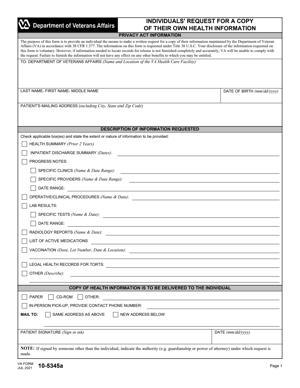
VHA Form 10-5345a – Individual’s Request for a Copy of Their Own Health Information
Fill out nowJurisdiction: Country: United States | Province or State: Federal
If you receive care through the Department of Veterans Affairs, you may want a copy of your medical records for your own use. VHA Form 10-5345a – Individual’s Request for a Copy of Their Own Health Information is the document used to make that request.
This form allows you to ask for copies of your health information that the Veterans Health Administration maintains. It is designed for veterans and other eligible individuals who receive care through VA facilities.
You might need your records for personal review, disability claims, insurance matters, or to share with another healthcare provider. Having the correct form helps ensure your request is processed without unnecessary delay.
This document does not give someone else access to your records. It is specifically for you to request your own information. If someone else needs access, a different authorization form is typically required.
Understanding what this form does and how to complete it makes the process smoother. When you know what information to provide and what to expect, you reduce the risk of your request being returned or delayed.
What is VHA Form 10-5345a – Individual’s Request for a Copy of Their Own Health Information?
Clear definition
VHA Form 10-5345a – Individual’s Request for a Copy of Their Own Health Information is a written request you submit to the Veterans Health Administration to obtain copies of your medical records.
It is a federal form used within the VA healthcare system. By signing it, you confirm your identity and specify what health information you want released to you.
The form allows you to describe the records you are requesting. You can request specific documents, records from certain dates, or your complete medical file. You also indicate how you want to receive the copies, such as by mail or another approved method.
This document creates a clear record of your request. It helps the VA verify that the request came from you and that you are asking for your own protected health information.
Who typically uses this form?
This form is most commonly used by veterans who receive medical care through VA hospitals, clinics, or other VA healthcare facilities.
It may also be used by individuals who are eligible for VA health services, such as certain dependents or beneficiaries, when they are requesting their own health information.
You use this form if you want personal access to your medical records. For example, you may want to review treatment notes, lab results, imaging reports, or discharge summaries.
Attorneys, family members, or representatives do not use this specific form to request records for themselves. When a third party is involved, a separate authorization document is generally required.
Why might you need this form?
You may need your medical records to better understand your health history. Reviewing your records can help you track diagnoses, medications, or treatment plans.
Some people request copies to support a benefits claim. For example, medical records are often used when applying for disability compensation or appealing a benefits decision.
You might also need your records if you are seeing a non-VA provider. Sharing accurate medical history can help avoid repeated tests and improve coordination of care.
In other cases, you may want your records for personal organization. Keeping copies at home allows you to reference them quickly when questions arise about past treatment.
Typical real-life scenarios
- You recently moved and plan to see a new primary care provider outside the VA system. Your new doctor asks for copies of your past treatment records. You complete the form to obtain them and provide the copies directly.
- You are preparing a claim related to a service-connected condition. You want to review your VA treatment notes before submitting supporting documents. You use the form to request records from specific years.
- You notice an error in your online health summary and want to confirm what is in your official file. You request a copy of your records to review the full documentation.
- You are organizing your personal records for long-term planning. You decide to request a complete copy of your medical file so you have it available for future reference.
When would you use VHA Form 10-5345a – Individual’s Request for a Copy of Their Own Health Information?
You use this form any time you want copies of your own medical records from a VA healthcare facility. It applies whether the records are recent or several years old.
This form is appropriate when you are making the request directly. You are asking the VA to provide information to you, not to another person or organization.
You might use it before filing a benefits application. Having your records allows you to confirm dates of treatment, diagnoses, and provider notes.
You may also use it after a hospital stay. If you were admitted to a VA medical center, you might want discharge instructions, operative reports, or imaging results.
In some cases, you use this form during an appeal process. Reviewing your file helps you understand what documentation is already included in your record.
It is also used when you prefer a paper or formal copy of records that may not be fully available through online patient portals. Some records, especially older ones, may require a written request.
Legal characteristics of VHA Form 10-5345a – Individual’s Request for a Copy of Their Own Health Information
This form is part of the VA’s process for complying with federal privacy laws that protect health information. It serves as your written request and confirms that you are seeking access to your own protected health information.
For the form to be effective, it must be complete and signed. The VA generally needs enough information to identify you and locate your records. This typically includes your full name, date of birth, and other identifying details.
Requests may be delayed or rejected if key sections are missing. Common issues include incomplete identifying information, an unclear description of the records requested, or a missing signature.
Because this is a federal VA form, it is used across all states in the same general way. However, specific processing times or submission methods may vary slightly by facility.
This document does not transfer your rights to someone else. It does not authorize another person to access your records. It also does not change your medical record or correct errors. If you want to amend your record, a separate process is usually required.
Submitting the form does not guarantee immediate delivery of records. The VA may have internal timelines and procedures for responding to requests. In some cases, copying fees or limits on certain sensitive information may apply under federal rules.
Is it legally binding?
VHA Form 10-5345a – Individual’s Request for a Copy of Their Own Health Information is not a contract. It does not create a legal obligation between you and another private party.
However, your signature has legal significance. By signing, you confirm that you are the individual whose records are being requested and that the information provided is accurate.
The form activates your right to access your own health information under federal privacy laws. Once properly submitted, it typically requires the VA to process your request in accordance with its policies and applicable regulations.
It does not create new rights beyond access to your records. It also does not waive other rights or settle any claims. Its purpose is limited to requesting copies of existing health information.
How to fill out VHA Form 10-5345a – Individual’s Request for a Copy of Their Own Health Information
Step 1 – Provide your identifying information
Enter your full legal name exactly as it appears in your VA records. Include your date of birth and any other required identifiers, such as the last four digits of your Social Security number or VA file number if requested.
This information allows the VA to locate the correct medical record. Small errors can delay processing, so review your entries carefully before moving on.
Step 2 – Specify the information you are requesting
Clearly describe the records you want. You may request your entire medical file or limit your request to certain types of records, such as laboratory results, imaging reports, mental health notes, or records from specific dates.
Be as specific as possible. For example, you can list a date range or identify a particular VA facility. Clear details reduce the risk of receiving incomplete records or needing to submit a second request.
Step 3 – Choose the format and delivery method
Indicate how you want to receive the records. The form may offer options such as paper copies or another approved format.
If mailing is available, confirm that your mailing address is correct. If you request electronic delivery where permitted, ensure that your contact details are accurate and legible.
Step 4 – Review any acknowledgments or statements
Read the statements included in the form. These often explain your rights, possible fees, and how the VA will process your request.
Make sure you understand what you are authorizing. Although you are only requesting your own records, your signature confirms that the information you provided is true and that you are requesting access to protected health information.
Step 5 – Sign and date the form
Sign your name in the designated signature line. Use the same name that appears in your identifying information section.
Enter the current date next to your signature. An unsigned or undated form is commonly returned without processing.
If the form allows for a printed name below the signature, include it clearly. This helps ensure your signature is properly matched to your record.
Step 6 – Submit the form to the appropriate VA facility
Send or deliver the completed form to the VA medical center or healthcare facility that maintains your records. Some facilities may accept the form by mail, in person, or through another approved method.
Before submitting, review the entire document once more. Confirm that all sections are complete, legible, and consistent. A careful final review can prevent delays and the need for follow-up corrections.
Legal terms you might encounter in VHA Form 10-5345a – Individual’s Request for a Copy of Their Own Health Information
- Protected Health Information (PHI): This refers to your medical records and any information that identifies you and relates to your health, treatment, or payment for care. On this form, you are asking for access to your own PHI. It can include doctors’ notes, lab results, imaging reports, discharge summaries, and billing records.
- Privacy Act: A federal law that governs how government agencies handle personal information. When you submit this form, you are exercising your right under the Privacy Act to access records the agency maintains about you. The agency must verify your identity before releasing information.
- HIPAA: The Health Insurance Portability and Accountability Act sets national standards for protecting health information. Even though you are requesting your own records, the agency must still follow HIPAA rules when processing and delivering them.
- Verification of Identity: This is the process used to confirm you are who you say you are. You may need to provide identifying details such as your Social Security number, date of birth, or a copy of a government-issued ID. If identity cannot be verified, your request may be delayed or denied.
- Designated Record Set: This term describes the group of records the agency maintains and uses to make decisions about your care. When you request copies, you are generally asking for records within this set. It may include both electronic and paper files.
- Authorization: Although this document is primarily a request for your own records, your signature acts as formal authorization for release. Without a proper signature and date, the agency cannot legally send you the information.
- Electronic Format: You may be able to request records in digital form, such as a secure electronic file. Choosing an electronic format can affect how quickly you receive your records and how you store them.
- Delivery Method: This refers to how you want the records sent to you. Options may include mail, in-person pickup, or secure electronic delivery. Selecting a clear delivery method reduces processing delays.
- Amendment: An amendment is a change or correction to your health record. This form is for obtaining copies, not for correcting information. If you find errors after reviewing your records, you may need a separate request to amend them.
FAQs
How long does it take to receive my records after submitting this form?
Processing time can vary depending on the volume of records and how they are stored. Once your identity is verified and the request is complete, the agency typically processes it within a set period under federal privacy rules. Delays often happen if identifying information is missing or if the requested date range is unclear. Make sure every identifying field is complete to avoid unnecessary back-and-forth.
Do I have to pay for copies of my health records?
You may be charged a reasonable fee for copying or mailing, especially for large paper files. Electronic copies are often less expensive. The agency cannot charge you for searching for or retrieving the records, but duplication and postage may apply. If a fee is required, you may be contacted before the records are released.
What if I only need records from a specific appointment or date range?
You should clearly list the exact dates or type of treatment in the section where you describe the information requested. Being specific helps staff locate the right records and avoids sending you unnecessary documents. If you leave the date range blank, you may receive a much larger file than expected, which can increase processing time and copying costs.
Can someone else pick up my records for me?
If you want another person to receive the records, you must clearly authorize that in writing. Simply naming them informally is not enough. The agency will need proof that you intended to grant access, and they may verify that person’s identity before release. Without proper written authorization, records will only be given to you.
What happens if my name on the form does not exactly match my medical record?
Any mismatch in your name, date of birth, or identification number can slow down verification. If you recently changed your name, include your former name so staff can locate older records. Make sure the information matches what appears in your medical file. Inconsistent details may cause the request to be returned for clarification.
Can I use VHA Form 10-5345a – Individual’s Request for a Copy of Their Own Health Information to correct errors in my file?
No. This document is used only to obtain copies of your records. If you find mistakes after reviewing them, you must submit a separate written request to amend your records. Keep the copies you receive so you can clearly point to the specific page or entry you believe is incorrect.
What if I do not know exactly which records I need?
You can describe the type of care or department involved, such as primary care, mental health, or a specific hospital stay. The more detail you provide, the easier it is to identify the right records. Avoid vague descriptions like “all my records” unless you truly want the entire file.
How do I know my request was accepted?
After submitting VHA Form 10-5345a – Individual’s Request for a Copy of Their Own Health Information, you may receive a confirmation letter, phone call, or electronic notice acknowledging receipt. If you do not hear back within a reasonable period, you can contact the facility’s records or privacy office to confirm they received your request and that no additional information is needed.
Checklist: Before, During, and After VHA Form 10-5345a – Individual’s Request for a Copy of Their Own Health Information
Before
- Gather your government-issued identification.
- Confirm the exact name used in your medical records.
- Write down your Social Security number or patient identification number.
- Decide which date range or type of treatment records you need.
- Choose your preferred format (paper or electronic).
- Verify the correct facility that holds your records.
- Check whether you recently changed your address.
During
- Print clearly and use your full legal name.
- Double-check your date of birth and identification numbers.
- Specify the exact records or date range requested.
- Select only one delivery method unless instructed otherwise.
- Read each acknowledgment carefully before signing.
- Sign and date the form in the correct place.
- Review the entire document for missing fields.
After
- Make a copy of the completed form for your records.
- Submit the form using the facility’s accepted method.
- Note the date you submitted the request.
- Watch for confirmation or follow-up communication.
- Respond promptly if additional verification is requested.
- Review the records carefully once received.
- Store the records securely to protect your privacy.
Common mistakes to avoid with VHA Form 10-5345a – Individual’s Request for a Copy of Their Own Health Information
- Mistake: Leaving key identification fields blank because you assume the agency already has your information, which leads to verification delays and possible rejection; do not forget to complete every required identifying detail.
- Mistake: Requesting “all records” without thinking it through because it seems easier, which can result in large copying fees and long wait times; do not forget to narrow the date range if you only need specific visits.
- Mistake: Forgetting to sign and date the form because you focus on the medical details, which makes the request invalid; do not forget that your signature is what authorizes release.
- Mistake: Providing an outdated mailing address because you recently moved, which can cause records to be sent to the wrong location; do not forget to confirm your current contact information.
- Mistake: Assuming someone else can pick up your records without written authorization, which results in refusal at the facility; do not forget to clearly name and authorize any third party in writing.
- Mistake: Submitting the form to the wrong facility because you received care at multiple locations, which delays processing; do not forget to verify where the specific records are maintained.
- Mistake: Ignoring follow-up requests for identity verification because you think the process is complete, which can halt release; do not forget to respond promptly to any additional documentation requests.
- Mistake: Failing to keep a copy of your completed request because you trust the process, which leaves you without proof of submission; do not forget to retain your own copy for reference.
What to do after filling out VHA Form 10-5345a – Individual’s Request for a Copy of Their Own Health Information
Once you complete the form, slow down and review it line by line. Look for missing signatures, incomplete dates, or unclear handwriting. Small errors can delay your request.
- Step 1: Make a clear copy or take a photo of the signed form for your personal records.
- Step 2: Confirm the correct submission location, such as the medical records or privacy office of the facility where you received care.
- Step 3: Submit the form using the accepted delivery method, whether by mail, in person, or another approved option.
- Step 4: Record the date you submitted the request and how you sent it.
- Step 5: Keep any mailing receipt or delivery confirmation if you used postal services.
- Step 6: Monitor your mail, phone, or email for acknowledgment or questions about your request.
- Step 7: Provide additional identification promptly if the agency asks for it.
- Step 8: Review the records carefully once you receive them to ensure they match what you requested.
- Step 9: Organize the records by date or provider so you can easily reference them later.
- Step 10: Store the records in a secure location to protect your personal health information.
If you discover missing pages or receive the wrong records, contact the facility promptly and reference the date of your original submission. Keep your copy of the form nearby when you call so you can confirm exactly what you requested. Staying organized and responsive helps you resolve issues faster and ensures you receive the complete information you need.
Disclaimer: This guide is provided for informational purposes only and is not intended as legal advice. You should consult a legal professional.