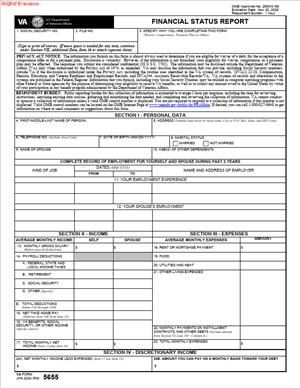
VA Form 5655 – Financial Status Report
Fill out nowJurisdiction: Country: United States | Province or State: Federal
The VA Form 5655 – Financial Status Report is a federal document used by the Department of Veterans Affairs to review your financial situation. You complete it when you owe money to the VA and want to explain your ability to repay that debt. It gives the agency a clear picture of your income, expenses, assets, and liabilities.
If you are about to fill out this form, you are likely dealing with a VA debt. That debt may result from overpayment of benefits, medical copayments, or another VA-related obligation. This document helps the VA assess whether you can repay the full amount at once or need a different arrangement.
The information you provide can influence payment terms. The VA may consider installment plans, compromises, or other collection alternatives based on your financial condition. Accuracy and completeness matter because the decision often relies heavily on what you report.
This form is not a general benefits application. It is specifically focused on your current financial status. When you submit it, you are formally presenting your financial profile for review.
What is VA Form 5655 – Financial Status Report?
Clear definition
The VA Form 5655 – Financial Status Report is a standardized federal financial disclosure form. It requires you to list detailed information about your income, living expenses, assets, debts, and dependents.
It functions as a snapshot of your finances at a specific point in time. The VA uses that snapshot to evaluate your repayment capacity. The document is structured to capture both monthly cash flow and overall financial resources.
You are asked to report wages, benefits, and other sources of income. You also list regular expenses such as housing, utilities, food, transportation, insurance, and medical costs. In addition, the form requires disclosure of bank accounts, vehicles, real estate, and other property.
Because it is a federal form, its structure and wording are standardized. You cannot modify its format, but you can attach additional pages if you need more space to explain your situation.
Who typically uses this form?
This form is typically used by veterans who have been notified of a debt owed to the Department of Veterans Affairs. It is also used by surviving spouses or other beneficiaries who receive VA benefits and are responsible for repayment.
In some cases, a fiduciary or authorized representative may complete the form on behalf of a veteran who cannot manage their own financial affairs. The person signing the document is responsible for the accuracy of the information provided.
It is commonly requested by the VA’s debt management functions when a person seeks relief from repayment terms. If you receive a letter asking for financial information related to a debt, this is often the form referenced.
The form may also be used during review of a request for a waiver or compromise of debt. In those situations, your financial condition is central to the evaluation process.
Why might you need this form?
You may need this form if the VA determines that you were overpaid benefits. Overpayments can occur for several reasons, such as changes in income, dependency status, or eligibility that were not updated in time.
You might also need it if you owe medical copayments related to VA healthcare services. If you cannot pay the full amount immediately, the VA may request a financial status report to assess payment options.
Another common reason is when you request a reduced monthly payment amount. The VA needs to understand your income and expenses before adjusting a repayment schedule.
In some cases, you may submit the form voluntarily to support a request for debt relief. The document provides a structured way to explain financial hardship.
Typical real-life scenarios
- You receive a notice stating that you were overpaid disability compensation. The notice explains that you must repay the amount. You believe that paying the full sum at once would create financial strain, so you complete the form to show your monthly budget and limited surplus.
- You are a surviving spouse receiving dependency and indemnity compensation. Later, you are informed that an administrative adjustment resulted in an overpayment. You fill out the form to demonstrate that your income barely covers essential living expenses.
- You owe medical copayments from multiple appointments over the past year. The total balance has grown beyond what you can comfortably manage. You use the form to request a structured repayment plan based on your available income.
- You previously agreed to a monthly repayment amount, but your financial situation has changed. Perhaps your hours were reduced at work, or a household member lost employment. You submit an updated financial report to reflect the new circumstances.
- You are assisting a family member who is a veteran and cannot manage their own paperwork. As their authorized representative, you gather financial documents and complete the form to help them seek more manageable repayment terms.
When would you use VA Form 5655 – Financial Status Report?
You use this form when the VA requests detailed financial information related to a debt. This request often follows a notice of indebtedness. The VA needs to evaluate your financial capacity before deciding on repayment terms.
You may also use it when applying for a waiver of collection. In that context, your current financial condition may influence whether repayment would create undue hardship.
If you are negotiating a compromise settlement, this document may support your proposal. The VA reviews your income, assets, and obligations to determine whether a reduced lump-sum payment is reasonable.
The form is also relevant if you are seeking to modify an existing repayment plan. If your financial situation changes, you may provide updated information through a new submission.
Although the form is federal, it applies uniformly across states because it is administered by a federal agency. State-specific debt collection laws generally do not control how the VA evaluates this document, though broader federal collection standards apply.
Legal characteristics of VA Form 5655 – Financial Status Report
This form is an official federal financial disclosure. Its effectiveness depends on complete and truthful reporting. When you sign it, you are certifying that the information is accurate to the best of your knowledge.
The form becomes part of your VA debt file. Decisions about payment plans, waivers, or compromises may rely on the information you provide. Incomplete sections or inconsistent figures can delay review or result in follow-up requests.
Common problems include leaving blanks where amounts are required, underreporting income, or failing to list assets such as vehicles or savings accounts. Arithmetic errors in monthly totals can also create confusion and prompt additional review.
The document does not eliminate a debt by itself. Submitting it does not automatically approve a waiver or reduced payment. It simply provides the financial context needed for evaluation.
Although federal in nature, administrative practices may vary slightly in processing time or follow-up procedures. However, the core requirements of the form remain consistent nationwide.
Is it legally binding?
The VA Form 5655 – Financial Status Report is not a contract in the traditional sense. It does not create new legal obligations beyond those already tied to the debt. However, it is a formal statement made to a federal agency.
When you sign the form, you certify that the information is true and correct. Providing false or misleading information can have serious consequences. The certification gives the document legal weight as an official declaration.
The financial information you disclose may influence legally enforceable repayment arrangements. For example, if a payment plan is approved based on your reported income, that plan may carry its own binding terms.
In short, the form itself is a disclosure tool. Its legal significance comes from the certification of accuracy and its role in shaping decisions about an existing federal debt.
How to fill out VA Form 5655 – Financial Status Report
Step 1 – Review the entire form before writing
Start by reading the full document from beginning to end. This gives you a clear view of the information required. You will see sections for personal identification, employment, income, expenses, assets, and debts. Reviewing first helps you gather the right documents before entering any numbers.
Step 2 – Enter personal and identifying information
Provide your full name, contact details, and any requested identification numbers. Make sure this information matches your VA records. If you are completing the form as a representative, include your details where required and clarify your role.
Step 3 – Provide employment information
List your current employment status. If you are employed, include your employer’s name and your position. If you are unemployed, retired, or disabled, indicate that clearly. This section establishes the source and stability of your income.
Step 4 – Report all monthly income
Enter your gross monthly income from all sources. This may include wages, VA benefits, retirement payments, Social Security, or other recurring income. Use consistent monthly figures. If you are paid weekly or biweekly, convert those amounts into monthly totals for accuracy.
If you share household income with a spouse or partner, include their income where the form requests it. Be clear about which amounts belong to you and which belong to other household members.
Step 5 – List monthly living expenses
Carefully itemize your regular monthly expenses. Include housing costs such as rent or mortgage, utilities, food, transportation, insurance, medical expenses, and other recurring bills. Use realistic averages if amounts vary slightly each month.
Do not guess without a basis. Review recent statements or bank records to estimate accurate monthly figures. The goal is to show your true cost of living, not an idealized or reduced version.
Step 6 – Disclose assets
Identify assets such as checking and savings accounts, cash on hand, vehicles, real estate, and other valuable property. Provide approximate current values where requested. This section reflects your overall financial resources beyond monthly income.
If an asset is jointly owned, report it as directed on the form. Clarity about ownership and value reduces the chance of follow-up questions.
Step 7 – List installment contracts and other debts
Detail any outstanding debts, including credit cards, car loans, mortgages, or personal loans. Include the creditor name, total amount owed, and monthly payment. This helps show your total financial obligations.
Ensure that the monthly payments you list here align with the expense figures reported earlier. Consistency across sections strengthens the reliability of your submission.
Step 8 – Calculate totals and review for accuracy
Add all income sources and confirm the total monthly income. Then total your monthly expenses and debt payments. Compare the figures to determine your net monthly balance.
Check all calculations carefully. Even small math errors can affect how your financial condition is evaluated. Make corrections neatly if needed before finalizing.
Step 9 – Sign and date the form
Read the certification statement near the signature line. By signing, you confirm that the information is true and complete to the best of your knowledge. Sign and date the form where indicated.
If someone completed the document on your behalf, ensure the appropriate signature lines are completed. Keep a copy of the finished form for your records before submitting it as directed in your VA correspondence.
Legal terms you might encounter in VA Form 5655 – Financial Status Report
- Gross Income: This is your total income before taxes and other deductions. On this form, you report your full monthly earnings from employment, benefits, retirement, or other sources. Do not subtract withholding, insurance, or retirement contributions when listing gross income unless the form specifically asks for net income in a separate field.
- Net Income: This is the amount you take home after taxes and deductions. Some sections may require you to show how much is actually deposited into your account each month. Be clear about the difference between gross and net so your budget calculations are accurate.
- Installment Contract: This refers to a loan or agreement where you make regular payments over time, such as for a car, furniture, or appliances. The form asks you to list each contract separately. You must include the creditor’s name, balance owed, and monthly payment amount.
- Secured Debt: A secured debt is backed by collateral, like a house or car. If you fail to pay, the lender may take the property. When reporting debts, identify which ones are secured because they often affect how repayment plans are evaluated.
- Unsecured Debt: This is debt not tied to specific property, such as credit cards or medical bills. These debts still matter, but they do not involve collateral. You should report all unsecured balances and monthly payments clearly.
- Assets: Assets include cash, bank account balances, vehicles, real estate, and other items of value. The form requires you to disclose what you own and its approximate value. Even if you believe an asset has little value, you should still list it.
- Liabilities: Liabilities are the debts or financial obligations you owe. This includes mortgages, personal loans, child support, and other recurring obligations. Your total liabilities are compared against your assets and income.
- Disposable Income: This is the amount of money left after you subtract monthly expenses from monthly income. It helps determine your ability to repay a debt. If your disposable income is small or negative, that may support a request for relief or a repayment arrangement.
- Financial Hardship: Financial hardship refers to difficulty meeting basic living expenses due to limited income, high expenses, or unexpected events. The information you provide is used to assess whether you qualify for payment relief or a modified repayment schedule.
- Delinquency: Delinquency means a debt is past due. If your account is delinquent, this document helps explain why and shows your current financial situation. Accurate reporting can influence how the matter is handled.
FAQs
What documents should I gather before completing this form?
You should collect recent pay stubs, benefit award letters, bank statements, mortgage or rent statements, loan balances, and monthly bills. The amounts you enter must match real numbers from current documents. If your income changes from month to month, calculate a reasonable monthly average using recent records.
Do I need to include my spouse’s income and expenses?
If you are married and share household finances, you generally include your spouse’s income and expenses because this document evaluates the total household’s ability to pay. If you are separated or manage finances independently, review the instructions carefully and explain the situation clearly in the appropriate section. Make sure the household size and income entries are consistent throughout.
What if my income changes frequently?
Use a monthly average based on recent months. Add the income you received over the past three to six months and divide by the number of months. Enter that average as your monthly income and keep your calculations with your records in case you are asked to explain the numbers.
How detailed do my monthly expenses need to be?
List regular, necessary living expenses such as housing, utilities, food, transportation, insurance, medical costs, and minimum debt payments. Use actual amounts from recent bills whenever possible. Do not guess or round numbers excessively, and do not combine unrelated expenses into one large estimate.
What happens after I submit VA Form 5655 – Financial Status Report?
The agency reviews the financial information to determine your ability to repay a debt or qualify for relief. They may compare your reported income to your reported expenses and assets. You may be contacted if clarification or additional documents are needed.
Do I need to attach proof of income and expenses?
Follow the submission instructions carefully. You may be asked to attach pay stubs, bank statements, or billing statements to support the amounts you reported. If attachments are requested, make sure copies are clear and match the figures listed on this form.
Is this document legally binding once I sign it?
When you sign, you are certifying that the information is true and correct to the best of your knowledge. False or incomplete information can lead to denial of relief or further collection action. Review every number and statement before signing.
What if I realize I made a mistake after sending VA Form 5655 – Financial Status Report?
If you discover an error, correct it as soon as possible by submitting updated information or contacting the appropriate office. Provide a clear explanation of what changed and why. Keep copies of both the original submission and the corrected information for your records.
Checklist: Before, During, and After VA Form 5655 – Financial Status Report
Before
- Gather recent pay stubs, benefit letters, and proof of other income.
- Collect monthly bills for housing, utilities, insurance, and debts.
- Check current balances for loans, credit cards, and other obligations.
- Review bank account balances and cash on hand.
- Confirm the approximate value of vehicles or real estate you own.
- Set aside uninterrupted time to complete the form carefully.
- Read all instructions provided with the form.
- Make a list of all creditors to avoid forgetting any debts.
During
- Write clearly and use consistent monthly amounts.
- Double-check that income figures match your supporting documents.
- List all household members accurately.
- Separate secured and unsecured debts correctly.
- Add totals carefully for income, expenses, assets, and liabilities.
- Do not leave required fields blank; write zero if appropriate.
- Use additional pages if you need more space and label them clearly.
- Review calculations before moving to the next section.
After
- Review the entire form from start to finish.
- Confirm that totals are accurate and consistent.
- Sign and date the form where required.
- Make a complete copy for your records.
- Attach any required supporting documents.
- Submit the form using the instructed method.
- Note the date of submission and method used.
- Monitor for confirmation or follow-up communication.
- Store copies in a safe and organized file.
Common mistakes to avoid with VA Form 5655 – Financial Status Report
- Mistake: Underreporting income because you forget part-time work or benefits, which happens when you rely on memory instead of documents; this can lead to denial of relief and questions about accuracy, so do not forget to review all income sources carefully.
- Mistake: Overstating expenses by estimating instead of using real bills, which often occurs when you rush; this may weaken your credibility during review, so do not forget to verify each amount with a statement.
- Mistake: Leaving out assets like secondary vehicles or savings accounts because you think they are minor; this can be viewed as incomplete disclosure and delay processing, so do not forget to list everything of value.
- Mistake: Failing to total income and expenses correctly due to math errors; this creates inconsistencies that slow review, so do not forget to recheck all calculations.
- Mistake: Not signing and dating the form, which happens when you focus only on the financial sections; unsigned forms may be rejected, so do not forget the certification section.
- Mistake: Sending the form without required attachments because you overlooked the instructions; this can result in requests for more information and longer processing times, so do not forget to include supporting documents.
- Mistake: Providing outdated information from old statements, which happens when you reuse prior paperwork; this may lead to incorrect evaluation of your ability to pay, so do not forget to use current figures.
- Mistake: Ignoring follow-up communication after submission, which can occur if you assume silence means approval; this may cause missed deadlines, so do not forget to monitor your mail or account for updates.
What to do after filling out VA Form 5655 – Financial Status Report
Once you complete the form, shift your focus to accuracy, documentation, and tracking. This stage is just as important as filling it out.
- Step 1: Review every section line by line to confirm names, account numbers, and financial figures are correct.
- Step 2: Check that all totals add up and that monthly income minus monthly expenses equals the correct remaining amount.
- Step 3: Confirm you have signed and dated the certification section.
- Step 4: Make a complete copy of the signed form for your records.
- Step 5: Gather and copy all supporting documents that are required or helpful, such as pay stubs or billing statements.
- Step 6: Submit the form using the approved submission method and keep proof of submission if available.
- Step 7: Record the date you sent it and any confirmation number or tracking details.
- Step 8: Monitor your mail, phone messages, or online account for acknowledgment or requests for additional information.
- Step 9: Respond promptly if you are asked to clarify numbers or provide more documentation.
- Step 10: Update your personal financial records to reflect any repayment agreement or decision that results from the review.
Keep everything organized in one folder. If your financial situation changes significantly after submission, be prepared to provide updated information. Staying proactive helps prevent misunderstandings and delays.
Disclaimer: This guide is provided for informational purposes only and is not intended as legal advice. You should consult a legal professional.