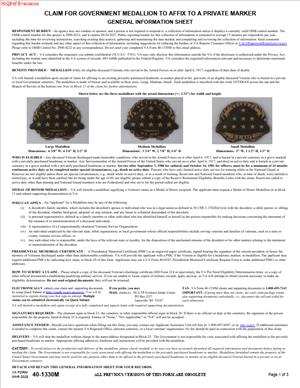
VA Form 40-1330M – Claim for Government Medallion for Placement in a Private Cemetery
Fill out nowJurisdiction: Country: United States | Province or State: Federal
VA Form 40-1330M – Claim for Government Medallion for Placement in a Private Cemetery is used to request a government-issued medallion to place on an existing headstone or marker for an eligible deceased Veteran. This form allows families to honor military service when burial takes place in a private cemetery rather than a national or state veterans cemetery.
You may be completing this form during a time of loss. The process can feel overwhelming. Knowing exactly what this document does can make it easier to move forward.
This form does not arrange a burial or provide funeral benefits. It focuses only on a medallion that can be attached to a privately purchased headstone or marker.
If you are filling it out, you are likely a family member, personal representative, or cemetery official acting on behalf of the Veteran’s family. Understanding what information is required will help you avoid delays.
What is VA Form 40-1330M – Claim for Government Medallion for Placement in a Private Cemetery?
Clear definition
VA Form 40-1330M – Claim for Government Medallion for Placement in a Private Cemetery is a federal request form. It asks the Department of Veterans Affairs to provide a bronze medallion that signifies the deceased person’s status as a Veteran.
The medallion is designed to be affixed to an existing private headstone or marker. It is not a full government headstone. Instead, it serves as an official emblem of military service.
The form collects identifying details about the Veteran, information about military service, and delivery instructions for the medallion. It also identifies the person making the request.
Who typically uses this form?
Most often, a surviving spouse, child, or other close relative completes the form. A personal representative of the estate may also submit it.
Funeral directors sometimes help families prepare and submit the document. Cemetery officials may also assist, especially when coordinating the installation of the medallion on a private marker.
The person signing the form does not need to be a lawyer. It is designed for individuals to complete on their own, as long as they have accurate service and identification details.
Why might you need this form?
You may need this form if the Veteran is buried in a private cemetery and already has a privately purchased headstone or marker.
In these situations, the government does not automatically provide a marker. The medallion offers a way to recognize the Veteran’s service without replacing the existing headstone.
Families often choose this option when they want to keep a specific style of marker but still display official recognition of military service.
The form is also used when the burial has already taken place, and the family later decides to request formal acknowledgment of service.
Typical real-life scenarios
- A Veteran passes away and is buried in a family plot at a private cemetery. The family selects a custom granite headstone. Later, they decide they want the Veteran’s military service formally recognized. They submit the form to request a medallion.
- A spouse arranges a burial quickly and focuses on immediate needs. Months later, while organizing records, the spouse learns about the medallion option and completes the document to add it to the existing marker.
- Adult children of a deceased Veteran discover that no military emblem appears on the grave. They gather discharge papers and file the claim so the medallion can be installed.
- A cemetery requires official documentation before allowing a medallion to be affixed to a marker. The family submits the form and coordinates shipment directly to the cemetery for proper placement.
When would you use VA Form 40-1330M – Claim for Government Medallion for Placement in a Private Cemetery?
You would use this form after the Veteran has passed away and burial arrangements have been made in a private cemetery. It applies when the grave is not located in a national, state, or military cemetery that already provides government-issued markers.
The timing can vary. Some families complete the submission shortly after the burial. Others apply years later. There is generally no strict deadline tied to the date of death, but processing requires proof of eligible military service.
You might also use this document when a private headstone is already in place, and you want to add official recognition without removing or replacing it.
Funeral homes may present the option during planning. However, the request can also be made independently by a family member at a later date.
This form is not used to request burial in a national cemetery. It is also not used to request a flat marker or upright headstone from the government. It specifically addresses the medallion for placement on a privately purchased marker.
Legal characteristics of VA Form 40-1330M – Claim for Government Medallion for Placement in a Private Cemetery
This is an official federal government form. Its effectiveness depends on accurate and complete information. The Veteran must meet eligibility requirements based on military service and discharge status.
The form typically requires details such as the Veteran’s full name, branch of service, dates of service, and service number or Social Security number. Proof of service, such as discharge documents, is commonly required.
A claim may be delayed or denied if key information is missing. Common problems include incomplete service details, lack of supporting documents, or unclear delivery instructions. Errors in spelling or service dates can also slow processing.
Because this is a federal program, the basic eligibility standards apply nationwide. However, private cemeteries may have their own rules about installation. Some require prior approval before attaching any medallion to a marker.
This document does not grant monetary benefits. It does not change burial arrangements or create survivor benefits. Its sole purpose is to request the medallion itself.
The person signing the form certifies that the information provided is true to the best of their knowledge. False statements can have serious consequences under federal law.
Is it legally binding?
The form functions as a formal request to a federal agency. When you sign it, you are certifying the accuracy of the information provided. That certification carries legal weight.
It is not a contract between you and the government in the traditional sense. Instead, it is an application for a benefit. Approval depends on meeting eligibility requirements.
Once the medallion is issued, the government has fulfilled the request described in the form. The document does not create ongoing obligations beyond the truthfulness of the information submitted.
How to fill out VA Form 40-1330M – Claim for Government Medallion for Placement in a Private Cemetery
Step 1 – Provide the Veteran’s personal information
Enter the full legal name of the deceased Veteran exactly as it appears on official records. Include the Social Security number or service number if requested. Provide the date of birth and date of death. Accuracy here helps match the claim to military records.
Step 2 – Enter military service details
List the branch or branches of service, along with the dates of active duty. If the form asks for rank or discharge information, complete those sections carefully. Attach a copy of the discharge document or other proof of honorable service if required.
Step 3 – Confirm burial information
Indicate the name and address of the private cemetery where the Veteran is buried. Make sure the cemetery type matches the purpose of this form. This section confirms that the burial took place in a private cemetery rather than a national or state veterans cemetery.
Step 4 – Select the appropriate medallion size if applicable
Some versions of the form allow you to indicate the size of the medallion based on the dimensions of the existing marker. Review the headstone measurements before choosing. The selection affects how the medallion will fit on the marker.
Step 5 – Provide delivery instructions
Enter the name and mailing address where the medallion should be sent. This may be the cemetery, funeral home, monument company, or family member. Double-check the address to prevent shipping delays.
Step 6 – Identify the applicant
Fill in your name, address, and contact information as the person making the request. Indicate your relationship to the Veteran or your role, such as family member or authorized representative. This clarifies who is responsible for the submission.
Step 7 – Sign and date the form
Read the certification statement carefully. Sign and date the document in the space provided. Your signature confirms that the information is accurate and complete to the best of your knowledge. Once signed, the form is ready for submission according to the listed instructions.
Legal terms you might encounter in VA Form 40-1330M – Claim for Government Medallion for Placement in a Private Cemetery
- Eligible Veteran: This refers to a deceased former service member who meets the federal requirements for burial benefits. On this form, you confirm that the Veteran was discharged under conditions other than dishonorable. Eligibility is the foundation of the request. If the Veteran does not qualify, the medallion cannot be issued.
- Private Cemetery: A burial ground not operated by a federal veterans cemetery system. This form is specifically for graves located in a private cemetery. You must provide the cemetery’s name and location so the medallion can be associated with the correct gravesite.
- Government Medallion: A bronze device that signifies the Veteran’s service. It is designed to be affixed to an existing, privately purchased headstone or marker. The medallion does not replace the headstone. It supplements it.
- Next of Kin: The closest living relative of the deceased Veteran, often a spouse, child, or parent. The form asks you to identify your relationship to the Veteran. This helps confirm that you have authority or a legitimate interest in making the request.
- Applicant: The person completing and signing the form. The applicant may be a family member, personal representative, or another authorized individual. Your name and contact details are required so officials can communicate with you if questions arise.
- Proof of Military Service: Official documentation that verifies the Veteran’s service and character of discharge. This is often a discharge document. You must provide accurate service information to avoid delays.
- Character of Discharge: The classification given at separation from military service. The form requires confirmation that the discharge was not dishonorable. This detail directly affects eligibility for the medallion.
- Delivery Information: The shipping details for the medallion. You must clearly indicate where the medallion should be sent. It can go to you, another family member, or the cemetery, depending on your choice.
- Certification and Signature: Your formal statement that the information provided is true and complete. By signing, you confirm accuracy. An unsigned form will not be processed.
- Supporting Documentation: Any additional documents required to verify the Veteran’s identity and service. This may include discharge papers or death information. Missing documents are a common cause of processing delays.
FAQs
Do I need to submit proof of military service with VA Form 40-1330M – Claim for Government Medallion for Placement in a Private Cemetery?
Yes. You must provide enough information to confirm the Veteran’s service and character of discharge. If you have official discharge documents, include clear copies. If you do not provide proof, the reviewing office may not be able to verify eligibility, which can delay or stop processing.
Who is allowed to complete and sign this form?
A family member, next of kin, personal representative, or another authorized person may complete it. You must state your relationship to the Veteran. Make sure the name you sign matches the name you print in the applicant section so there is no confusion about who submitted the request.
Can I request a medallion if the Veteran already has a private headstone?
Yes. This document is specifically for adding a government medallion to an existing privately purchased headstone or marker. The medallion is not a replacement. You should confirm that the headstone is suitable for attachment before submitting the request.
What information about the cemetery do I need to provide?
You must enter the cemetery’s full name and location, including city and state. This ensures the medallion is associated with the correct gravesite. Double-check spelling and details so the record matches the burial location exactly.
How do I choose the correct medallion size?
The form provides size options. You should measure or confirm the available space on the headstone before selecting a size. If you guess and select the wrong size, installation may be difficult or require adjustments later.
What happens after I submit this document?
The reviewing office checks the Veteran’s eligibility and verifies the information provided. If something is missing, they may contact you using the details listed in your application. Once approved, the medallion is produced and shipped to the address you provided.
Can the medallion be shipped directly to the cemetery?
Yes, if you list the cemetery’s mailing address in the delivery section. Confirm with the cemetery first that they are willing to receive and install it. Clear delivery instructions reduce the risk of lost or delayed shipments.
Will this form change the official burial record?
No. This form requests a medallion only. It does not alter burial records, discharge status, or other official military documents. It simply authorizes the issuance of a medallion to honor the Veteran’s service at the gravesite.
Checklist: Before, During, and After VA Form 40-1330M – Claim for Government Medallion for Placement in a Private Cemetery
Before
- Confirm the Veteran was discharged under conditions other than dishonorable.
- Locate official proof of military service.
- Verify the full legal name of the Veteran as shown on service records.
- Confirm the exact cemetery name and location.
- Measure the headstone space to determine medallion size.
- Speak with the cemetery about installation requirements.
- Decide where the medallion should be shipped.
- Gather your own contact information for the applicant section.
During
- Print clearly or type to avoid misreading of names and numbers.
- Enter the Veteran’s name exactly as it appears on service documents.
- Double-check service dates and the branch of service.
- Select only one medallion size option.
- Provide complete mailing details, including ZIP code.
- State your relationship to the Veteran clearly.
- Review all fields for blanks before signing.
- Sign and date the certification section.
After
- Make a full copy of the completed form and attachments.
- Submit the form according to the official instructions.
- Note the date you submitted the request.
- Monitor your mail or email for follow-up communication.
- Respond promptly if additional information is requested.
- Inform the cemetery once the medallion is approved.
- Store copies with other important family records.
- Confirm safe delivery once the medallion arrives.
Common mistakes to avoid with VA Form 40-1330M – Claim for Government Medallion for Placement in a Private Cemetery
- Mistake: Entering a nickname instead of the Veteran’s legal name, which happens when families use informal names, leading to verification delays because records must match exactly, and you must not forget to copy the name precisely from official documents.
- Mistake: Leaving the discharge status unclear, often because the applicant assumes eligibility, resulting in processing holds, and you must not forget to confirm and state the character of discharge accurately.
- Mistake: Choosing a medallion size without measuring the headstone, which happens when applicants guess, causing installation problems later, and you must not forget to verify dimensions before selecting a size.
- Mistake: Providing an incomplete mailing address, often due to rushing, which can result in lost shipments, and you must not forget to include full street details and ZIP code.
- Mistake: Failing to attach proof of service, which occurs when documents are misplaced, causing review delays, and you must not forget to include clear copies of supporting paperwork.
- Mistake: Forgetting to sign and date the form, which happens easily when focusing on other sections, resulting in automatic rejection, and you must not forget the certification signature.
- Mistake: Not confirming cemetery’s acceptance of the medallion shipment, which happens when assumptions are made, leading to delivery confusion, and you must not forget to coordinate with the cemetery staff in advance.
- Mistake: Submitting inconsistent service dates, often from memory instead of records, causing verification issues, and you must not forget to rely on official documents for accuracy.
What to do after filling out VA Form 40-1330M – Claim for Government Medallion for Placement in a Private Cemetery
Once you complete the form, slow down before sending it. A careful review now prevents delays later.
- Step 1: Review every entry against official documents, especially the Veteran’s name, service dates, and discharge status.
- Step 2: Confirm you selected the correct medallion size based on actual measurements.
- Step 3: Make clear copies of the completed form and all supporting documents for your records.
- Step 4: Attach proof of military service securely so pages do not separate during processing.
- Step 5: Submit the form using the official submission method listed in the instructions.
- Step 6: Record the submission date and keep any mailing receipt or confirmation notice.
- Step 7: Monitor your mail, phone, or email for communication about missing information or approval status.
- Step 8: Respond promptly if you are contacted for clarification or additional documents.
- Step 9: Notify the cemetery that a medallion has been requested and confirm their installation process.
- Step 10: Once the medallion arrives, inspect it for accuracy before installation.
- Step 11: Coordinate with the cemetery or installer to ensure proper attachment to the headstone.
- Step 12: Store all related paperwork with other important family records for future reference.
Taking these steps helps ensure the medallion is issued and installed without unnecessary complications. Careful preparation, accurate information, and organized recordkeeping make the process smoother and more respectful of the Veteran’s service.
Disclaimer: This guide is provided for informational purposes only and is not intended as legal advice. You should consult a legal professional.