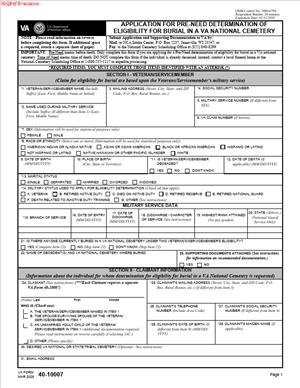
VA Form 40-10007 – Application for Pre-Need Determination of Eligibility for Burial in a VA National Cemetery
Fill out nowJurisdiction: Country: United States | Province or State: Federal
VA Form 40-10007 – Application for Pre-Need Determination of Eligibility for Burial in a VA National Cemetery is a federal document used to confirm eligibility for burial in a VA national cemetery before death occurs. It allows you or your family to receive a decision in advance, rather than during a time of grief.
This form is part of the Department of Veterans Affairs burial benefits process. It focuses only on determining eligibility for burial in a national cemetery. It does not arrange funeral services or select a specific gravesite.
If you are a veteran or a qualifying family member, this form helps clarify whether you meet the requirements. Having an advanced determination can ease uncertainty and prevent delays later.
For families, this document can provide peace of mind. Instead of gathering records and proving service after a death, eligibility is already on file.
Understanding what this form does and what it does not do will help you complete it accurately and avoid common mistakes.
What is VA Form 40-10007 – Application for Pre-Need Determination of Eligibility for Burial in a VA National Cemetery?
Clear definition
VA Form 40-10007 – Application for Pre-Need Determination of Eligibility for Burial in a VA National Cemetery is an official request for the Department of Veterans Affairs to review a person’s military service and other qualifying details in advance. The goal is to confirm whether that person qualifies for burial in a VA national cemetery.
“Pre-need” means the application is submitted while the veteran or eligible family member is still living. The VA reviews the service record, discharge status, and other eligibility criteria. If approved, the VA issues a written decision confirming eligibility.
This form is not a reservation system. It does not assign a cemetery location or specific plot. It simply confirms that the individual meets federal requirements for burial in a VA national cemetery.
Who typically uses this form?
Veterans often complete this form for themselves. Many choose to do so as part of their overall end-of-life planning.
Spouses of veterans may also be included in the application. In some cases, surviving spouses or dependent children may qualify and be listed.
Family members sometimes complete the form on behalf of a living veteran, especially if the veteran is elderly or has health challenges. A legal representative, such as someone holding power of attorney, may also assist with the submission.
Funeral directors do not usually complete this form as part of a pre-need filing. It is generally handled directly by the veteran or family before death.
Why might you need this form?
You may want certainty about eligibility before making funeral or burial plans. A confirmed decision can help you and your family plan with accurate information.
If military service records are incomplete or hard to locate, applying early allows time to resolve those issues. Waiting until after death can create stress and delays.
Families often find it easier to make arrangements when eligibility has already been determined. It reduces paperwork during an emotional time.
This form can also prevent misunderstandings. Not every veteran qualifies for burial in a VA national cemetery. Discharge status and length of service may affect eligibility.
Typical real-life scenarios
- A retired veteran in their seventies is updating their will and advance directives. As part of that process, they submit this form to confirm burial eligibility and keep the approval letter with their estate documents.
- A veteran with a serious illness wants to reduce the administrative burden on their spouse. By filing in advance, they ensure their service record has already been reviewed.
- An adult child is helping aging parents organize important documents. The parent is a veteran, and the family decides to request a pre-need determination to avoid confusion later.
- A spouse of a veteran wants to understand whether they would be eligible for burial alongside the veteran. The family includes both individuals in the application to clarify their status.
When would you use VA Form 40-10007 – Application for Pre-Need Determination of Eligibility for Burial in a VA National Cemetery?
You would use VA Form 40-10007 – Application for Pre-Need Determination of Eligibility for Burial in a VA National Cemetery when you want a formal decision about burial eligibility before death occurs. This is typically part of long-term planning rather than an urgent filing.
Many people complete this form during retirement planning. It often happens at the same time as updating a will, setting up advance healthcare directives, or organizing financial accounts.
You might also use it after locating discharge papers and military service records. Once you have the necessary documentation, it can make sense to request a determination while everything is accessible.
If there are questions about discharge status or length of service, applying in advance gives you time to address potential issues. For example, if records are unclear, you can gather additional documents without the pressure of immediate funeral arrangements.
Family members may use this form when helping a veteran prepare for future needs. In some cases, a legal representative completes and submits the application on behalf of the veteran with proper authority.
This form is not used after death. When a veteran passes away, a different process applies for arranging burial. The pre-need form is strictly for advance eligibility decisions.
Legal characteristics of VA Form 40-10007 – Application for Pre-Need Determination of Eligibility for Burial in a VA National Cemetery
This document is governed by federal law and regulations administered by the Department of Veterans Affairs. Eligibility is based primarily on military service, discharge status, and qualifying family relationships.
For the form to be effective, it must be completed accurately and include the required supporting documents. This often includes a copy of the veteran’s discharge papers or other official service records. Incomplete submissions may delay review or result in a request for more information.
Common problems include missing signatures, incorrect service dates, or unclear documentation of discharge status. Errors in personal identifying information can also slow processing. Providing consistent information across all documents helps avoid confusion.
The VA reviews each application against federal criteria. Approval depends on meeting those criteria, not on personal preference or financial need.
This form does not create a contract for burial services. It does not guarantee burial at a specific cemetery or on a specific date. Availability of space and other conditions may still apply at the time of need.
Although burial in a VA national cemetery is a federal benefit, certain details, such as cemetery location and scheduling, may vary based on availability and administrative procedures. However, the underlying eligibility rules are federal and generally consistent across states.
Is it legally binding?
The approval decision issued after submitting this form is an official determination by the Department of Veterans Affairs. It confirms that, based on the information reviewed, the individual is eligible for burial in a VA national cemetery.
The form itself is not a contract between you and the government. It is an application for a benefit determination. Once approved, the decision typically remains valid as long as the eligibility criteria continue to be met.
If information provided in the application is later found to be incorrect or incomplete, the determination may be affected. Accuracy at the time of submission is important because the decision relies on the facts presented.
The document does not obligate you to choose burial in a VA national cemetery. It simply confirms that you qualify under federal rules.
How to fill out VA Form 40-10007 – Application for Pre-Need Determination of Eligibility for Burial in a VA National Cemetery
Step 1 – Review the instructions and gather service records
Start by reading the form carefully from beginning to end. Identify what information is required and what documents must be attached. Most applications require proof of military service, such as discharge papers.
Gather these records before you begin filling in the form. Having them in front of you reduces errors and helps you enter dates and service details accurately.
Step 2 – Provide the veteran’s personal information
Enter the veteran’s full legal name, Social Security number or service number, date of birth, and contact details exactly as they appear on official records. Consistency matters.
Double-check spelling and numbers. Small mistakes in identifying information can delay processing or require follow-up clarification.
Step 3 – Enter military service details
List all relevant periods of active duty service. Include branch of service, service dates, and discharge information as requested.
Use the official discharge document to confirm these details. Avoid estimating dates or relying on memory if records are available.
Step 4 – Indicate discharge status
The form will ask about the character of discharge. This is a key eligibility factor. Enter the discharge type exactly as shown on the official document.
If the discharge status is unusual or unclear, provide any supporting paperwork that explains the circumstances.
Step 5 – Add information for a spouse or dependent, if applicable
If the application includes a spouse or dependent child, complete the required sections for each person. Provide full legal names, dates of birth, and relationship to the veteran.
Ensure that supporting documents, such as marriage certificates or proof of dependency, are available if required. Accurate relationship information supports a smooth review.
Step 6 – Review all entries for completeness and accuracy
Before signing, read through every section. Confirm that all required fields are completed and that the attached documents are included.
Check that names, dates, and identification numbers match across the form and supporting records. Correcting errors before submission can prevent delays.
Step 7 – Sign and date the application
The veteran or authorized representative must sign and date the form where indicated. An unsigned form is generally not processed.
If someone is signing on behalf of the veteran, ensure the capacity to sign is clearly stated and supported by appropriate authority.
Step 8 – Submit the form according to the provided instructions
Follow the submission instructions listed on the form. This may involve mailing or electronically submitting the completed document and attachments.
Keep a copy of the completed form and all supporting documents for your records. Store the approval decision with other important planning documents once it is issued.
Legal terms you might encounter in VA Form 40-10007 – Application for Pre-Need Determination of Eligibility for Burial in a VA National Cemetery
- Pre-Need Determination: A decision made before a veteran’s death confirming eligibility for burial in a VA national cemetery. This form is used to request an advance decision. It helps your family avoid delays or uncertainty later.
- Eligibility: The legal qualification for burial in a VA national cemetery. In this document, eligibility depends mainly on military service history and discharge status. The VA reviews the information you provide to confirm whether you meet the requirements.
- Discharge Characterization: The official description of how a service member left the military, such as Honorable, General (Under Honorable Conditions), or Other Than Honorable. This detail appears on the discharge papers and directly affects burial eligibility. You must report it exactly as shown in your records.
- Active Duty: Full-time service in the Armed Forces. The form asks for your periods of active duty because the length and type of service matter in determining qualification. Training periods or reserve service may be evaluated differently.
- DD Form 214: The Certificate of Release or Discharge from Active Duty. This is one of the most important documents you may need to attach. It verifies service dates and discharge status.
- Next of Kin: The closest living relative, such as a spouse, adult child, or parent. While this document is typically completed by the veteran, a next of kin may help gather information or act on the veteran’s behalf if needed.
- Dependent: A spouse or qualifying child who may also be eligible for burial in a VA national cemetery. The form includes space to list dependents so their eligibility can be reviewed at the same time.
- Supporting Documentation: Official records submitted with the application to prove service history or family relationships. This can include discharge papers, marriage certificates, or birth certificates. Without proper documentation, the review process may be delayed.
- Determination Letter: The written response issued after review. This letter states whether eligibility has been approved, denied, or requires additional information. You should keep it with your important personal documents.
FAQs
Do I have to wait until I am seriously ill to submit VA Form 40-10007 – Application for Pre-Need Determination of Eligibility for Burial in a VA National Cemetery?
No. You can submit this form at any time after completing qualifying military service. Many people apply years in advance so their family will not have to gather service records during a difficult time. The key is that your service history is complete and accurately documented when you apply.
What documents do I need to attach to this form?
You usually need a copy of your discharge papers showing character of service and dates of active duty. If you are listing a spouse or dependent child, you may need a marriage certificate or birth certificate to confirm the relationship. Make sure names match exactly across all documents. If there are differences, include records that explain the change, such as a legal name change document.
Who is allowed to sign this document?
The veteran typically signs the application. If the veteran cannot sign due to health or other reasons, an authorized representative may sign, but that person must have proper authority. The signature confirms that the information provided is accurate and complete to the best of the signer’s knowledge.
What happens after I submit this form?
The VA reviews the information and any attachments you provided. If something is missing or unclear, you may receive a request for additional documentation. Once the review is complete, you will receive a written determination stating whether eligibility has been approved.
Does approval guarantee a specific cemetery location?
Approval confirms general eligibility for burial in a VA national cemetery. It does not reserve a specific gravesite or guarantee space at a particular location. Final arrangements are made at the time of need, based on availability and scheduling.
What if my name is different from what appears on my discharge papers?
You must report your current legal name on this document, but also ensure the VA can connect it to your military records. If your name changed due to marriage, divorce, or court order, include documentation showing that change. Consistency prevents delays in confirming your service history.
Can I update my information after submitting this document?
Yes. If your marital status changes, you gain a dependent, or you discover an error in what you submitted, you can provide updated information. Keep a copy of your original submission and any later correspondence so you have a complete record of changes.
Will this determination become part of a public record?
The eligibility decision becomes part of your VA records, not a general public record. It is used internally to confirm burial eligibility at the time of need. Your family may be asked to present the determination letter when making arrangements.
Checklist: Before, During, and After VA Form 40-10007 – Application for Pre-Need Determination of Eligibility for Burial in a VA National Cemetery
Before
- Locate your DD Form 214 or other official discharge documents.
- Confirm your dates of active duty service.
- Verify your discharge characterization exactly as written.
- Gather the marriage certificate if listing a spouse.
- Gather birth certificates for dependent children.
- Check that your current legal name matches your identification.
- Collect any legal name change documentation, if applicable.
- Review prior VA correspondence for consistent service details.
During
- Enter your full legal name exactly as it appears on official records.
- Double-check your Social Security number and date of birth.
- List all periods of qualifying active duty service.
- Accurately state your branch of service.
- Record discharge status exactly as shown on your DD Form 214.
- Include complete information for spouse or dependents if applicable.
- Attach clear copies of supporting documents.
- Review every section for blanks or incomplete fields.
- Sign and date the application in the correct place.
After
- Make a full copy of the completed application and all attachments.
- Store the copy in a secure but accessible location.
- Inform your next of kin that you have applied.
- Wait for written confirmation of eligibility.
- Respond promptly if additional information is requested.
- Keep the determination letter with estate planning documents.
- Update your personal records to note approval status.
- Provide a copy of the approval letter to a trusted family member.
Common mistakes to avoid with VA Form 40-10007 – Application for Pre-Need Determination of Eligibility for Burial in a VA National Cemetery
- Mistake: Entering service dates from memory because records are hard to find, which happens often, leading to discrepancies that delay review, so do not forget to verify dates directly from official discharge papers.
- Mistake: Listing a discharge status inaccurately because the terminology seems similar, which can affect eligibility decisions, so do not forget to copy the exact wording from your DD Form 214.
- Mistake: Forgetting to attach supporting documents due to assuming the VA already has them, which can result in requests for more information, so do not forget to include clear copies with your submission.
- Mistake: Using a nickname or outdated legal name because that is how you are commonly known, which may prevent matching with service records, so do not forget to use your full current legal name.
- Mistake: Leaving sections blank because they seem optional, which may cause processing delays, so do not forget to review each question and write “N/A” where appropriate.
- Mistake: Failing to inform family members about the application, which can create confusion later, so do not forget to share the determination letter and its location.
- Mistake: Assuming approval reserves a gravesite, which can lead to misunderstanding at the time of need, so do not forget that final arrangements are made later based on availability.
- Mistake: Not keeping a personal copy because you expect records to be accessible later, which can complicate future arrangements, so do not forget to store a complete copy in a secure place.
What to do after filling out VA Form 40-10007 – Application for Pre-Need Determination of Eligibility for Burial in a VA National Cemetery
Once you complete the application, your focus should shift to documentation, submission, and recordkeeping. This form is about reducing stress for your family later. The steps you take now matter.
- Step 1: Make a complete copy of the signed application and every attachment.
- Step 2: Confirm that all supporting documents are legible and complete.
- Step 3: Submit the application according to the current VA instructions, ensuring it is sent to the correct processing location.
- Step 4: Note the date you submitted it and keep proof of submission if available.
- Step 5: Monitor your mail for any follow-up requests for additional information.
- Step 6: Respond promptly if the VA asks for clarification or missing records.
- Step 7: Once you receive the determination letter, review it carefully to confirm your name and service details are correct.
- Step 8: Place the approval letter with your will, advance directives, and other important end-of-life documents.
- Step 9: Tell your spouse, children, or trusted representative where the letter is stored.
- Step 10: Update your estate planning summary or personal records to reflect that eligibility has been approved.
- Step 11: Revisit your file if your marital status or dependent information changes and provide updates if necessary.
- Step 12: Periodically confirm that your family understands what the determination means and what steps they would take when the time comes.
Taking these steps turns a completed form into a clear plan. You are not just submitting paperwork. You are creating certainty for the people who will handle your final arrangements.
Disclaimer: This guide is provided for informational purposes only and is not intended as legal advice. You should consult a legal professional.