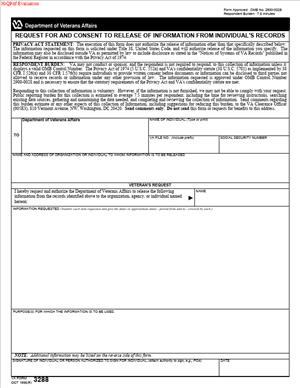
VA Form 3288 – Request for and Consent to Release of Information from Individual’s Records
Fill out nowJurisdiction: Country: United States | Province or State: Federal
VA Form 3288 – Request for and Consent to Release of Information from Individual’s Records is the document you use to authorize the Department of Veterans Affairs to release your personal records to someone else. If you are about to complete this form, you are likely trying to access or share VA information quickly and correctly.
This form gives written permission for the VA to disclose records it maintains about you. Without your consent, federal privacy laws generally prevent the VA from sharing your information.
You might need this form if a family member, attorney, representative, or another organization needs access to your VA file. It is commonly used when handling benefits, claims, appeals, or medical record requests.
Filling it out accurately matters. Incomplete or unclear information can delay your request or prevent the release of records altogether. Understanding what the form does and how it works helps you avoid setbacks.
What is VA Form 3288 – Request for and Consent to Release of Information from Individual’s Records?
Clear definition
VA Form 3288 – Request for and Consent to Release of Information from Individual’s Records is a written authorization that allows the Department of Veterans Affairs to share specific information from your VA records with a person or organization you name.
The VA maintains many types of records. These can include benefits files, claim documents, payment history, and certain administrative records. Because these records contain personal data, the VA cannot release them without proper consent, unless a specific legal exception applies.
By signing this document, you tell the VA exactly what information may be released, to whom, and often for what purpose. The form acts as your formal consent under federal privacy rules.
Who typically uses this form?
Veterans commonly use this form when they need to share records with a third party. This may include a lawyer assisting with a benefits appeal or a claims representative helping with paperwork.
Family members sometimes use it when assisting a veteran with managing benefits or resolving an issue. If you want your spouse, adult child, or caregiver to speak with the VA about your records, written consent is often required.
Surviving dependents and beneficiaries may also use the form when seeking access to records connected to claims or benefits. In some cases, former service members who are not receiving benefits still use it to access historical records maintained by the VA.
Organizations can request that you complete this form before they assist you. For example, a housing agency, financial institution, or insurance carrier may need confirmation of VA benefits.
Why might you need this form?
You may need this form to speed up communication. Without written authorization, the VA may decline to discuss your case with anyone other than you.
If someone is helping you prepare an appeal, they may need copies of your claims file or medical records. This form allows the VA to release those materials directly to them.
You might also need it if you are unable to manage communications yourself. Providing written consent allows another person to request information on your behalf.
In some situations, you may want records sent to you at a different address or through a designated third party. The form gives the VA clear instructions about where and to whom to send the information.
Typical real-life scenarios
- You filed a disability claim and later decided to hire an attorney. The attorney needs access to your VA claims file to review evidence and prepare arguments. You complete the form to authorize the release of your records to that attorney.
- You are applying for a home loan, and the lender asks for proof of VA benefits or eligibility. You submit the form so the VA can send confirmation directly to the lender.
- Your adult child is helping you organize your finances and benefits. To allow them to speak with the VA and request copies of documents, you provide written consent using this form.
- You believe there is an error in your payment history. You ask the VA to release detailed payment records to an accountant who is reviewing your finances. The form provides the necessary authorization.
- You are moving and need your VA records sent to a new representative in another state. The form ensures the records are sent to the correct recipient with your permission.
When would you use VA Form 3288 – Request for and Consent to Release of Information from Individual’s Records?
You would use VA Form 3288 – Request for and Consent to Release of Information from Individual’s Records when you want the VA to release your personal information to a specific person or organization.
This situation often arises during active benefit claims or appeals. Representatives, attorneys, or accredited agents typically need access to your file to assist effectively.
You may also use the form when applying for programs that require proof of VA status. Some state or local agencies request direct confirmation from the VA rather than relying on documents you provide yourself.
Healthcare coordination can be another reason. If a non-VA medical provider needs information from your VA records, you may authorize the release through this document.
Financial planning is another common situation. Accountants or financial advisors sometimes request documentation of VA income or benefits for planning purposes.
In short, you use this form any time you want to control who can access your VA records and ensure the release happens with your clear consent.
Legal characteristics of VA Form 3288 – Request for and Consent to Release of Information from Individual’s Records
This form operates under federal privacy laws that protect personal information held by government agencies. The VA cannot release protected records without proper authorization unless a specific legal exception applies.
For the form to be effective, it generally must clearly identify you, the records to be released, and the recipient. Your signature and date are essential elements. Without them, the VA is unlikely to process the request.
Clarity is critical. If the request is too vague, such as asking for “all records” without context, the VA may require clarification. Incomplete identifying information can also cause delays.
Timing matters. Some authorizations may have time limits or may be treated as valid only for a reasonable period. If too much time passes, a new form may be required before additional releases occur.
This document does not transfer decision-making authority. It does not appoint someone as your legal guardian or representative for all purposes. It only authorizes the release of information described in the form.
There may be other VA forms used for the representation or appointment of an accredited representative. This form focuses on consent to release information, not on formal representation rights.
Is it legally binding?
When properly completed and signed, the form is legally effective as your written consent. It allows the VA to rely on your authorization when disclosing information to the named party.
It is binding in the sense that the VA can act on it and release the information described. Once the information is released to an authorized recipient, it may no longer be protected by the same federal privacy rules.
However, the form does not create a contract between you and the recipient. It does not require the third party to act in a particular way. It only permits the VA to share specified records.
You may generally revoke consent in writing if you no longer want the VA to release information under that authorization. Revocation typically affects future disclosures, not information already released.
How to fill out VA Form 3288 – Request for and Consent to Release of Information from Individual’s Records
Step 1 – Review the form before writing
Read through the entire form once before filling it in. This helps you understand what information is required and where you will need to be specific about the records and the recipient.
Step 2 – Provide your identifying information
Enter your full name as it appears in VA records. Include any required identification numbers, such as your Social Security number or VA file number, if requested on the form.
Add your current mailing address and contact information. This helps the VA confirm your identity and process the request accurately.
Step 3 – Identify the records to be released
Clearly describe the information you want released. Be as specific as possible. You might list a particular claim file, a range of dates, medical records from certain years, or payment history.
Avoid overly broad language if the form asks for detail. Clear descriptions reduce the chance of follow-up questions or delays.
Step 4 – Name the person or organization receiving the information
Write the full name of the individual or organization authorized to receive your records. Include a complete mailing address and any other required contact details.
Ensure the information is accurate. If the address is incorrect, the records may not reach the intended recipient.
Step 5 – State the purpose of the release if requested
Some versions of the form ask for the purpose of the disclosure. Provide a brief, clear explanation, such as a claim review, financial verification, or legal assistance.
The purpose helps clarify why the release is requested and may assist the VA in processing it.
Step 6 – Review limitations and conditions
Read any statements about the scope of consent, time limits, or revocation. Confirm that you understand what you are authorizing and whether the consent has an expiration period.
This step ensures you are aware of how long the authorization may remain effective and how it can be withdrawn.
Step 7 – Sign and date the form
Sign your name exactly as required. Add the date of signature. Unsigned or undated forms are typically not processed.
If you are signing in a specific capacity, such as a legal representative, follow the form’s instructions for indicating your authority.
Step 8 – Submit the completed form
Send the completed form to the VA office handling your records or claim, following the submission instructions provided on the document. Keep a copy for your records so you can reference what you authorized and when.
Legal terms you might encounter in VA Form 3288 – Request for and Consent to Release of Information from Individual’s Records
- Authorization: Your written permission allowing the Department of Veterans Affairs to disclose your records. On this form, you grant that permission by signing and dating it. Without your authorization, the agency will not release protected information to a third party.
- Disclosure: The act of releasing information from your file to someone else. The form specifies what may be disclosed and to whom. Disclosure only covers what you clearly identify in the document.
- Personally Identifiable Information (PII): Information that can identify you, such as your full name, Social Security number, VA file number, date of birth, or address. You provide this so the agency can locate the correct records. If these details do not match your file, processing may be delayed.
- VA File Number: A unique number assigned to you by the Department of Veterans Affairs. It may be different from your Social Security number. Including the correct file number helps the agency find your records quickly.
- Scope of Release: The boundaries of what you are allowing to be shared. You may limit the scope to specific documents, date ranges, or types of records. If you leave it broad, more information than you intended could be disclosed.
- Purpose of Disclosure: The reason the information is being requested. Some agencies ask you to state why the records are needed. While not always required, clearly stating the purpose can help avoid confusion about what should be sent.
- Designated Recipient: The person or organization you authorize to receive your records. You must clearly name this recipient and, when possible, provide contact details. If the recipient is unclear, the request may be rejected or delayed.
- Revocation: Your right to cancel the authorization after you sign it. Revocation generally must be made in writing. It applies going forward and does not undo disclosures already made.
- Sensitive Records: Certain records, such as mental health, substance use, or HIV-related information, may have extra privacy protections. If these are included, the form may require a clear acknowledgment that you understand what you are authorizing.
- Signature Certification: Your confirmation that the information you provided is accurate and that you understand the release. By signing, you confirm you have authority over the records. If you sign on behalf of someone else, you must indicate your relationship and authority.
FAQs
Do I need to use VA Form 3288 – Request for and Consent to Release of Information from Individual’s Records every time someone asks for my VA records?
You generally need a written authorization whenever a third party asks the Department of Veterans Affairs for your personal records. If the request is coming from someone other than you, this document gives the agency permission to release the information. If you are requesting your own records directly, a different process may apply.
What information must exactly match my VA file to avoid delays?
Your full legal name, Social Security number or VA file number, and date of birth should match what the agency already has on record. Even small differences, like a missing middle name or an incorrect digit, can cause processing delays. Check recent VA correspondence to confirm the exact format of your identifying information before submitting the form.
Can I limit the release to only certain records or dates?
Yes. In the section where you describe the records to be released, you can specify types of documents, such as medical records, claims files, or billing information. You can also limit the release to a certain time period. Be precise. If you write “all records,” the agency may release everything in your file that falls within the authorization.
What happens if I forget to include the recipient’s full contact details?
If the designated recipient is not clearly identified, the agency may not process the request. Include the person’s or organization’s full name and mailing address. If possible, include a phone number or department name. Missing details can result in returned forms or significant delays.
Do I need to state a purpose for the release?
Some situations ask for a purpose, such as “for legal review” or “for disability claim support.” If the form includes a space for purpose, complete it clearly and briefly. While not always mandatory, leaving it blank when a purpose is requested may lead to follow-up questions before processing.
How long does this authorization stay valid?
The document may remain valid until a specific date you list or until it is revoked. If there is a space for an expiration date, consider whether you want the authorization to end automatically after a certain time. If you leave the expiration blank, it may remain valid under the terms stated on the form until you submit a written revocation.
Can someone sign this document on my behalf?
Yes, but only if they have legal authority, such as a court-appointed guardian or someone with valid power of attorney. The signer must clearly state their relationship and authority in the signature section. Supporting documents may be required to prove that authority before the agency will release records.
What should I do if I realize I made a mistake after submitting this form?
If you notice an error, such as an incorrect record description or a wrong recipient, submit a new, corrected document as soon as possible. Clearly, complete all fields again rather than trying to amend the old version. If the information has already been disclosed, you may not be able to undo that release, so act quickly.
Checklist: Before, During, and After VA Form 3288 – Request for and Consent to Release of Information from Individual’s Records
Before
- Confirm why the records are needed and who is requesting them
- Gather your full legal name, Social Security number, and VA file number
- Verify the correct spelling of the recipient’s name and mailing address
- Decide whether to limit the release to certain records or dates
- Check if sensitive records require special acknowledgment
- Review recent VA correspondence to match identifying details
- Determine whether you want to include an expiration date
During
- Write clearly and legibly in all sections
- Provide complete identifying information exactly as shown in your VA records
- Clearly describe the records to be released without vague wording
- List the full name and contact details of the designated recipient
- Fill in the purpose of disclosure if the form requests it
- Review any statements about revocation and limitations
- Sign and date the form in the correct section
- Indicate your authority if signing on someone else’s behalf
After
- Make a copy of the signed form for your records
- Attach any required proof of authority if applicable
- Submit the form using the accepted submission method
- Note the date you sent or delivered the document
- Follow up if you do not receive confirmation within a reasonable time
- Keep records of any correspondence related to the release
- Monitor whether the recipient confirms receipt of the records
Common mistakes to avoid with VA Form 3288 – Request for and Consent to Release of Information from Individual’s Records
- Mistake: Leaving the description of records too broad because you assume more detail is unnecessary, which can result in more information being disclosed than you intended, so do not forget to clearly limit the scope if you only need specific documents.
- Mistake: Providing incorrect or outdated identifying information because you rely on memory, which can delay processing or cause rejection, so do not forget to verify your details against official VA documents.
- Mistake: Forgetting to sign and date the form because you focus on filling in other sections, which makes the authorization invalid, so do not forget to complete the signature certification section.
- Mistake: Naming a recipient without full contact information because you assume the agency will locate them, which may result in processing delays, so do not forget to include complete mailing details.
- Mistake: Failing to specify your authority when signing for someone else because you think your relationship is obvious, which can lead to rejection, so do not forget to state your legal authority and attach proof if required.
- Mistake: Not keeping a copy of the signed form because you assume you will not need it again, which can create problems if there is a dispute about what was authorized, so do not forget to retain a complete copy for your records.
What to do after filling out VA Form 3288 – Request for and Consent to Release of Information from Individual’s Records
Once you complete the form, your job is not quite finished. Proper follow-through helps ensure your records are released correctly and without delay.
- Step 1: Review the entire form one more time for accuracy and completeness.
- Step 2: Make at least one clear copy of the signed and dated form for your personal records.
- Step 3: Gather any supporting documents required to prove authority if you signed for someone else.
- Step 4: Submit the form using the submission method accepted by the Department of Veterans Affairs, such as mail, fax, or in-person delivery where available.
- Step 5: Record the date you submitted the form and how you sent it.
- Step 6: If mailing, consider using a method that provides proof of delivery so you can confirm it was received.
- Step 7: Wait for acknowledgment or confirmation from the agency that the request is being processed, if such confirmation is typically provided.
- Step 8: Follow up after a reasonable period if you have not received confirmation or if the recipient has not received the records.
- Step 9: Confirm with the designated recipient that the records were received and are complete.
- Step 10: If you no longer want the authorization to remain active, prepare and submit a written revocation to the agency.
Keep all related paperwork together in a secure location. This includes copies of the authorization, any proof of authority, delivery confirmation, and correspondence. If questions arise later about what you approved, you will have clear documentation.
If the released records will be used for another process, such as a benefits claim or legal matter, make sure those documents are properly stored and referenced in your file. Staying organized reduces confusion and helps protect your privacy going forward.
Disclaimer: This guide is provided for informational purposes only and is not intended as legal advice. You should consult a legal professional.