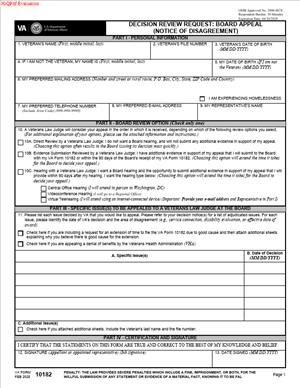
VA Form 10182 – Decision Review Request – Board Appeal (Notice of Disagreement)
Fill out nowJurisdiction: Country: United States | Province or State: Federal
If you disagree with a recent decision about your VA benefits, VA Form 10182 – Decision Review Request – Board Appeal (Notice of Disagreement) is the document used to ask for a review by the Board of Veterans’ Appeals. It is a formal way to continue your case after an initial decision from the Department of Veterans Affairs.
This form is part of the modern VA appeals system. It allows you to tell the VA that you want a Board review and how you want that review handled. The choice you make on the form affects what evidence can be considered and whether you will have a hearing.
If you are filling this out, you likely received a decision letter about disability compensation, pension, education benefits, or another VA benefit. You believe the decision is incorrect or incomplete. This form moves your case to the next level of review.
Understanding how this document works helps you avoid delays. Small errors, such as choosing the wrong review option or listing the wrong issue, can slow down your appeal. Clear and accurate completion supports a smoother submission process.
What is VA Form 10182 – Decision Review Request – Board Appeal (Notice of Disagreement)?
Clear definition
VA Form 10182 – Decision Review Request – Board Appeal (Notice of Disagreement) is a written request asking the Board of Veterans’ Appeals to review a specific VA decision. It serves as your formal notice that you disagree with that decision and want further review at the Board level.
The form identifies the issues you are appealing and requires you to select one of three Board review options. It also captures basic identifying information so the VA can match your appeal to the correct file.
This document does not start a brand-new claim. It continues an existing claim by moving it into the appeals phase before a Veterans Law Judge.
Who typically uses this form?
Most people who use this form are veterans who received an unfavorable or partially favorable decision on a benefits claim. This often involves disability compensation ratings, service connection decisions, or effective dates.
Surviving spouses, dependents, and other eligible family members may also use the form. This happens when they disagree with decisions about survivor benefits, dependency and indemnity compensation, or accrued benefits.
Accredited representatives, claims agents, and attorneys sometimes complete and submit the form on behalf of a claimant. Even in those cases, the appeal is filed in the name of the veteran or eligible family member.
Why might you need this form?
You may need this form if you believe the VA made an error in applying the law or reviewing the evidence. For example, the VA may have denied service connection for a condition you believe is related to your service.
You might also disagree with the disability rating assigned. A lower rating can affect monthly compensation, so you may want the Board to review how your symptoms were evaluated.
In some cases, you agree that a benefit was granted but disagree with the effective date. An earlier effective date can result in additional back pay. This form allows you to identify that specific issue for review.
You may also use this document if you want a Veterans Law Judge to consider additional evidence or hear your testimony. The form gives you options on how the Board will review your appeal.
Typical real-life scenarios
- A veteran applies for disability compensation for a back condition. The VA denies the claim, stating there is no link to service. The veteran believes the decision overlooked medical records showing an in-service injury. The veteran files this form to request Board review.
- Another veteran receives service connection for post-traumatic stress disorder but is assigned a 30 percent rating. The veteran believes the symptoms meet the criteria for a higher rating. The form is used to appeal the percentage assigned.
- A surviving spouse applies for dependency and indemnity compensation. The VA denies the claim based on the cause of death listed in the record. The spouse disagrees and requests a Board appeal to review medical opinions and other evidence.
- A veteran is granted benefits but disagrees with the effective date, believing it should be earlier based on when the original claim was filed. The form allows the veteran to specify that the appeal concerns only the effective date, not the entire decision.
When would you use VA Form 10182 – Decision Review Request – Board Appeal (Notice of Disagreement)?
You would use this form after receiving a VA decision and deciding to pursue a Board appeal instead of other review options. In the current VA system, there are different lanes for review, and this form is specifically for requesting review by the Board of Veterans’ Appeals.
Timing matters. The form is generally filed within a set period after the date on the VA decision letter. Filing within that period keeps the appeal active and preserves the original claim date for certain purposes.
You may choose this form when you want a Veterans Law Judge to review your case rather than having it reconsidered at a regional office. This is common when you believe the issue involves legal interpretation, weighing of evidence, or credibility determinations.
This document is also used when you want to select how the Board handles your appeal. You can choose a direct review of the existing record, submit additional evidence within a set timeframe, or request a hearing before a Veterans Law Judge.
Claimants, surviving family members, and authorized representatives may all use this form when the dispute has reached the stage where Board review is appropriate. The key point is that it is tied to a specific decision you are challenging.
Legal characteristics of VA Form 10182 – Decision Review Request – Board Appeal (Notice of Disagreement)
This form becomes effective when it is properly completed and received by the VA within the required timeframe. It must clearly identify the claimant, the VA decision being appealed, and the specific issues in dispute.
One critical feature is the selection of the Board review option. The option you choose affects whether new evidence can be considered and whether you will have a hearing. An unclear or missing selection can cause processing delays.
Common problems include listing issues that were not part of the referenced decision, failing to sign the form, or submitting it after the filing deadline. Incomplete identifying information can also delay matching the appeal to the correct claims file.
The form operates within a federal administrative system. While procedures are uniform across the country, individual cases may vary based on the type of benefit involved and the evidence presented. The rules governing appeals are federal and apply nationwide.
This document does not automatically grant benefits. It does not present new evidence by itself. It simply moves the disagreement to the Board level and defines the scope of the appeal.
Filing this form also does not stop other potential actions on separate claims. It applies only to the specific issues you identify from the particular decision listed.
Is it legally binding?
VA Form 10182 – Decision Review Request – Board Appeal (Notice of Disagreement) is not a contract between you and the government. It does not create a negotiated agreement. Instead, it is a procedural filing that triggers a formal review process.
Once accepted, it commits the appeal to the Board’s jurisdiction for the issues listed. The Board then has authority to review, affirm, reverse, or remand those issues according to applicable laws and regulations.
Your selection of a review option on the form generally guides how the Board handles your case. While certain changes may be allowed under specific circumstances, the initial selection shapes the process that follows.
The legal effect of the form is procedural. It preserves your right to Board review when filed correctly and on time. It does not determine the outcome of your appeal.
How to fill out VA Form 10182 – Decision Review Request – Board Appeal (Notice of Disagreement)
Step 1 – Provide your identifying information
Enter your full name, current mailing address, and contact details exactly as they appear in VA records. Include your VA file number or Social Security number, as requested. This ensures your appeal is matched to the correct claims file.
If someone is representing you, provide the representative’s information in the appropriate section. Accurate contact information helps prevent missed notices or hearing updates.
Step 2 – Identify the VA decision you are appealing
Locate the date of the decision on the notification letter you received from the VA. Enter that decision date carefully. This tells the Board which specific decision you are challenging.
If you have received multiple decisions, confirm that you are referencing the correct one. The appeal will generally apply only to the decision date you list.
Step 3 – List the specific issues you disagree with
Write out each issue you want the Board to review. Be clear and specific. For example, identify whether you are appealing a denial of service connection, a disability rating percentage, or an effective date.
If you agree with part of the decision but not another part, list only the issues in dispute. Issues not listed may not be reviewed as part of this appeal.
Step 4 – Select your Board review option
Choose one of the available review lanes on the form. One option focuses on direct review of the existing record. Another allows you to submit additional evidence within a set period. A third option includes the opportunity for a hearing before a Veterans Law Judge.
Read each option carefully on the form before making your selection. Your choice affects what the Board will consider and whether you will present testimony.
Mark only one option unless the form instructions allow otherwise. An unclear selection can delay processing.
Step 5 – Indicate if you want a hearing, if applicable
If you selected a review option that includes a hearing, confirm the type of hearing requested, such as a virtual or in-person appearance, if those choices are listed. Ensure your contact information is accurate so you receive scheduling details.
If you do not want a hearing, make sure your selected review option reflects that choice.
Step 6 – Review the form for completeness
Before signing, read through every section. Confirm that your identifying details are correct, the decision date is accurate, and all intended issues are clearly listed.
Check that you have selected a review option and completed any additional required sections. Missing information can result in processing delays or requests for clarification.
Step 7 – Sign and date the form
Sign the form in the designated signature block. Enter the date of your signature. An unsigned form is generally not considered valid.
If a representative is signing on your behalf where permitted, ensure that the appropriate authorization is already on file with the VA.
Step 8 – Submit the completed form
Follow the submission instructions provided with the form or in your decision letter. Submit the document to the correct VA address or intake location as indicated in the official instructions.
After submission, keep a copy of the completed form and any confirmation of receipt for your records. This helps you track your appeal and respond to any follow-up correspondence from the VA.
Legal terms you might encounter in VA Form 10182 – Decision Review Request – Board Appeal (Notice of Disagreement)
- Notice of Disagreement (NOD): This is the formal statement that you disagree with a VA decision. By filing this form, you are telling the Department of Veterans Affairs that you want the Board of Veterans’ Appeals to review specific issues in your case. The NOD is what starts your Board appeal.
- Board of Veterans’ Appeals (Board): The Board is part of the VA but operates separately from the regional offices that make initial decisions. A Veterans Law Judge at the Board reviews your appeal. The Board looks at the evidence, your arguments, and the law before making a decision.
- Veterans Law Judge (VLJ): A VLJ is the official who reviews and decides your appeal at the Board level. If you request a hearing, this is the person who will conduct it. The VLJ will issue a written decision explaining whether your appeal is granted, denied, or sent back for more development.
- Docket: The docket is the Board’s official schedule of appeals waiting to be reviewed. When your appeal is received and accepted, it is placed on a docket. Your docket position can affect how long it takes for the Board to review your case.
- Evidence Submission Lane: This is one of the review options you can choose on the form. In this lane, you may submit additional evidence within a set time after filing. The Board will consider both the existing record and the new evidence you provide within that window.
- Hearing Lane: If you select this option, you request a hearing before a Veterans Law Judge. You can present testimony and may submit additional evidence within a defined period tied to the hearing. This option often takes longer because a hearing must be scheduled.
- Direct Review Lane: This option asks the Board to review your case based only on the evidence that was in your file at the time of the original decision. You cannot add new evidence. This lane may move faster because no hearing or additional submissions are involved.
- Remand: A remand occurs when the Board sends your case back to a VA regional office for more development. This might happen if more evidence is needed or if the VA did not follow proper procedures. A remand is not a final denial; it means more work must be done before a final decision.
- Effective Date: The effective date determines when your benefits start if your appeal is granted. It can affect how much back pay you receive. When you identify the decision you are appealing, you are also protecting the effective date tied to that decision.
- Representative: A representative is someone authorized to act on your behalf, such as an accredited agent or attorney. If you have a representative, their information must match what the VA has on file. The Board will communicate with your representative unless you state otherwise.
FAQs
How do I know if I am still within the deadline to file this form?
Check the date on the VA decision letter you received. You generally have one year from the date the VA mailed that decision to submit your Notice of Disagreement. Look at the top of your decision letter for the mailing date and compare it to today’s date. If you are close to the deadline, make sure your submission is sent in a way that creates a clear record of when it was filed.
Do I have to appeal every issue listed in my decision letter?
No. You must clearly list only the specific issues you disagree with. If your decision letter covers several conditions or ratings, you can select just one or several. Anything you do not list on this document will usually not be reviewed by the Board.
What happens if I choose the wrong review option?
The review option you select controls whether you can submit new evidence or request a hearing. If you choose Direct Review, the Board will look only at the existing record. If you meant to submit more evidence or testify, that option would not allow it. Read each lane carefully before you mark your choice, because changing lanes later can be limited and may affect timing.
Do I need to submit evidence at the same time I file VA Form 10182 – Decision Review Request – Board Appeal (Notice of Disagreement)?
It depends on the review lane you select. If you choose Direct Review, you should not submit new evidence because the Board will not consider it. If you select the Evidence Submission or Hearing option, you may submit evidence within the allowed time window. Make sure any documents you send clearly show your name and file number so they are matched to your appeal.
What information must match my VA records exactly?
Your full name, file number or Social Security number, and contact details should match what the VA has on file. Even small differences, like a missing middle initial or outdated address, can cause confusion. If you recently changed your name or address, update that information promptly so your appeal correspondence reaches you.
Can someone else sign this document for me?
You must sign it yourself unless you have a legally recognized representative authorized to act for you. If a representative signs, the VA must already have proper authorization on file. Make sure the signature is clear and dated, because an unsigned form can delay acceptance.
How will I know if the Board received and accepted my appeal?
After submission, you should receive confirmation that your appeal has been received and placed on the docket. Keep copies of what you sent and any delivery confirmation. If you do not receive acknowledgment within a reasonable period, follow up to confirm that your filing was processed.
What changes once my appeal is docketed?
Once your appeal is docketed, it is officially in line for review by a Veterans Law Judge. The review option you selected controls what happens next, including whether you can add evidence or attend a hearing. From that point, most communication about the appealed issues will relate to the Board’s review process rather than the regional office decision stage.
Checklist: Before, During, and After VA Form 10182 – Decision Review Request – Board Appeal (Notice of Disagreement)
Before
- Read your VA decision letter carefully and highlight each issue decided.
- Confirm the mailing date of the decision to track your one-year deadline.
- Gather your VA file number or Social Security number.
- Decide which specific issues you want to appeal.
- Review the three Board review options and compare timelines and evidence rules.
- Check whether your contact information is current with the VA.
- Confirm whether you have an authorized representative on record.
- Organize any new evidence if you plan to choose a lane that allows submission.
During
- Enter your full legal name exactly as it appears in VA records.
- Provide your file number or Social Security number accurately.
- Clearly identify the date of the decision you are appealing.
- List each issue you disagree with in plain, specific terms.
- Select only one review option and mark it clearly.
- Indicate whether you want a hearing if that option applies.
- Review every page for missing fields or unchecked boxes.
- Sign and date the form in the correct place.
After
- Make a complete copy of the signed form for your records.
- Keep copies of any evidence you submit with the appeal.
- Submit the form using a method that provides confirmation.
- Store proof of submission with your copy of the form.
- Watch for written confirmation that your appeal was docketed.
- Respond promptly to any Board correspondence.
- Update your address immediately if you move.
- Keep a timeline of all appeal-related communications.
Common mistakes to avoid with VA Form 10182 – Decision Review Request – Board Appeal (Notice of Disagreement)
- Mistake: Missing the one-year filing deadline because you rely on memory instead of checking the decision letter date, which can result in losing your appeal rights; do not forget to verify the exact mailing date and track it on a calendar.
- Mistake: Failing to list specific issues you disagree with because you assume the entire decision is under review, which can limit what the Board considers; do not forget to name each condition or rating clearly.
- Mistake: Choosing Direct Review when you intend to submit new evidence, often due to misunderstanding the lane descriptions, which can prevent the Board from considering additional documents; do not forget to match your choice to your evidence plan.
- Mistake: Leaving the signature or date blank because you focus only on the issue section, which can delay processing or cause rejection; do not forget to sign and date the form before submission.
- Mistake: Providing outdated contact information because you recently moved, which can cause you to miss important notices; do not forget to confirm your current mailing address and phone number.
- Mistake: Submitting documents without your file number attached, which can lead to misfiled evidence and delays; do not forget to include identifying information on every page you send.
- Mistake: Sending original evidence without keeping copies because you assume the VA will return it, which can result in lost records; do not forget to keep complete copies for yourself.
- Mistake: Assuming a representative will file the appeal without confirming, which can lead to missed deadlines; do not forget to verify in writing who is responsible for submission.
What to do after filling out VA Form 10182 – Decision Review Request – Board Appeal (Notice of Disagreement)
Once you complete the form, shift your focus to documentation and follow-through. An appeal is not just about what you write. It is about creating a clear paper trail and staying organized.
- Step 1: Review the entire form one more time for accuracy, including spelling of your name and your file number.
- Step 2: Make a full copy of the signed and dated form for your personal records.
- Step 3: If you are submitting evidence, label each page with your name and file number before sending it.
- Step 4: Submit the form using an accepted filing method and keep proof of submission, such as a confirmation receipt or tracking record.
- Step 5: Create a dedicated folder, physical or digital, for all appeal-related documents and correspondence.
- Step 6: Mark your calendar with the date you filed and note when you expect acknowledgment.
- Step 7: Watch your mail and any official communication channels for confirmation that your appeal has been received and docketed.
- Step 8: If you requested a hearing, begin preparing an outline of the points you want to present and gather supporting documents.
- Step 9: Respond promptly to any requests for additional information from the Board.
- Step 10: Keep your contact information current to avoid missing deadlines or notices.
Staying organized can make the appeal process less stressful. Treat each communication as important. Keep everything dated. If you work with a representative, maintain regular contact and confirm who is handling each step.
Your appeal moves forward only if you remain engaged. Careful recordkeeping and timely responses help protect your rights and ensure that your case receives full consideration.
Disclaimer: This guide is provided for informational purposes only and is not intended as legal advice. You should consult a legal professional.