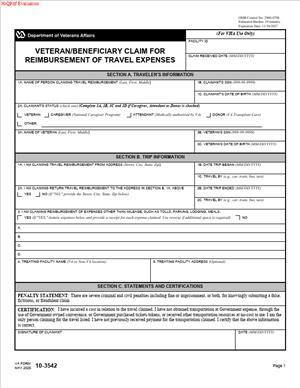
VA Form 10-3542 – Veteran or Beneficiary Claim for Reimbursement of Travel Expenses
Fill out nowJurisdiction: Country: United States | Province or State: Federal
VA Form 10-3542 – Veteran or Beneficiary Claim for Reimbursement of Travel Expenses is the document you use to request payment back for certain travel costs related to approved medical care through the Department of Veterans Affairs. If you paid out of pocket to get to a VA health care appointment, this form is how you formally ask to be reimbursed.
This form matters because travel expenses can add up. Gas, public transportation, lodging, or special transportation services may qualify in some situations. Filing correctly can mean recovering money you already spent.
You complete this document after travel has taken place. It is not a pre-approval form. It is a claim for reimbursement based on a completed appointment or authorized care.
If you are about to fill it out, you likely want clear answers about eligibility, what details to include, and how to avoid delays. This guide walks through what the form does and how to complete it carefully and accurately.
What is VA Form 10-3542 – Veteran or Beneficiary Claim for Reimbursement of Travel Expenses?
Clear definition
VA Form 10-3542 – Veteran or Beneficiary Claim for Reimbursement of Travel Expenses is a federal claim form used to request repayment for eligible travel costs connected to VA-approved medical care. It records who traveled, why the travel occurred, where the appointment took place, and what expenses were incurred.
The form creates an official record of your request. It allows the VA to review whether the travel qualifies under its reimbursement rules and calculate the amount that may be paid.
It is not a general expense claim. It is specifically tied to medical care or services that meet VA travel benefit requirements.
Who typically uses this form?
Most commonly, veterans who receive medical treatment at a VA medical center or clinic use this form. Beneficiaries, including certain family members receiving approved care, may also use it when eligible.
In some cases, a representative may complete the document on behalf of a veteran or beneficiary. This might occur if the person receiving care is unable to complete the paperwork independently.
Caregivers sometimes help gather receipts and travel details, but the claim itself is still tied to the eligible individual.
Why might you need this form?
- You might need this form if you traveled to a VA facility for a scheduled appointment and paid for transportation yourself. If the travel meets eligibility requirements, you can request reimbursement.
- You may also need it if you have to travel a significant distance for specialized treatment that was not available closer to home. In certain cases, lodging or meals related to extended travel may be part of the claim.
- If you use a personal vehicle, the reimbursement is often calculated based on mileage. If you used public transportation, you may need to provide proof of the actual cost.
- Without filing this form, the VA has no formal record of your request for repayment. The reimbursement process generally starts with the submission of this completed document.
Typical real-life scenarios
You drive 60 miles to a VA hospital for a specialist appointment. You pay for gas and parking. After the appointment, you complete the form to request mileage reimbursement.
You take a bus to a VA clinic for routine treatment. You keep your ticket receipt and submit it with your claim to recover the transportation cost.
You travel out of town for a multi-day procedure authorized by the VA. You incur lodging expenses because returning home between appointments is not practical. You include those details in your claim if they meet eligibility criteria.
You arrange special medical transportation because your condition prevents you from driving. The transportation provider charges a fee. You use the form to request reimbursement for that service, subject to applicable rules.
When would you use VA Form 10-3542 – Veteran or Beneficiary Claim for Reimbursement of Travel Expenses?
You use this form after completing travel related to approved VA medical care. It is generally submitted once the appointment or service has taken place.
It is often used for outpatient visits, therapy sessions, diagnostic testing, and other covered medical services at VA facilities. It may also apply to authorized care at non-VA facilities when the VA has approved the treatment in advance.
If you make multiple trips for ongoing treatment, you may submit claims periodically, depending on administrative procedures. Some facilities allow electronic claims, while others process paper submissions.
The form may also be used when a beneficiary travels with a required attendant, if that attendance is recognized as medically necessary. In such situations, details about both individuals may need to be included.
The key point is that the travel must be connected to eligible care. Personal travel or unrelated trips do not qualify under this filing.
Legal characteristics of VA Form 10-3542 – Veteran or Beneficiary Claim for Reimbursement of Travel Expenses
This form is an administrative claim under federal veterans’ benefits rules. It operates within a structured system that defines who qualifies, what expenses are covered, and how reimbursement is calculated.
For the claim to be effective, the form must be complete and accurate. It generally requires identifying information, appointment details, dates of travel, and the type of transportation used. Missing information can delay review or result in denial.
Common issues include incorrect dates, mismatched appointment information, lack of supporting documentation for certain expenses, or failure to sign the form. Inaccurate mileage reporting can also create problems.
Because this is a federal program, the rules are applied consistently across states. However, local VA facilities may have different administrative procedures for submission timelines or documentation handling.
This form does not authorize treatment. It does not approve future travel. It does not guarantee payment. It simply initiates a review of whether your completed travel qualifies for reimbursement under existing guidelines.
Is it legally binding?
VA Form 10-3542 – Veteran or Beneficiary Claim for Reimbursement of Travel Expenses is legally significant because it is a formal claim for federal benefits. When you sign it, you certify that the information provided is true and correct to the best of your knowledge.
By signing, you are making a factual statement about your travel and expenses. Providing false information can have consequences under federal law.
However, the form itself is not a contract between you and the government. It does not create new rights beyond those already established under veterans’ benefits laws and regulations.
Payment is not automatic upon submission. The VA reviews the claim and determines eligibility and reimbursement amount according to its rules.
How to fill out VA Form 10-3542 – Veteran or Beneficiary Claim for Reimbursement of Travel Expenses
Step 1 – Identify the veteran or beneficiary
Start by entering the full legal name of the person who received care. Provide any required identifying numbers, such as a Social Security number or other VA identification number, as requested on the form.
Double-check spelling and numbers. Errors here can delay processing because the claim must match official records.
Step 2 – Provide contact information
Enter the current mailing address and contact details. This is where reimbursement payments or correspondence may be sent.
Make sure the address is complete, including apartment numbers if applicable. If your contact information has recently changed, use the most up-to-date details.
Step 3 – Enter appointment or treatment details
List the date or dates of the medical appointment related to the travel. Include the name and location of the VA facility or authorized provider.
The dates of travel should correspond to the dates of care. If you traveled on different days for the same course of treatment, record each date clearly.
Step 4 – Describe the type of transportation used
Indicate whether you used a personal vehicle, public transportation, special medical transport, or another method. Follow the form’s instructions for specifying round-trip or one-way travel.
If claiming mileage, enter the total number of miles traveled. Measure carefully to avoid overstatement or understatement.
Step 5 – Report actual expenses when required
If you are claiming costs such as bus fares, train tickets, lodging, or authorized transportation services, enter the exact amount paid. Attach any required receipts or documentation if the form calls for them.
Only include expenses directly related to the approved medical travel. Keep your records organized in case clarification is needed later.
Step 6 – Indicate attendant or escort information if applicable
If someone traveled with you because it was medically necessary, provide their information where requested. Explain the relationship and the reason attendance was required, if the form includes a section for this.
Ensure that the details align with any prior authorization or medical documentation connected to your care.
Step 7 – Review certifications and statements
Before signing, read the certification section carefully. This section confirms that the information you provided is accurate and complete.
Take a moment to verify dates, mileage, and dollar amounts. Confirm that all required sections are filled in.
Step 8 – Sign and date the form
Sign your name in the designated area. Enter the date of signing. If a representative completes the form on your behalf, they must sign in the appropriate section and indicate their role.
An unsigned form is typically not processed, so confirm that your signature is present and legible.
Step 9 – Prepare the form for submission
Make a copy of the completed form and any supporting documents for your records. Organize receipts or additional pages in the order referenced in your claim.
Submit the form according to the instructions provided by your VA facility, ensuring it reaches the correct office for travel reimbursement processing.
Legal terms you might encounter in VA Form 10-3542 – Veteran or Beneficiary Claim for Reimbursement of Travel Expenses
- Beneficiary Travel: This refers to the program that allows eligible veterans and certain beneficiaries to receive reimbursement for travel related to approved medical care. On this form, you are asking to be paid back under this program. The term signals that not all travel qualifies—only travel connected to authorized care.
- Service-Connected Disability: This means a disability that the Department of Veterans Affairs has officially linked to your military service. Your service-connected status can affect eligibility and reimbursement amounts. The form may ask about this because it can change how your claim is processed.
- Attendant or Escort: An attendant or escort is a person who travels with you because your medical condition requires assistance. If you list an attendant, you must provide identifying details and explain why one was medically necessary. This impacts whether their travel costs are reimbursable.
- Deductible: A deductible is the amount subtracted from your reimbursement before payment is made. Some claimants are subject to a travel deductible unless they meet certain criteria. Understanding this helps you estimate what you will actually receive.
- Mileage Reimbursement Rate: This is the set rate per mile used to calculate payment when you drive a personal vehicle. You do not choose this rate; it is established by the agency. The form relies on your reported mileage, which is multiplied by this rate.
- Date of Service: This refers to the exact date you received medical care. Each claim must clearly tie travel to a specific appointment or treatment date. Incorrect or missing dates can delay review.
- Certify: To certify means you confirm that the information you provided is true and correct to the best of your knowledge. When you sign the form, you are making a formal statement. False certifications can lead to denial or other consequences.
- Claimant: The claimant is the person requesting reimbursement. In most cases, that is you as the veteran or eligible beneficiary. The form collects identifying information so the agency can match your claim to your records.
- Electronic Funds Transfer (EFT): EFT allows reimbursement to be deposited directly into your bank account. If the form requests banking details, accuracy is critical. A single-digit error can delay payment.
- Supporting Documentation: This includes receipts, appointment confirmations, or other records that support your claim. Not every situation requires attachments, but when required, they help verify distance, expenses, or special circumstances.
FAQs
Do I need to file VA Form 10-3542 – Veteran or Beneficiary Claim for Reimbursement of Travel Expenses after every appointment?
Yes, you generally submit a claim for each qualifying trip. Each appointment has its own date of service, and the document records travel tied to that specific date. If you attend multiple appointments on different days, you usually complete separate claims unless instructions at your facility allow combined reporting. Always confirm the date of service you enter matches the actual visit.
What happens if the name on this form does not exactly match my VA records?
Your name must match the name in your official records so the agency can link your claim to the correct file. If you recently changed your name, make sure your records were updated before submitting the claim. If there is a mismatch, processing may pause while staff verify your identity. Double-check spelling, middle initials, and suffixes before signing.
Do I have to include receipts with my claim?
It depends on how you traveled. If you are claiming mileage for a personal vehicle, you usually report the distance rather than attach gas receipts. If you are claiming actual expenses such as airfare or special transportation, you may need proof of payment. Review the section that asks for expenses and attach clear copies when required.
Can someone else sign this document for me?
In limited situations, yes. If you are unable to sign due to incapacity, a legally authorized representative may sign. The signer must have proper authority on record. The signature line must clearly identify who is signing and in what capacity.
Is there a deadline to submit this form after my appointment?
There is typically a time limit tied to the date of service. You should check the instructions provided by your facility and submit as soon as possible after travel. Waiting too long can result in denial. Make sure the appointment date you list is accurate so timeliness can be verified.
How do I know if my claim was accepted?
After you submit VA Form 10-3542 – Veteran or Beneficiary Claim for Reimbursement of Travel Expenses, you should receive confirmation through the method used by your facility, such as a receipt notice or payment record. Payment is often the first sign of approval. If there is an issue, you may be contacted for clarification. Keep a copy of what you submitted so you can respond quickly.
What if I made a mistake after I already signed and submitted this document?
If you notice an error, contact the office where you submitted the claim as soon as possible. Minor clerical errors may be corrected without starting over. Larger errors, such as wrong dates or mileage, may require a corrected submission. Do not ignore the mistake, especially if it affects payment.
Does this form change my disability rating or benefits?
No. This document only requests reimbursement for qualifying travel. It does not alter your disability rating, compensation level, or eligibility status. It simply records your request to be repaid for a specific trip related to approved care.
Checklist: Before, During, and After VA Form 10-3542 – Veteran or Beneficiary Claim for Reimbursement of Travel Expenses
Before
- Confirm your appointment qualifies for travel reimbursement.
- Gather appointment details, including exact date and location.
- Measure or verify the round-trip mileage if using a personal vehicle.
- Collect receipts for airfare, bus, taxi, or other transportation.
- Confirm whether an attendant was medically required.
- Check that your name and contact information match official records.
- Verify your banking details if the payment will be deposited electronically.
During
- Enter your full legal name exactly as it appears in records.
- Write the correct date of service for each appointment.
- Accurately report the starting point and destination.
- Record total miles traveled, not estimates rounded excessively.
- List any attendant information if applicable.
- Attach required supporting documentation.
- Review every section before moving to the certification.
- Sign and date the form in the correct place.
After
- Make a full copy of the completed form and attachments.
- Submit the claim using the approved method for your facility.
- Note the date you submitted the claim.
- Watch for confirmation or payment notification.
- Respond quickly to any request for additional information.
- Keep proof of payment with your personal records.
- Track deadlines if you need to follow up.
Common mistakes to avoid with VA Form 10-3542 – Veteran or Beneficiary Claim for Reimbursement of Travel Expenses
- Mistake: Entering the wrong date of service because you rely on memory instead of checking your appointment record, which can lead to delays or denial; do not forget to confirm the exact appointment date before submitting.
- Mistake: Estimating mileage without verifying the actual round-trip distance, which can cause underpayment or overpayment review; do not forget to calculate the full distance carefully.
- Mistake: Forgetting to sign and date the certification section because you focus only on travel details, which results in automatic rejection; do not forget that an unsigned claim cannot be processed.
- Mistake: Leaving out required receipts for airfare or special transportation because you assume mileage rules apply, which may cause payment delays; do not forget to attach proof when claiming actual expenses.
- Mistake: Using a nickname or outdated name that does not match official records, which creates identity verification problems; do not forget to use your full legal name as recorded.
- Mistake: Failing to include attendant information when it was medically necessary, which can prevent reimbursement for that person’s travel; do not forget to complete the attendant section fully.
- Mistake: Submitting the claim long after the allowed timeframe because you were unsure about eligibility, which can result in denial; do not forget to check and follow submission deadlines.
- Mistake: Providing incorrect bank account numbers for direct deposit due to a typing error, which delays payment; do not forget to double-check every digit before submitting.
What to do after filling out VA Form 10-3542 – Veteran or Beneficiary Claim for Reimbursement of Travel Expenses
Once you complete the form, pause before you send it. A careful final review can prevent weeks of delay.
Start by reading every entry out loud. This helps you catch missing numbers, incorrect dates, or skipped sections. Confirm that the date of service matches your appointment record. Verify your mileage and any listed expenses.
- Step 1: Make a complete copy of the signed form and all attachments for your records.
- Step 2: Organize receipts and label them clearly so they match the travel date.
- Step 3: Submit the form using the submission method accepted by your facility, such as in person, by mail, or through an approved system.
- Step 4: Record the submission date in a personal log or calendar.
- Step 5: Keep proof of submission if available, such as a stamped copy or confirmation notice.
- Step 6: Monitor your bank account or payment method for reimbursement.
- Step 7: Review the payment amount to confirm it reflects the travel claimed.
- Step 8: If payment is less than expected, compare the reimbursement to your mileage and deductible rules.
- Step 9: Respond promptly to any request for clarification or missing information.
- Step 10: File the final documents with your medical and financial records for future reference.
If you do not receive payment within a reasonable period, contact the office where you filed the claim. Have your copy ready so you can provide exact details. Being organized makes follow-up much easier.
Keep a running folder for all travel claims. This helps you track patterns, confirm what was paid, and prepare future submissions more efficiently. Staying consistent reduces stress and speeds up processing over time.
Disclaimer: This guide is provided for informational purposes only and is not intended as legal advice. You should consult a legal professional.