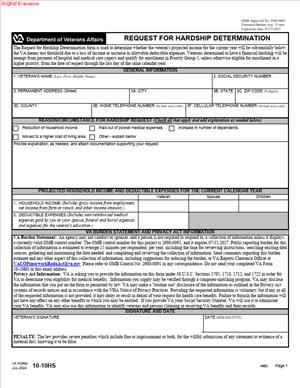
VA Form 10-10HS- Request for Hardship Determination
Fill out nowJurisdiction: Country: United States | Province or State: Federal
If you are struggling to pay for your medical care through the Department of Veterans Affairs, VA Form 10-10HS- Request for Hardship Determination may be the document you need. This form allows you to ask the VA to review your financial situation and consider reducing or eliminating certain copayments.
The VA uses income information to determine whether you must pay copays for health care and prescriptions. If your income drops or you face serious financial strain, your current status may no longer reflect your reality. This form gives you a way to explain that change.
You complete this document when you believe your current financial classification does not accurately reflect your hardship. It focuses on your present circumstances, not just past income reported to the VA.
Understanding how the form works helps you avoid delays. Clear, complete information makes it easier for the VA to assess your request and decide whether a hardship adjustment is appropriate.
What is VA Form 10-10HS- Request for Hardship Determination?
Clear definition
VA Form 10-10HS- Request for Hardship Determination is a federal document used by veterans to request a review of their financial status due to hardship. It allows you to report current income, expenses, and financial difficulties that may affect your ability to pay VA health care copayments.
This form is part of the VA health benefits system. It does not enroll you in benefits. Instead, it asks the VA to reconsider how your income is categorized for billing purposes.
The form collects updated financial details. These details help the VA determine whether you qualify for reduced or eliminated copay obligations based on hardship.
Who typically uses this form?
Veterans enrolled in VA health care most commonly use this form. It is generally submitted by individuals who are already receiving services and have been assessed for copay responsibilities.
You might use it if your income has recently decreased. This can happen because of job loss, reduced work hours, retirement changes, or other financial setbacks.
Surviving spouses or dependents do not typically use this specific form unless they are applying within a context tied to a veteran’s health eligibility classification. In most cases, it is completed directly by the veteran whose financial status is under review.
Why might you need this form?
You may need this form if your financial situation has changed since your last income assessment. The VA often relies on prior tax information. That information may not reflect your current hardship.
If you are unable to pay required copayments without sacrificing basic needs, this form creates a formal record of your situation. It allows the VA to evaluate whether billing adjustments are appropriate.
Using this document may help prevent debt from increasing. It also gives you a structured way to communicate financial stress instead of relying on informal conversations.
Typical real-life scenarios
- You recently lost your job and are now relying on unemployment benefits. Your prior tax return showed steady income, but your present earnings are much lower. You submit the form to explain the gap between past income and current hardship.
- You experienced a major medical event that led to unexpected expenses. Even if your income remains similar, high out-of-pocket costs may strain your finances. The form allows you to show how those expenses affect your ability to pay VA copays.
- You are separated from a spouse and now manage a household on one income. Your financial responsibilities have changed, and your current resources may not cover required payments.
- You are facing foreclosure, eviction, or utility shutoff due to limited funds. While the VA does not manage housing directly, financial instability may be relevant to your hardship request.
When would you use VA Form 10-10HS- Request for Hardship Determination?
You use this form when your current financial hardship is not reflected in the VA’s existing records. Timing often matters. It is commonly submitted after a significant income reduction or increase in essential expenses.
Veterans may complete the form after receiving a billing statement that they cannot reasonably pay. It can also be used if you anticipate difficulty paying future copays based on your new financial reality.
The document is typically used by individuals in Priority Groups that require copays. If you believe you may qualify for a lower priority group due to hardship, this filing allows the VA to review your classification.
Health care administrators and VA eligibility staff review the submission. They evaluate the information you provide against federal guidelines for hardship determinations. The review is administrative rather than court-based.
You may also use this form when updating financial information outside of the standard annual income verification cycle. It serves as a mechanism for mid-cycle review.
Legal characteristics of VA Form 10-10HS- Request for Hardship Determination
This form is an administrative request within a federal benefits system. Its effectiveness depends on accurate, complete, and truthful information. The VA evaluates your submission under federal rules governing health care eligibility and copayment requirements.
For the document to be considered valid, it generally must be fully completed and signed. Missing income details, unsigned certifications, or incomplete household information may delay processing or lead to denial.
Common problems include failing to report all sources of income, omitting household members, or providing estimates without clarification. Inconsistent information compared to prior filings may also trigger additional review.
The form does not automatically grant hardship status. It initiates a review process. The VA makes the final determination based on the information submitted and applicable federal standards.
Because this is a federal program, the rules apply nationwide. There are no state-by-state variations in the core eligibility standards. However, how quickly requests are processed may vary depending on administrative workload.
This document does not erase unrelated debts. It focuses on VA health care copayment obligations. It also does not serve as an appeal of a disability rating or other benefit decision.
Is it legally binding?
The form itself is not a contract between you and the government. Instead, it is a formal request supported by your signed certification that the information is true.
When you sign the form, you confirm that your statements are accurate to the best of your knowledge. Providing false information can have serious consequences because it relates to federal benefits.
Once submitted, the VA’s decision regarding hardship status can affect your copayment responsibilities. That administrative determination has practical financial consequences, even though the form is not a contract in the traditional sense.
How to fill out VA Form 10-10HS- Request for Hardship Determination
Step 1 – Review your current financial situation
Before writing anything, gather your recent income records. This may include pay stubs, benefit statements, pension information, or other proof of earnings. You need a clear picture of what you currently receive, not what you earned last year.
Identify your essential monthly expenses. Focus on housing, utilities, food, transportation, medical costs, and insurance. Knowing these figures helps you provide accurate information on the form.
Step 2 – Enter your personal identification information
Begin the form by providing your full legal name, Social Security number, and contact information as requested. Use the same information the VA has on file to avoid confusion.
If the form asks for your VA file number or other identifying details, copy them carefully. Errors in this section can delay review because the VA must match your request to the correct record.
Step 3 – List your current household members
Provide information about your spouse and dependents if required. Household size can affect financial classification.
Include only those individuals who meet the definition provided in the form’s instructions. Accurate reporting of household members ensures your income threshold is evaluated correctly.
Step 4 – Report all current sources of income
List each type of income separately. This may include wages, retirement payments, disability benefits, unemployment compensation, or other regular payments.
Use current monthly amounts if the form requests monthly income. If your income varies, provide a reasonable average and ensure it reflects your present situation.
Avoid rounding excessively. Specific figures help the reviewer understand the extent of your hardship.
Step 5 – Document significant expenses
Enter your regular monthly expenses in the spaces provided. Focus on necessary living costs rather than discretionary spending.
If the form allows additional explanation, clarify unusual or high expenses. For example, you may note temporary medical bills or emergency repairs that affect your finances.
Clear explanations reduce the chance that your hardship will be misunderstood.
Step 6 – Explain the hardship circumstances
Some versions of the form include space to describe your situation in your own words. Use this section to explain what changed and when.
Keep your explanation factual and direct. State the event that caused hardship, such as job loss or reduced hours, and describe how it impacts your ability to pay copays.
Avoid emotional language. Concrete details are more helpful than general statements about stress or difficulty.
Step 7 – Review for accuracy and completeness
Read each section carefully before signing. Check that all required fields are filled in and that your income and expense figures are consistent.
Make sure totals add up correctly if you calculated combined amounts. Small math errors can slow the review process.
Confirm that your contact information is current so the VA can reach you if clarification is needed.
Step 8 – Sign and date the certification
Sign the form where indicated. Your signature confirms that the information is true and complete to the best of your knowledge.
Add the date of signing. An undated form may not be processed until corrected.
After signing, keep a copy for your records. Having a copy allows you to refer back to the information you provided if questions arise.
Legal terms you might encounter in VA Form 10-10HS- Request for Hardship Determination
- Hardship Determination: This is the decision made about whether your financial situation qualifies as a hardship. On this form, you provide detailed income, expense, and asset information so the agency can decide if you should receive reduced or waived copayments.
- Copayment: A copayment is the portion of medical costs you are responsible for paying. The form focuses on whether your current financial condition makes it difficult or impossible for you to pay those required amounts.
- Household Income: This refers to the total income of everyone in your household, not just your personal earnings. The form may ask you to include wages, benefits, retirement income, and other financial support that contribute to your household’s overall resources.
- Financial Disclosure: Financial disclosure means you are formally reporting your income, assets, and expenses. When you complete this document, you are certifying that the financial information you provide is accurate and complete.
- Dependents: Dependents are individuals who rely on you for financial support. The form may require you to list a spouse, children, or other family members living with you because their needs affect your overall financial picture.
- Gross Income: Gross income is the total amount you earn before taxes or deductions. The form may ask for gross income rather than take-home pay, so you need to look at pay statements or benefit award letters carefully.
- Assets: Assets include savings, checking account balances, investments, real estate (other than your primary residence in some cases), and other items of value. You may need to report these to give a full picture of your financial situation.
- Certification: Certification is the statement at the end of the form where you confirm the information is true and correct to the best of your knowledge. By signing, you acknowledge that providing false information could lead to penalties or repayment obligations.
- Verification: Verification refers to the process of confirming the information you provide. You may be asked to submit documents such as pay stubs, bank statements, or bills to support your hardship claim.
- Effective Date: The effective date is when any approved hardship status would begin. This date matters because it can affect whether past or future copayments are reduced, adjusted, or waived.
FAQs
What documents should I gather before completing this form?
You should collect recent pay stubs, benefit award letters, bank statements, and bills that show your monthly expenses. You may also need statements for retirement income, disability payments, or unemployment benefits. Having these documents nearby helps you report accurate numbers and reduces the risk of missing required details.
Do I need to report my spouse’s income?
Yes, if you live with your spouse, you generally need to include their income as part of your household income. This document looks at your full household financial situation, not just your individual earnings. Make sure the names and identifying details match other records to avoid processing delays.
What if my income recently changed?
If your income has decreased due to job loss, reduced hours, illness, or another event, you should report your current income and clearly explain the change. Use the explanation section to describe when the change happened and whether it is temporary or ongoing. If possible, include documents that show the new amount and the date it began.
How detailed do my expense entries need to be?
Be specific and realistic. List regular monthly expenses such as rent or mortgage, utilities, food, transportation, insurance, and medical costs. If your expenses vary, use a reasonable monthly average and make sure your totals match the documents you provide.
Where do I sign, and who is allowed to sign?
You must sign and date the certification section yourself unless you have a legally authorized representative. If someone else signs for you, they must have proper authority, and their name and role should be clearly stated. An unsigned document may be rejected or delayed.
Will filing VA Form 10-10HS- Request for Hardship Determination automatically stop my copayments?
Submitting VA Form 10-10HS- Request for Hardship Determination does not automatically stop billing. A decision must be made after review. You may still receive statements while the request is being processed, so monitor your mail and account carefully.
How will I know if my hardship request is approved?
You should receive written notice explaining the decision and the effective date of any approved hardship status. Review the notice closely to confirm that your name, identifying information, and financial details are correct. Keep the approval letter with your records.
What happens if my hardship request is denied?
If this form results in a denial, you will usually receive a written explanation. Read it carefully to understand the reason, such as income exceeding limits or missing information. You may have options to submit updated financial details or correct errors if your situation changes.
Checklist: Before, During, and After VA Form 10-10HS- Request for Hardship Determination
Before
- Gather recent pay stubs, benefit letters, and proof of all income sources.
- Collect monthly bills for housing, utilities, food, insurance, and medical expenses.
- Review bank statements and account balances.
- Confirm the full legal names and identifying numbers for yourself and household members.
- Check whether your income has changed recently and note the date of change.
- Make a list of all dependents living in your household.
- Set aside time to complete the form without rushing.
During
- Enter your name and identifying information exactly as it appears on official records.
- List all household members and their relationship to you.
- Report gross income amounts, not estimated take-home pay.
- Itemize monthly expenses clearly and consistently.
- Double-check math when totaling income and expenses.
- Provide explanations for unusual or temporary financial changes.
- Review every page before signing.
- Sign and date the certification section.
After
- Make a complete copy of the signed form and all attachments.
- Submit the form using the instructed delivery method.
- Note the date you submitted the request.
- Watch for written confirmation or follow-up requests.
- Respond promptly if additional documents are requested.
- Keep all correspondence in one organized file.
- Monitor billing statements to see if changes are applied.
- Update your records if your hardship status is approved.
Common mistakes to avoid with VA Form 10-10HS- Request for Hardship Determination
- Mistake: Leaving income fields blank because you think they do not apply, which often happens when income is irregular, leading to delays or denial; do not forget to enter zero where appropriate or explain the situation clearly.
- Mistake: Reporting net income instead of gross income because it seems more accurate to your budget, which can result in inconsistent figures; do not forget to use pre-tax amounts if the form requests them.
- Mistake: Forgetting to include a spouse’s or dependent’s income because you view finances as separate, which may cause the review to be incomplete; do not forget that household income usually includes everyone living with you.
- Mistake: Submitting the form without supporting documents because you assume they are optional, which can slow processing; do not forget to attach proof of income and key expenses when requested.
- Mistake: Failing to sign and date the certification section due to oversight, which can make the form invalid; do not forget to check for your signature before submitting.
- Mistake: Underestimating expenses to “look responsible,” which may weaken your hardship claim; do not forget to list your true and full monthly costs.
- Mistake: Ignoring follow-up letters requesting more information because you believe you already provided enough, which can result in closure of your request; do not forget to respond by the stated deadline.
- Mistake: Not keeping copies of what you submitted because you trust the process, which leaves you without proof if questions arise; do not forget to store a full copy for your records.
What to do after filling out VA Form 10-10HS- Request for Hardship Determination
Once you complete the form, slow down and review everything one more time. Look at each number. Confirm that totals are accurate and that your explanation clearly describes your hardship.
Make sure every required attachment is included. Missing documents are one of the most common reasons for delays.
- Step 1: Make a complete copy of the signed form and all supporting documents for your records.
- Step 2: Submit the form using the approved submission method provided in the instructions.
- Step 3: Write down the date you submitted it and how you sent it.
- Step 4: Organize a folder—paper or digital—where you keep a copy of the form, attachments, and any confirmation.
- Step 5: Monitor your mail and any official account statements for updates or requests for additional information.
- Step 6: Respond quickly if you receive a letter asking for clarification or more documents.
- Step 7: Review any decision notice carefully, paying attention to the effective date and what costs are affected.
- Step 8: Compare future billing statements to the decision to confirm changes were applied correctly.
- Step 9: Update your personal financial records to reflect any reduced or waived copayments.
- Step 10: If your financial situation changes again, prepare to submit updated information promptly.
Stay proactive. Keep records organized. Track deadlines. A hardship request is based on the details you provide, so your follow-through matters just as much as the initial form.
Disclaimer: This guide is provided for informational purposes only and is not intended as legal advice. You should consult a legal professional.