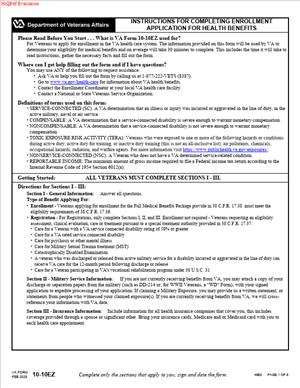
VA Form 10-10EZ – Application for Health Benefits
Fill out nowJurisdiction: Country: United States | Province or State: Federal
The VA Form 10-10EZ – Application for Health Benefits is the main form used to apply for health care through the federal Department of Veterans Affairs. If you are a veteran seeking medical coverage through the VA system, this is the starting point.
This form collects information about your military service, financial situation, insurance coverage, and household details. The information helps determine whether you qualify for VA health care and what priority group you may fall into.
Filling out the VA Form 10-10EZ – Application for Health Benefits is often the first step toward accessing VA hospitals, clinics, and related medical services. Without this application, enrollment in the VA health care system generally cannot move forward.
You may complete this document when leaving active duty, years after separation, or when your health needs change. The timing depends on your situation. What matters is that the form establishes your eligibility for care within the federal VA system.
Understanding what this form does and how it works can make the process clearer. When you know what information is being requested and why, you can complete it with fewer delays.
What is VA Form 10-10EZ – Application for Health Benefits?
Clear definition
VA Form 10-10EZ – Application for Health Benefits is an official federal application used to request enrollment in the Department of Veterans Affairs health care system. It is not a treatment record or a medical claim. It is an enrollment document.
The form gathers personal identifying details, service history, income information, insurance coverage, and dependent information. This data allows the VA to evaluate your eligibility under federal law and place you in an appropriate enrollment priority group.
In simple terms, this document tells the VA who you are, how you served, and what your financial and insurance situation looks like. Based on that, the agency decides whether you qualify for care and what costs, if any, may apply.
Who typically uses this form?
Most people who use this form are military veterans seeking access to VA medical services. This includes individuals recently separated from active duty and those who served many years ago.
Members of the National Guard or Reserve may also use the form if they meet certain federal service requirements. Eligibility often depends on the type and length of service.
Some veterans complete the application on their own. Others may receive help from a family member, caregiver, or authorized representative. In some cases, a VA staff member assists with the completion during an in-person or phone appointment.
Surviving spouses and dependents generally do not use this specific form for their own coverage. Their eligibility is handled under different programs and documents.
Why might you need this form?
You need this form if you want to enroll in VA health care for the first time. Enrollment is not automatic for most veterans. The VA must review your information before granting access to services.
You may also need to submit it if you were previously enrolled, but your status changed, and a new application is required. For example, significant changes in income or discharge status may trigger a new review.
The form may also be necessary if you have never used VA medical services before but now want to explore care options within the federal system. Without this application, the VA generally cannot assess your eligibility.
Typical real-life scenarios
- You recently separated from active duty and want to continue receiving medical care. You complete the application to transition from military health coverage to VA health services.
- You served years ago but have developed a chronic health condition. A friend mentions that you might qualify for VA care. You submit the form so the VA can review your service record and determine eligibility.
- You are paying for private insurance but want to see whether you qualify for VA coverage, which may reduce your out-of-pocket costs. Filing the application allows the VA to evaluate your financial information and service history.
- You moved to a new state and have not used VA health care before. A local VA clinic informs you that enrollment is required. You complete the form to gain access to that facility and related services.
- You experienced a service-connected injury and were recently rated for disability. You apply for VA health care to access treatment connected to that condition.
When would you use VA Form 10-10EZ – Application for Health Benefits?
You use this form when you want to begin the enrollment process for VA health care. This typically happens after military service ends, but it can also occur later in life.
Many veterans submit the form soon after discharge, especially during the initial post-service period when certain enhanced eligibility rules may apply. Others wait until they need medical care or become aware of potential benefits.
You may also use the form if your personal or financial circumstances change in a way that could affect your eligibility or priority group. For example, a significant drop in income may affect how the VA classifies your enrollment status.
Some veterans complete the document during a visit to a VA medical center. Others submit it electronically or by mail. The method of submission does not change the purpose of the form, which is to establish or confirm eligibility for VA health care services.
In general, this form is used at the beginning of the relationship between you and the VA health care system. It sets the foundation for future appointments, billing arrangements, and coverage determinations.
Legal characteristics of VA Form 10-10EZ – Application for Health Benefits
This form is a federal administrative application. Its legal effect comes from federal statutes and regulations governing veterans’ health benefits. The information you provide is used by a federal agency to make an eligibility determination.
For the form to be effective, it must be complete and accurate. Required sections generally include identifying information, military service details, and financial data if applicable. Missing or inconsistent information can delay processing.
The VA relies on the accuracy of your statements. Providing incorrect or incomplete details may lead to processing delays or additional verification requests. In some situations, inaccurate information can affect eligibility outcomes.
The form must typically be signed. Your signature confirms that the information provided is true to the best of your knowledge. An unsigned application is commonly considered incomplete.
Federal standards apply across all states because this is a nationwide program. However, local VA facilities may have different administrative procedures for intake or follow-up. The underlying eligibility rules remain federal.
This document does not, by itself, grant benefits. It initiates a review process. The VA evaluates the information and then issues a decision regarding enrollment and priority group placement.
It also does not replace other claims forms. For example, applying for disability compensation or pension benefits usually requires separate filings. This application focuses specifically on health care enrollment.
Is it legally binding?
The application is not a contract between you and the government in the traditional sense. It does not create a negotiated agreement. Instead, it is a formal request for benefits under an existing federal program.
However, your signature has legal significance. By signing, you certify that the information provided is accurate and complete to the best of your knowledge. This certification carries weight because the agency relies on your statements to make eligibility decisions.
If approved, your enrollment in the VA health care system creates certain rights and responsibilities under federal law. These may include obligations related to copayments or reporting changes in income, depending on your priority group.
In short, the form itself is an administrative filing, but the information you submit can affect your legal eligibility for federal health benefits.
How to fill out VA Form 10-10EZ – Application for Health Benefits
Step 1 – Gather your personal and service information
Before you begin, collect key details. This often includes your Social Security number, date of birth, contact information, and discharge papers showing your character of service and dates served. Having these documents nearby reduces errors and saves time during completion.
Step 2 – Provide your identifying information
Enter your full legal name, previous names if applicable, date of birth, and contact details. Make sure the information matches your official records. Consistency helps the VA locate and verify your military service history.
Step 3 – Enter your military service details
You will provide the branch of service, service dates, and discharge status. Accuracy is important because eligibility for VA health care often depends on length and character of service. If you are unsure about specific dates, review your discharge documents before entering them.
Step 4 – Disclose insurance coverage
The form asks whether you have other health insurance, including private coverage or employer-sponsored plans. This information does not automatically disqualify you. It helps the VA coordinate benefits and determine billing arrangements where applicable.
Step 5 – Report financial information if required
Depending on your situation, you may need to provide income details for yourself and possibly your spouse or dependents. This information can affect your enrollment priority group and whether copayments apply. Enter amounts carefully and ensure they reflect the requested time period.
Step 6 – Provide dependent and household information
If the form asks about dependents, list required details such as names, relationship to you, and identifying information. Household size and dependent status can influence financial assessment under VA rules.
Step 7 – Review for completeness and accuracy
Before signing, read through each section. Confirm that names, numbers, and dates are correct. Check that all required fields are filled in. Small errors can delay processing and lead to follow-up requests.
Step 8 – Sign and date the form
Sign the application where indicated. Your signature confirms that the information is true and complete to the best of your knowledge. Include the date of signing, as this establishes the official submission timeline.
Step 9 – Submit the application through the appropriate channel
Submit the completed document according to the available submission options, such as online, by mail, or in person at a VA facility. Keep a copy for your records so you can reference the information later if questions arise.
Legal terms you might encounter in VA Form 10-10EZ – Application for Health Benefits
- Service-Connected Disability: This refers to an illness or injury that was caused or worsened by your military service. On this form, you may be asked whether you have a service-connected disability and what percentage rating you have. That rating can affect your eligibility group and potential costs.
- Priority Group: The Department of Veterans Affairs assigns veterans to priority groups based on service history, disability status, income, and other factors. Your placement in a priority group determines when and how you can access health care services. The information you provide in this document helps determine your group.
- Gross Household Income: This is the total income before taxes for everyone in your household. The form may require you to report income from wages, retirement benefits, Social Security, or other sources. Income information can affect whether you qualify for cost-free care or reduced copayments.
- Dependents: Dependents include your spouse and certain children who rely on you for financial support. You may need to list them and provide identifying details. This information can affect financial assessment and eligibility considerations.
- Third-Party Insurance: This refers to any private or public health insurance coverage you have outside the VA system. You are asked to disclose other coverage so the VA can coordinate benefits and bill your insurance when appropriate.
- Financial Assessment: This is the review of your reported income, assets, and household size. The VA uses this assessment to determine whether you qualify for free care or if copayments apply. Accurate financial entries are essential for a correct decision.
- Enrollment Determination: This is the decision made after reviewing your application. It confirms whether you are enrolled in VA health care and identifies your priority group. You will receive written notice of this determination.
- Discharge Status: This describes the type of separation you received from military service, such as honorable or general. Your discharge status can directly affect eligibility for health benefits. You must report it accurately as shown on your discharge documents.
- Effective Date: This is the date your enrollment or benefits begin once approved. It may be based on when your application was received or when the eligibility criteria were met. Keep this date for your records.
FAQs
Do I need my discharge papers to complete VA Form 10-10EZ – Application for Health Benefits?
You do not always need to submit your discharge papers with this form, but you should have them available. You will need to enter details such as branch of service, dates of service, and discharge status exactly as they appear on your records. If the information does not match official records, your application could be delayed while your service is verified.
What income should I include when reporting household finances?
You should include gross income for yourself and your dependents, if required. This often includes wages, retirement pay, Social Security benefits, disability payments, and other regular income. Follow the instructions carefully and report amounts for the requested year so the financial assessment can be completed correctly.
What happens after I submit this form?
After submission, your information is reviewed to confirm service eligibility and to complete any required financial assessment. If approved, you will receive written notice of your enrollment determination and assigned priority group. Keep that notice because it confirms your status in the VA health care system.
Can I leave the insurance section blank if I only want VA care?
No. You should still disclose any other health coverage you have. This document asks for insurance details so benefits can be coordinated properly. If you leave the section blank when you do have coverage, your application may be flagged for follow-up.
How do I know if I must complete the financial information section?
The form instructions explain when financial disclosure is required. Some veterans are exempt from financial assessment based on service-connected disability ratings or other qualifying factors. If you are unsure, review the criteria listed in the instructions and complete the income section unless you clearly meet an exemption.
Will my enrollment start on the day I fill out this form?
Enrollment generally becomes effective based on when the application is received and processed, not the day you sign it. The confirmation notice you receive will state the effective date. Keep a copy of your submission so you can verify when it was sent.
What if my name on this document does not match my military records?
Your identifying information must match official records as closely as possible. If your name has changed, you should provide your current legal name and any prior name used during service if requested. Inconsistent information can slow verification and delay your enrollment decision.
Can someone else sign and submit this form for me?
In most cases, you must sign your own application. If someone has legal authority to act on your behalf, they may be able to complete and sign it, but they must indicate their authority where required. The signature confirms that the information provided is true and complete to the best of your knowledge.
Checklist: Before, During, and After VA Form 10-10EZ – Application for Health Benefits
Before
- Gather your discharge documents showing branch, dates of service, and discharge status.
- Collect your Social Security number and any dependent Social Security numbers if required.
- Compile gross income information for the requested year for everyone in your household.
- Locate details about any private or public health insurance coverage.
- Confirm your current mailing address, phone number, and email address.
- Review instructions to determine whether you qualify for a financial assessment exemption.
- Set aside enough uninterrupted time to complete the form carefully.
During
- Enter your full legal name exactly as it appears on official records.
- Double-check service dates and discharge status before moving to the next section.
- Answer every question, even if the answer is “no” or “not applicable,” where allowed.
- Report financial amounts in the correct format and for the correct time period.
- Provide complete insurance policy details if you have other coverage.
- Review dependent information for correct spelling and dates of birth.
- Re-read each section before proceeding to the signature page.
After
- Make a full copy of the completed application for your records.
- Note the date you signed and submitted the form.
- Submit the form through the approved channel and retain proof of submission if available.
- Watch for written confirmation of your enrollment determination.
- Review your assigned priority group in the confirmation notice.
- Store your confirmation letter with your important records.
- Update your records if your address, income, or household size changes later.
Common mistakes to avoid with VA Form 10-10EZ – Application for Health Benefits
- Mistake: Entering incorrect service dates because you rely on memory; this happens often when documents are not reviewed first, and it can delay verification of eligibility, so do not forget to check your discharge papers before completing that section.
- Mistake: Omitting other health insurance information because you believe it is unnecessary; this happens when applicants assume VA coverage replaces all others, and it can lead to follow-up requests or billing confusion, so do not forget to list all coverage accurately.
- Mistake: Underreporting or overreporting household income due to confusion about gross versus net pay; this happens when applicants use take-home pay instead of total earnings, and it can affect copayment determinations, so do not forget to use gross amounts for the specified year.
- Mistake: Skipping dependent details because you think they are not relevant; this happens when applicants misunderstand financial assessment rules, and it may result in an incomplete review, so do not forget to include all required household members.
- Mistake: Failing to sign and date the application; this happens when forms are completed electronically or in a hurry, and it can result in rejection or processing delays, so do not forget to confirm your signature is properly placed.
- Mistake: Using a nickname or outdated name that does not match official records; this happens when applicants do not consider record consistency, and it can slow identity verification, so do not forget to use your full legal name as recorded.
What to do after filling out VA Form 10-10EZ – Application for Health Benefits
Once you complete the application, pause before sending it. Read through every page again. Look for blank fields, missing signatures, or numbers that seem inconsistent. Small errors can cause unnecessary delays.
- Step 1: Make a complete copy of the signed form for your personal records, whether digital or paper.
- Step 2: Confirm you are using an approved submission method, such as online submission, mailing, or in-person delivery, where available.
- Step 3: If mailing, ensure the address is correct and that you have sufficient postage.
- Step 4: If submitting online, save or print the confirmation screen showing the date and time of submission.
- Step 5: Record the date you sent or submitted the application in a personal log.
- Step 6: Monitor your mail and any provided contact method for acknowledgment or requests for additional information.
- Step 7: Respond promptly if you are asked to clarify service history, income, or insurance details.
- Step 8: Once you receive your enrollment determination, review the assigned priority group and effective date carefully.
- Step 9: Store the approval notice with other important documents, such as discharge papers and insurance information.
- Step 10: Update your information in the future if your address, income, household size, or insurance coverage changes, so your records remain accurate.
Staying organized helps you avoid repeating the process. Keep all related documents in one place. That way, if you need to reference your enrollment date or confirm your priority group later, you can do so quickly.
Disclaimer: This guide is provided for informational purposes only and is not intended as legal advice. You should consult a legal professional.