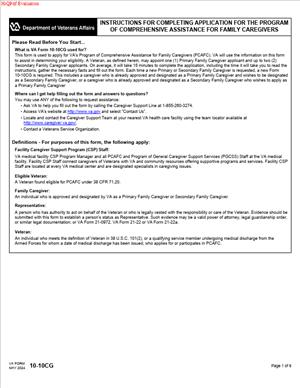
VA Form 10-10CG – Application for the Program of Comprehensive Assistance for Family Caregivers
Fill out nowJurisdiction: Country: United States | Province or State: Federal
The VA Form 10-10CG – Application for the Program of Comprehensive Assistance for Family Caregivers is the document used to apply for a federal program that supports caregivers of eligible veterans. It connects both the veteran and the caregiver to benefits designed to help with daily care needs.
If you are helping a veteran with personal care, supervision, or daily living activities, this form may be the first step toward formal support. The program can include training, financial assistance, and access to certain health services for caregivers.
This document is handled by the federal Department of Veterans Affairs. It is not a private agreement between family members. It is an official government application that begins a review process.
When you sit down to complete it, you are providing detailed information about the veteran’s health needs and your role as a caregiver. Accuracy matters because the information you provide is used to decide eligibility.
Understanding how the form works before you start can save time and reduce delays in processing.
What is VA Form 10-10CG – Application for the Program of Comprehensive Assistance for Family Caregivers?
Clear definition
VA Form 10-10CG – Application for the Program of Comprehensive Assistance for Family Caregivers is a federal application used to request enrollment in a caregiver support program administered by the Department of Veterans Affairs.
The form gathers information about the veteran’s service, medical condition, and need for personal care services. It also collects details about the individual applying to serve as the primary or secondary family caregiver.
This document starts a formal evaluation process. Submitting it does not automatically grant benefits. Instead, it allows the agency to review whether both the veteran and caregiver meet program requirements.
Who typically uses this form?
You would use this form if you are a veteran who needs regular personal care assistance, or if you are a family member or close individual who provides that care.
Often, the veteran and the caregiver complete the form together. In some cases, a legal representative or guardian may assist with the completion if the veteran cannot manage paperwork independently.
Primary caregivers are usually individuals who provide most of the hands-on care. Secondary caregivers may also be listed if they regularly assist but are not the main provider of daily support.
Why might you need this form?
You may need this form if the veteran requires help with activities such as bathing, dressing, eating, mobility, medication management, or supervision for safety.
The program connected to this form may offer a monthly stipend to eligible primary caregivers. It may also provide training, counseling, and access to certain health benefits related to the caregiver role.
Filing this application creates a record of the caregiving relationship and the level of support required. That documentation can be important when formal recognition of caregiver status is needed within the VA system.
Typical real-life scenarios
- A spouse provides daily assistance to a veteran who has mobility limitations due to a service-connected injury. The spouse helps with transfers, personal hygiene, and medication reminders. They use this form to seek structured support.
- An adult child moves into a veteran parent’s home after a serious medical event. The child now manages appointments, supervises safety, and assists with daily living tasks. They complete the application to explore eligibility for caregiver benefits.
- A veteran with cognitive impairment relies on a sibling for supervision and help with finances and daily routines. The sibling applies through this document to formalize their role within the caregiver program.
- A veteran who was recently discharged and now needs ongoing personal care identifies a trusted friend as a primary caregiver. Together, they submit the form to begin the review process.
When would you use VA Form 10-10CG – Application for the Program of Comprehensive Assistance for Family Caregivers?
You would use this form when caregiving has become consistent and significant, not occasional. The program is generally intended for veterans who need personal care services due to injury, illness, or disability.
This application is often used after a change in health status. For example, a new diagnosis, surgery, or decline in functioning may increase the need for daily support.
You may also use it when an informal caregiving arrangement needs to become official within the VA system. Formal recognition can open the door to evaluations, training, and possible financial support.
Veterans, spouses, partners, adult children, and other qualifying individuals commonly take part in the completion. The veteran’s participation is central because the benefits are connected to the veteran’s eligibility and care needs.
If you are unsure whether the level of care qualifies, the form itself begins the evaluation. The review process determines whether the situation meets program standards.
Legal characteristics of VA Form 10-10CG – Application for the Program of Comprehensive Assistance for Family Caregivers
This document is a federal benefits application. It becomes effective once it is properly completed, signed where required, and submitted to the appropriate VA office or facility.
For the form to be considered valid, required sections must be completed clearly. Missing signatures, incomplete identifying information, or unanswered mandatory questions can delay processing or result in rejection.
The information you provide must be truthful and accurate. Federal forms generally require certification that the statements made are correct to the best of your knowledge. Inaccurate or misleading information can affect eligibility decisions.
Because this is a federal program, rules are consistent across states. However, practical steps such as local review procedures or scheduling of evaluations may vary depending on the VA medical center handling the application.
It is important to understand what this form does not do. It does not create a private employment contract between the veteran and the caregiver. It does not automatically assign payment. It also does not replace other VA benefit applications that may be required for separate programs.
Is it legally binding?
The form itself is not a contract between two private parties. It is an official application submitted to a federal agency.
When you sign it, you are certifying that the information provided is accurate. That certification carries legal significance because it is a statement made to the federal government.
If approved, participation in the caregiver program may involve additional agreements, training requirements, and ongoing compliance with program rules. Those obligations arise from program enrollment rather than from the application form alone.
In short, signing the form binds you to the accuracy of your statements, but it does not by itself create a private legal contract between the veteran and the caregiver.
How to fill out VA Form 10-10CG – Application for the Program of Comprehensive Assistance for Family Caregivers
Step 1 – Gather essential information before you begin
Before starting the form, collect key details about the veteran and the caregiver. This typically includes full legal names, Social Security numbers or other identifying numbers, contact information, and service details.
Have basic medical information available, including diagnoses, limitations, and the type of daily assistance required. Preparing this information in advance helps you complete the document without leaving sections blank.
Step 2 – Provide veteran identification details
Enter the veteran’s full legal name, date of birth, and identification numbers exactly as they appear in official records. Accuracy here is critical because the VA uses this information to match the application to existing records.
Include current contact information. If the veteran has recently moved or changed phone numbers, make sure the details reflect the most up-to-date information.
Step 3 – Describe the veteran’s service information
Complete the section related to military service. This usually includes branch of service, service dates, and discharge status.
Provide information as it appears on official discharge documents when possible. Inconsistent dates or incomplete service history can slow down the review process.
Step 4 – Explain the veteran’s care needs
In the section about health and daily functioning, describe the types of assistance the veteran requires. Focus on specific activities such as bathing, dressing, mobility, feeding, supervision, or medication management.
Be clear and factual. Instead of general statements, explain what support is needed and how often it is required. This helps evaluators understand the level of care involved.
Step 5 – Enter primary caregiver information
Provide the full legal name, date of birth, and contact information of the person applying as the primary caregiver. Include the relationship to the veteran and details about living arrangements if requested.
Answer questions about the amount of care provided and how frequently you assist. This section helps determine whether the caregiving role meets program expectations.
Step 6 – Add secondary caregiver details if applicable
If there is a secondary caregiver, complete the required information for that person as well. This may include contact details and a description of the support they provide.
Make sure the roles are clearly defined. The primary caregiver and secondary caregiver have different responsibilities within the program structure.
Step 7 – Review declarations and certifications
Carefully read all statements near the end of the form. These often include privacy notices and certifications about the truthfulness of your answers.
Take time to understand what you are confirming. Signing means you acknowledge that the information is accurate and complete to the best of your knowledge.
Step 8 – Sign and date the form
Ensure that all required parties sign and date the application. This usually includes the veteran and the caregiver. Unsigned forms are commonly returned without processing.
Use consistent dates and verify that signatures match the printed names provided earlier in the document.
Step 9 – Make a complete copy before submission
Before submitting VA Form 10-10CG – Application for the Program of Comprehensive Assistance for Family Caregivers, make a full copy of the completed and signed document for your records. Keep this copy in a safe place along with any supporting information you provided.
Having a copy allows you to reference your answers if follow-up questions arise during the review process.
Legal terms you might encounter in VA Form 10-10CG – Application for the Program of Comprehensive Assistance for Family Caregivers
- Primary Family Caregiver: This is the main person who provides personal care services to the veteran. On this form, you must identify who will serve in this role and provide detailed contact and background information. The primary caregiver may be eligible for certain benefits, including a stipend and access to training, if approved.
- Secondary Family Caregiver: This is a backup caregiver who can step in when the primary caregiver is unavailable. You can list one or more secondary caregivers on the form. Each secondary caregiver must provide personal information and agree to participate in required training and evaluation.
- Eligible Veteran: This term refers to a veteran who meets specific service and clinical criteria for the program. The form asks for service history and health information to determine whether the veteran qualifies. Eligibility depends on factors such as service-connected conditions and the level of personal care needed.
- Personal Care Services: These are activities that help the veteran with daily living. The form asks you to describe assistance with bathing, dressing, eating, mobility, medication management, and supervision for safety. Your answers directly affect how the VA evaluates the level of need.
- Serious Injury: This generally means a condition incurred or aggravated in the line of duty that results in a need for ongoing care. On the form, you may need to describe how the injury or illness affects daily functioning. Clear details help the reviewer understand the severity and impact.
- Activities of Daily Living (ADLs): These are basic self-care tasks such as bathing, dressing, toileting, transferring, continence, and feeding. The form may require you to indicate which ADLs the veteran cannot perform independently. Be specific about frequency and level of assistance.
- Instrumental Activities of Daily Living (IADLs): These are more complex tasks like managing finances, cooking, shopping, and handling medications. The form may ask whether the veteran needs help with these tasks. This information supports the overall assessment of care needs.
- Certification and Signature: This section confirms that the information provided is true and complete. Both the veteran and the caregiver usually must sign. By signing, you acknowledge that false statements can affect eligibility and benefits.
- Privacy Act Statement: This explains how personal information will be used and protected. It appears on the form to inform you about data sharing within the Department of Veterans Affairs and related agencies. Reading this section helps you understand where your information may go.
- Stipend: This is a monthly financial benefit that may be paid to an approved primary caregiver. The form itself does not guarantee payment. Approval depends on a full review process after submission.
FAQs
Do both the veteran and the caregiver have to sign?
Yes. In most cases, the veteran and the proposed primary caregiver must both sign the document. If a secondary caregiver is listed, that person may also need to sign certain sections. Check the signature blocks carefully and make sure each required person signs and dates in the correct place.
What if the veteran cannot sign because of a medical condition?
If the veteran cannot sign, you must indicate who has legal authority to act on the veteran’s behalf. That may be a legal guardian, fiduciary, or person with a valid power of attorney. Enter that person’s full legal name and explain the authority clearly so the reviewer understands why the veteran’s signature is missing.
How detailed should I be when describing care needs?
Be specific and concrete. Instead of writing “needs help daily,” explain what tasks require assistance, how often help is needed, and what happens if help is not provided. For example, state whether the veteran needs hands-on assistance with bathing every day or supervision due to memory issues. Detailed answers help avoid follow-up requests for clarification.
Do I need to attach medical records to VA Form 10-10CG – Application for the Program of Comprehensive Assistance for Family Caregivers?
You are not always required to attach records at the time you complete this form, but you should follow any instructions provided with it. The agency may already have access to the veteran’s treatment records. If you do submit attachments, make sure the veteran’s name and identifying information appear on each page.
What happens after I submit this form?
After submission, the application goes through an eligibility review. They may be scheduled for a clinical evaluation, and the caregiver may need to complete training. You may receive written notice confirming receipt and, later, a decision explaining approval or denial.
Can I change the primary caregiver after approval?
Yes, but you must formally update the record. This usually requires submitting additional paperwork or a new application. Do not assume that simply informing a local office verbally will change the designation in the system.
What if I make a mistake on this document?
If you notice an error before submission, correct it clearly and neatly. If you already submitted it, contact the appropriate office as soon as possible to explain the mistake. You may be asked to submit a corrected page or a new VA Form 10-10CG – Application for the Program of Comprehensive Assistance for Family Caregivers to ensure the file reflects accurate information.
How do I know if my application was accepted for processing?
Acceptance for processing means the agency received the paperwork, not that you are approved. You should receive confirmation by mail or through an official communication channel. Keep copies of everything you sent so you can reference dates and details if you need to follow up.
Checklist: Before, During, and After VA Form 10-10CG – Application for the Program of Comprehensive Assistance for Family Caregivers
Before
- Confirm the veteran meets basic service and care criteria for the program.
- Gather the veteran’s full legal name, Social Security number, and contact details.
- Collect service history information, including branch and dates of service.
- Write down specific examples of daily care needs and supervision.
- Identify who will serve as primary and secondary caregivers.
- Review any existing legal authority documents, if someone signs for the veteran.
- Set aside enough uninterrupted time to complete the form carefully.
During
- Read each question fully before writing an answer.
- Print clearly or type if completing electronically.
- Use full legal names that match official records.
- Provide detailed explanations for care needs instead of brief phrases.
- Double-check Social Security numbers and dates for accuracy.
- Ensure all required sections are completed without leaving blanks.
- Review and sign all certification statements in the correct places.
After
- Make a complete copy of the signed form for your records.
- Organize any attachments and keep copies of those as well.
- Submit the application using an approved submission method.
- Note the date you sent or delivered the form.
- Watch for written confirmation of receipt.
- Respond promptly to any requests for additional information.
- Keep a file with all correspondence related to the application.
Common mistakes to avoid with VA Form 10-10CG – Application for the Program of Comprehensive Assistance for Family Caregivers
- Mistake: Providing vague descriptions of care needs because you assume the agency already knows the medical history, which can delay review or lead to denial; do not forget to describe specific daily tasks and frequency of assistance.
- Mistake: Leaving sections blank because they seem unimportant, which can result in the application being returned as incomplete; do not forget to review every page and answer each required question.
- Mistake: Using nicknames instead of legal names because that is what you use at home, which can cause identity verification problems; do not forget to match names exactly to official identification.
- Mistake: Forgetting a required signature because multiple people must sign, which can invalidate the submission; do not forget to check every signature and date line before sending.
- Mistake: Failing to keep a copy of the completed form because you are in a hurry, which makes it harder to respond to follow-up questions; do not forget to save or print a full copy.
- Mistake: Assuming approval is automatic once you submit, which can lead to financial planning problems; do not forget that benefits begin only after formal approval.
What to do after filling out VA Form 10-10CG – Application for the Program of Comprehensive Assistance for Family Caregivers
Once you complete and sign the form, slow down before you send it. A careful final review can prevent weeks of delay. Check that every page is included and that no required field is missing.
- Step 1: Make a full copy of the signed form, including all attachments.
- Step 2: Confirm the correct submission method listed in the form instructions.
- Step 3: Submit the application using the approved channel and note the date.
- Step 4: Store your copy in a dedicated folder, either physical or digital.
- Step 5: Monitor your mail and official messages for confirmation of receipt.
- Step 6: Respond quickly to any request for additional documents or clarification.
- Step 7: Prepare for possible evaluations, including clinical assessments for the veteran and training requirements for the caregiver.
- Step 8: Keep a written log of phone calls, letters, and appointments related to the application.
- Step 9: If approved, review the approval notice carefully and confirm that the designated primary and secondary caregivers are listed correctly.
- Step 10: Update your personal records and care plans to reflect any new responsibilities or benefits.
Stay organized throughout the process. Keep every notice you receive. If circumstances change, such as a new address or a change in caregiver, report the update promptly through the proper process. Careful recordkeeping helps protect both the veteran and the caregiver and supports a smoother review experience.
Disclaimer: This guide is provided for informational purposes only and is not intended as legal advice. You should consult a legal professional.