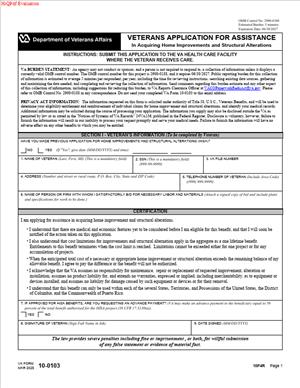
VA Form 10-0103 – Veterans Application for Assistance
Fill out nowJurisdiction: Country: United States | Province or State: Federal
VA Form 10-0103 – Veterans Application for Assistance is a federal form used by veterans and, in some cases, their families to request specific types of help through the U.S. Department of Veterans Affairs. If you are about to complete this document, you likely want to understand what information it asks for and what happens after you submit it.
This form is part of the VA’s broader system for delivering support and services. It helps the agency identify who you are, confirm your eligibility, and determine what kind of assistance you are requesting.
Filling out VA Form 10-0103 – Veterans Application for Assistance carefully matters because it can affect how quickly your request is processed. Incomplete or inconsistent information can slow down review.
Before you begin, it helps to know what the form is designed to do, what it does not do, and how your answers may be used. That context makes each section easier to complete with confidence.
What is VA Form 10-0103 – Veterans Application for Assistance?
Clear definition
VA Form 10-0103 – Veterans Application for Assistance is an official federal application used to request certain support services offered by the Department of Veterans Affairs. It collects personal, service-related, and contact information so the agency can evaluate eligibility and respond to your request.
The form functions as a formal written request. By submitting it, you are asking the VA to review your situation and determine whether you qualify for the specific assistance described in the document.
It is not a general inquiry form. It is structured to gather details necessary for an administrative decision.
Who typically uses this form?
This form is commonly used by veterans seeking assistance connected to their military service. In some cases, a family member, caregiver, or authorized representative may complete or help complete the form on a veteran’s behalf.
You might use this form if you are newly seeking assistance and have not previously applied for that specific benefit. It may also be used when requesting a particular program that requires a separate application, even if you already receive other VA benefits.
Individuals who are assisting veterans, such as accredited representatives or support staff, may also work with this document during the application process.
Why might you need this form?
You may need this form when the VA requires a formal written application before reviewing your eligibility for assistance. Many federal programs cannot begin without a completed and signed submission.
The form provides the VA with consistent information in a standardized format. This allows the agency to compare your details with service records and other documentation already on file.
It also creates an official record of your request. That record can be important if there are follow-up questions, additional document requests, or later reviews.
Completing the form is often the first step in accessing structured support rather than informal guidance.
Typical real-life scenarios
- You recently separated from military service and learned you may qualify for a specific type of assistance. To begin the process, you complete the application so the VA can assess your eligibility.
- You have been receiving certain benefits but now need additional support due to a change in circumstances. The VA requires a new application for that specific program, and you use this form to provide updated details.
- A family member is helping an elderly veteran apply for assistance. They gather discharge papers and identification documents, then work through the form together to ensure accuracy.
- You previously contacted the VA for information and were told that a formal application is required. This form becomes the official way to move from an inquiry to a review.
When would you use VA Form 10-0103 – Veterans Application for Assistance?
You would use this form when the VA requires a structured application to consider your request for assistance. This usually happens at the beginning of a benefits or services process.
It may be used after you speak with a VA representative who explains that eligibility cannot be determined without a completed application. The form becomes the starting point for evaluation.
You might also use it when reapplying after a prior denial, if the program allows a new submission based on updated information. In that situation, the form provides a fresh record reflecting your current circumstances.
If you are acting as an authorized representative, you may complete the form alongside the veteran to ensure all required fields are addressed. The document is designed to capture both identity and service-related details in one place.
Because this is a federal form, it is used consistently across the United States. Processing and review procedures are handled at the federal level rather than by individual states.
Legal characteristics of VA Form 10-0103 – Veterans Application for Assistance
VA Form 10-0103 – Veterans Application for Assistance is an administrative application. Its legal effect comes from federal regulations that govern how the Department of Veterans Affairs processes requests.
For the form to be effective, it generally must be complete, legible, and signed where required. Missing signatures, blank mandatory fields, or inconsistent identifying information can delay review or lead to the form being returned for correction.
The information you provide is typically reviewed against official military service records and other documentation. If the details do not match, the VA may request clarification or supporting documents.
Common issues that cause problems include incorrect service dates, mismatched names due to name changes, and failure to include required attachments. Even small errors in identification numbers can slow verification.
Because this is a federal document, its structure and review standards are generally uniform nationwide. However, internal processing times and administrative practices may vary by office or workload.
It is important to understand what the form does not do. Submitting it does not automatically grant benefits or guarantee approval. It initiates a review process. The final outcome depends on eligibility rules and the information provided.
Is it legally binding?
VA Form 10-0103 – Veterans Application for Assistance is not a contract between you and the government. It does not create a negotiated agreement. Instead, it is a formal request for consideration under existing federal programs.
When you sign the form, you are typically certifying that the information you provided is true and accurate to the best of your knowledge. That certification carries legal significance. Providing knowingly false information can have consequences under federal law.
The binding element relates to your statements and attestations, not to an automatic approval of benefits. The VA is not obligated to grant assistance simply because the form is submitted.
If the VA approves your application, any resulting benefits or services are governed by federal statutes and regulations. The form itself serves as the gateway to that administrative decision.
How to fill out VA Form 10-0103 – Veterans Application for Assistance
Step 1 – Review the entire form before writing anything
Start by reading through the full document from beginning to end. This gives you a clear picture of what information is required and what documents you may need to gather.
Pay attention to instructions printed on the form. Some sections may apply only in certain situations. Understanding the structure in advance helps you avoid incomplete answers.
Step 2 – Provide your personal identification information
Enter your full legal name exactly as it appears on official records. Include any middle name or suffix if requested.
Fill in your date of birth, Social Security number, and current contact details as required. Make sure this information matches your military and VA records to reduce verification issues.
If you have had a name change, follow the form’s instructions for listing prior names.
Step 3 – Enter your military service details
Provide the requested information about your branch of service, dates of active duty, and discharge status. Use official documents, such as your discharge papers, to ensure accuracy.
Double-check service entry and separation dates. Even small errors can cause delays when records are reviewed.
If the form asks for service numbers or related identifiers, copy them carefully from official records.
Step 4 – Describe the assistance you are requesting
Complete the section that identifies the type of assistance you are seeking. Be clear and consistent in your answers.
If the form includes checkboxes, select the options that accurately reflect your request. If narrative explanations are required, write clearly and keep your statements focused on the information asked.
Avoid leaving required sections blank. If a question does not apply, follow the form’s instructions for indicating that.
Step 5 – Provide additional background information if required
Some versions of the form may request details about your current circumstances, such as health, financial status, or living situation. Answer these questions honestly and completely.
If additional documentation is needed, gather it before submitting your application. Attach copies as directed, not original documents unless specifically requested.
Make sure any attachments clearly show your name or identifying number so they can be matched to your form.
Step 6 – Review your answers for accuracy and completeness
Before signing, read through each section again. Confirm that all required fields are filled in and that your responses are consistent.
Check for spelling errors in your name and numerical errors in identification numbers. Verify that all pages of the form are included.
If someone assisted you in completing the document, ensure their information is included if the form asks for it.
Step 7 – Sign and date the form
Locate the signature section and sign your full legal name as instructed. Enter the date of signing in the required format.
If the form allows or requires a representative’s signature, make sure that section is completed properly.
A missing signature is one of the most common reasons applications are returned. Confirm that every required signature line has been completed before submission.
Legal terms you might encounter in VA Form 10-0103 – Veterans Application for Assistance
- Applicant: This is you, the veteran completing the form. The applicant is the person requesting assistance and providing personal, service, and contact information. Your name must match your official records to avoid processing delays.
- Service Number: This is the identification number assigned to you during your military service. Older records may list a service number instead of a Social Security number. You must enter the correct number exactly as it appears on your discharge documents.
- Social Security Number (SSN): This is used to identify your federal records and match your request with existing files. It must be accurate. Even one incorrect digit can prevent the VA from locating your records.
- Character of Discharge: This refers to how you were released from military service, such as honorable, general, or other-than-honorable. The character of discharge can affect eligibility for certain benefits or assistance programs. You should copy this information directly from your discharge paperwork.
- Period of Service: This means the dates you entered and left active duty. You must list these dates clearly and completely. Incomplete service timelines can result in follow-up requests for clarification.
- Claim Number: If you have previously filed for VA benefits, you may have a claim number. Including it helps connect your current request to past applications. If you do not know it, check prior correspondence from the VA.
- Dependent: A dependent is a spouse, child, or other qualifying family member who relies on you financially. Some assistance programs consider dependents when determining eligibility or level of support. You must provide accurate information about each dependent.
- Supporting Documentation: These are documents you attach to support your request. Examples include discharge papers, medical records, financial statements, or prior VA decisions. Submitting clear and complete documentation helps avoid delays.
- Certification: This is your formal statement that the information you provided is true and correct. By signing the form, you certify that everything is accurate to the best of your knowledge. False information can result in denial or penalties.
- Authorized Representative: This is a person legally allowed to act on your behalf. If someone else completes or signs the form for you, their authority must be clearly stated and documented.
FAQs
Do I have to complete every section of VA Form 10-0103 – Veterans Application for Assistance?
You should complete every section that applies to you. If a section does not apply, write “N/A” instead of leaving it blank. Blank spaces may cause the reviewer to question whether you missed something. Always review the instructions at the top of each section to confirm what is required.
What if my name has changed since my military service?
If your current legal name is different from the name on your service records, list both. Enter your current legal name where requested and include your former name in any section that asks for other names used. Make sure the spelling matches your official documents. You may need to attach proof of the name change so your records can be properly matched.
How do I know which service dates to enter?
Use the exact entry and separation dates shown on your discharge papers. Do not estimate. If you had multiple periods of service, list each one separately if the form provides space. If it does not, attach an additional sheet with the full timeline so your record is complete.
What documents should I attach to this form?
Attach copies of documents that directly support your request. This often includes discharge paperwork, identification, and any records that explain why you are requesting assistance. Do not send original documents unless specifically instructed. Make sure each attachment clearly shows your name and identifying number.
Can someone else fill out and sign this document for me?
Yes, but only if they are legally authorized to do so. The form must clearly show their role, such as authorized representative or legal guardian. They must provide their contact information and sign in the appropriate section. If authorization paperwork is required, attach it to avoid rejection.
What happens after I submit VA Form 10-0103 – Veterans Application for Assistance?
Once submitted, the form is reviewed to confirm your identity and eligibility. The agency may contact you if information is missing or unclear. Processing times vary depending on workload and the complexity of your request. Keep copies so you can respond quickly if additional details are requested.
How can I confirm that my application was received?
If you submit by mail, consider using a tracking method so you have proof of delivery. If you submit electronically, save the confirmation page or email. Keep this confirmation with your records. If you do not receive acknowledgment within a reasonable period, follow up using the contact information provided in the instructions.
What should I check before signing the certification section?
Read every answer carefully and confirm it matches your supporting documents. Make sure your identifying numbers, dates, and spellings are correct. Ensure all required attachments are included. Your signature confirms accuracy, so review the entire document one final time before signing.
Checklist: Before, During, and After VA Form 10-0103 – Veterans Application for Assistance
Before
- Gather your discharge papers and verify your character of discharge.
- Locate your Social Security number and any prior claim number.
- Confirm your full legal name matches your identification documents.
- Collect supporting documents related to your request for assistance.
- Review instructions to understand which sections apply to you.
- Make a list of any prior assistance or benefits you have requested.
- Ensure you have accurate contact information, including mailing address and phone number.
During
- Print clearly or type to avoid unreadable information.
- Enter all dates in the required format.
- Write “N/A” in sections that do not apply.
- Double-check spelling of names and identification numbers.
- Attach copies, not originals, of supporting documents.
- Complete every required signature and date line.
- Confirm that any representative information is fully completed.
- Review each page to ensure nothing is missing.
After
- Make a full copy of the completed form and attachments.
- Save proof of submission or delivery confirmation.
- Store your copy in a secure but accessible location.
- Mark your calendar to follow up if you do not receive confirmation.
- Respond promptly to any request for additional information.
- Update your personal records to note the date you submitted the form.
- Keep all future correspondence together with your copy.
Common mistakes to avoid with VA Form 10-0103 – Veterans Application for Assistance
- Mistake: Leaving sections blank because you are unsure what to write, which often happens when instructions are skimmed, leading to processing delays or returned applications; do not forget to write “N/A” if a section does not apply.
- Mistake: Entering incorrect service dates from memory, which happens when discharge papers are not reviewed, causing record mismatches and verification delays; do not forget to copy dates exactly from official documents.
- Mistake: Sending original documents instead of copies, often done to appear thorough, which can result in lost records and difficulty replacing them; do not forget to keep originals safely stored.
- Mistake: Using a nickname instead of your legal name, which occurs out of habit, leading to identification issues and requests for clarification; do not forget to use the exact name shown on official records.
- Mistake: Forgetting to sign and date the certification section, which is common when focusing on attachments, resulting in automatic rejection; do not forget that an unsigned form is incomplete.
- Mistake: Failing to include representative authorization paperwork, which happens when someone else helps complete the form, causing delays or refusal to discuss your case; do not forget to attach proof of authority.
- Mistake: Providing outdated contact information, which occurs when recent moves or phone changes are not updated, leading to missed correspondence; do not forget to verify your current address and phone number.
- Mistake: Submitting incomplete supporting documentation, which often happens when applicants assume records are already on file, resulting in follow-up requests and slower review; do not forget to attach documents that directly support your request.
What to do after filling out VA Form 10-0103 – Veterans Application for Assistance
Once you complete the form, pause before sending it. A careful final review can prevent weeks of delay. Read each page slowly and compare your answers to your supporting documents.
Make sure your attachments are in logical order. Place identification documents first, then service records, then any materials related to your request. This helps the reviewer understand your situation quickly.
- Step 1: Make a complete copy of the signed form and every attachment.
- Step 2: Submit the form using the method described in the official instructions, such as mail or electronic submission if available.
- Step 3: Save proof of submission, such as a receipt, tracking number, or confirmation page.
- Step 4: Record the date you submitted the form in your personal records.
- Step 5: Monitor your mail, email, or online account for acknowledgment or follow-up requests.
- Step 6: Respond promptly if additional information or clarification is requested.
- Step 7: Keep all correspondence together in one dedicated folder.
- Step 8: Update your contact information immediately if it changes during the review period.
- Step 9: Note any reference or case number assigned to your request and use it in future communications.
- Step 10: Retain your copy of the completed form for long-term records, even after your request is resolved.
Stay organized throughout the process. If you speak with a representative by phone, write down the date, the name of the person you spoke with, and a summary of the conversation. This record can help if questions arise later.
Most importantly, be patient but proactive. If you do not receive confirmation within a reasonable timeframe, follow up using the contact information provided in the submission instructions. Clear communication and good recordkeeping will help your request move forward smoothly.
Disclaimer: This guide is provided for informational purposes only and is not intended as legal advice. You should consult a legal professional.