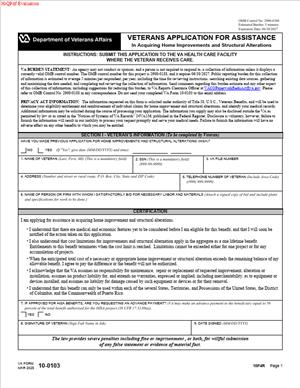
VA Form 10-0103 – Veterans Application for Assistance in Acquiring Home Improvements and Structural Alterations
Fill out nowJurisdiction: Country: United States | Province or State: Federal
VA Form 10-0103 – Veterans Application for Assistance in Acquiring Home Improvements and Structural Alterations is a federal form used by veterans and certain service members to request financial help for medically necessary home modifications. It connects your health needs to the changes required in your living space.
This document is part of a program administered by the U.S. Department of Veterans Affairs. The goal is to help eligible individuals live more safely and independently at home.
If you are preparing to fill out this form, you are likely facing a specific medical challenge. You may need ramps, bathroom modifications, widened doorways, or other structural changes tied to a service-connected or qualifying condition.
Understanding what the form asks for can save time and prevent delays. This guide explains what the form is, when it is used, and how to complete it clearly and accurately.
What is VA Form 10-0103 – Veterans Application for Assistance in Acquiring Home Improvements and Structural Alterations?
Clear definition
VA Form 10-0103 – Veterans Application for Assistance in Acquiring Home Improvements and Structural Alterations is a written request for financial assistance to modify a home for medical reasons. It allows you to ask the Department of Veterans Affairs to help cover the cost of specific structural improvements.
The form gathers details about you, your medical condition, your home, and the proposed modifications. It also requires medical justification from a VA health care provider or authorized clinician. The focus is on functional needs, not cosmetic upgrades.
This is not a general home repair application. It is limited to improvements that are medically necessary and directly related to your diagnosed condition.
Who typically uses this form?
You typically use this form if you are a veteran enrolled in the VA health care system and have a medical condition that affects mobility, access, or safety in your home. Some active-duty service members may also qualify under certain circumstances.
Common users include veterans who use wheelchairs, walkers, or other mobility aids. It also includes individuals with respiratory conditions, visual impairments, or other disabilities that require structural changes for safe daily living.
In some cases, a caregiver or family member helps complete the form. However, the request is made on behalf of the eligible veteran or service member.
Why might you need this form?
You may need this form if your current home setup creates barriers to basic activities. These activities include bathing, entering or exiting the home, cooking, or moving between rooms.
For example, stairs at the entrance may prevent safe access. A narrow bathroom doorway may block wheelchair use. A bathtub may pose a fall risk due to limited balance or strength.
This form starts the official process of requesting financial assistance for those changes. Without it, the VA generally cannot review or approve funding for the proposed improvements.
Typical real-life scenarios
- You recently began using a wheelchair due to a service-connected spinal injury. Your bathroom door is too narrow to enter safely. You need to widen the doorway and modify the sink area for access.
- You have severe knee and hip limitations. Climbing stairs to enter your home causes pain and instability. A ramp and handrails may reduce the risk of falling.
- You live in an older home with a traditional bathtub. After a stroke, stepping over the tub wall is unsafe. You need a roll-in shower or a walk-in modification to bathe independently.
- You have a respiratory condition that requires specialized ventilation or air filtration equipment. Structural changes may be needed to install and operate that equipment safely.
- In each situation, the key factor is medical necessity. The improvements must be directly connected to your diagnosed condition and daily functional needs.
When would you use VA Form 10-0103 – Veterans Application for Assistance in Acquiring Home Improvements and Structural Alterations?
You use this form when a VA clinician determines that home modifications are medically necessary. The process usually begins during medical treatment or evaluation within the VA health system.
Often, a primary care provider, occupational therapist, or rehabilitation specialist identifies safety concerns in your living environment. They may recommend specific structural changes to support mobility or reduce risk.
You would also use the form before starting construction if you plan to request VA funding. Submitting the document in advance allows the VA to review the proposal and determine eligibility and scope.
In many cases, estimates from contractors are part of the process. The form helps connect those estimates to a documented medical need. It brings together medical approval and housing details in one filing.
You may also use this form if your condition changes over time. A worsening disability can create new barriers in your home. If additional modifications become necessary, a new application may be required.
The form is typically submitted through your VA medical center or the appropriate department handling prosthetics and sensory aids services. The exact internal routing can vary, but the form itself remains a federal document used nationwide.
Legal characteristics of VA Form 10-0103 – Veterans Application for Assistance in Acquiring Home Improvements and Structural Alterations
This form is an official federal document. It is part of an administrative benefits process, not a private contract between you and a contractor.
For the form to be effective, it must be completed fully and accurately. Required sections generally include personal identification details, a description of the home, and medical authorization or recommendation. Missing information can slow review or lead to return for correction.
Medical documentation is central to the request. The VA evaluates whether the proposed alterations are medically justified and consistent with program rules. If the changes are not clearly tied to a qualifying condition, the request may not be approved.
The form does not guarantee funding. Approval depends on eligibility, medical necessity, and program limits. There may also be caps on the amount of assistance available during a lifetime.
Because this is a federal program, the core rules apply across all states. However, housing codes, contractor licensing, and local building requirements vary by state or municipality. Those local requirements operate separately from the VA approval process.
The form does not transfer property rights. It does not change ownership of your home. It also does not serve as a building permit or construction agreement. It is strictly a request for financial assistance under a federal benefits program.
Is it legally binding?
The form itself is not a binding contract in the traditional sense. By signing it, you are certifying that the information you provide is true and complete to the best of your knowledge.
Your signature authorizes the VA to review your medical information and evaluate the request. It may also confirm that you understand program conditions, including limits on funding and use of funds.
If the VA approves the application, the approval can create obligations related to how funds are used. For example, funds are typically restricted to the approved modifications. Using them for unrelated purposes could create administrative consequences.
The binding effect, in practical terms, relates to accuracy and compliance with program rules. The document is part of a federal record, and false statements can carry serious implications.
How to fill out VA Form 10-0103 – Veterans Application for Assistance in Acquiring Home Improvements and Structural Alterations
Step 1 – Review the entire form before writing anything
Read through every page of the form from start to finish. Notice the sections that require your information and the sections that must be completed by a medical provider.
This first review helps you understand what documents you may need. You may need identification details, contact information, and written cost estimates for proposed modifications.
Step 2 – Provide your personal identification information
Enter your full legal name exactly as it appears in your VA records. Include your Social Security number or other required identification number, if requested.
Provide your current address and reliable contact details. Make sure the address matches the home where the modifications will take place.
Accuracy matters here. Errors in identifying information can delay processing or cause confusion in your file.
Step 3 – Describe the property to be modified
Indicate whether the home is owned or rented. Provide the full address of the property where the improvements are planned.
If the form asks about type of dwelling, answer clearly. For example, identify whether it is a single-family home, apartment, or other structure.
If you do not own the home, additional authorization from the property owner may be required. The form may request written consent for structural changes.
Step 4 – Explain the requested home improvements
List the specific structural alterations you are requesting. Use clear and practical language.
Instead of writing “bathroom upgrade,” describe the actual modification. For example, state that you are requesting installation of a roll-in shower, grab bars, and widening of the doorway.
If estimates are required, include the projected cost for each item. Ensure that the description matches the contractor’s estimate and the medical recommendation.
Step 5 – Connect the improvements to your medical condition
This section typically requires medical input. A VA clinician may need to certify that the requested changes are medically necessary.
Make sure the explanation clearly links your condition to the proposed modifications. For example, reduced lower-body strength may justify a ramp and handrails.
The medical portion must be complete. An unsigned or incomplete certification can prevent the application from moving forward.
Step 6 – Review funding limits and prior assistance
If the form asks about previous assistance under the same program, answer honestly. Indicate whether you have received similar benefits before.
Some programs have lifetime maximum amounts. Your response helps the VA determine available funding under current rules.
Check that all financial figures are accurate and consistent across the form and any attached estimates.
Step 7 – Sign and date the form
Read the certification statement carefully before signing. By signing, you confirm that the information is true and that you understand the program conditions.
Sign and date the form in the designated area. If a representative is signing on your behalf, ensure that the appropriate authorization is included, if required.
Confirm that all required signatures, including medical provider signatures, are present before submission.
Step 8 – Make a copy and submit through the appropriate VA channel
Before submitting, make a complete copy of the finished form and all attachments for your records. Keep copies of cost estimates and medical documentation.
Submit the form according to the instructions provided by your VA medical center or program office. Ensure that all pages and supporting documents are included in the submission package.
After submission, keep track of any communication from the VA regarding follow-up information or additional documentation requests.
Legal terms you might encounter in VA Form 10-0103 – Veterans Application for Assistance in Acquiring Home Improvements and Structural Alterations
- Service-Connected Disability: This refers to a medical condition that the Department of Veterans Affairs has officially determined was caused or worsened by your military service. On this form, you may need to indicate whether your disability is service-connected because it can affect eligibility and funding limits. The VA will match your statement with its existing records, so your information must be consistent.
- Non-Service-Connected Disability: This means a medical condition not directly tied to your military service. You can still qualify for assistance in some cases, but the benefit limits may differ. The form may ask you to clarify your status so the VA can apply the correct funding rules.
- Home Improvements and Structural Alterations (HISA): This is the benefit program that provides financial assistance for medically necessary changes to your home. The term covers permanent changes such as widening doorways, installing ramps, or modifying bathrooms. It does not cover luxury upgrades or general home repairs unrelated to your medical needs.
- Medically Necessary: This phrase means the requested modification is required to treat, accommodate, or improve a diagnosed medical condition. A VA clinician must usually confirm this. If your request is not clearly tied to a documented condition, it may be denied.
- Primary Residence: This is the home where you live most of the time. The form typically requires you to confirm that the improvements will be made to your primary residence. Rental properties or secondary homes are generally not eligible.
- Property Owner Authorization: If you do not own the home, the legal owner must give written permission for the modifications. The VA needs this to ensure the work is authorized. Without it, your application may not move forward.
- Lifetime Benefit Cap: This is the maximum dollar amount you can receive under the program over your lifetime. The form may ask whether you have previously used HISA benefits. The VA will calculate how much remains available to you.
- Itemized Estimate: This is a written breakdown from a contractor showing the specific work to be done and the cost of each part. The VA uses this to evaluate whether the proposed changes are reasonable and medically appropriate. A vague or lump-sum estimate can delay review.
- Certification: This usually refers to a statement signed by a VA health care provider confirming the medical need for the alteration. It connects your condition to the requested home change. Without this certification, your request may not be approved.
- Applicant Signature: Your signature confirms that the information you provided is true and complete. It also authorizes the VA to review your records as needed. An unsigned form is not considered valid.
FAQs
Do I need a doctor’s statement before submitting VA Form 10-0103 – Veterans Application for Assistance in Acquiring Home Improvements and Structural Alterations?
In most cases, yes. You need a statement or certification from a VA health care provider explaining why the home modification is medically necessary. Before submitting, confirm that the provider has clearly described your condition and linked it to the specific improvement you listed on the form.
What if I rent my home?
You can still apply, but you must include written permission from the property owner. Make sure the authorization clearly states that the owner approves the specific alterations described in this document. Without that attachment, processing may stop until it is provided.
How do I show that the costs are accurate?
You should attach a detailed, itemized estimate from a contractor. The estimate must match the exact work described in your application. If the numbers on the estimate and the form do not align, the VA may ask for clarification or a revised quote.
What happens if I already received assistance in the past?
The VA tracks prior benefits under this program. On this form, you will need to indicate whether you previously used HISA funds. The agency will calculate your remaining lifetime benefit cap and notify you if the requested amount exceeds what is available.
Can I start construction before my application is approved?
Starting early can create problems. If you begin work before receiving approval, you risk not being reimbursed. Wait for written confirmation that your request has been reviewed and authorized before committing to construction.
What if my name is different from what appears in VA records?
Your name on this document must match the name in your VA health records. If you recently changed your name, include supporting documentation. This helps avoid delays caused by identity verification issues.
How will I know if my application was accepted?
After submission, you should receive confirmation that the form was received and is under review. If something is missing, you may get a request for additional information. Keep copies of everything you submitted so you can respond quickly.
Does this form change my property ownership or public records?
No. This document requests financial assistance for medically necessary home changes. It does not transfer ownership, create a lien by itself, or automatically update property records. However, you remain responsible for complying with any local building or permit requirements.
Checklist: Before, During, and After VA Form 10-0103 – Veterans Application for Assistance in Acquiring Home Improvements and Structural Alterations
Before
- Confirm you are enrolled in VA health care.
- Verify whether your disability is service-connected or non-service-connected.
- Schedule an evaluation with a VA clinician to discuss medical necessity.
- Obtain written medical certification linking your condition to the requested modification.
- Gather at least one detailed, itemized contractor estimate.
- Confirm the work will be done at your primary residence.
- Obtain written property owner authorization if you rent.
- Check whether you previously used HISA benefits and how much remains.
During
- Read every section carefully before writing.
- Enter your full legal name exactly as it appears in VA records.
- Provide accurate contact information so the VA can reach you.
- Clearly describe each requested home improvement.
- Make sure the description matches the contractor’s estimate.
- Attach all required documents, including medical certification and estimates.
- Review funding limits before listing total costs.
- Sign and date the form in the appropriate space.
After
- Make a complete copy of the signed form and all attachments.
- Submit the application through the approved VA channel.
- Track the date you submitted the package.
- Watch for written confirmation or follow-up requests.
- Respond promptly if the VA asks for additional documents.
- Wait for written approval before starting construction.
- Keep all receipts and final invoices after the work is completed.
- Store approval letters with your permanent records.
Common mistakes to avoid with VA Form 10-0103 – Veterans Application for Assistance in Acquiring Home Improvements and Structural Alterations
- Mistake: Submitting the form without medical certification because you assume your condition is already on file, which happens when applicants think existing records are enough, leading to delays or denial, and forgetting to attach a clear provider statement linking the condition to the specific modification.
- Mistake: Providing a vague contractor quote, which occurs when you accept a simple total price without details, causing review delays or requests for clarification, and forgetting to ensure the estimate is itemized and matches your description.
- Mistake: Starting construction before approval, often due to urgency or contractor scheduling pressure, risking non-reimbursement, and forgetting to wait for written authorization.
- Mistake: Listing improvements unrelated to your medical need, which happens when you try to combine general home upgrades with necessary alterations, leading to partial denial, and forgetting to separate non-covered work.
- Mistake: Failing to disclose prior HISA benefits, usually because you do not remember past assistance, which can create discrepancies in your funding limit, and forgetting to verify your benefit history.
- Mistake: Leaving the signature line blank, often due to rushing, which makes the application invalid, and forgetting to sign and date before submission.
- Mistake: Using a nickname or outdated name, which happens after a name change or informal use, causing identity verification delays, and forgetting to ensure your legal name matches VA records.
- Mistake: Not including landlord permission when renting, which occurs when tenants assume verbal approval is enough, resulting in processing delays, and forgetting to attach written authorization.
What to do after filling out VA Form 10-0103 – Veterans Application for Assistance in Acquiring Home Improvements and Structural Alterations
Once you complete the form, slow down before sending it. A careful final review can prevent weeks of delay.
- Step 1: Review every page for completeness.
Make sure each required field is filled in. Confirm your contact information is correct. Double-check that your description of the improvements matches the contractor’s written estimate word for word where possible.
- Step 2: Confirm all attachments are included.
You should have your medical certification, itemized estimate, and property owner authorization if needed. Place them in a logical order behind the form.
- Step 3: Sign and date the form.
Your signature validates the application. Ensure the date is accurate and legible.
- Step 4: Make complete copies.
Create a full copy of the signed form and every attachment. Keep both a paper copy and a scanned digital version if possible.
- Step 5: Submit through the appropriate VA submission method.
Follow the submission instructions provided by your VA medical facility or benefits office. Record the date and method of submission for your records.
- Step 6: Track confirmation of receipt.
Watch for written or electronic confirmation that your application was received. If you do not receive acknowledgment within a reasonable time, follow up using your saved copy for reference.
- Step 7: Respond quickly to requests for additional information.
If the VA asks for clarification or more documentation, provide exactly what is requested. Reference your original submission to keep details consistent.
- Step 8: Wait for written approval before starting work.
Do not rely on verbal conversations. Keep the official approval letter in your records.
- Step 9: Keep all invoices and proof of payment.
After the work is completed, retain contractor invoices and payment receipts. These documents may be required for reimbursement or final processing.
- Step 10: Update your personal records.
Store the approval letter, receipts, and a copy of the completed form with your important documents. This will help if you apply for additional assistance later or need to confirm how much of your lifetime benefit remains.
Taking these steps protects you. It reduces delays. It also creates a clear record of what you requested, what was approved, and what work was completed.
Disclaimer: This guide is provided for informational purposes only and is not intended as legal advice. You should consult a legal professional.