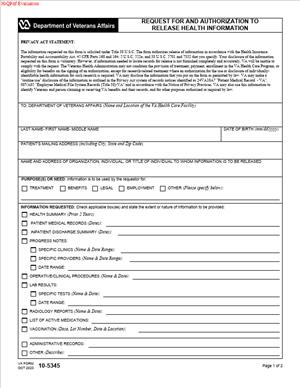
Form VA-10-5345 – Request for and Authorization to Release Health Information
Fill out nowJurisdiction: Country: United States | Province or State: Federal
Form VA-10-5345 – Request for and Authorization to Release Health Information is a federal document used to give permission for the release of medical records from the Department of Veterans Affairs. If you are about to complete this form, you are likely trying to access or share health information connected to VA medical treatment.
This document allows the VA to send your health records to a person or organization you choose. Without written authorization, your records are generally kept private and cannot be shared.
You may need this form for a disability claim, insurance review, legal matter, or personal records request. It is often used by veterans, but it can also be completed by a legal representative or guardian in certain situations.
Filling it out correctly matters. Incomplete or unclear information can delay the release of records. Understanding what the form does and how it works will help you avoid common mistakes.
What is Form VA-10-5345 – Request for and Authorization to Release Health Information?
Clear definition
Form VA-10-5345 – Request for and Authorization to Release Health Information is a written authorization that permits the Department of Veterans Affairs to disclose a veteran’s medical records to a specific person or organization. It is a privacy release document.
The form identifies who the records belong to, what information may be released, who may receive it, and for what purpose. It also sets limits on how long the authorization remains valid.
This form does not create new medical records. It only allows existing records to be shared.
Who typically uses this form?
Veterans who have received treatment at VA medical facilities commonly use this form. They may need copies of their health information for personal, medical, insurance, or legal reasons.
Family members may use it if they are authorized to act on behalf of a veteran. This often includes a legal guardian, someone with power of attorney, or a personal representative of an estate.
Attorneys and claims representatives may ask a veteran to complete the form so they can obtain medical records related to a disability or benefits claim.
Healthcare providers outside the VA system may also request that a veteran complete this form to coordinate ongoing treatment.
Why might you need this form?
You may need this form if you want your VA medical records sent to another doctor. This can help ensure continuity of care.
You might also use it if you are applying for disability benefits and need to share medical evidence with an agency or representative.
In some cases, insurance companies require medical documentation before approving coverage or processing a claim. This form allows the VA to send the necessary records.
If you are involved in a legal matter, such as a personal injury case or estate administration, your attorney may need access to specific medical records. The completed form provides the required authorization.
Typical real-life scenarios
- You are moving to a new state and plan to see a private doctor instead of continuing care at a VA facility. Your new provider asks for copies of your VA treatment records. You complete the form to authorize the transfer.
- You are applying for an increase in disability compensation. Your representative needs access to past treatment notes to support your claim. You sign the form so they can receive the relevant records.
- You are reviewing your own medical history and want copies for your personal files. You fill out the form and request that the VA send the records directly to you.
- A family member is managing the affairs of a deceased veteran. They need medical records to settle certain matters related to benefits or insurance. They submit the form with documentation showing their authority to act.
When would you use Form VA-10-5345 – Request for and Authorization to Release Health Information?
You would use this form any time you want the VA to release protected health information to someone outside the VA system. Federal privacy laws restrict how medical information can be shared. Written authorization is usually required unless a specific exception applies.
Common situations include applying for government benefits, pursuing a legal claim, or coordinating care with a non-VA provider. The form may also be used when transferring records between facilities or requesting copies for personal review.
If you are working with a representative, such as an attorney or accredited claims agent, they may provide you with this document to complete. The VA generally cannot send your records directly to them without your signed authorization.
In estate situations, the personal representative of a deceased veteran may use this form to request records. Additional documentation showing legal authority is often required in those cases.
The timing can matter. You may need the records by a certain deadline for a claim or hearing. Submitting a clear and complete authorization helps reduce delays in processing.
Legal characteristics of Form VA-10-5345 – Request for and Authorization to Release Health Information
This form functions as a written consent under federal privacy rules governing medical records. For it to be effective, it must clearly identify the patient, the recipient of the information, and the type of information to be disclosed.
A valid authorization typically includes a signature and date. It must also state an expiration date or event. Without these elements, the VA may decline to release the records.
The authorization can be limited. You can restrict it to certain types of records, such as mental health notes, lab results, or treatment summaries. If you do not clearly specify limits, broader information may be released as described in the form.
Common problems include missing signatures, incomplete addresses, or unclear identification of the recipient. If the VA cannot determine exactly where to send the records, processing may be delayed.
Because this is a federal form used by a federal agency, it applies across all states. However, certain types of sensitive information, such as substance use treatment records or HIV-related information, may have additional disclosure rules. Extra acknowledgment sections may be required.
This document does not guarantee that a third party will accept or rely on the records once received. It only authorizes the VA to release them. It also does not automatically grant someone decision-making authority over medical care.
Is it legally binding?
Yes, once properly completed and signed, this authorization is legally effective. It permits the VA to release the specified health information to the named recipient.
The binding effect is limited to the scope of the authorization. It does not create ongoing rights beyond what is written. If you limit the records to a specific date range, the VA is only authorized to release that range.
You may generally revoke the authorization in writing before the records are released. After disclosure, the information may no longer be protected in the same way by the VA, depending on who receives it.
If the form is incomplete, altered, or signed by someone without authority, the VA may treat it as invalid. Ensuring accuracy and clarity helps avoid rejection.
How to fill out Form VA-10-5345 – Request for and Authorization to Release Health Information
Step 1 – Identify the patient
Enter the full legal name of the veteran whose records are being requested. Include any other required identifying details, such as date of birth, Social Security number, or VA file number, as requested on the form. This information allows the VA to locate the correct records.
Step 2 – Provide contact information
Fill in the current mailing address and contact details for the veteran. Make sure the address is accurate and complete. If you are requesting that records be sent to you directly, this is often where they will be delivered unless another recipient is listed.
Step 3 – Name the recipient of the records
Clearly state the name of the person or organization that will receive the health information. Include a full mailing address and any other requested contact details. Be specific so the VA can send the records without confusion.
Step 4 – Describe the information to be released
Indicate what type of medical information you are authorizing for release. You may be able to select all records or limit the release to certain dates, conditions, or types of treatment. If there are special categories listed, read them carefully before selecting.
Step 5 – State the purpose of the disclosure
Write the reason for the request, if the form asks for it. Examples may include personal use, insurance review, legal matter, or continuation of care. A clear purpose helps document why the records are being shared.
Step 6 – Review expiration terms
Identify the expiration date or event for the authorization. Some forms allow you to set a specific date, while others may expire after a certain period. Make sure you understand how long the authorization will remain in effect.
Step 7 – Read the acknowledgment statements
Carefully review the sections explaining your rights, including the right to revoke the authorization and any limits on re-disclosure. This section outlines how your information may be used once released.
Step 8 – Sign and date the form
Sign your full legal name in the designated area. Enter the date of signing. If you are signing as a legal representative, indicate your relationship and provide any required supporting documentation.
Step 9 – Submit the completed form
Send the completed document to the VA office or medical facility listed in the instructions. Confirm that all pages are included and that every required field is filled in before submission.
Legal terms you might encounter in Form VA-10-5345 – Request for and Authorization to Release Health Information
- Authorization: This is your written permission allowing the Department of Veterans Affairs to disclose your health information to someone else. On this form, your signature creates that authorization. Without it, the VA generally cannot release your records to a third party.
- Protected Health Information (PHI): PHI refers to your medical records and any information that identifies you and relates to your health, treatment, or payment for care. This form is specifically used to release PHI maintained by the VA. You control what categories of PHI are shared by describing them clearly.
- Minimum Necessary Standard: This concept means that only the amount of information reasonably needed for the stated purpose should be disclosed. When you complete the section describing what records to release, you help define what is “necessary.” Being specific limits unnecessary disclosure.
- Expiration Date or Event: This is when your authorization ends. The form asks you to state either a specific date or an event, such as “end of my appeal.” After that date or event, the VA should no longer rely on the authorization to release your records.
- Revocation: Revocation means canceling your authorization. The form explains that you may revoke it in writing. Once revoked, the VA will generally stop releasing information going forward, but it cannot undo disclosures already made.
- Personal Representative: This is someone legally authorized to act on your behalf, such as a guardian, executor, or person with a valid power of attorney. If someone signs for you, they must indicate their authority and may need to provide documentation. The VA relies on this status before releasing records.
- Sensitive Information: Certain records, such as those related to mental health treatment, substance use treatment, HIV status, or sexually transmitted infections, may require specific acknowledgment. The form often includes language about these categories. You must clearly indicate if you want these records included.
- Third-Party Recipient: This is the individual or organization that will receive your records. You must provide a full name and mailing address. If the recipient is unclear, the VA may delay processing.
- Redisclosure: Once your information is released to a third party, it may no longer be protected under federal privacy rules in the same way. The form warns you about this possibility. You should consider this risk before authorizing broad disclosures.
- Scope of Disclosure: This refers to the range and detail of information you are permitting the VA to release. It can include specific dates of treatment, types of records, or entire medical files. The scope is controlled by how you complete the description section.
FAQs
Do I have to use Form VA-10-5345 – Request for and Authorization to Release Health Information to get my own records?
If you are requesting your own records directly from the VA for personal use, there may be other request processes available. This document is primarily used when you want the VA to send your records to someone else. If you are both the patient and the recipient, check whether the recipient section lists you or another person. Make sure the mailing information matches exactly where you want the records sent.
What happens if I leave the expiration date blank?
If you do not list an expiration date or event, the authorization may be considered incomplete. Some processing offices will not act on it without that detail. Locate the section that asks when the authorization ends and clearly write either a specific calendar date or a clear event, such as “upon completion of my disability claim.” Without this, your request could be delayed or rejected.
Can someone else sign this document for me?
Yes, but only if they are your legally recognized personal representative. The signer must print their name, sign in the correct signature block, and describe their authority, such as guardian or agent under a power of attorney. They may need to attach documentation proving that authority. If that proof is missing, the VA may refuse to release the records.
How specific do I need to be when describing the records to release?
You should be as specific as possible. Instead of writing “all records,” consider listing date ranges, types of treatment, or specific clinics. This helps the VA identify the correct records and reduces the chance of over-disclosure. It also speeds up processing because the staff know exactly what to gather.
Will signing this document affect my VA benefits?
Signing this form does not automatically change your benefits. It simply allows your health information to be shared with the person or organization you name. However, if you are authorizing release to support a benefits claim or appeal, the information disclosed could be used in that decision process. Review the purpose section carefully so you understand how the records may be used.
Can I cancel this authorization after I submit it?
Yes. You can revoke your authorization in writing. Send a signed revocation statement to the same VA office that received your Form VA-10-5345 – Request for and Authorization to Release Health Information. Keep in mind that any disclosures already made before the revocation cannot be undone.
What if the name on my records is different from my current legal name?
If your records were created under a former name, list that name in the patient identification section. You may include both your current legal name and prior names to help staff locate your file. Make sure your date of birth and other identifiers are accurate. Mismatched information can cause delays or incomplete searches.
How do I know if the VA accepted and processed this form?
You typically will not receive an automatic confirmation unless you request one. After submitting this document, follow up with the office where you sent it and ask whether it was received and deemed complete. Confirm that the recipient information is correct and that the records were sent. Keep a copy of your signed authorization in case questions arise later.
Checklist: Before, During, and After Form VA-10-5345 – Request for and Authorization to Release Health Information
Before
- Confirm the full legal name and mailing address of the person or organization receiving the records.
- Gather your identifying information, including full name, prior names, date of birth, and any patient or claim numbers.
- Decide exactly which records you want released and the relevant date ranges.
- Determine whether sensitive categories of information should be included.
- Choose a clear expiration date or event for the authorization.
- Verify whether you or a personal representative will sign.
- Collect any documents that prove representative authority, if applicable.
During
- Print clearly or type to avoid misreading of names and numbers.
- Complete every required field, including contact information.
- Describe the records to be released with specific dates and types of treatment.
- Fill in the purpose of disclosure in plain, direct language.
- Enter an expiration date or event in the designated section.
- Review acknowledgment statements before signing.
- Sign and date the form in the correct signature block.
- If signing as a representative, state your authority and attach proof.
After
- Make a complete copy of the signed form for your records.
- Submit the form using the method accepted by the VA office handling your records.
- Note the date you submitted the authorization.
- Follow up within a reasonable time to confirm receipt.
- Confirm that the recipient’s address was recorded correctly.
- Document any confirmation numbers or staff names you speak with.
- Store the copy with other important medical or benefits paperwork.
- If needed, send a written revocation to stop future disclosures.
Common mistakes to avoid with Form VA-10-5345 – Request for and Authorization to Release Health Information
- Mistake: Leaving the expiration section blank because you assume it is optional, which often leads to rejection or processing delays; do not forget to enter a specific date or event.
- Mistake: Writing “all medical records” without date limits because it feels easier, which can cause over-disclosure and longer processing times; do not forget to narrow the scope when possible.
- Mistake: Forgetting to include full recipient details, which happens when you assume the VA knows the organization; this can result in records being sent to the wrong place or not sent at all, so do not forget the complete name and address.
- Mistake: A representative signing without stating their legal authority, often due to confusion about signature blocks; this can invalidate the form, so do not forget to describe and document your authority.
- Mistake: Using an outdated name or incorrect date of birth, which commonly occurs after a name change; this may prevent staff from locating your file, so do not forget to list prior names if relevant.
- Mistake: Failing to keep a copy of the signed form because you assume you will not need it; this leaves you without proof of what you authorized, so do not forget to store a complete copy.
- Mistake: Not clearly indicating whether sensitive information should be released, which happens when you skip over dense acknowledgment language; this can lead to unintended disclosure, so do not forget to review those sections carefully.
- Mistake: Submitting the form without reviewing every field for completeness, often due to rushing; incomplete forms may be returned, so do not forget a final line-by-line check before sending.
What to do after filling out Form VA-10-5345 – Request for and Authorization to Release Health Information
Once you finish the form, pause before sending it. A careful review now can prevent delays later.
Start by checking every entry against your identification documents. Make sure your name, prior names, and date of birth are accurate. Confirm that the recipient’s name and address are complete and spelled correctly.
- Step 1: Make at least one clear copy of the fully signed and dated form for your records.
- Step 2: Attach any required proof of authority if you signed as a personal representative.
- Step 3: Submit the form to the correct VA office that maintains your health records.
- Step 4: Record the date and method of submission, such as mail or in-person delivery.
- Step 5: If mailing, consider using a method that provides delivery confirmation.
- Step 6: Wait a reasonable processing period, then contact the office to confirm receipt.
- Step 7: Ask whether the form was accepted as complete or if additional information is needed.
- Step 8: Confirm when the records were sent and to whom.
- Step 9: Inform the recipient to expect the records and verify once they receive them.
- Step 10: File your copy of the authorization with related medical or benefits documents.
- Step 11: If circumstances change, send a written revocation to stop future disclosures.
- Step 12: Update any internal case notes or personal records to reflect that you authorized the release and when it expires.
You should also monitor the expiration date you listed. If you need records released again after that date, you will likely need to complete a new authorization. Keep track of this timeline, especially if the disclosure relates to an ongoing claim, appeal, or legal matter.
Finally, treat your authorization like any other important legal document. Store it in a secure location. If questions come up months later about what you allowed to be shared, you will have a clear record of your instructions.
Disclaimer: This guide is provided for informational purposes only and is not intended as legal advice. You should consult a legal professional.