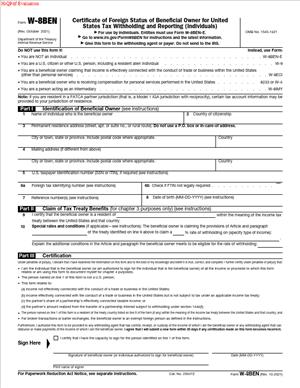
Form W-8BEN – Certificate of Foreign Status of Beneficial Owner for United States Tax Withholding and Reporting (Individuals)
Fill out nowJurisdiction: Country: United States | Province or State: Federal
The Form W-8BEN – Certificate of Foreign Status of Beneficial Owner for United States Tax Withholding and Reporting (Individuals) is a federal tax document used by non-U.S. individuals. You complete it to confirm that you are not a U.S. person for tax purposes. It is commonly requested before you receive certain types of U.S.-source income.
This form is part of the federal tax reporting system administered by the Department of the Treasury, Internal Revenue Service. It helps U.S. payers determine how much tax to withhold from payments made to you.
If you are about to fill it out, you are likely being asked to certify your foreign status. The payer wants documentation before releasing funds. Without it, they may be required to withhold tax at a higher default rate.
This document does not calculate your tax. Instead, it tells the payer how to treat your income under U.S. withholding rules. In some cases, it also allows you to claim reduced withholding under a tax treaty between your country and the United States.
Understanding what the form does will help you complete it accurately. Small errors can delay payment or result in unnecessary withholding.
What is Form W-8BEN – Certificate of Foreign Status of Beneficial Owner for United States Tax Withholding and Reporting (Individuals)?
Clear definition
The Form W-8BEN – Certificate of Foreign Status of Beneficial Owner for United States Tax Withholding and Reporting (Individuals) is a written certification. You use it to confirm that you are a foreign individual who is the beneficial owner of certain income. “Beneficial owner” generally means you are the person who actually owns and controls the income.
The form is given to the U.S. payer or financial institution, not directly filed with the federal government in most cases. The payer keeps it on record to support the withholding rate applied to your payments.
It covers income such as interest, dividends, rents, royalties, and some other types of U.S.-source payments. It may also apply to certain financial accounts.
Who typically uses this form?
This form is typically used by individuals who are not U.S. citizens and not U.S. residents for tax purposes. You might be living outside the United States and earning income from U.S. investments or business activities.
Foreign investors often complete this form when opening accounts with U.S. financial institutions. Independent contractors living abroad may also be asked to complete it if they receive certain U.S.-source payments.
Students, researchers, and professionals temporarily connected to U.S. institutions may encounter it. However, other versions of the W-8 series may apply in different situations, depending on your status and the type of income.
Only individuals use this specific form. Entities such as corporations or partnerships use different forms in the W-8 series.
Why might you need this form?
You may need this form because U.S. law generally requires withholding on certain payments made to foreign persons. The default withholding rate is often 30 percent. Without documentation, the payer may have to apply that rate automatically.
By completing the form, you certify your foreign status. This may confirm that the default rate applies, or it may allow a reduced rate under an applicable income tax treaty.
Many countries have tax treaties with the United States. These treaties often reduce withholding on dividends, interest, or royalties. To access those reduced rates, you must provide the required certification in your submission.
Financial institutions also use the form to comply with reporting rules. They need documentation to classify account holders correctly under federal tax regulations.
Typical real-life scenarios
- You live in another country and own shares in a U.S. company. The company pays dividends to you. Before paying, the financial institution asks you to complete this form so it knows how much tax to withhold.
- You are a freelance designer based outside the United States. A U.S. company pays you royalties for licensed artwork. The company requests this document to confirm your foreign status and determine whether treaty benefits apply.
- You open an investment account with a U.S. brokerage while living abroad. As part of the onboarding process, the institution asks for this certification to document your tax classification.
- You hold U.S. bonds that generate interest income. The paying agent needs written confirmation that you are not a U.S. person. Without it, the agent may apply backup withholding or the standard nonresident withholding rate.
When would you use Form W-8BEN – Certificate of Foreign Status of Beneficial Owner for United States Tax Withholding and Reporting (Individuals)?
You use this form when a U.S. payer requests proof that you are a foreign individual receiving certain types of income. The request usually happens before the first payment is made. It may also happen when you open a financial account or update your account information.
If you are claiming a reduced withholding rate under a tax treaty, you generally provide the form at the time of payment setup. The payer reviews your certification and applies the appropriate rate going forward.
You may also be asked to resubmit the form periodically. Many certifications remain valid for a limited period, often ending after a set number of calendar years unless your circumstances change sooner.
If your personal details change, such as your country of residence or legal name, the payer may request an updated document. Changes that affect treaty eligibility can also trigger the need for a new submission.
This form is typically used by investors, independent contractors, royalty recipients, and account holders with U.S. financial institutions. It is not generally used by U.S. citizens or U.S. resident aliens.
Legal characteristics of Form W-8BEN – Certificate of Foreign Status of Beneficial Owner for United States Tax Withholding and Reporting (Individuals)
This form functions as a formal certification under federal tax rules. When you sign it, you declare under penalties of perjury that the information provided is accurate and complete. The payer relies on your certification to determine withholding.
For the document to be effective, it must be properly completed and signed. Missing information, inconsistent details, or failure to sign can cause the payer to reject it. An incomplete submission may result in the default withholding rate being applied.
Accuracy is critical. If the name on the form does not match the account records, or if your country of residence is unclear, the payer may request clarification. Inconsistent treaty claims can also delay processing.
The form generally remains valid until the end of the third calendar year after signing, unless a change in circumstances makes the information incorrect sooner. If your status changes, the prior certification may no longer be valid.
This document does not eliminate tax by itself. It does not guarantee a refund or confirm that you owe no tax in any country. It simply informs the U.S. payer how to treat your income under withholding rules.
It also does not replace a tax return if you are otherwise required to file one. In some situations, nonresident individuals may still have U.S. filing obligations depending on the type of income and activities.
Is it legally binding?
Yes, in a practical sense, it is legally binding because you sign it under penalties of perjury. By signing, you are making a formal statement about your tax status and eligibility for treaty benefits, if claimed.
If the information is incorrect, and withholding was reduced based on that information, there may be consequences under federal tax rules. The payer may also update the withholding rate once an issue is identified.
The binding nature comes from your signed certification. The payer relies on it to comply with federal law. That reliance gives the document legal significance in the withholding process.
How to fill out Form W-8BEN – Certificate of Foreign Status of Beneficial Owner for United States Tax Withholding and Reporting (Individuals)
Step 1 – Provide your full legal name
Enter your full name exactly as it appears on your official identification and account records. The name should match the records held by the payer or financial institution. Differences in spelling or order can cause processing delays.
Step 2 – Identify your country of citizenship
State your country of citizenship. This identifies you as a foreign individual and helps determine whether a tax treaty may apply.
Step 3 – Enter your permanent residence address
Provide your permanent residence address in your country of residence. This is generally your home address, not a post office box or care-of address. The address should be outside the United States unless you qualify as a foreign resident under specific rules.
Step 4 – Provide your mailing address if different
If your mailing address is different from your permanent residence address, enter it in the designated section. If it is the same, you typically leave this section blank or follow the form’s instructions.
Step 5 – Enter your foreign tax identifying number
Provide your foreign tax identifying number if required. Many countries issue a number used for tax purposes. This supports your claim of foreign status and may be required for treaty benefits.
Step 6 – Provide a U.S. taxpayer identification number if required
In some cases, you may need to provide a U.S. taxpayer identification number to claim treaty benefits. If the form requests this and it applies to your situation, enter the number in the appropriate field.
Step 7 – Claim tax treaty benefits if applicable
If you are claiming a reduced withholding rate under a tax treaty, complete the treaty section. Identify your country of residence and the specific type of income covered. Enter the reduced rate you are claiming and confirm that you meet the conditions described.
Step 8 – Review the certification statement
Read the certification carefully. It explains that you are signing under penalties of perjury and confirms that you are the beneficial owner of the income. Make sure all information on the form is accurate before proceeding.
Step 9 – Sign and date the form
Sign and date the form in the space provided. Your signature finalizes the certification. Once signed, deliver the completed document to the requesting payer or financial institution according to their instructions.
Legal terms you might encounter in Form W-8BEN – Certificate of Foreign Status of Beneficial Owner for United States Tax Withholding and Reporting (Individuals)
- Beneficial Owner: This is the person who actually owns and controls the income being paid. In this document, you certify that you are the true owner of the income, not just an agent or intermediary. The withholding agent relies on this statement to determine the correct tax treatment.
- Withholding Agent: This is the person or organization that pays you and may be required to withhold U.S. tax. It could be a financial institution, brokerage, partnership, or other payer. You give this form directly to the withholding agent, not to the tax authority.
- Foreign Person: In this context, it means you are not a U.S. citizen or U.S. resident for tax purposes. By signing, you declare that you meet the definition of a foreign individual. Your residency status determines whether U.S. withholding rules apply.
- Tax Treaty: A tax treaty is an agreement between the United States and another country that may reduce or eliminate withholding tax on certain types of income. In the treaty section of the document, you must identify your country and the specific article that supports your claim. You also certify that you meet the treaty’s conditions.
- Taxpayer Identification Number (TIN): This is a number used to identify you for tax purposes. You may need to provide a foreign TIN issued by your country of residence. In some cases, a U.S. TIN may also be required to claim treaty benefits.
- Permanent Residence Address: This is your fixed address in the country where you claim tax residency. It cannot be a P.O. box or an address of a financial institution. The address you enter supports your claim of foreign status and treaty eligibility.
- Certification: The certification section is where you declare under penalties of perjury that the information is correct. By signing, you confirm that you are the beneficial owner, that you are not a U.S. person, and that any treaty claim is accurate. This statement gives the document legal force.
- Withholding Rate: This is the percentage of U.S. tax that may be withheld from certain types of income. The standard rate is often 30 percent, but it can be reduced by a tax treaty. The rate applied depends on the information you provide.
- Capacity in Which Acting: If you sign on behalf of someone else, you must indicate your legal authority. This might apply if you are a guardian, executor, or hold a power of attorney. The form asks you to confirm your capacity when signing for another individual.
FAQs
Do I send Form W-8BEN – Certificate of Foreign Status of Beneficial Owner for United States Tax Withholding and Reporting (Individuals) to the tax authority?
No. You give this document directly to the withholding agent or payer who requested it. They keep it in their records to justify applying a reduced or zero withholding rate. You generally do not mail it to the government unless specifically instructed by the payer in a rare situation.
How long does this form stay valid once I sign it?
This document is generally valid starting on the date you sign it and remains in effect until the last day of the third calendar year after signing, unless your circumstances change. For example, if you sign in June 2026, it usually stays valid through December 31, 2029. If your residency, name, or treaty eligibility changes before then, you must provide an updated form sooner.
What happens if I do not provide a foreign tax identification number?
If a foreign TIN is required and you leave it blank without meeting an exception, the withholding agent may not accept your treaty claim. That can result in the full statutory withholding rate being applied. You should check whether your country issues TINs and confirm the correct format before submitting this form.
When do I need to provide a U.S. taxpayer identification number?
You may need a U.S. TIN if you are claiming certain treaty benefits that require it. The instructions in this document explain when a U.S. TIN is mandatory for reduced rates. If required and not provided, the payer may deny the treaty rate and withhold at the higher default rate.
What if my name on this document does not match my account records?
The withholding agent compares the name you enter with their account records. If the names do not match, they may reject the form and ask for clarification or updated documentation. Make sure the spelling and order of your name match the account exactly, especially if you use multiple surnames or transliterations.
Can I submit a scanned or electronic version?
Many withholding agents accept electronic or scanned copies, but acceptance depends on their internal compliance procedures. You must follow the payer’s specific submission method. Always confirm whether they require a wet signature or accept digital signatures before sending it.
What should I do if my residency status changes after I file this form?
If you become a U.S. resident for tax purposes or move to a different country affecting your treaty claim, you must provide a new form reflecting the updated information. The previous certification becomes invalid once your status changes. Prompt updates help prevent incorrect withholding or reporting.
Do I need to attach proof of residence or other documents?
Usually, you do not attach supporting documents when submitting this form to the payer. However, the withholding agent may request additional proof, such as identification or residency confirmation, to validate your claims. Be prepared to provide documents if asked, especially when claiming treaty benefits.
Checklist: Before, During, and After Form W-8BEN – Certificate of Foreign Status of Beneficial Owner for United States Tax Withholding and Reporting (Individuals)
Before
- Confirm that you are not a U.S. citizen or U.S. tax resident.
- Verify your country of tax residence under local law.
- Locate your foreign tax identification number.
- Determine whether a tax treaty applies to your type of income.
- Review your account records to match your legal name exactly.
- Check whether you need a U.S. TIN to claim treaty benefits.
- Ask the payer about their submission requirements (paper or electronic).
During
- Enter your full legal name as it appears on official identification.
- Provide your country of citizenship accurately.
- List your permanent residence address, not a mailing service or P.O. box.
- Add a mailing address only if different from your residence.
- Input your foreign TIN in the correct format.
- Complete the treaty section carefully, including the article and rate.
- Read the certification statement word for word.
- Sign and date the form using the correct format.
- Indicate your capacity if signing for someone else.
After
- Make a complete copy for your personal records.
- Confirm that the payer received the form.
- Ask whether the form has been accepted and processed.
- Check your next payment statement for correct withholding.
- Calendar the expiration date (end of the third calendar year).
- Monitor any changes in your residency or tax status.
- Update the form promptly if your details change.
- Store the document securely with other tax records.
Common mistakes to avoid with Form W-8BEN – Certificate of Foreign Status of Beneficial Owner for United States Tax Withholding and Reporting (Individuals)
- Mistake: Leaving the foreign tax identification number blank because you are unsure of the format, which often happens due to confusion about local tax documents, leading to rejection or full withholding; do not forget to confirm whether your country issues a TIN and enter it correctly.
- Mistake: Using a mailing address or financial institution address as your permanent residence, which happens when you move frequently, causing the payer to question your foreign status; do not forget that the residence address must reflect where you actually live.
- Mistake: Claiming a treaty rate without identifying the specific article and rate, often due to a misunderstanding of treaty language, resulting in denial of reduced withholding; do not forget to specify the exact article and percentage.
- Mistake: Forgetting to sign and date the form, which commonly occurs when submitting electronically, making the document invalid; do not forget that the certification has no effect without a valid signature and date.
- Mistake: Failing to update the form after a change in residency, often because people assume it renews automatically, leading to incorrect tax treatment; do not forget to submit a new version when your status changes.
- Mistake: Entering a name that does not match account records due to spelling differences or name order conventions, which can delay processing or cause rejection; do not forget to match the exact name used by the withholding agent.
- Mistake: Assuming the form was accepted without confirmation, which happens when you do not follow up, potentially resulting in continued higher withholding; do not forget to verify acceptance and review your payment statements.
What to do after filling out Form W-8BEN – Certificate of Foreign Status of Beneficial Owner for United States Tax Withholding and Reporting (Individuals)
Once you complete the form, pause before sending it. Review every line. Small errors can lead to higher withholding or processing delays.
- Step 1: Re-read your name, address, and tax numbers for accuracy and consistency with your account records.
- Step 2: Confirm that you signed and dated the certification section.
- Step 3: Make a clear copy or digital scan for your records.
- Step 4: Submit the form to the withholding agent using their required method.
- Step 5: Request confirmation that they received it.
- Step 6: Ask whether the form has been accepted as valid.
- Step 7: Check your next income payment statement to see which withholding rate was applied.
- Step 8: Record the expiration date based on the year you signed.
- Step 9: Store the document with your tax and financial records.
- Step 10: Monitor for changes in your citizenship, residency, or treaty eligibility and prepare a new form if needed.
Keep your communication with the payer organized. Save emails or written confirmations that show when you submitted the document and when it was accepted. This record can help resolve disputes about withholding rates later.
Review your account annually. Even if the form has not expired, confirm that your personal details remain accurate. Address changes, legal name changes, or new tax identification numbers should trigger an update.
If you open additional accounts with other payers, you will usually need to provide a separate form to each one. One submission does not automatically apply everywhere. Treat each account relationship independently.
Staying proactive helps you avoid over-withholding and administrative delays. A properly completed and maintained form ensures that your income is taxed at the correct rate based on your status and any applicable treaty benefits.
Disclaimer: This guide is provided for informational purposes only and is not intended as legal advice. You should consult a legal professional.